-
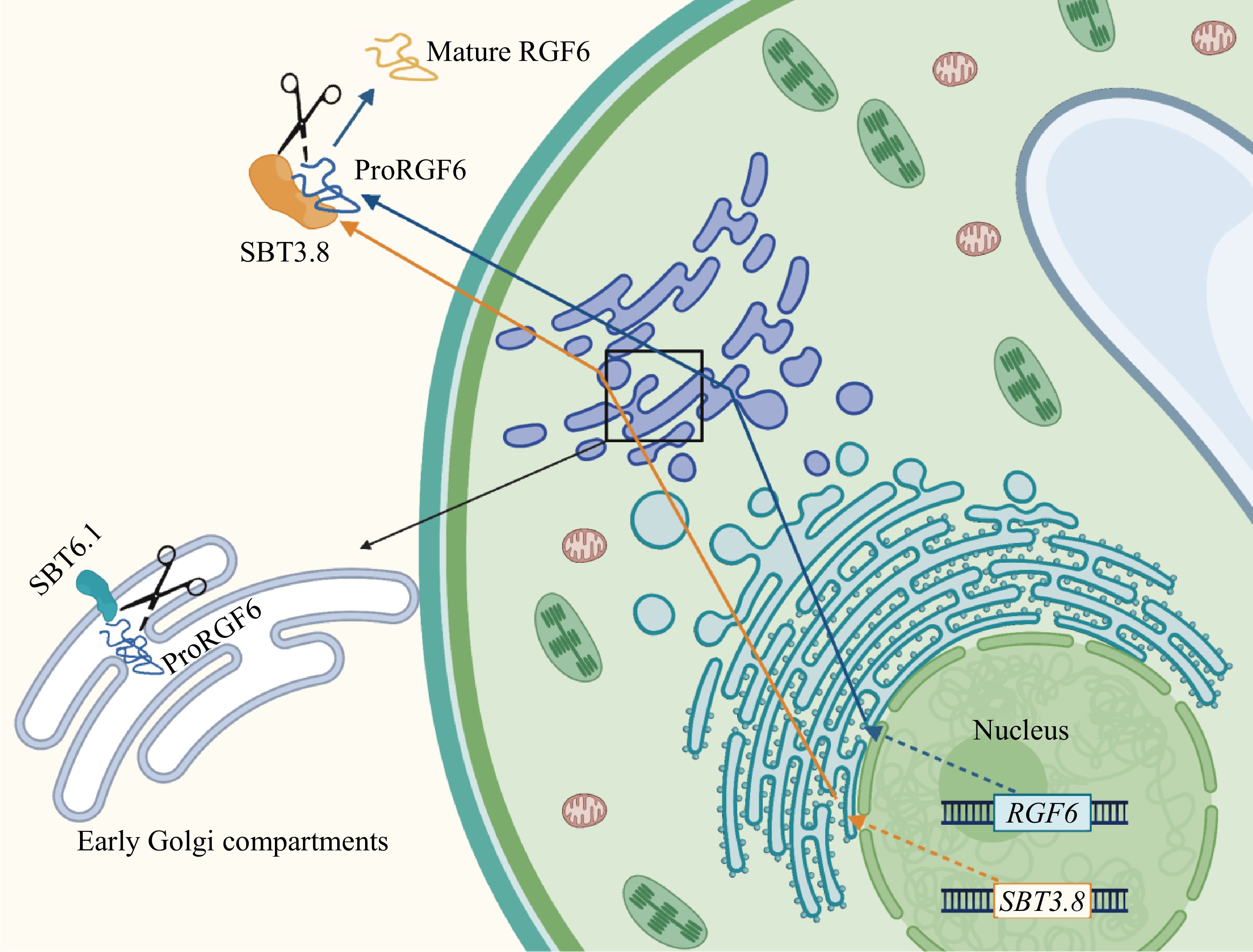
Figure 1.
Schematic diagram of the peptide signal processing process (using RGF6 as an example).
-
Protein ID Substrate Cleave site Ref. AtSBT1.1 proAtPSK4 SLVL↓HTDY [11] AtSBT1.4 proCLE40 QVPT↓GSDPLHHK↓HIPF [15] AtSBT1.7 proCLE40 QVPT↓GSDPLHHK↓HIPF [15] AtSBT1.8 proTWS1 LE↓DYNFPVDP...KPGPIEH↓GTP [16] AtSBT2.4 proTWS1 PIEH↓GTP [19] AtSBT3.5 proSCOOP12 RRLM↓ [20] AtSBT3.8 proPSK1 YIYTQ↓DLN [13] proSCOOP20 VWD↓ [20] proRGF6 VM↓D [18] proRGF9 DM↓D [18] AtSBT4.12 proIDA YLPK↓GVPIPPSAPSKRHN↓SFVN [14] AtSBT4.13 proCLE40 RQVPT↓GSDPLHHK↓HIPF [15] proIDA YLPK↓GVPIPPSAPSKRHN↓SFVN [14] AtSBT5.2 proEPF2 SLPD↓CSYA [40] proIDA YLPK↓GVPIPPSAPSKRHN↓SFVN [14] AtSBT5.4 proCIF4 PVPH↓GSL [41] AtSBT6.1 proRGF6 RRLR↓and RRRAL↓ [21] proRGF9 RRLR↓and RRRAL↓ [18] proRALF23 RRAL↓and RRIL↓ [17] SlPhyt2 proSlPSK HLD↓ [12] Table 1.
Proteolytic processing of plant signaling peptides by SBTs.
-
Protein ID Biological function Ref. AtSBT1.1 Callus induction [11] Control of cotyledon cell number [53] AtSBT1.2 Controls the development of cell lineages [49] AtSBT1.4 Reproductive development and silique number [29] AtSBT1.6 Regulating germination through GA [54] AtSBT1.7 Mucilage release from seed coats [27] AtSBT2.4 Controls embryonic cuticle formation via [48] AtSBT2.5 Plant morphogenesis and development [55] AtSBT3.3 Immune priming [56] AtSBT3.5 Root development [57] AtSBT3.8 Drought responses [13] AtSBT3.14 Basal immunity priming [58] AtSBT4.12 Abscission of floral organs [14] AtSBT4.13 Abscission of floral organs [14] AtSBT5.2a Control of stomatal development [40] Abscission of floral organs [14] AtSBT5.2b Attenuation of defense gene expression [59] AtSBT5.3 Lateral root development [60] AtSBT5.4 Overexpression produced a clavata-like phenotype [52] AtSBT6.1 Precursor processing [17,31] AtSBT6.2 Protein turnover [61] SlPhyt2 Drought-induced flower drop [12] SlPhyt3 Trigger non-autolytic cell death under oxidative stress [62] SlPhyt4 SlPhyt5 CpSUB1 Fruit ripening [63] GmSLP-1 Seed coat development [64] AcoSBT1.12 Floral transition [65] TaSBT1.7 Plant defense [66] GhSBT27A Drought responses [67] Table 2.
Biological functions of SBTs.
Figures
(1)
Tables
(2)