-
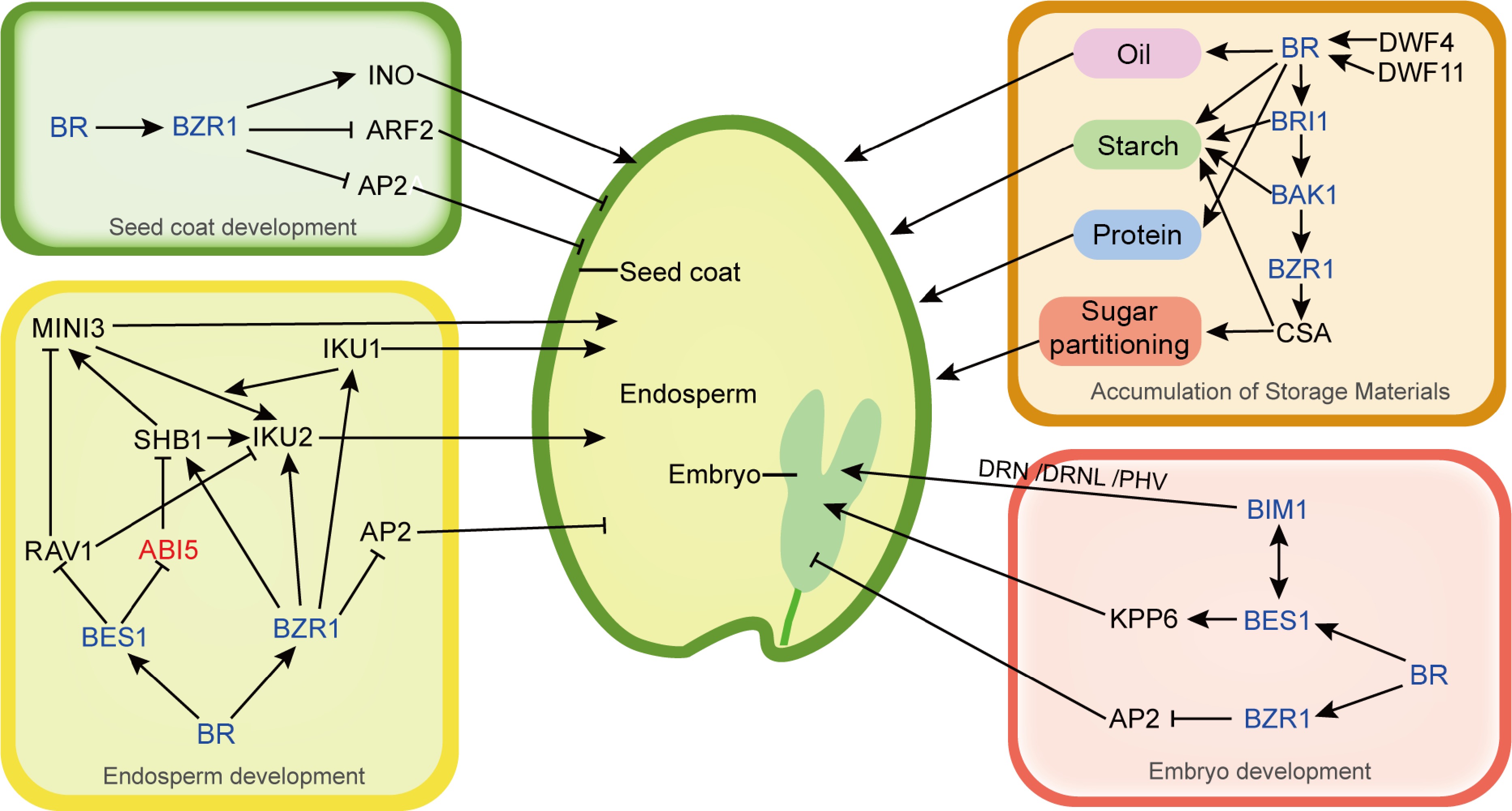
Figure 1.
BR regulates seed development and accumulation of storage materials mainly through transcription factors BZR1 and BES1. In the regulation of seed coat development, BZR1 can bind to the promoter of ARF2, a negative regulator gene for seed coat development, and inhibit its expression, and BZR1 can bind to the promoter of INO, a positive regulator gene for seed coat development, and promote its expression. Additionally, AP2 negatively regulates seed coat, embryo and endosperm, and BZR1 can bind to the promoter of AP2 and inhibit its expression. In the regulation of seed endosperm development, BES1 can inhibit the expression of the negative regulatory genes RAV1 and ABI5, which are associated with endosperm development, to positively regulate seed endosperm development. BZR1 can bind to the promoters of positive regulators of endosperm development, SHB1, IKU1, IKU2, and activate their expression. In the regulation of seed embryo development, BES1 can promote the expression of KPP6 to positively regulate embryo development, and the BR signal transduction element BIM1 can also interact with DRN, DRNL, or PHV to regulate early embryonic development. Furthermore, the accumulation of oil, starch and protein in seeds can be affected by changes of BR content through up-regulation of BR-biosynthesis genes (DWF4 or DWF11) or exogenous 24-epibrassinolide. The component and accumulation of starch can be regulated by the BRI1 and BAK1 BR-signal. BZR1 can regulate sugar partitioning as well as starch synthesis through the regulation of CSA expression. Activated and repressive effects are shown by arrows and bars, respectively. Blue represents the BR and BR signaling components and red represents the ABA signaling component.
-
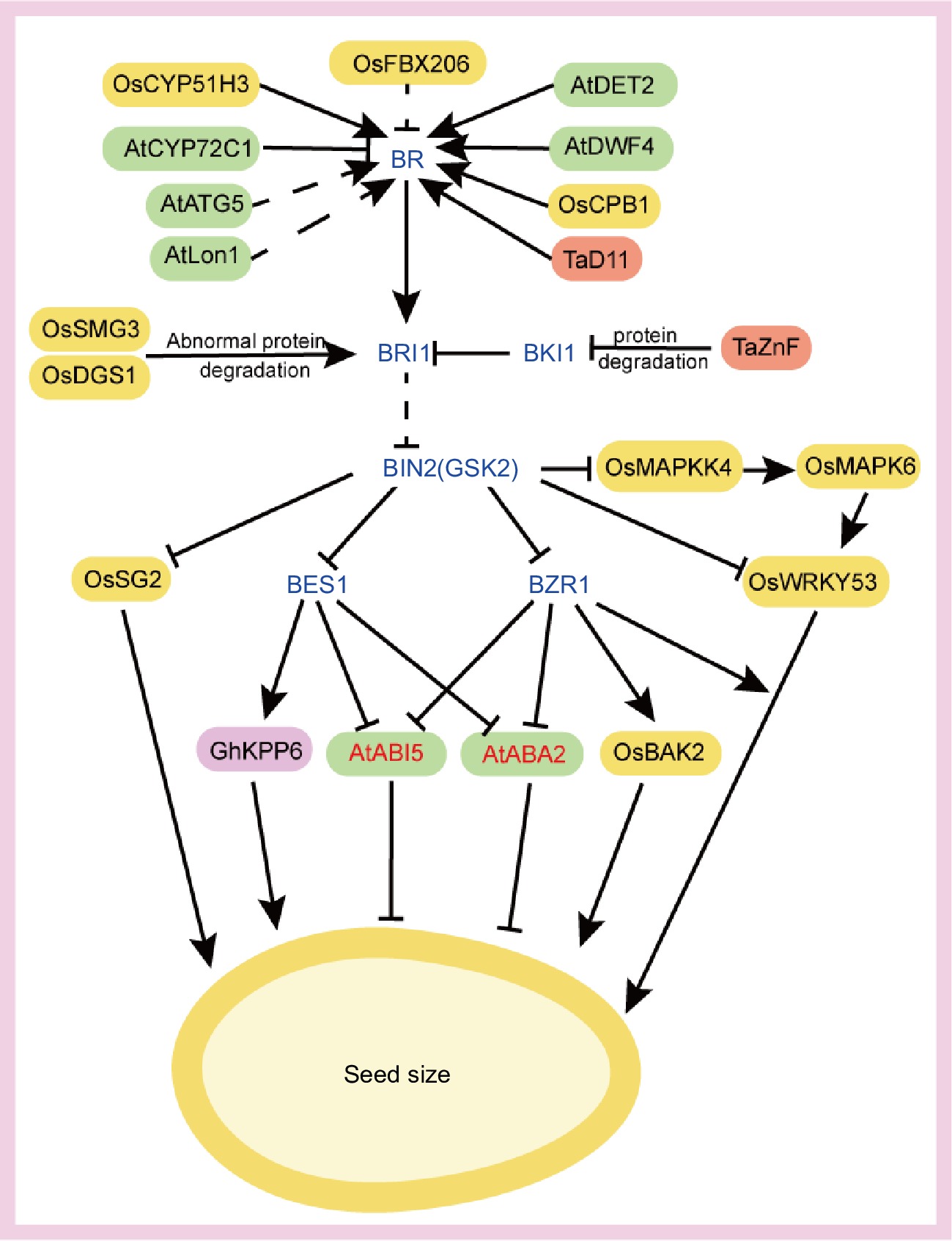
Figure 2.
BRs change morphology and size of seeds. Expression of the BR-synthesis genes DET2, DWF4, CPB1, and D11 can enlarge seeds by increasing the BR content. The expression of the BR-degradation gene CYP72C1 can reduce the BR content and thus reduce the seed size. Additionally, CYP51H3, Lon1, ATG5, FBX206 can also change seed size by affecting BR content. SMG3 as well as DGS1 can regulate seed size by degrading the aberrant BRI1 protein. ZnF changes seed size by degrading the BKI1 protein, prompting the binding of BRI1 to BAK1. BIN2 alters seed size by phosphorylating SG2, WRKY53, and MAPKK4, respectively. BES1 and BZR1 can change seed size by promoting the expression of KPP6 and BAK2, respectively. In addition, BZR1 and BES1 can enlarge seeds by inhibiting the expression of ABA-related ABI5 and ABA2. Activated and repressive effects are shown by arrows and bars, respectively. The blue and red letters represent the BR and BR signaling components and the ABA signaling components, respectively. The colors of the background represent the components of a certain plant, e.g., yellow represents rice. To be concise, other factors affecting seed size in rice[20] are not presented here.
-
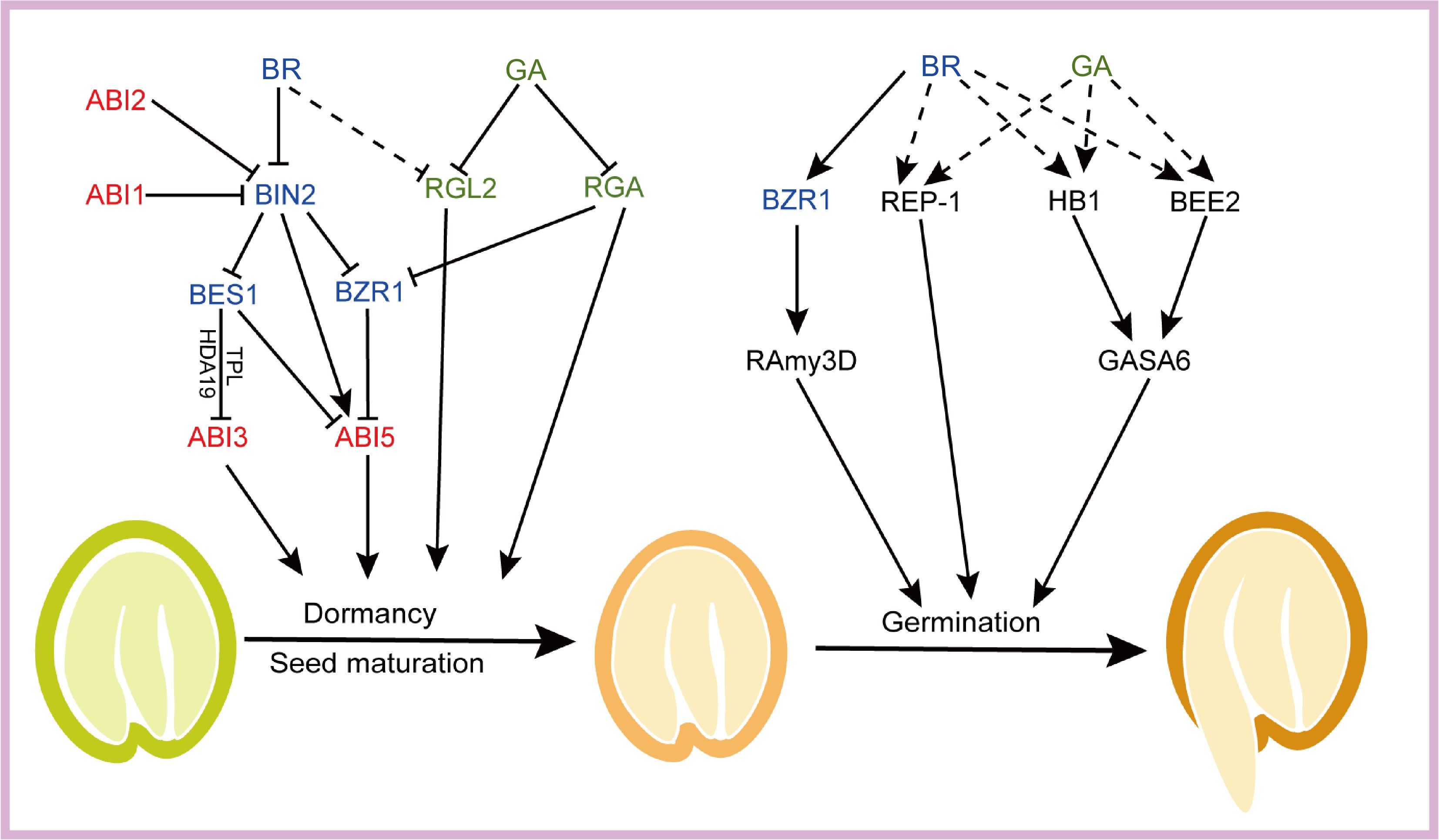
Figure 3.
BRs regulate seed dormancy and germination mainly by cross-talking with components of ABA and GA signal. BR and GA can promote the expression of some genes to positively regulate seed germination, such as REP-1, HB1, BEE2, and the application of BR also inhibits the expression of the GA-related signal RGL2. BES1 can form BES1-TPL-HDA19 co-repressor and deacetylate ABI3 chromatin histones, repressing its transcription. Additionally, BIN2 can phosphorylate ABI5 and stabilize ABI5 protein, thus inhibiting seed germination. BZR1 is capable of binding to the upstream promoter of ABI5 and repressing ABI5 expression. BES1 is able to interact with ABI5 and inhibited binding of ABI5 to the promoter region of downstream genes, resulting in the promotion of seed germination. BZR1 can also promote the expression of α-amylase RAmy3D to positively regulate seed germination. In addition, ABA-related signal elements ABI1 and ABI2 can interact with BIN2 and dephosphorylate and inactivate BIN2, thereby promoting BR response. The GA-related signal element RGA can also inhibit BZR1 expression to repress the progression of the BR response. Activated and repressive effects are shown by arrows and bars, respectively. Blue represents BR and BR signaling components, green represents GA and GA signaling components, and red represents ABA signaling components. Dashed lines represents an indirect action.
Figures
(3)
Tables
(0)