-
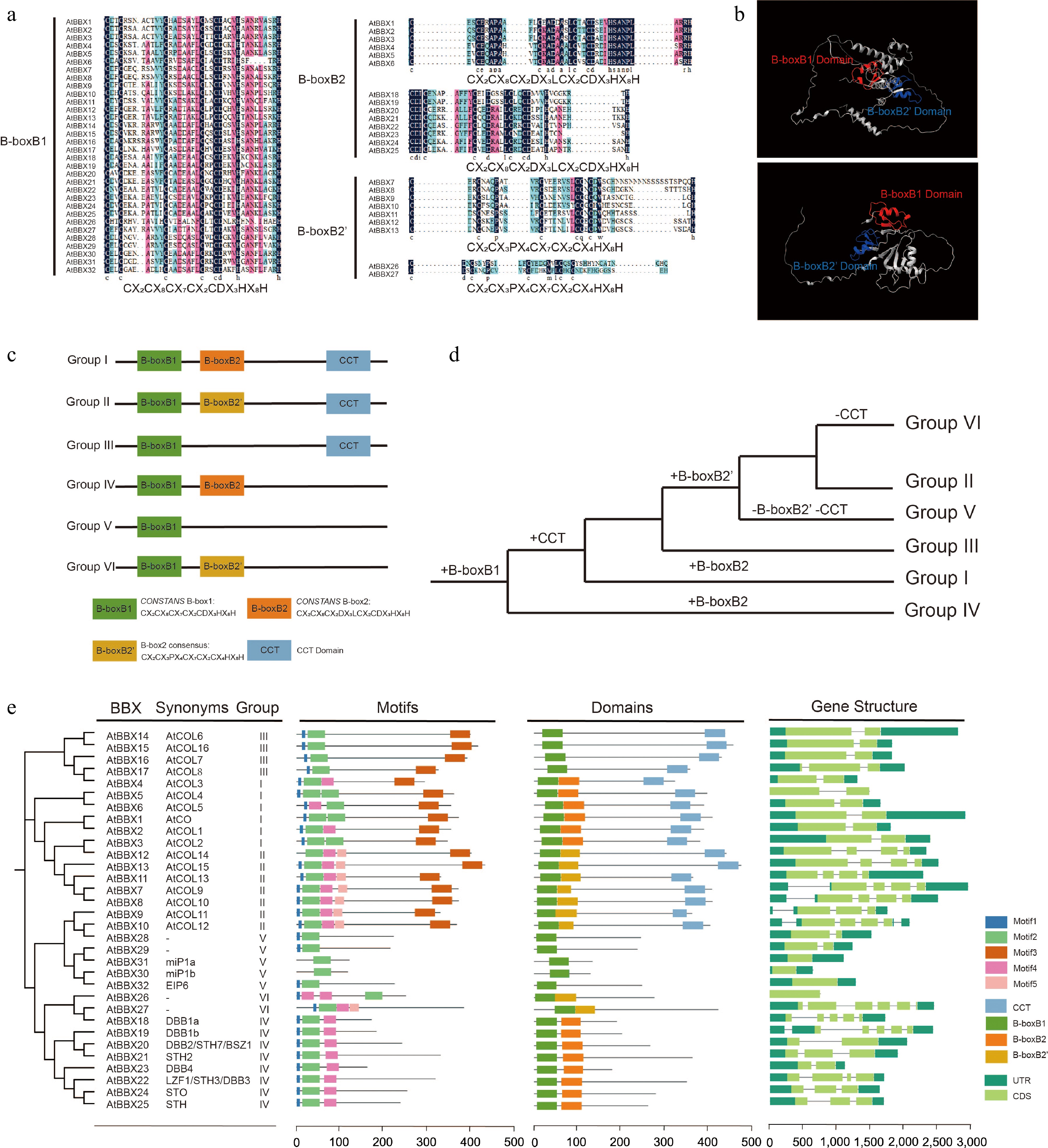
Figure 1.
Structural features of the AtBBX gene family. (a) Multiple sequence alignment analysis of AtBBX gene family member domains. B-boxB1 of groups I−VI, B-boxB2 of groups I and IV, and B-boxB2' of groups II and VI are indicated. The black color indicates 100% similarity. Red and blue indicate 75% and 50% similarity, respectively. (b) Tertiary structures of AtBBX26 and AtBBX27 (Group VI) proteins were retrieved from observations by Cheng & Wang[69]. Homology modeling of two proteins was constructed using the AlphaFold (
https://alphafold.ebi.ac.uk ) online server. Visualization with Chimera X. B-boxB1 and B-boxB2' domains are shown with red and blue colors, respectively. (c) Classification of AtBBX gene family structural groups (Groups I−VI). (d) Evolutionary hypothesis of BBX protein domains. (e) Characterization of Arabidopsis AtBBX genes. Neighbor-joining trees, synonyms, conserved motifs, domains, and exon-intron structures are indicated. '−' signifies that it is not available. Five color boxes indicate different motifs. Four color boxes indicate different domains. The dark green icon means UTR (untranslated region), the light green icon means CDS (coding sequence), and the line between UTR and CDS means intron (a non-coding part of a gene or mRNA molecule). -
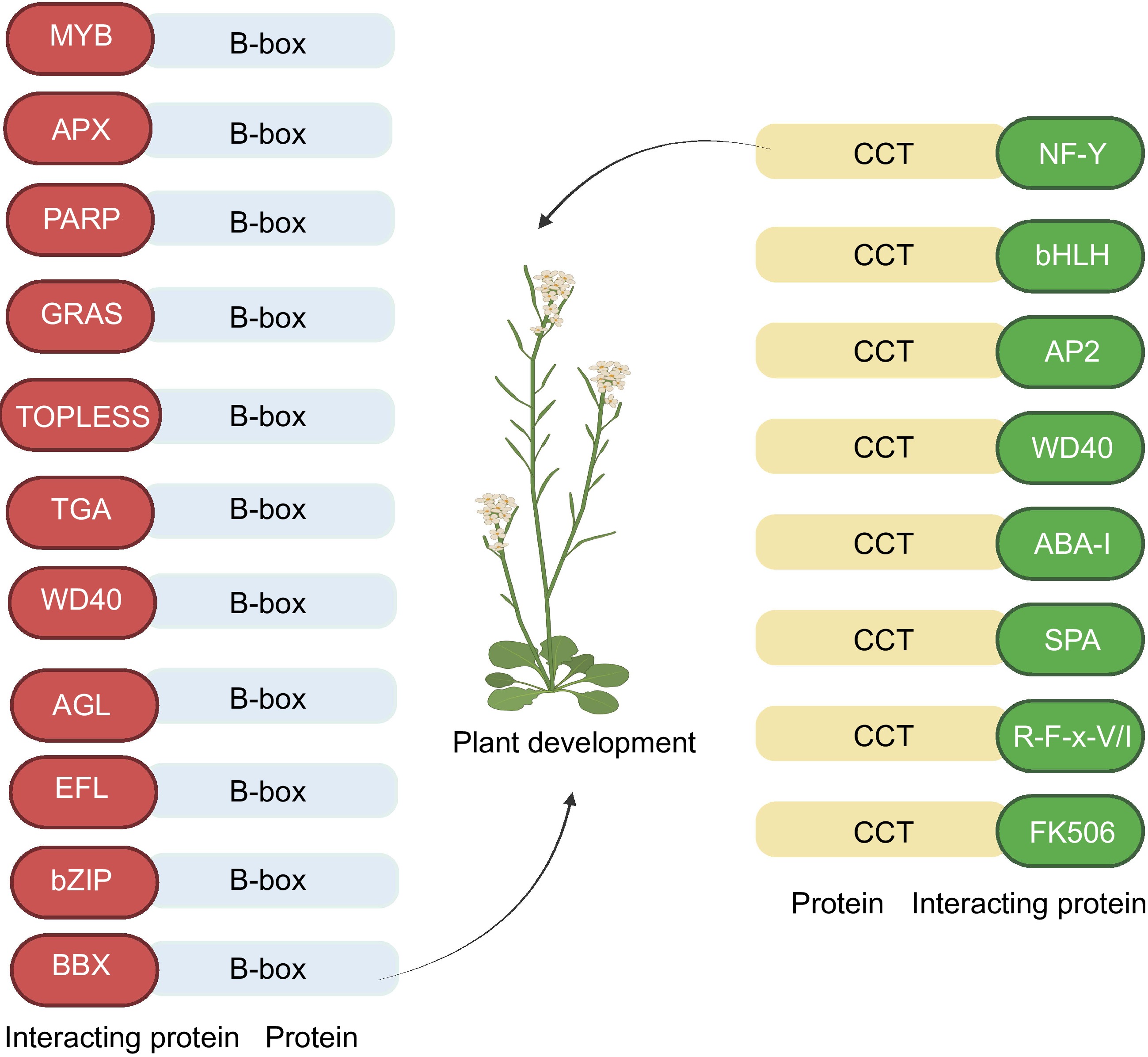
Figure 2.
Protein interactions of B-box and CCT domain in plants. Letters in the ellipses represent acronyms for the type of proteins interacting with the domain. B-box interacting proteins: BBX (AtBBX32-GmBBX62)[24], bZIP (PpBBX18-PpHY5)[13], EFL (AtBBX19-EFL3)[38], AGL (BrBBX32-BrAGL24)[23], WD40 (AtBBX19-COP1)[38], TGA (CO-TGA4)[39], TOPLESS (CO-TPL/TPR)[35], GRAS (AtBBX4-DELLA)[40], PARP (CmBBX8-CmRCD1)[41], APX (AtBBX18-APX1)[42] MYB (CO-AS1)[43]. Interacting proteins of CCT: FK506 (CO-FKBP12)[44], R-F-x-V/I (WNK-OSR1)[45], SPA (CO-SPA1)[34], ABA-I (CO-ABI3)[46], WD40 (CO-COP1)[47], AP2 (CO-TOE1/2)[48], bHLH (CO-CIB1)[49], NF-Y (CO-NF-YB/YC)[28].
-
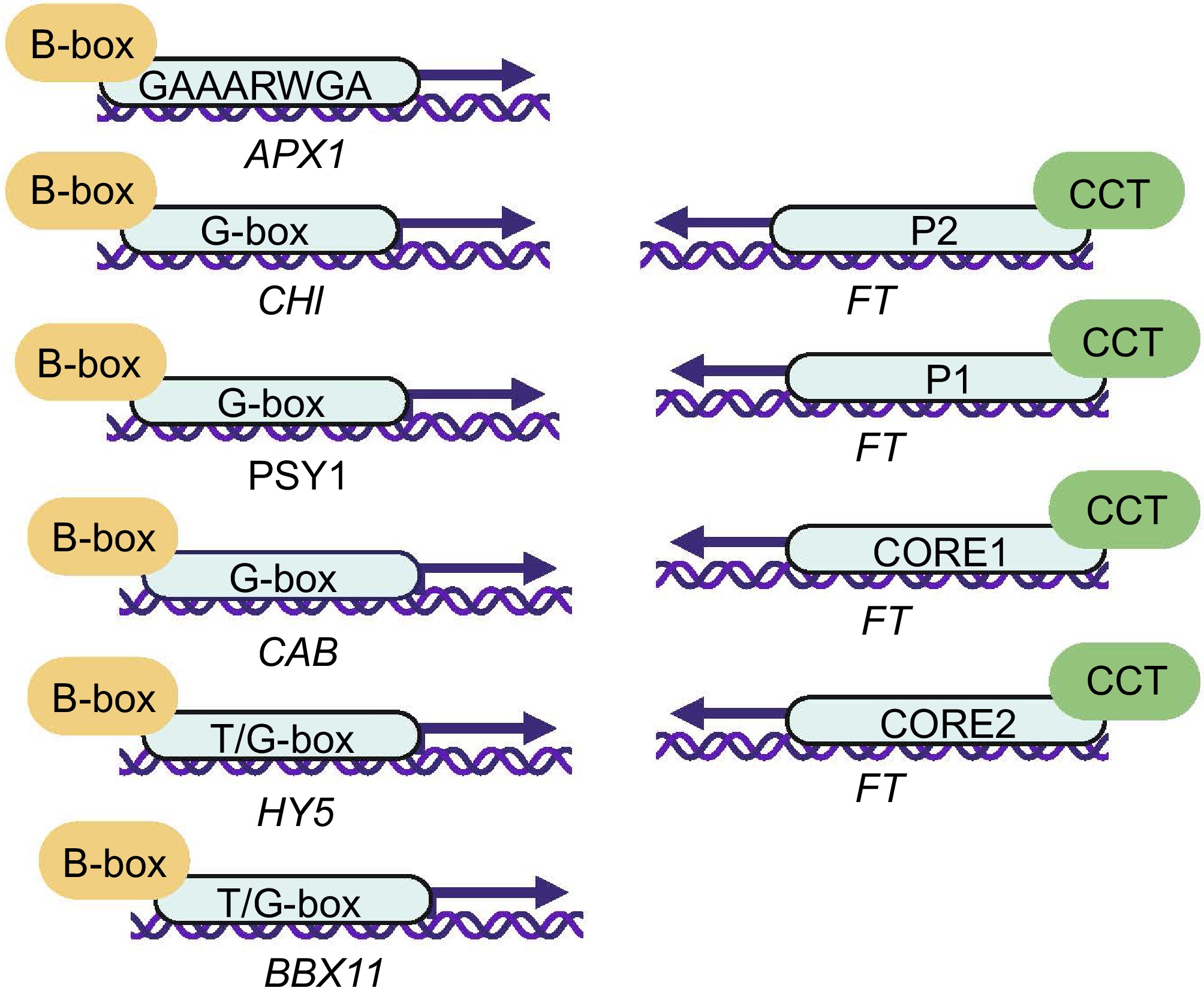
Figure 3.
Transcriptional regulation of B-box and CCT domain in plants. Letters in ellipses with arrows represent promoter binding site abbreviations. Transcriptional regulation of B-box: GAAARWGA (AtBBX18-APX1)[42], G-box (AtBBX21/22-CHI)[50], G-box (SlBBX20-PSY1)[51], G-box (AtBBX22-CAB)[50], T/G-box (AtBBX21-HY5)[52], T/G-box (AtBBX21-AtBBX11)[53]. Transcriptional regulation of CCT: P1/P2/CORE1/CORE2 (CO-FT)[29,54].
-
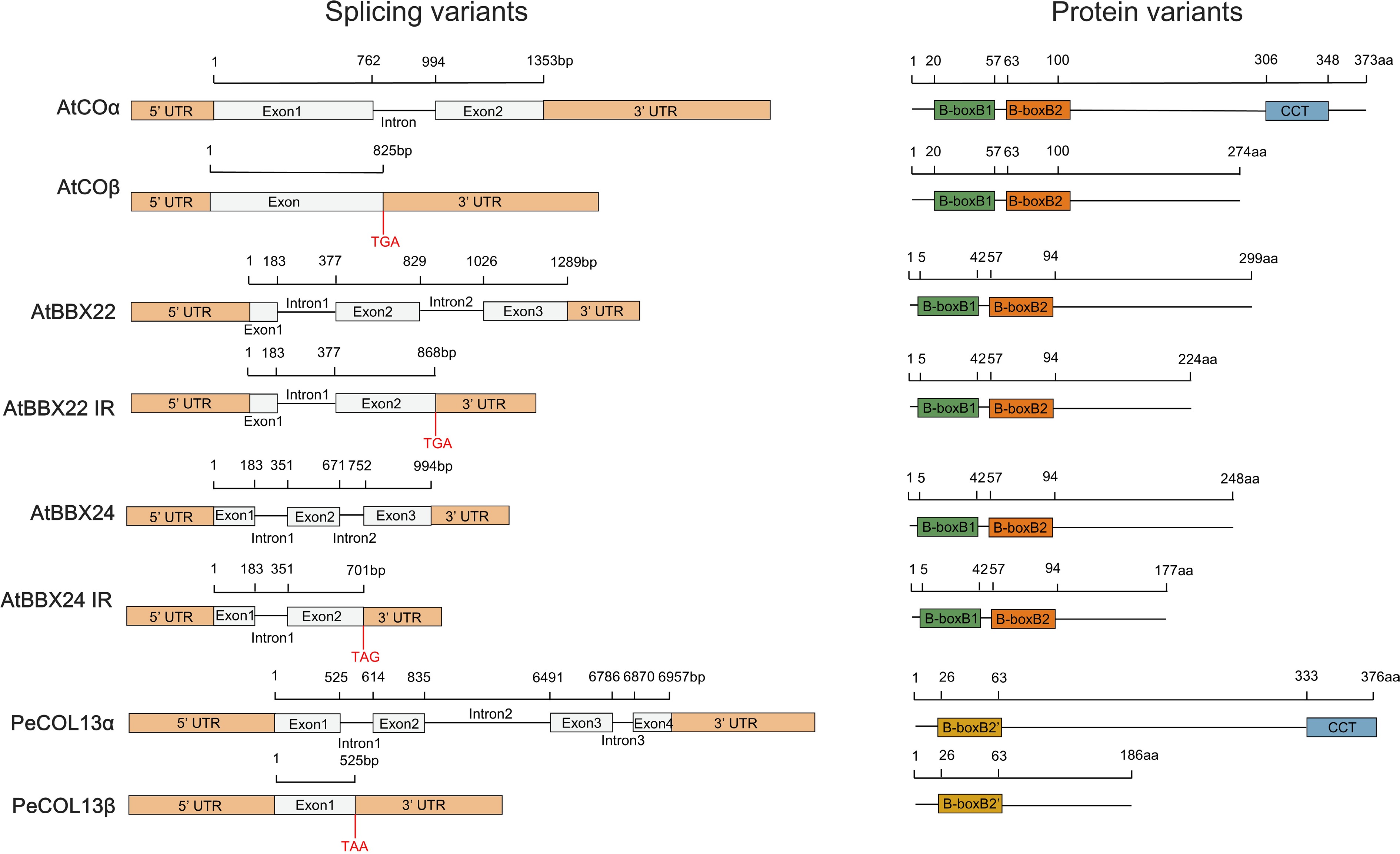
Figure 4.
Sequence structures of mRNA and protein isoforms of four BBX genes. The black horizontal line indicates the number of base pairs and amino acids. Yellow boxes indicate 5'/3' UTRs, grey boxes indicate exons, and black lines indicate excised introns. Four colour boxes indicate different domains.
-
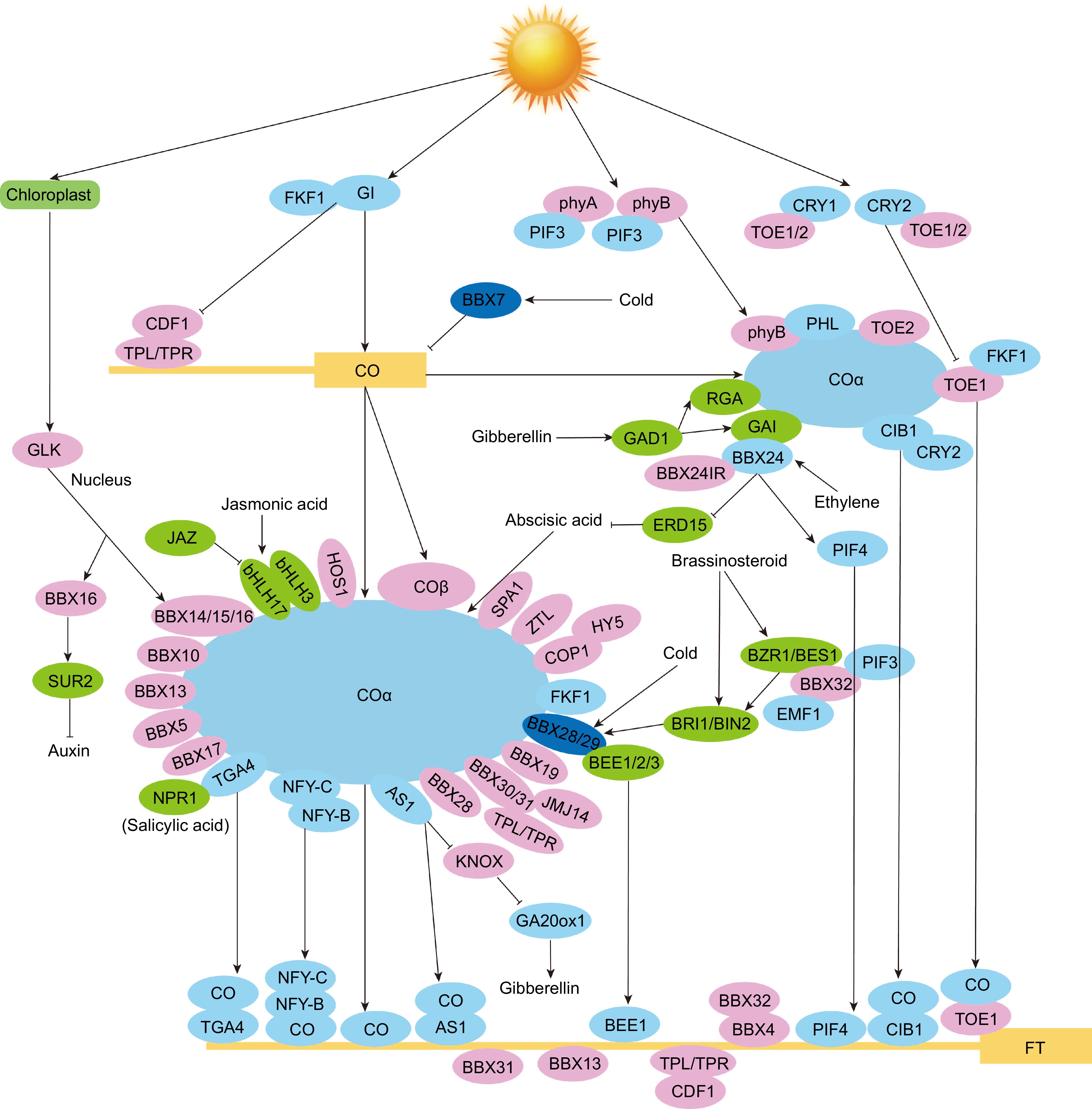
Figure 5.
Mechanism of AtBBX genes in reproductive phase transition in Arabidopsis. The letters in the boxes represent short names of genes, and the letters in the ellipses represent short names of proteins. Positive regulators are shown as light blue circles. Negative regulators are in pink, and hormone-responsive proteins are in green. Cold-responsive proteins are shown in dark blue. Solid lines with arrows represent facilitation, and solid lines with flat ends represent inhibition[1,3,12,14,15,21,30,31,40,48,49,58,63,113−118].
-
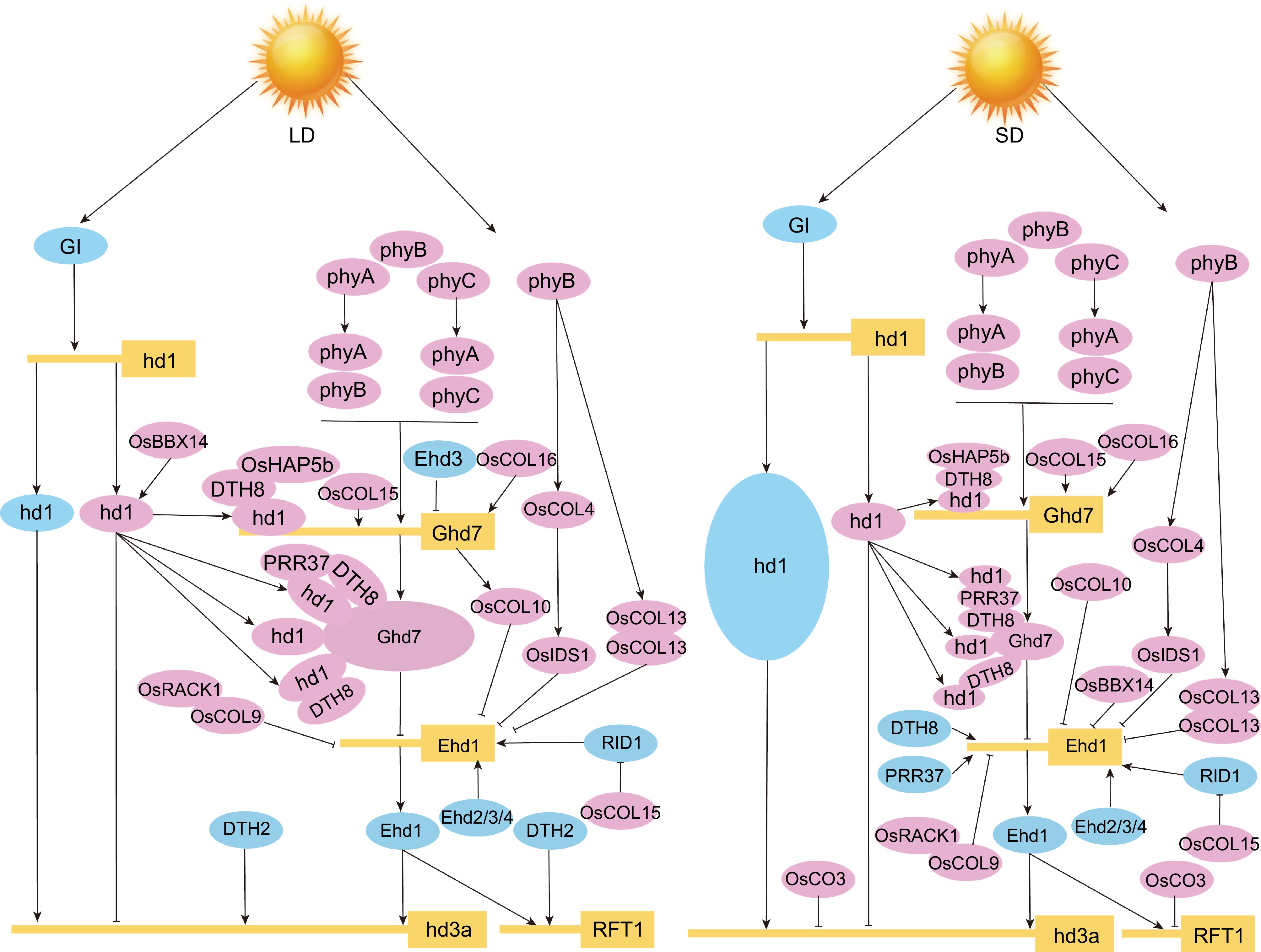
Figure 6.
Rice OsBBX genes regulatory network during photoperiodic flowering. The left plot represents LD conditions, and the right plot represents SD conditions. The letters in the boxes represent short names of genes, and the letters in the ellipses represent short names of proteins. Positive regulators are shown in light blue circles, and negative regulators are shown in pink. Solid lines with arrows represent facilitation, and solid lines with flat ends represent inhibition[74−77,79,80,82−84,119−122].
-
Species BBX Gene ID Function Ref. Arabidopsis thaliana AtBBX1 Q39057 CO is involved in the photoperiodic regulation of flowering under LD conditions by binding to the FT promoter and activating its expression over a longer time;
Phytochrome B delays flowering in plants under SD conditions by directly reducing CO protein activity or indirectly antagonizing its effect on flowering time;
CO can inhibit FT induction of flowering by affecting TFL1 expression under SD conditions[16,65] AtBBX4 Q9SK53 Interaction of AtBBX32 with AtCOL3 under LD conditions enables AtCOL3 protein to bind the FT promoter and repress its transcription [66] AtBBX5 Q940T9 AtCOL4 interacts with CO proteins to inhibit flowering under LD and SD conditions in plants [67] AtBBX6 Q9FHH8 AtCOL5 overexpression plants flower early under SD conditions, and AtCOL5 mutant plants do not affect flowering [68] AtBBX7 Q9SSE5 AtCOL9 regulates flowering time under LD conditions by repressing CO expression while reducing FT expression and delaying the floral transition [69] AtBBX10 Q9LJ44 AtCOL12 physically interacts with CO in vivo to inhibit flowering under LD conditions by inhibiting CO protein function while reducing FT expression [70] AtBBX13 Q9C7E8 AtCOL15 interacts with CO protein and represses CO-mediated transcriptional activation of FT in LD conditions;
AtCOL15 can also compete with CO protein and directly bind to the CORE2 motif on the FT promoter to repress flowering in Arabidopsis[71] AtBBX14 Q8LG76 AtBBX14 interacts with CO in the nucleus and disrupts CO binding to the FT promoter, preventing the ability of CO to activate FT and inhibiting flowering under LD conditions [72] AtBBX15 Q8RWD0 AtBBX15 interacts with CO in the nucleus and disrupts CO binding to the FT promoter, preventing the ability of CO to activate FT and inhibiting flowering under LD conditions [72] AtBBX16 Q8RWD0 AtBBX16 interacts with CO in the nucleus and disrupts CO binding to the FT promoter, preventing the ability of CO to activate FT and inhibiting flowering under LD conditions [72] AtBBX17 Q9M9B3 Overexpression of AtCOL8 causes late flowering under LD conditions and AtBBX17 protein inhibits FT transcription by interacting with CO [73] AtBBX19 C0SVM5 AtBBX19 inhibits flowering by consuming CO and ultimately inhibiting FT as the primary pathway for regulating SOC1 [26] AtBBX24 Q96288 Overexpression of AtBBX24 accelerated flowering under LD and SD conditions, whereas mutant AtBBX24 delayed flowering only under SD conditions
AtBBX24 not only repressed FLC expression but also competed with FLC to regulate FT and SOC1 expression, thereby promoting flowering[63] AtBBX28 NP_194461 The interaction of AtBBX28 with CO reduced the binding of CO to FT promoter and inhibited flowering under LD conditions;
AtBBX28-AtBBX29 double mutant plants have reduced transcriptional activation activity of CO to FT promoter, and the interaction of AtBBX28 with CO reduces CO binding to the FT promoter and represses flowering under LD and low-temperature conditions[17,25] AtBBX29 NP_200258 AtBBX28-AtBBX29 double mutant plants have reduced transcriptional activation activity of CO to FT promoter, and the interaction of AtBBX29 with CO reduces CO binding to the FT promoter and represses flowering under LD and low-temperature conditions [17] AtBBX30 Q1G3I2 The miP1b interacts with TPL and forms a trimeric deterrent complex with CO to delay floral transition under LD conditions [35,36] AtBBX31 Q9LRM4 The miP1a interacts with TPL and forms a trimeric deterrent complex with CO to delay floral transition under LD conditions [35,36] AtBBX32 Q9LJB7 Interaction of AtBBX32 with COL3 under LD conditions enables AtCOL3 to bind the FT promoter and repress its transcription [66] Table 1.
Functions of AtBBX genes in inducing floral transition in Arabidopsis.
-
Species BBX Gene ID Function Ref. Oryza sativa OsCOL4 BAS79707 OsCOL4 inhibits rice flowering under SD and LD conditions [74] OsCOL9 BAS84196 OsCOL9 suppresses Ehd1 expression and inhibits rice flowering under SD and LD conditions [75] OsCOL10 BAS86019 OsCOL10 is a flowering repressor linking Ghd7 and Ehd1 in rice and inhibits flowering in rice under SD and LD conditions [76] OsBBX14 BAS92741 OsBBX14 acts as a floral repressor by promoting OsHd1 expression under LD conditions;
OsBBX14 delayed flowering under SD conditions by acting as a repressor of Ehd1[77] OsCCT19 XP_015642185 Transgenic plants of OsCCT19 with delayed tasseling in LD conditions [78] OsCOL16 BAS97134 OsCOL16 up-regulated the expression of Ghd7, which in turn down-regulated the expression of Ehd1, Hd3a, and RFT1, leading to late tasseling under both LD and SD conditions [79] OsCOL13 BAT03112 OsCOL13 functions as a negative regulator downstream of OsphyB and upstream of Ehd1 in rice, resulting in late tasseling under LD and SD conditions [80] OsHd1 BAS97223 OsHd1 acted as a promoter of tasseling under SD conditions and as a suppressor of tasseling under LD conditions [81] OsCOL15 BAT06449 OsCOL15 inhibited flowering under LD and SD conditions by up-regulating Ghd7 and down-regulating RID1 expression, thereby down-regulating Ehd1, Hd3a, and RFT expression [82] OsCO3 BAT06983 OsCO3 inhibits Hd3a and FTL expression to delay flowering under SD conditions [83] OsDTH2 BAS97360 OsDTH2 is independent of OsHd1 and Ehd1 and directly represses the expression of Hd3a and RFT1 to induce rice tasseling under LD conditions [84] Chrysanthemum
morifoliumCmBBX7 AMO42717 CmBBX7 and CmBBX8 interact with each other to positively regulate CmFTL1 expression by binding to its promoter to accelerate flowering under LD conditions [85] CmBBX5 − CmBBX5 interacts with CmBBX8 to inhibit CmFTL1 regulation of chrysanthemum flowering under LD and SD conditions [86] CmBBX8 AMO42713 CmBBX8 protein accelerates plant flowering under LD conditions by directly targeting CmFTL1 by interacting with CmERF3 or CmRCD1;
CmBBX8 and CmBBX7 interact with each other to positively regulate CmFTL1 expression by binding to its promoter to accelerate flowering under LD conditions[41,85,87] CmBBX13 KP963935 CmBBX13 delays flowering in plants under SD and LD conditions in a photoperiod-independent pathway [88] CmBBX24 KF385866 CmBBX24 inhibited flowering by affecting the photoperiod and GA pathways, and under LD conditions, CmBBX24 regulated flowering mainly by affecting the GA pathway [89] Fragaria × ananassa FaBBXx28c1 QOI16737 Overexpression of FaBBX28c1 showed a late-flowering phenomenon in LD conditions [90] FvCO WBW02120 Overexpression of FvCO plants under LD resulted in slightly early flowering, whereas overexpression under SD induced early flowering [91] Glycine max GmCOL1a Glyma08g28370 Overexpression of GmCOL1a leads to plants flowering late under LD conditions [92] Beta vulgaris BvBBX19 XP_019107108 BvBBX19 and BvBTC1 interact to form a heterodimer and bind the BvFT2 promoter to activate flowering under LD conditions [93,94] BvBTC1 BBH85249 BvBTC1 and BvBBX19 interact to form a heterodimer and bind the BvFT2 promoter to activate flowering under LD conditions [93,94] BvCOL1 ACC95129 Transgenic BvCOL1 plants compensate for the late-flowering phenotype of Athaliana co-2 mutants with a positional/gene-dose effect [95] Hordeum vulgare HvCO1 AF490467 HvCO1 activates HvFT1 to induce flowering under LD and SD conditions [96] HvCO9 AY082965 Overexpression of HvCO9 plants flowering late in LD and SD conditions [97] HvCO2 XP_044950638 Overexpression of HvCO2 promotes flowering induction by Ppd-H1 and HvFT1 expression in LD and SD conditions [98] Vitis vinifera VvCO XP_059589686 VvCO expression is associated with seasonal flowering induction in latent buds [99] Sorghum bicolor SbCO EER88227 SbCO promotes flowering by inducing SbEhd1 and SbFTL genes under LD conditions [100] Zea mays ZmCONZ1 ABW82153 ZmConz1 activates ZmZCN8, which acts as a floral inducer involved in photoperiod sensitivity in maize [101] Ananas comosus AcBBX5 XP_020107577 AcBBX5 protein binds the AcFT promoter and reduces its expression, thereby delaying flowering under LD conditions [59] Rosa rugosa RcCO RcChr2g0164091 Interaction between RcCO and RcCOL4 promotes the binding of RcCO protein to the CORE motif in the RcFT promoter and induces RcFT, accelerating flowering under LD and SD conditions [102] RcCOL4 RcChr6g0299051 Interaction between RcCOL4 and RcCO promotes the binding of RcCO protein to the CORE motif in the RcFT promoter and induces RcFT, accelerating flowering under LD and SD conditions [102] Mangifera indica MiCOL2A WED40957 Overexpression of MiCOL2A in Arabidopsis delays flowering of transgenic plants under LD and SD conditions [103] MiCOL2B WED40958 Overexpression of MiCOL2B in Arabidopsis delays flowering of transgenic plants under LD and SD conditions [103] MiCOL6 WED40966 MiCOL6 promotes early flowering in transgenic plants under LD and SD conditions [104] MiCOL7A WED40967 MiCOL7A inhibits flowering under LD and SD conditions by reducing AtFT and AtSOC1 expression [104] MiCOL7B WED40968 MiCOL7B inhibits flowering under LD and SD conditions by reducing AtFT and AtSOC1 expression [104] Solanum lycopersicum SlBBX4 Solyc08g006530 The SlBBX4 mutant showed delayed flowering in both LD and SD conditions [105] '−' signifies that it is not available. Table 2.
Functions of BBX genes in inducing floral transition in different plant species.
Figures
(6)
Tables
(2)