-
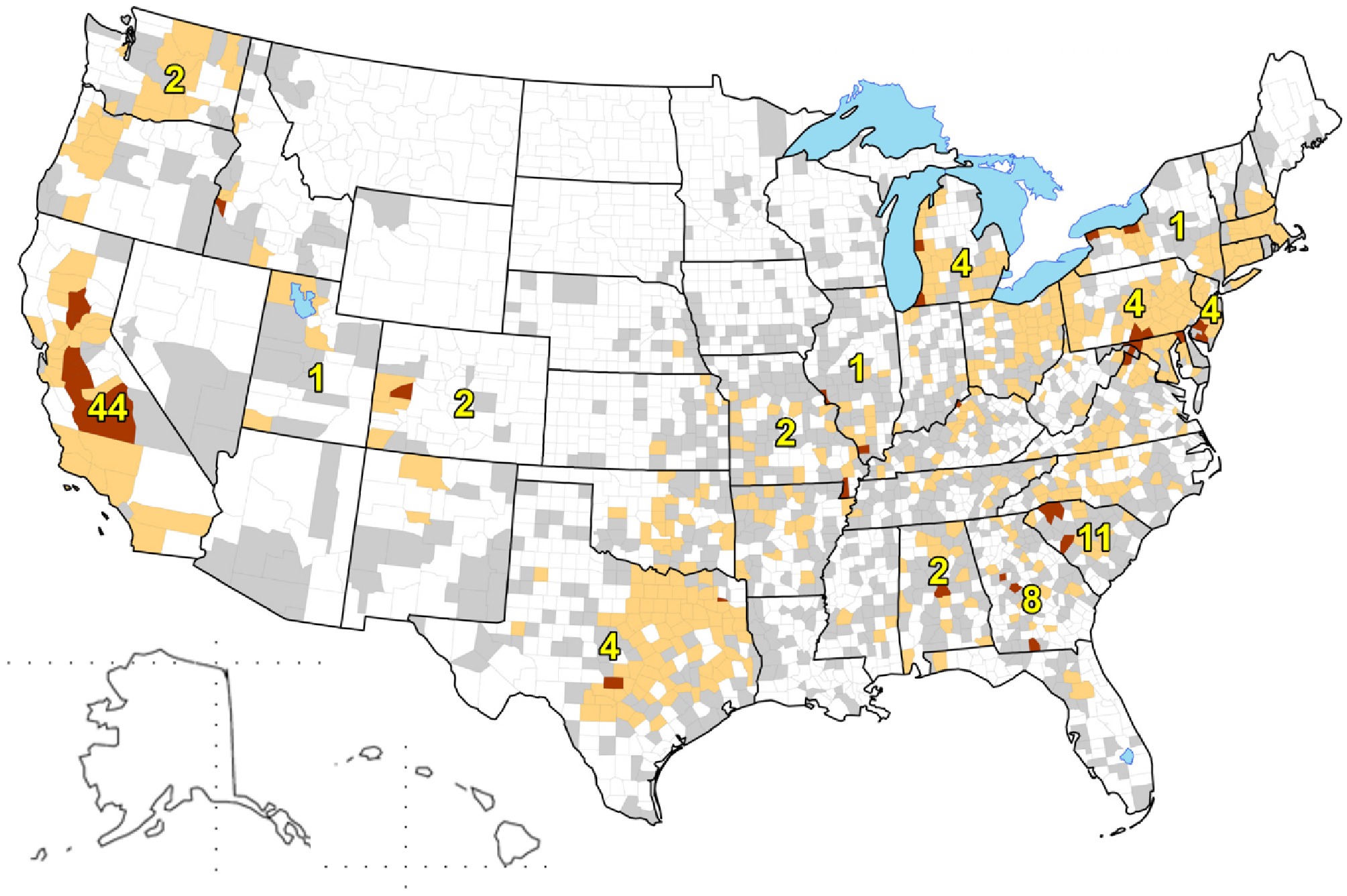
Figure 1.
U.S. major (red, accounting for 75%), and minor (orange, 24%) peach production areas and acreage percentages (yellow numbers) in each state to the national total. Grey color represented areas or counties with data not published by NASS and hence not used in delineating the major and minor agricultural areas. States not numbered contributed to less than 1% of the national total acreage. The percentages were derived from USDA NASS 2007 Census of Agriculture data. Additional information on these data can be found at
www.nass.usda.gov/AgCensus . This figure was modified slightly from its original USDA version athttps://ctgpublishing.com/united-states-strawberry-production/united-states-top-peaches-producing-areas-map/ . -
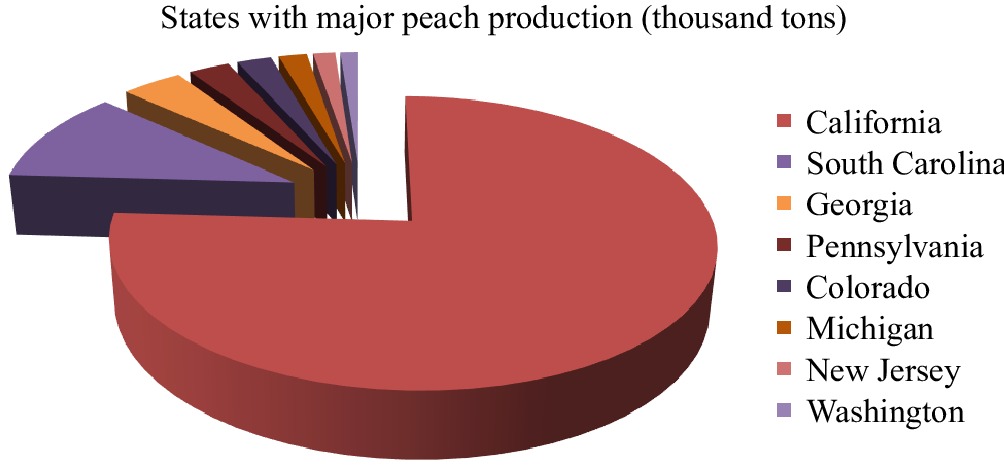
Figure 2.
States with major peach production (thousand tons) in the U.S. (data from USDA NASS 2022). Production ranks in states after the top three may vary from year to year.
-
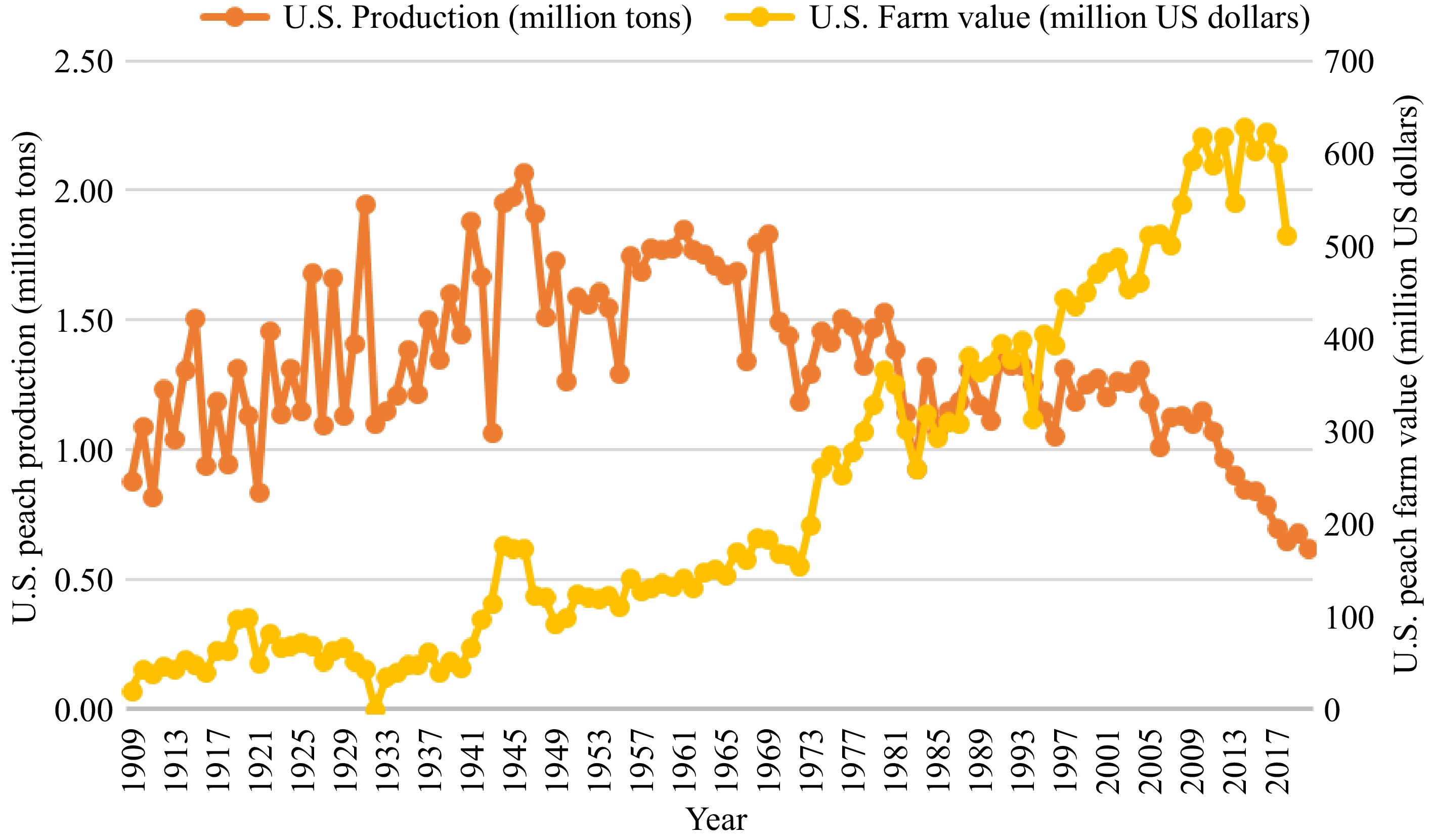
Figure 3.
Trend of U.S. total peach production and farm value (data from USDA NASS).
-
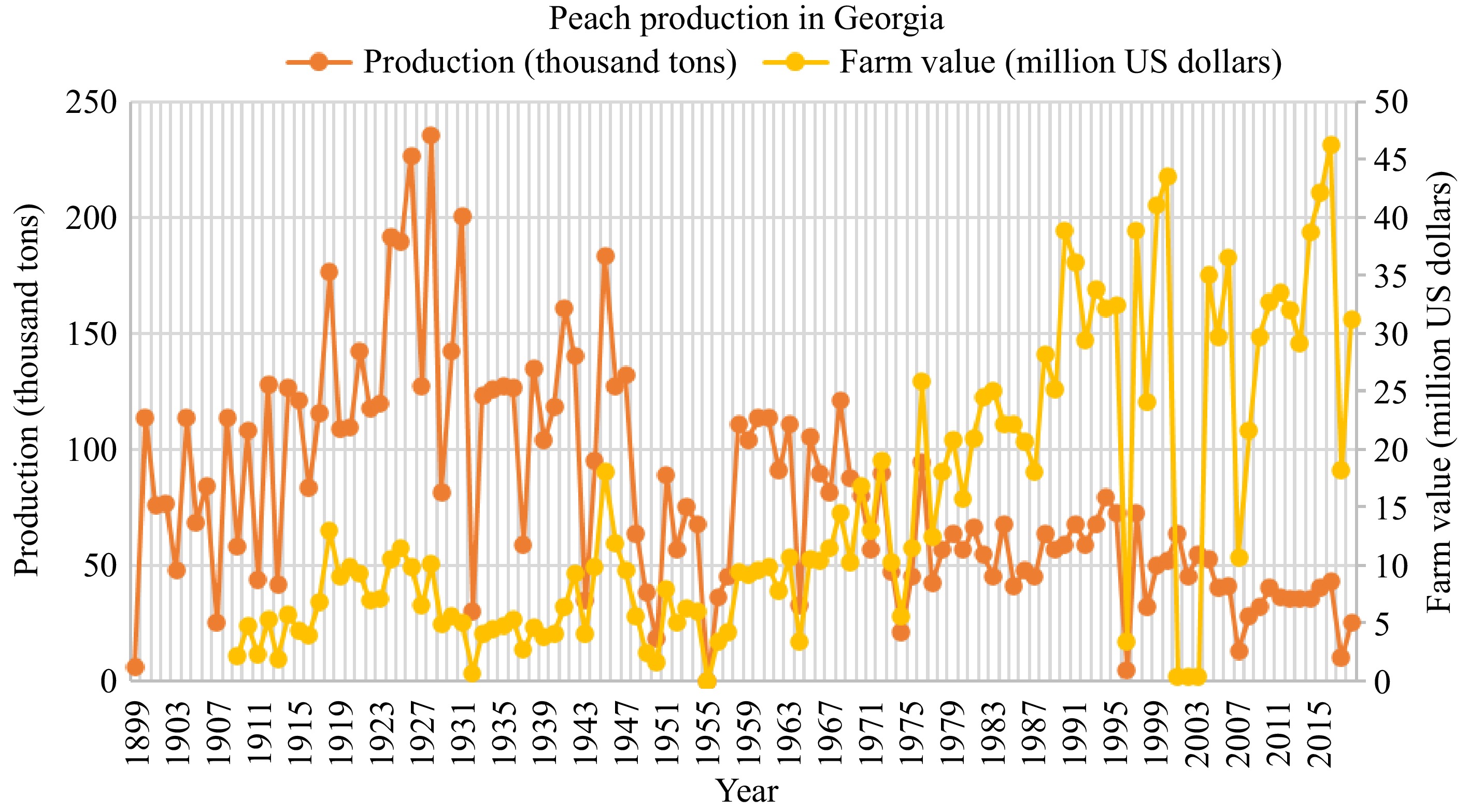
Figure 4.
Trend of peach production and farm value in Georgia (data from USDA NASS).
-
Breeding programs and locations Status Releases (series) Past/retired breeders Current breeders University of Arkansas, Fayetteville, AR Active White River, White Rock J. N. Moore, C. R. Rom, John R. Clark M. L. Worthington University of California, Davis, CA Active Fireglobe, Rizzi L. A. Thompson, P. Mansche, J. Beutel T. M. Gradziel University of California, Riverside, CA Terminated in the 1960s Banquet, Sunglow C. O. Smith, H. B. Frost, J. W. Lesley USDA-ARS, Fresno, CA; now in Parlier, CA Phased out recently Fairtime, Fantasia; Nemared L. A. Thompson, J. H. Weinberger, D. W. Ramming University of Florida, Gainesville, FL Active Flordaguard, UFSun, TropicSnow, GulfAtlas R. H. Sharpe, W. B. Sherman J. X. Chaparro USDA-ARS, Byron, GA Active Julyprince, Rich Joy, Gulfsnow; Guardian, MP-29 J. H. Weinberger, V. E. Prince, W. R. Okie, T. G. Beckman C. Chen, J. Lau University of Illinois, Urbana, IL Terminated in the 1950s Prairie Rose, Prairie Sunrise L. F. Hough, C. J. Birkeland, D. F. Dayton Louisiana State University, Baton Rouge, LA Terminated in the 2000s La Gem, GaLa, Harvester J. Boudreaux, C. E. Johnson, C. J. Graham Michigan State University, East Lansing, MI Active with reduced peach breeding Red haven, Crest haven S. Johnston, R. L. Andersen W. W. Shane North Carolina State University, Raleigh, NC Terminated recently Coralina Red, Clayton, Pekin F. E. Correll, J. R. Ballington Jr., D. J. Werner Rutgers University, New Brunswick, NJ Active with reduced peach breeding Jerseyqueen, Babygold 9, Nectared 6, Summer crest M. A. Blake, L. F. Hough, C. Bailey J. C. Goffreda Clemson University, Clemson, SC Active Carored, Camden; Guardian D. W. Cain, W. C. Newall, G. L. Geighard K. Gasic Texas A&M University, College Station, TX Active and being phased out recently Tex king, White Delight 4, White Zest One A. H. Krezdorn, J. B. Storey, H. H. Bowen D. H. Byrne USDA-ARS, Kearneysville, WV Phased out recently Earlired, Bounty, Redglobe R. Scorza Zaiger Inc. Genetics, Modesto, CA Active Arctic Queen, Sauzee Jewel, many other series, hundreds of patents Floyd Zaiger Gary Zaiger and other family members Paul Friday Farms Inc., Coloma, MI Phased out PF 24-C (Flamin' Fury series); dozens of patents Paul Friday z Not all U.S. peach breeding programs, releases (series), or past/retired breeders are listed. Same names in different programs are co-releases. Scions and rootstocks released in a program are separated by semicolons. Data on status and current breeders is as of 2023. Table 1.
Some U.S. public and private peach breeding programsz.
-
Cultivars Release year Ripe date relative to Elberta Chilling requirement Flesh Flower Leaf gland Bacterial spot Sunprince 1981 −1 800 YMF L, SH G R Juneprince 1985 −35 600 YMF L, SH N MR Fireprince 1985 −21 750 YMF L, SH R MR Goldprince 1989 −45 650 YMS L, SH N MR Summerprince 1992 −42 850 YMS L, SH R MR Flameprince 1993 14 850 YMF L, SH R MR Blazeprince 1997 −20 850 YMF L, SH R S Rubyprince 1997 −42 800 YMC L, SH R MR Autumnprince 1998 45 850 YMF L, SH G MR Springprince 1998 −50 650 YNC L, SH G MS Sureprince 1998 −33 900 YMS L, SH N MR Julyprince 2005 −10 850 YMF L, SH R R Scarletprince 2005 −13 850 YMF L, SH R MR Augustprince 2006 6 850 YMF L, SH R MR Early Augustprince 2006 1 825 YMF L, SH G MR Rich Joy 2019 2 850 YMF L, SH R MR Liberty Joy 2019 −15 650 YMF L, SH R MR Crimson Joy 2019 −25 850 YMF L, SH R MR Cardinal Joy 2023 −56 850 YMF L, SH R MR May Joy 2023 −71 650 YMF L, SH R MR Gulfprince 2000 N/A 400 YNC L, SH R R Gulfcrest 2005 N/A 525 YNC L, SH R R Gulfking 2005 N/A 350 YNC L, SH R R Gulfcrimson 2008 N/A 400 YNC L, SH R R Gulfsnow 2013 N/A 400 WNC L, SH G R GulfAtlas 2014 N/A 400 YNC L, SH R R y Some are joint releases. Table 2.
Three series of peach scion cultivar releases from the USDA-ARS Byron programsy.
-
Series Number Type Flesh color Texture Acidity Royal Zest 4 Peach Acid Fire Zest 2 Peach Yellow-
orange
Non-
melting
Acid Golden Zest 1 Peach Yellow-
orange
Non-
melting
Acid White Zest 1 Peach White Melting Acid White Delight 4 Peach White Melting Subacid Smooth Texan 3 Nectarine Yellow Melting 2 Acid, 1 Subacid Smooth Delight 3 Nectarine 1 yellow,
2 white
Melting Subacid Smooth Zest 2 Nectarine 1 Yellow,
1 white
Melting Acid Flat Delight 3 Peach 1 yellow,
2 white
Melting Subacid Tropic Zest 4 Peach Yellow Melting Acid Tropicprince 1 Peach Yellow Melting Acid Tex 4 Peach Yellow Melting Acid Royal Delight 4 Peach Yellow Melting Subacid x In the series names, Smooth is referred to as nectarine, Zest as traditional acid tart flavor, Delight as super sweet subacid flavor, and Flat as pantao peach. Additional releases may be planned in some series. Information courtesy of Dr. David Byrne. Table 3.
Series names and characteristics for releases from the Texas A&M University peach programx.
-
Rootstock Genetic background Year Propagation Dwarfness Brief comments USPP#, PVP#,
Developer, or Ref.Bailey Prunus persica 1836 seed 100% Popular in northern climates. Charles Jacob Friday, Scott County, IA[21] Lovell P. persica 1882 seed 100% A canning peach most commonly used. G. W. Thissell, Winters, CA[21] Halford P. persica 1919 seed 100% A canning peach (likely a seedling of Lovell) widely used since the 1920s. J. T. Halford, Modesto, CA[21] Nemaguard P. persica × davidiana or P. persica 1959 seed 100% Most commonly used for peaches and almonds. USDA-ARS, Fort Valley, GA[21] Nemared P. persica × davidiana or P. persica 1983 seed 100% Very similar to and more vigorous than Nemaguard. [22] Flordaguard P. persica × davidiana 1990 seed 100% Commonly used in low-chill regions. [23] Guardian P. persica 1994 seed 100% Mainly tested and used in the Southeast. PVP9400013[24] MP-29 Unknown plum species ×
P. persica2011 clonal 70% Mainly tested and used in the Southeast. PP23583[25] Controller 5 P. salicina × P. persica 2003 clonal 50%−60% Primarily used in CA. PP15228 Controller 9 P. salicina × P. persica 2003 clonal 90% Primarily used in CA. PP15225 Brights Hybrid 5 P. dulcis × P. persica 2006 seed 100% Surviving well in high pH soils. PP18782 Hansen 536 P. dulcis × P. persica 1982 clonal 100% Use with almonds and peaches. PP05173 Hansen 2168 P. dulcis × P. persica 1982 clonal 100% Use with almonds and peaches. PP05210 Cornerstone P. dulcis × P. persica 2009 clonal 100% Commonly used for almond and peach in CA. PP21248 Sharpe P. angustifolia × unknown
plum species2007 clonal 60% Not widely used. [54] Marianna 2624 P. cerasifera × P. munsoniana 1940 clonal 90% Use with plums in heavy soils. W. L. Howard, Davis, CA[55] M40 P. cerasifera × P. munsoniana 1998 clonal 100% Primary use with plums. PP11403 Atlas P. persica × (P. dulcis × (P. cerasifera × P. armeniaca)) 1994 clonal 100% One popular rootstock commonly used in CA. PP08913 Viking P. persica × (P. dulcis × (P. cerasifera × P. mume)) 1994 clonal 100% One popular rootstock commonly used in CA. PP08912 * The information is summarized primarily from patents and a handbook[21] for early-year, non-patented, unpublished rootstocks. Additional information on some stone fruit rootstocks may also refer to Foundation Plant Services and some commercial nurseries. Table 4.
Some rootstocks for use in the U.S.*
Figures
(4)
Tables
(4)