-
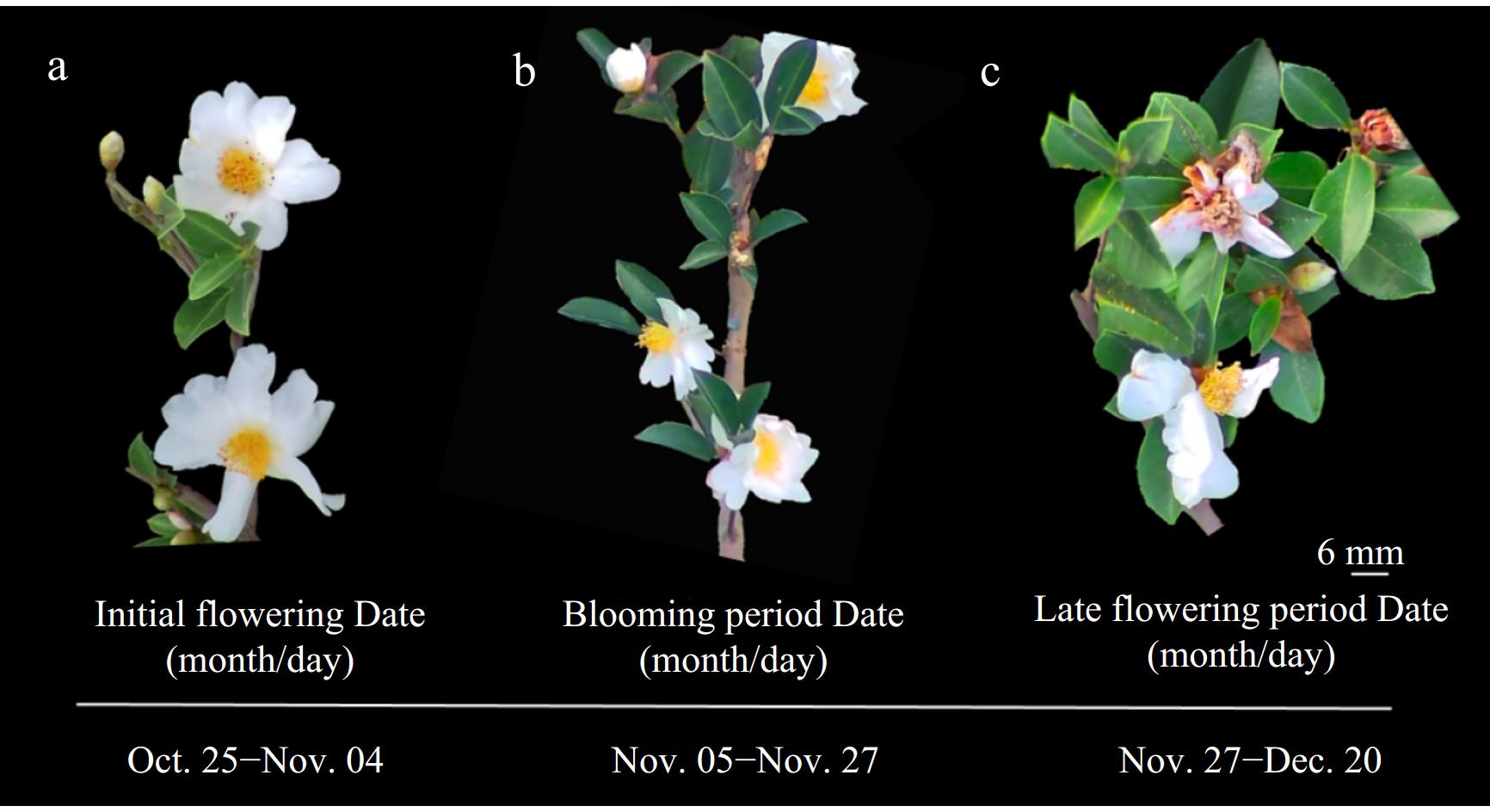
Figure 1.
Flowering phenology of C. hainanica 'H4' in 2023. (a) Initial flowering date (Oct. 25–Nov. 4); (b) blooming period date (Nov. 5–Nov. 27); (c) late flowering period date (Nov. 27–Dec. 20).
-
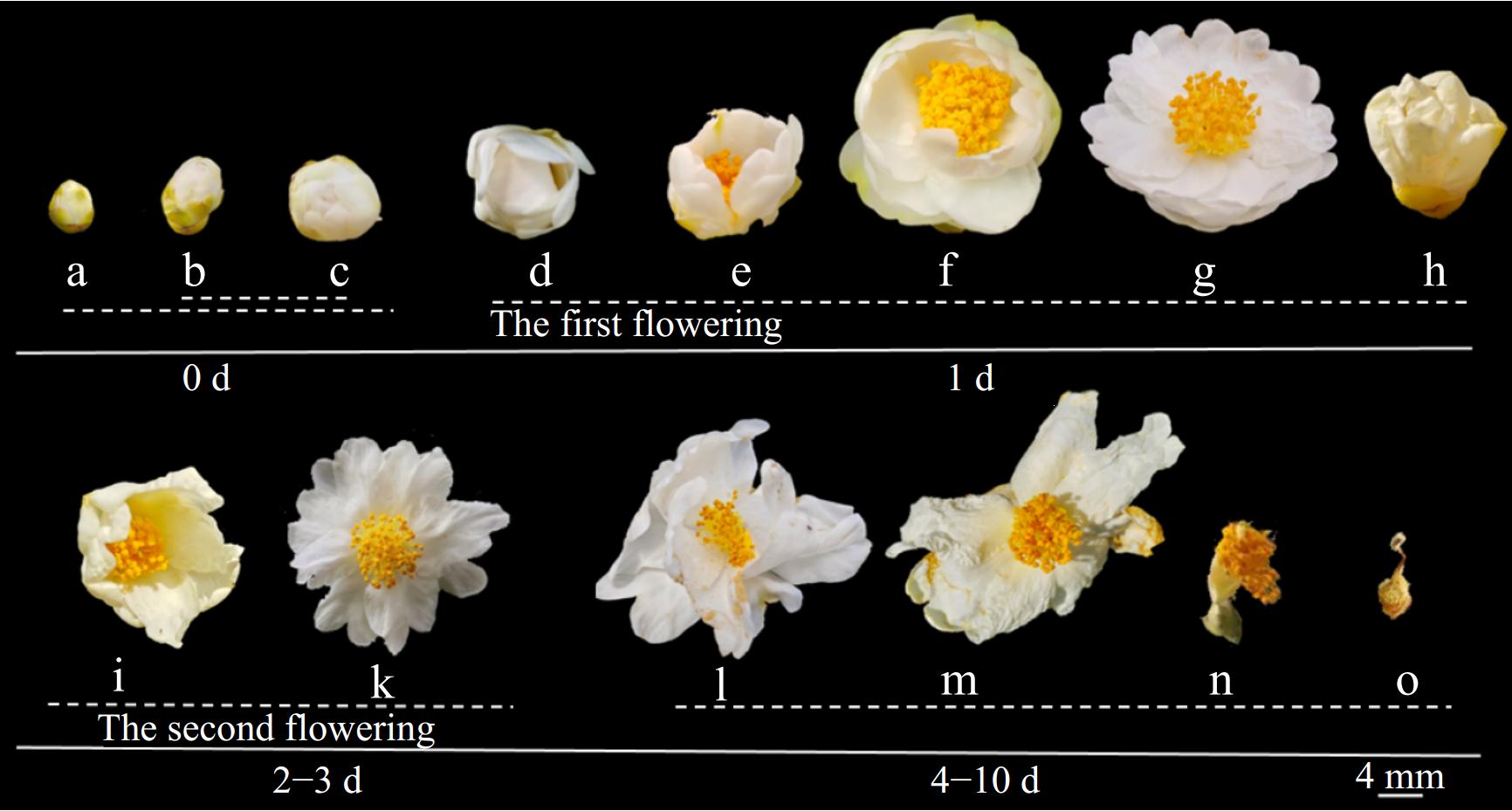
Figure 2.
The flowering process of C. hainanica single flower. (a) Outer part of the bud was green; (b) bud began to loosen; (c) top view of the bud as it started to loosen; (d) petals gradually began to unfold; (e) stamens were exposed; (f) stamens and pistils were completely protruding; (g) flower blossomed fully for the first time; (h) flower began to close; (i) flower bloomed again; (k) flowers were fully open again; (l) petals began to wilter and fade; (m) petals withered and dropped; (n) petals had dropped entirely; (o) style turned brown.
-
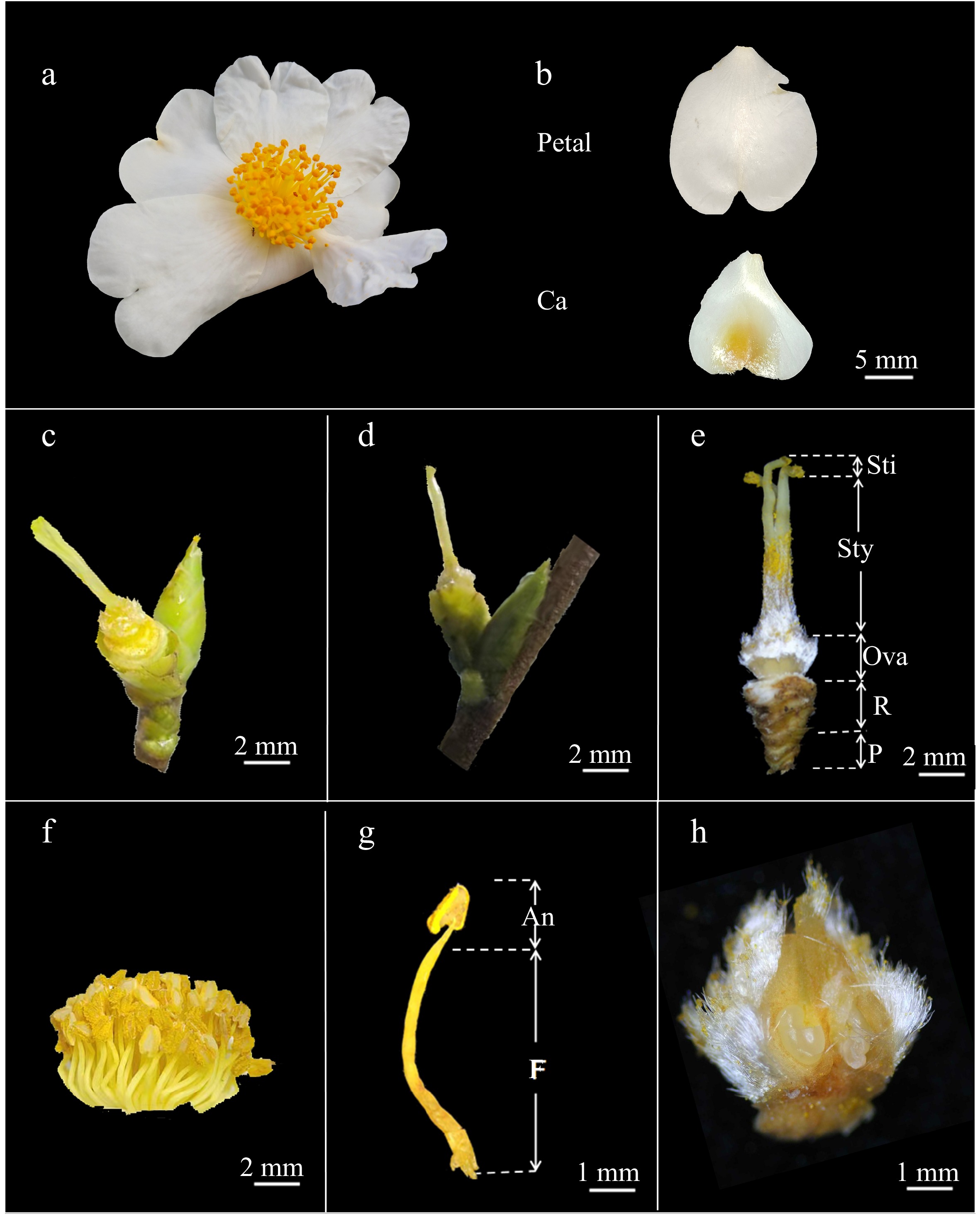
Figure 3.
Organ morphology of C. hainanica. (a) External morphology of a flower; (b) morphological features of floral organs; (c) terminal flower bud; (d) axillary flower bud; (e) gynoecium morphology; (f) stamen group; (g) structure of anther; (h) ovary anatomy diagram. Petal: normal petals; Ca: petaloid sepal; An: anthers; F: filament; Sti: stigma; Sty: style; Ova: ovary; R: receptacle; P: pedicel.
-
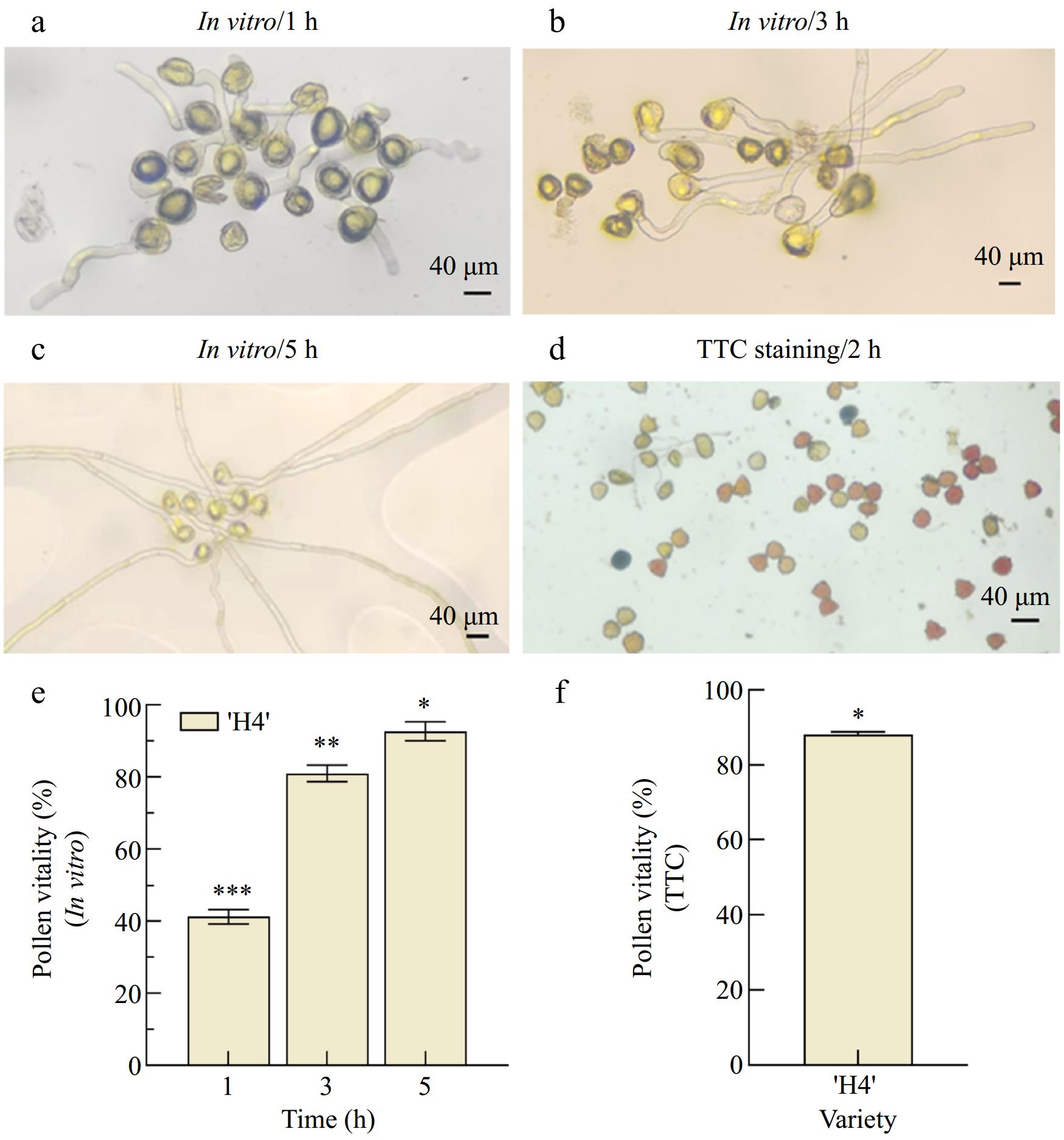
Figure 4.
Determination of pollen viability of C. hainanica using different methods. (a) Pollen phenotype of 'H4' after in vitro germination for (a) 1 h, (b) 3 h; and (c) 5 h. (d) Pollen phenotype of 'H4' after TTC staining for 2 h. (e) Germination rate of 'H4' pollen after 1, 3, and 5 h of in vitro culture, (f) 'H4' pollen TTC staining for 2 h. The symbols (*, **, ***) were significantly different by Duncan's test at p ≤ 0.05.
-
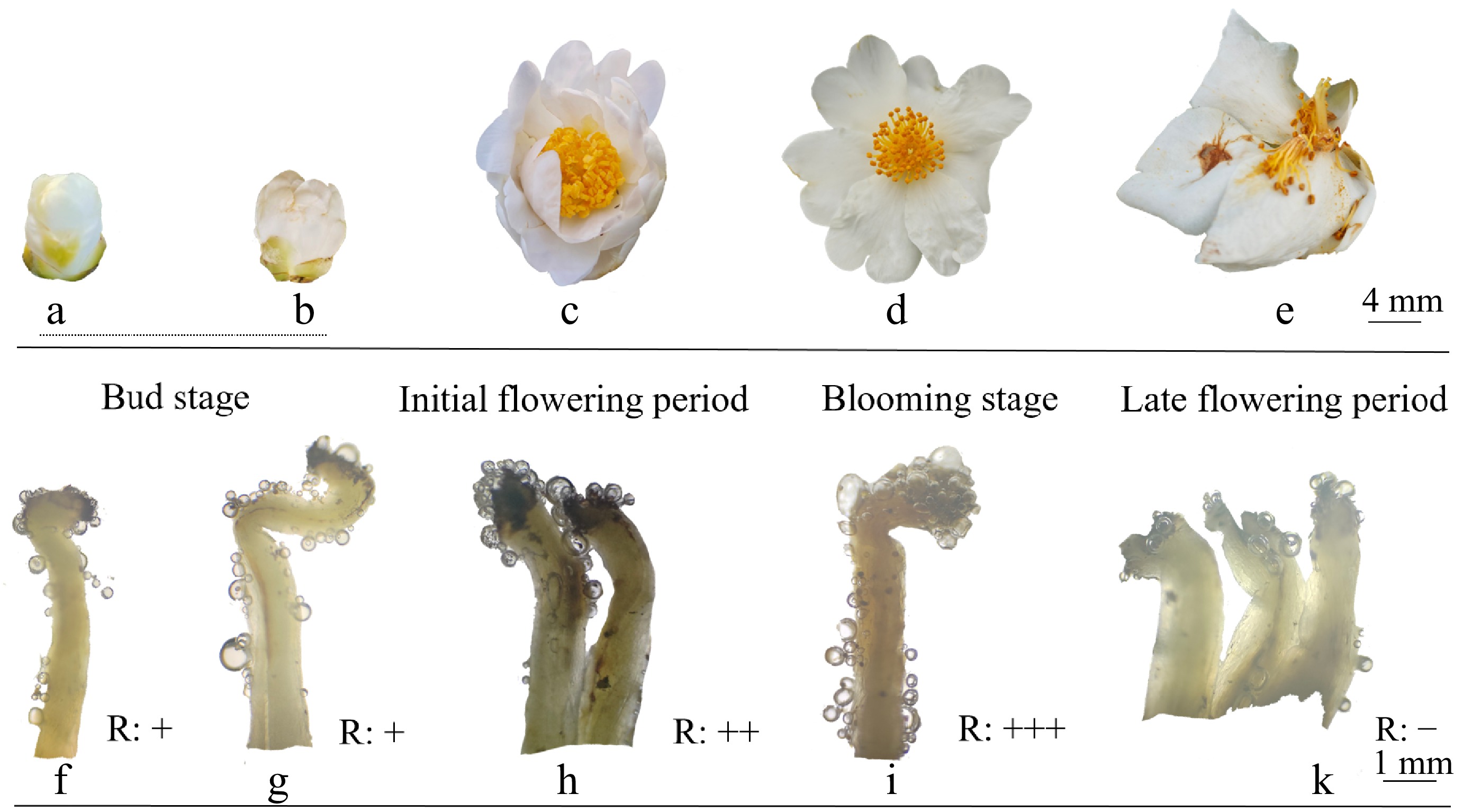
Figure 5.
Stigma receptivity of 'H4' at different blooming stages. (a) Small bud stage; (b) large bud stage; (c) initial flowering period; (d) blooming stage; (e) late flowering period. Graphical representation of the stigma receptivity in the (f) small bud stage, (g) large bud stage, (h) initial flowering period, (i) blooming stage, and (k) late flowering period.
-
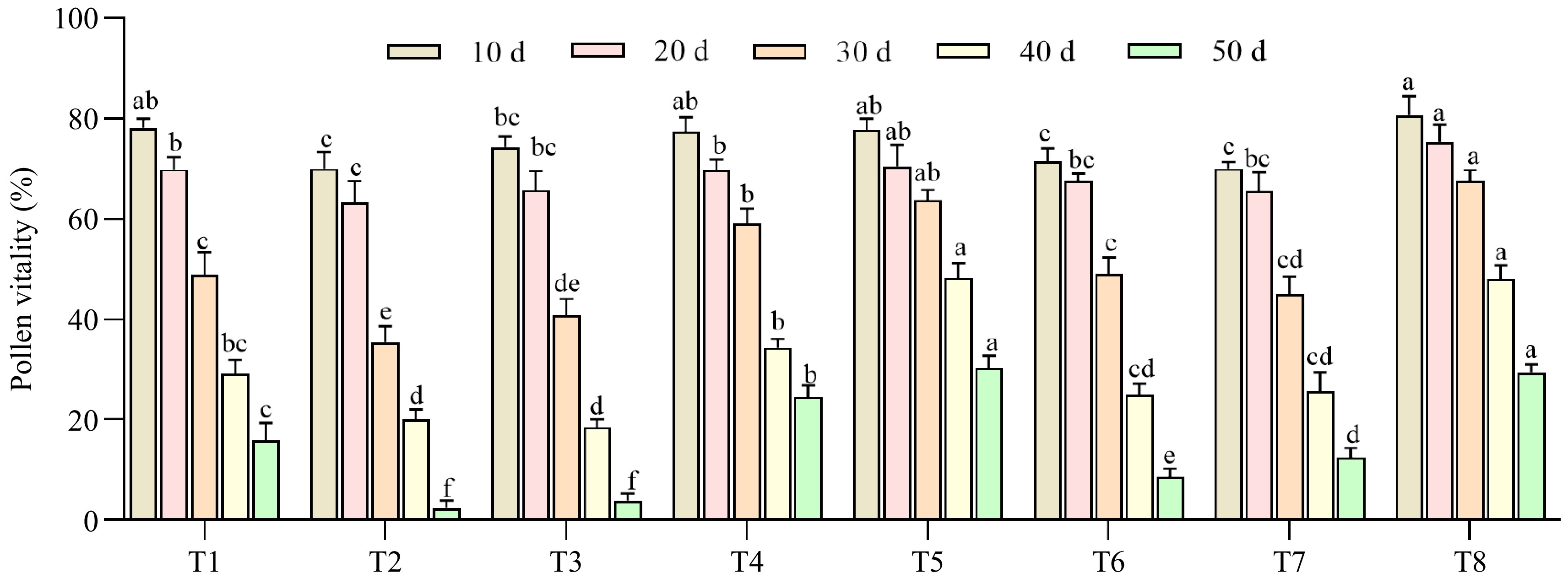
Figure 6.
Study on the effects of different treatment methods on the storage of C. hainanica pollen. T1 = RT + sealed + Fresh; T2 = RT + sealed & dry + Dried; T3 = 4 °C + sealed + Dried; T4 = 4 °C + sealed & dry + Fresh; T5 = −20 °C + sealed + Dried; T6 = −20 °C + sealed & dry + Fresh; T7 = −80 °C + sealed + Fresh; T8 = −80 °C + sealed & dry + Dried; 10 d, 20 d, 30 d, 40 d, 50 d = The number of days in storage. The different lowercase letters were significantly different by Duncan's test at p ≤ 0.05. (All data were compared horizontally at the same time).
-
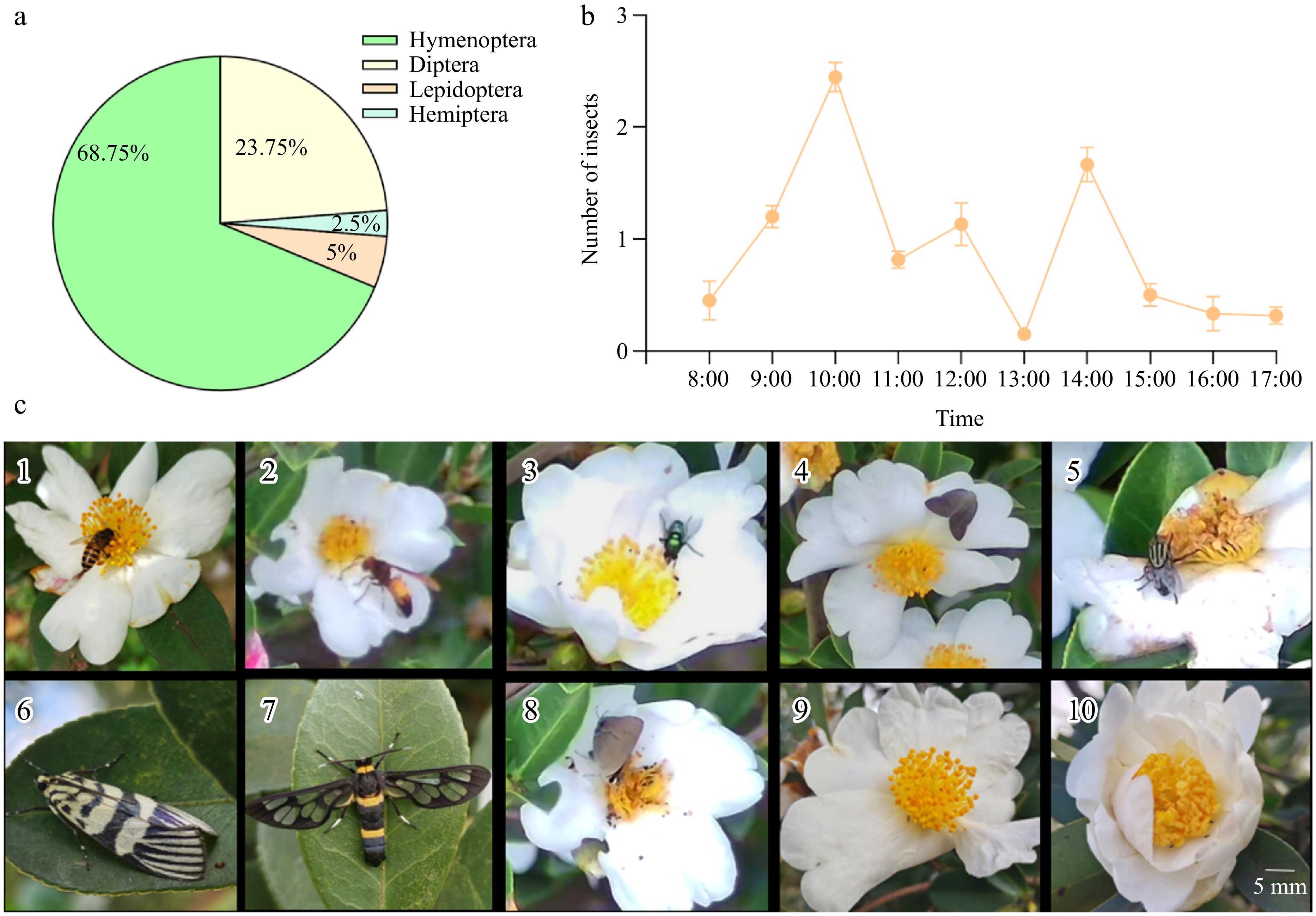
Figure 7.
Species of flower visiting insects. (a) Number of flower-visiting insects. (b) Average frequency of flower visits by insects (8:00–17:00). (c) Primary flower-visiting insects. (c1) Apis sp.; (c2) Vespa; (c3) Lucilia sp.; (c4) Hippoboscoidea; (c5) Sarcophaga; (c6) Heortia; (c7) Euproctis; (c8) Rapala; (c9) Formicidae; (c10) Thrips.
-
Treatment Temperature (°C) Mode Pollen state T1 RT Sealed Fresh T2 RT Sealed & dry Dried T3 4 Sealed Dried T4 4 Sealed & dry Fresh T5 −20 Sealed Dried T6 −20 Sealed & dry Fresh T7 −80 Sealed Fresh T8 −80 Sealed & dry Dried Table 1.
Orthogonal experimental design of C. hainanica pollen storage.
-
Items Value Number of pollen grains per flower 2,163,833−2,618,552 Number of ovules per flower 17−26 P/O ratio 83,224.35−154,032.47 Reference value 2,108.00−195,525.00 Table 2.
Pollen‒ovule (P/O) ratio of 'H4'.
-
Items Findings Scores Corolla diameter/mm > 6 3 Maturation sequence of androecium and gynoecium Protogyny 0 Spatial position between anthers and stigmas Existence of spatial segregation 1 Outcrossing index 4 Breeding systems Outcrossing, partially selfcompatible, pollinators required Table 3.
Outcrossing index (OCI) of C. hainanica.
-
Treatment No. of trees No. of flowers No. of fruits Fruit-set rate Natural pollination 4 30 2 6.67% No emasculation, bagged 4 30 0 0 Emasculation, not bagged 4 30 3 10% Geitonogamy 4 30 2 6.67% Xenogamy 4 30 5 16.67% Emasculation, bagged 4 30 0 0 Table 4.
C. hainanica setting rate of different pollination methods.
Figures
(7)
Tables
(4)