-
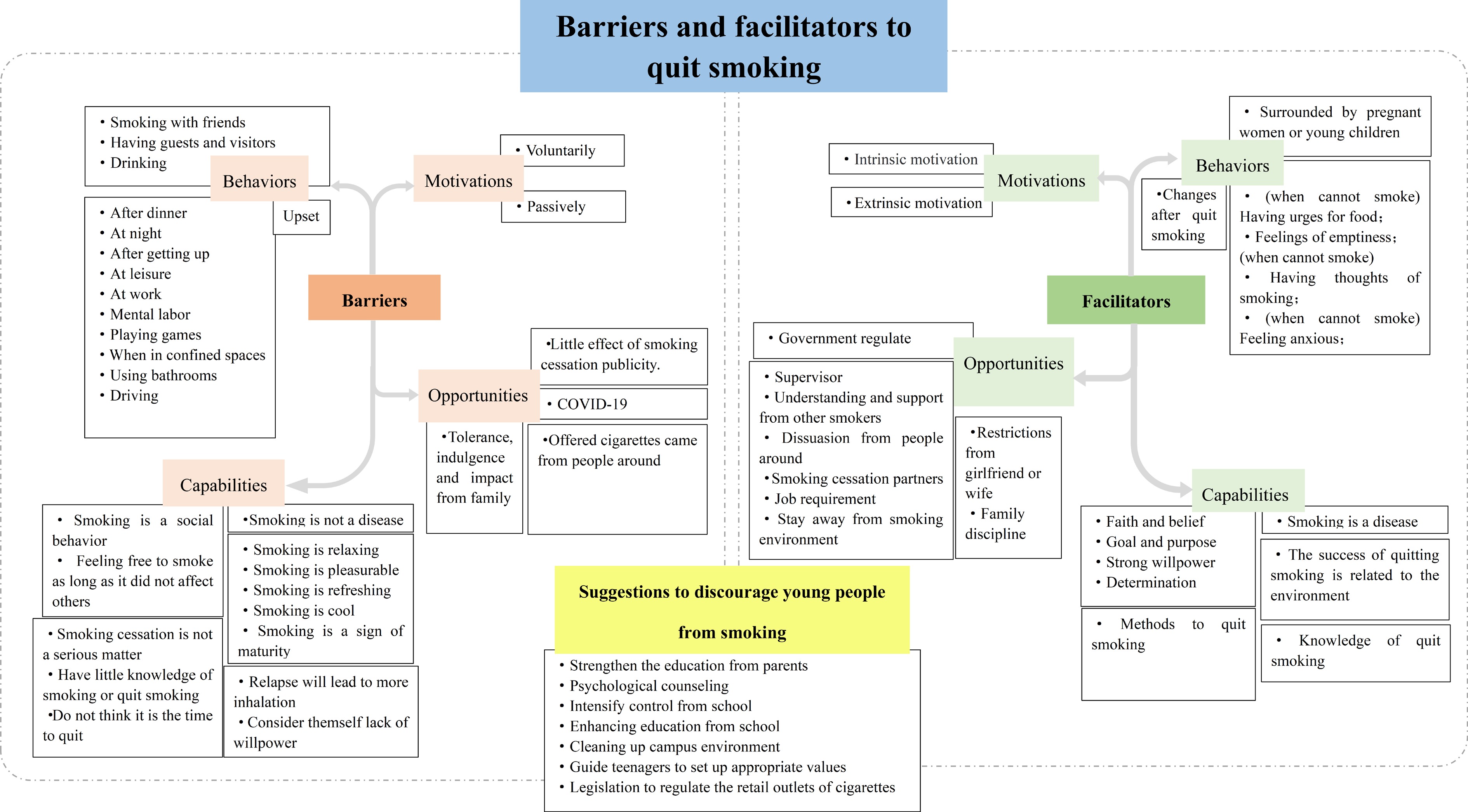
Figure 1.
Primary and secondary coding of barriers and facilitators to quitting smoking.
-
Question outline Additional questions/prompts Could you tell me the reason why you started smoking in the first place? ● Does anyone smoke in your household?
Yes. → Do you think family influence is related to your start of smoking?
No. → What affected you to start smoking mainly?
● Under what circumstances made you more prone to smoking? (such as time points or scenes)
● Why do you think these situations make it more likely for you to smoke? Have these been an obstacle to quit?
● Is it possible to avoid these situations?What do you think about stopping smoking? ● Do you think nicotine dependence is a condition that needs treatment? And why? How do you feel physically and emotionally when you abstain from smoking?
● If quitting smoking is not mandatory for you, would you still like to quit smoking? (Or, what are the reasons for the necessity to quit smoking?)
● (With smoking cessation experience(s)) Could you tell me about your considerations or motivations for each attempt? What effects did they have?
● (With no smoking cessation experience) Would you consider quitting smoking in the future? Under what circumstances will you quit/restart smoking?
● Which factors do you believe provide you with more confidence in quitting smoking, intrinsic or extrinsic factors? Intrinsic factors such as concerns for health conditions or personal images. Extrinsic factors such as opposition from families, concerns for others' health, or relevant regulations that make smoking inconvenient.
● (Have health issues) How has smoking affected your issues? Would you be willing to quit smoking for the sake of your health?What are your perceptions of the harm and danger associated with smoking? ● (For example, secondhand smoke, effects on the lungs, effects on fertility)
● Are you aware of any harmful substances that enter the body through smoking? (Such as nicotine, tar, sulfur monoxide, carbon monoxide, and others)
● Could you tell me about the diseases caused by smoking?
● Have you attended any seminars or public lectures on the dangers of smoking? (For example, community lectures, slogans, advertisements). How did these experiences make you feel?What methods have you tried to quit smoking? ● Do you think those methods were effective? To what extent did they help you? Could you list some approaches that you have heard of but have not yet tried? Why haven't you tried them?
● Do you think mindfulness therapy, acupuncture, traditional Chinese medicine can help with smoking cessation?
● Have you ever tried any traditional Chinese medicine methods to help quit smoking?
Yes. → What did you try and how do you feel about it?
● Do you have any partners or friends who supported you during your smoking cessation journey?
● Have you heard of smoking cessation clinics?
Yes. → How did you learn about them? Have you ever visited a smoking cessation clinic for consultation or treatments?
If yes, could you share with me more about your experience?
No.→Would you consider visiting a smoking cessation clinic in the future?
If no, what were the reasons for not seeking help from the clinics?
● Have you ever used e-cigarettes?
Yes. → Could you tell more about your experience of using them and whether they helped you in any way? Do you think that e-cigarettes are equivalent to regular cigarettes? Can e-cigarettes replace regular cigarettes, and why do you think so?
● In your opinion, which is more crucial for quitting smoking, determination or method?What do you think are the most important factors to succeed in quitting smoking? ● Which factor do you consider the most essential for yourself? Why?
● To achieve smoking cessation successfully, what type of assistance or support do you need throughout the process?
● Has the coronavirus disease 2019 (COVID-19) pandemic and its consequences influenced your attempts to quit smoking or your smoking behavior?
● What do you think regarding teenage smoking issues? Do you have any advice to prevent teenagers from smoking?Table 1.
Interview outline and additional questions.
-
Items Characteristics No. of participants (%) Gender Male 25 (83.3) Female 5 (16.7) Age (years) < 18 3 (10.0) ≥ 18 and ≤ 45 21 (70.0) > 45 and < 60 3 (10.0) ≥ 60 3 (10.0) Occupation Designer 3 (10.0) Lawyer 1 (3.3) Teacher 5 (16.7) Business manager 1 (3.3) Host of live RPG 1 (3.3) Student 6 (20.0) Civil servant 7 (23.3) Police 2 (6.7) Energy industry worker 1 (3.3) Ex-soldier 1 (3.3) Doctor 1 (3.3) Housewife 1 (3.3) Relationship status Dating 7 (23.3) Single 9 (30.0) Married 13 (43.3) Fertility status Have children 12 (40.0) No children 17 (56.7) Planning to have children 1 (3.3) Age of the first TC < 18 21 (70.0) ≥ 18 and ≤ 45 9 (30.0) Years of TC < 10 12 (40.0) ≥ 10 18 (60.0) Frequency of TC* Everyday 17 (56.7) Occasionally 4 (13.3) None 9 (30.0) Desire to smoke Yes 17 (56.7) No 4 (13.3) Quit 9 (30.0) No. of TC ≤ 5 cigs/d 7 (23.3) > 5 and ≤ 10 cigs/d 6 (20.0) > 10 cigs/d 11 (36.7) It depends 1 (3.3) E-cigs 1 (3.3) No. of attempts to quit smoking Never 13 (43.3) ≤ 3 14 (46.7) > 3 and ≤ 5 1 (3.3) > 5 and ≤ 10 1 (3.3) > 10 1 (3.3) Partners quit smoking / 13 (43.3) Yes 5 (16.7) No 12 (40.0) Experiences of e-cigarette use Yes 21 (70.0) Never 9 (30.0) No., Number; RPG, role playing game; TC, tobacco consumption. * The frequency of smoking in the past month. Table 2.
Summary of basic demographic information on 30 interviewees.
Figures
(1)
Tables
(2)