-
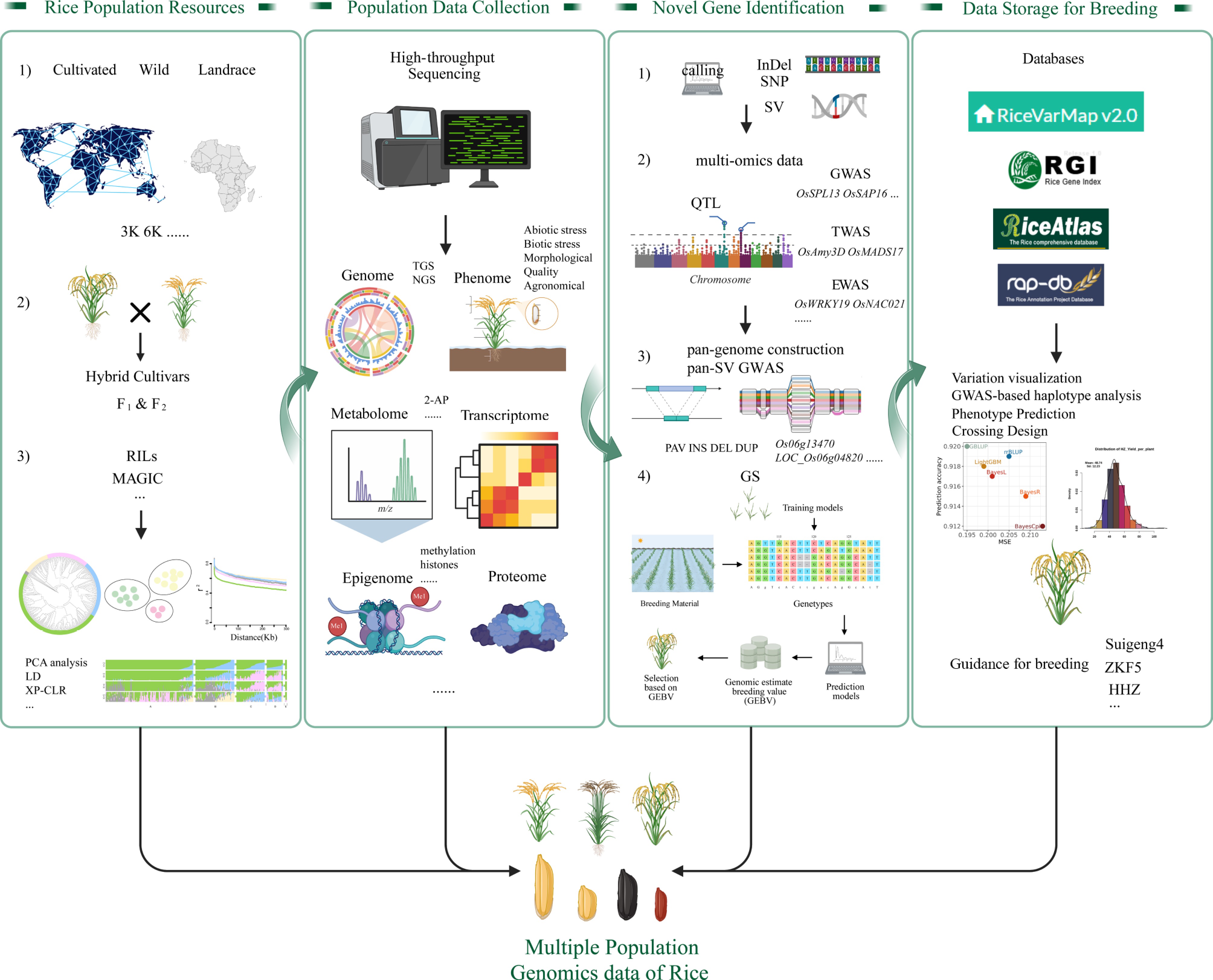
Figure 1.
The integrative framework of population genomics and multi-omics approaches for advancing rice breeding. Key components include: (1) Rice population resources, encompassing cultivated varieties, wild relatives, landraces, hybrid cultivars (F1/F2), recombinant inbred lines (RILs), multi-parent advanced generation inter-cross (MAGIC) populations, and so on. (2) High-throughput data collection across genomic, phenomic, transcriptomic, epigenomic, proteomic, and metabolomic layers. (3) Novel gene discovery strategies, leveraging pan-genome analyses (SNPs, InDels, structural variations), genome-wide association studies (GWAS), and genomic selection (GS). (4) Data storage and breeding applications featuring databases (RiceVarMapv2.0, RGI) that guide cultivar development (e.g., ZKF5, HHZ, Sujgeng4). Collectively, this big data-driven paradigm accelerates the identification of agronomically vital traits and informs precision breeding strategies to enhance global rice productivity and resilience.
-
Rice type Number of accessions Sequencing method Key results Sparking point Ref. Published year 129 O. rufpogon and 16 O. sativa 145 ONT (103×), PacBio HiFi (24×) and NGS 69,531 pan-genes, with 28,907 core genes and 13,728 wild-rice-specific genes Supports Asian rice's monophyletic origin from Or-IIIa (japonica ancestor) [33] 2025 Chinese cultivars 6,044 NGS (31×) 3,131 QTLs for 53 traits; cloned OsGL3.6 regulating grain length Unprecedented QTL scale with direct breeding applications [32] 2025 Asian cultivars 18,421 ONT (69×) and NGS (100×) on founders and NGS (0.3×) on F2 1,207 QTLs for 16 traits; validated OsMADS22 and OsFTL1 Hybrid sequencing resolves QTL-phenotype causality [34] 2024 73 Asian rice and two wild relatives 75 Pacbio HiFi (18×) 1,769 large inversions (≥ 100 bp) in pan-genome First pan-genome landscape defining and validating inversion dynamics in rice [31] 2024 Inbred lines 12 PacBio HiFi (30×) 47,490 gene families, 489,713 genes and heterosis of 17 agronomic traits SV-heterosis mechanism bridge structural and regulatory evolution [35] 2024 Wild rice 17 PacBio HiFi (60×) and NGS (100×) 101,723 gene families including 63,881 gene families absent in cultivated Loss of some resistance genes in cultivated rice during domestication and artificial selection [30] 2024 2,839 hybrid cultivars and 9,839 F2 12,678 NGS (F1 35×; F2 0.2×) 5.2 million SNPs, 1.7 million InDels and 22,555 SV Heterosis decoded and developed a genomic model [36] 2023 11 wild, 51 cultivated and 12 weedy rice 74 PacBio HiFi (32×) 175,528 syntelog groups in a syntelog-based pangenome with putative introgression regions Constructed syntelog-based pangenome [29] 2023 Northeast Asian cultivars 546 NGS (10×) 111 known QTLs genotyped and novel GWAS-QTLs Summarized a rice breeding principle [37] 2023 Indian rice landraces 108 ONT (20×) and NGS (67×) 7415 and 131 differentially expressed transcripts and miRNAs Identified miRNAs and their target genes in regulating anthocyanin biosynthesis [38] 2022 Asian and African rice 251 ONT (100×) and NGS (65×) 1.52 Gb non-redundant DNA sequences in pan-genome Revealed extensive SVs associated with grain weight and gene PAV [39] 2022 O. sativa and wild relatives 111 ONT (68×) and NGS (69×) 879 Mb novel sequences and 19,000 novel genes in the rice pan-genome New pan-genome construction method for long-read data [28] 2022 32 O. sativa and 1 O. glaberrima 33 PacBio (60×), and NGS (20×) 171,072 SVs and 25,549 gCNVs underlying environmental adaptation SV-adaptation nexus across species boundaries [27] 2021 299 papers published from 1995 to 2020 / / 562 alleles in 225 QTGs and 348 QTNs A comprehensive QTN map and genome navigation systemin of rice [40] 2021 Chinese cultivars 1,275 NGS (7×) 143 association loci, including three new genes, control heading date or amylose content GWAS-powered gene prioritization framework [41] 2020 53 O. sativa and 13 O. rufipogon 66 NGS (115×) 23 million sequence variants include many known QTNs Variant-to-QTN translation bridges genomics and breeding [42] 2018 Asian cultivars 3,010 NGS (18×) 29 million SNPs, 2.4 million indels, and over 90,000 SVs Domestication model challenger via population structure [22] 2018 10,074 F2 lines from 17 hybrid rice crosses 10,074 NGS (0.2×) A dense genotype map with 347,803 recombination events; 74 QTLs for seven yield traits Dominance theory revived in hybrid rice [43] 2016 Hybrid rice (F1) 1,495 NGS (2×) 38 agronomic traits and 130 associated loci Hybrid trait architecture blueprint [44] 2015 Asian cultivars and landraces 1,479 NGS (3×) 6,428,770 SNPs total and 200 selected regions between IndI and IndII Breeding signatures between IndI and IndII including loci associated with agronomic traits [45] 2015 446 O. rufipogon and 1,083 cultivated varieties 1,529 NGS (2×) 5,037,497 non-singleton SNPs and 55 selective sweeps Domestication geography redefined [46] 2012 Worldwide cultivars 950 NGS (1×) 32 new loci associated with flowering time and with ten grain-related traits Extend to a larger and more diverse sample of rice varieties [21] 2012 Chinese landraces 517 NGS (1×) GWAS of 14 traits via 3.6M SNPs in 517 indica landraces Complex trait genomics and GWAS on crop pioneer [20] 2010 Table 1.
Summary of landmark rice population genomics studies.
-
Database Number of cultivars Description Ref. URL RiceVarMap 4,726 High quality and complete genotype data; Comprehensive annotations of genomic variations; Phenotype data and GWAS results and tools [9,10] https://ricevarmap.ncpgr.cn/ RiceSuperPIRdb 356 (TGS),
10,548 (NGS)The super pan-genome based on reference-quality de novo long-read assemblies accessions [11] http://ricesuperpir.com/ RGI 16 Establishes gene relationships between different accessions and contains transcriptomes across different accessions and tissues [48] https://riceome.hzau.edu.cn/ RPAN 3,010 Consolidates 3,010 accessions, pan-genome annotations, PAVs, expression data, and analytical tools [12] https://cgm.sjtu.edu.cn/3kricedb/ RiceAtlas 3,733 Integrates large-scale rice phenotypic, genomic variation, and germplasm information [47] http://60.30.67.242:18076/#/home Rice Genome Hub 32 Reference genomes of 10 species in Oryza / https://rice-genome-hub.southgreen.fr/ OryzaGenome 466 A collection of short reads from 217 accessions covering 19 Oryza species and 446 O. rufipogon SNP viewer [49,50] http://viewer.shigen.info/oryzagenome21detail/ RiceRc 33 Integrates a genome browser and a BLAST function and includes the ancestral allele data for SNP/Indels [21] http://ricerc.sicau.edu.cn/ RAP-DB 685 Facilitates a comprehensive analysis of the genome structure and function of rice on the basis of the annotation [54,55] https://rapdb.dna.affrc.go.jp/ MBKbase-rice 137,796 Integrates rice germplasm information, reference genomes with gene loci, phenotypic and gene expression data [56] https://www.mbkbase.org/rice Rice3KGS 3K LGBMY GS model with a dataset of 56 trait phenotypes and seven genotype datasets. [57] http://101.201.107.228:8002/#/Rice3KGS/home/ AutoGP / A dataset of 143,477 rice G2P paired data for 41traits [58] http://autogp.hzau.edu.cn CropGS-Hub 2,578 Over 224 billion genotype data and 434 thousand phenotype data generated from >30 000 individuals belonging to 7 major crop species [13] https://iagr.genomics.cn/CropGS/#/ BreedingAIDB 415 129,449 rice genome-to-phenotype paired data [14] http://ibi.zju.edu.cn/BreedingAIDB/ Smart Breeding Platform / Various statistical analyses, GWAS and GS using both classical ML and DL models [15] https://sbp.ibreed.cn/#/ Table 2.
Databases for rice population genomics data storage with online visualization function.
Figures
(1)
Tables
(2)