-
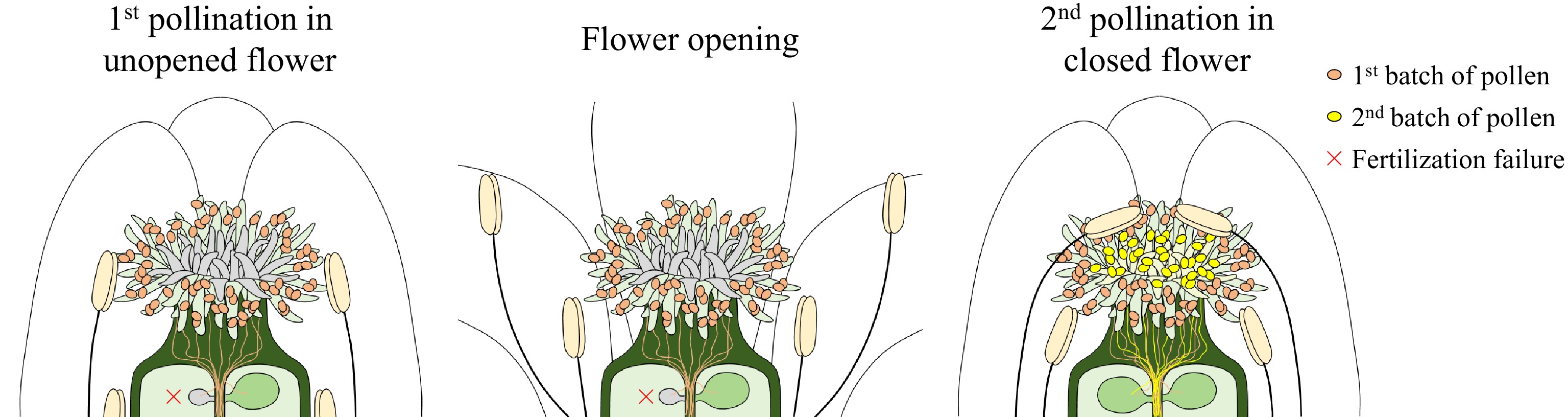
Figure 1.
Schematic diagram of two-step self-pollination by flower closure in Arabidopsis. The initial pollination occurs in unopened flowers, and the dehisced long stamens come into contact with lateral regions on the stigma's surface (left panel). When the flowers open, both the lengths of the stamens and pistil increase, but the long stamens become slightly longer than the pistil (middle panel). Approximately 7 h after the initial pollination, the closure of petals forces the long stamens into contact with the pistil again so that the second pollination occurs, doubling pollen deposition in the central region of the stigma's surface (right panel). This acts as a backup mechanism so that fertilization recovery is triggered in case unfertilized ovules remain. Notably, the second pollination is crucial for maximizing fertility under unfavorable conditions.
Figures
(1)
Tables
(0)