-
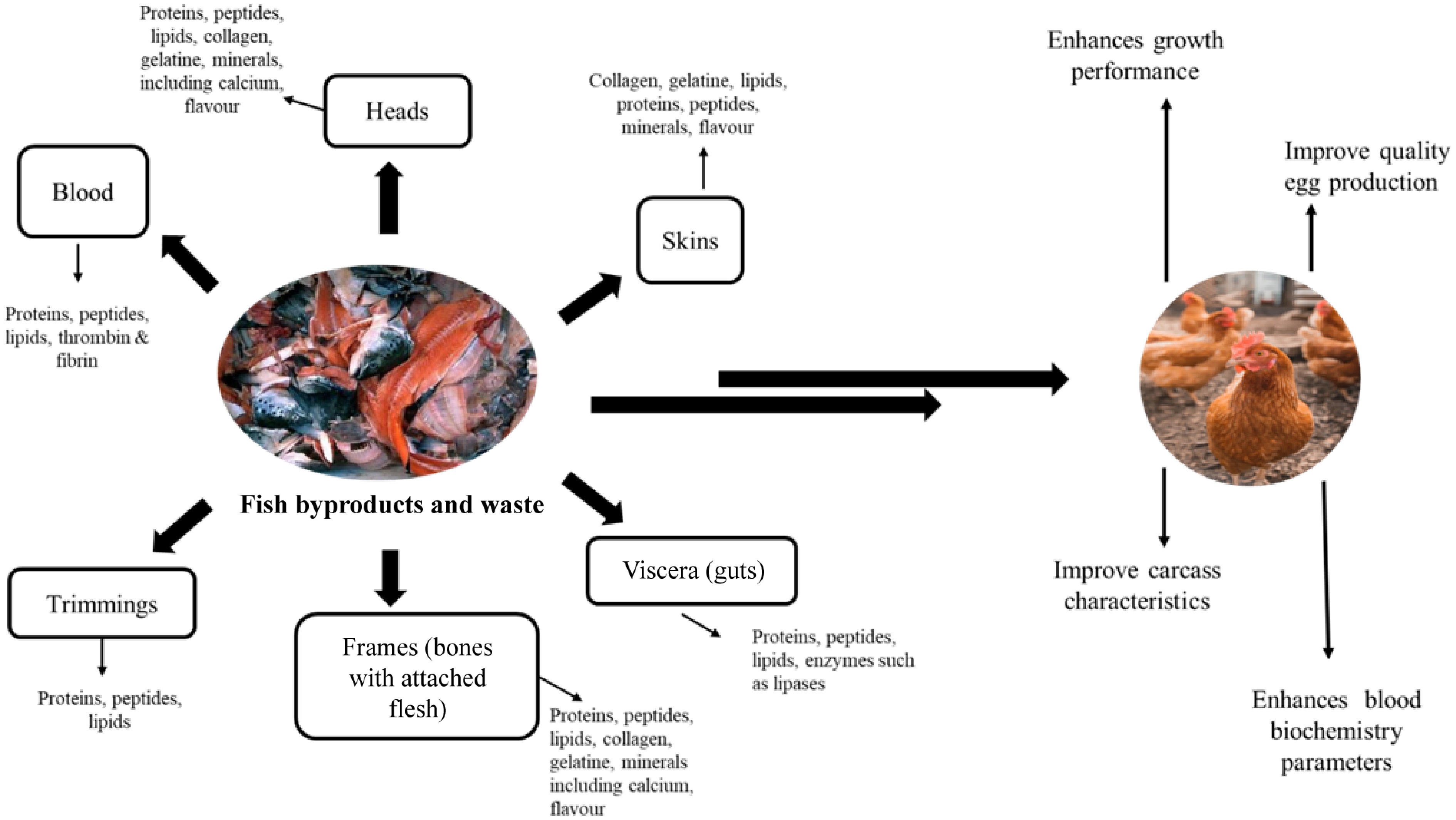
Figure 1.
Nutrient composition of fish byproducts and waste and their significance in poultry feed.
-
Poultry species Maturity rate Types of fish byproduct/waste Inclusion levels Experimental findings Ref. Hisex White laying hens 29 weeks Fish waste oil 0.5%, 1.0%, 1.5%, 2.0%, 2.5%, 3.0%, and 3.5% for 105 d Incorporating fish waste oil into laying hens' diets did not impact egg quality. However, its high inclusion adversely affected feed intake, egg mass, and flavor. [76] Local hens 27–34 weeks Skipjack fish waste 0%, 5%, 10%, 15%, and 20% Including 10% Skipjack fish waste in hens, diets improved egg characteristics like color, aroma, texture, and flavor compared to the control. It did not significantly affect SAFA, MUFA, n-3, n-6, or the n-3 ratio. Increasing the inclusion to 20% also had no significant impact on these fatty acids. [85] White leghorn layers 5 months Locally processed fish waste meal 5%, 10%, 15% at 90 d Hen day egg production and mass were higher in diets with 5%, 10%, and 15% FWM than in the control. Yolk quality met standards, with no consistent trends in egg quality. Eggs from hens fed 10%, and 15% FWM had a moderate fishy flavor. FWM inclusion improved egg-laying performance and profitability but caused a moderate fishy flavor at levels above 5%. [86] Native chicken 27–34 weeks Skipjack fish waste 5%, 10%, 15%, and 20% skipjack wastes for 8 weeks Skipjack waste had no significant effect on hen-day production (HDP), egg weight, yolk color, saturated fatty acids (SAFAs), monounsaturated fatty acids (MUFAs), omega-3 (En-3), omega-6 (En-6), or the omega-3 to omega-6 ratio compared to the control group. [87] Laying hen 12 months Sardine fish oil waste 0%, 5%, 10%, and 15% Adding 5% waste sardine fish oil significantly enhanced the chemical quality of laying hen eggs, including improved protein, fat, moisture, carbohydrate, ash, total energy content, and egg cholesterol levels. [88] Laying hen - Fish viscera silage (fresh, acid-preserved, ensiled, and ensiled concentrated viscera) 20% and 40% No significant differences in the quality of eggs from hens fed different diets were found. The inclusion of viscera waste did not significantly affect the sensory quality of the eggs but was better compared to the control. [89] Laying hens 22 weeks fish waste silage and fish fat 50 g/kg fish silage and fish fat (1.8, 8.8, 16.8 or 24.8 g/kg) Fish waste silage did not influence egg production, yolk color, or fatty acid composition. Diets with 16.8 or 24.8 g/kg fish fat reduced egg production but increased yolk color. The highest levels of C22:1 and PUFAs (C18:2 n-6, C20:5 n-3, C22:5 n-3, C22:6 n-3) were in diets with 24.8, 16.8, or 8.8 g/kg fish fat, while the lowest was in the 1.8 g/kg diet. C18:1 and C20:1 level was lowest in the 16.8 and 24.8 g/kg diets. Yolk cholesterol levels were unaffected. [90] Laying hens - Marine byproducts (scallop or squid viscera, shrimp heads, or whole mackerel waste) 5% 5% marine byproduct waste improves egg yolk composition by boosting omega-3 highly unsaturated fatty acids (HUFAs) compared to fishmeal. Additionally, these meals enhance astaxanthin levels and yolk pigmentation without altering egg sensory attributes. [91] ISA brown line laying hens (Gallus gallus domesticus) 16 weeks Silage waste from red tilapia viscera (Oreochromis sp.) 17.18% for 13 weeks Fish waste silage at a dry matter level of 17.18% did not yield statistically significant differences in egg quality parameters or their bromatological composition compared to the control. [92] Table 1.
Effect of fish waste on hen egg quality.
Figures
(1)
Tables
(1)