-
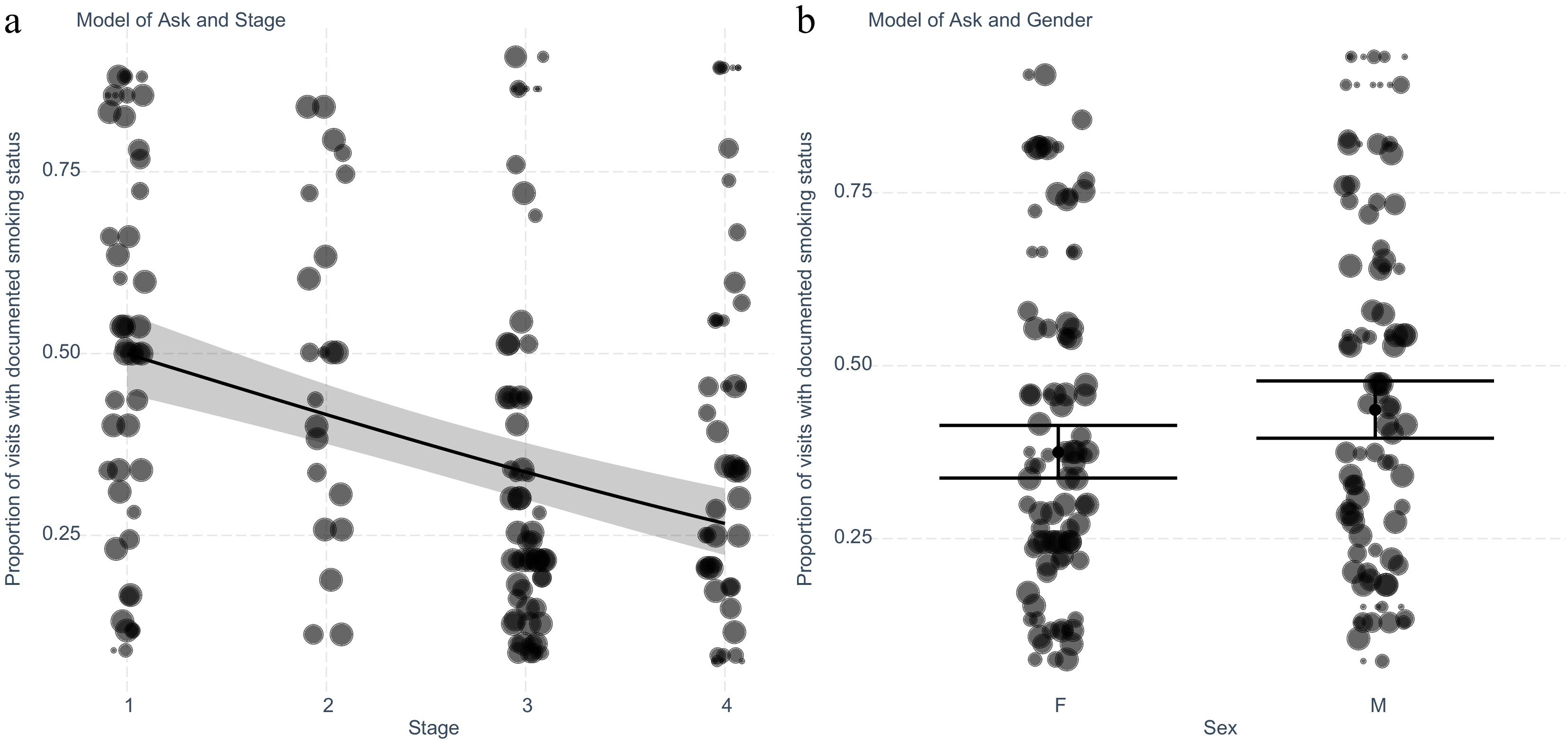
Figure 1.
Exploring the intervention 'Ask' for smoking cessation to patients with lung cancer adjusting for significant variables stage and gender identified after stepwise elimination. (a) Generalised linear model plotted with predicted and actual values shown for each cancer stage. Values shown are separated by patient (n = 184), and weighted for the number of encounters (n = 1,248) recorded by the size of the marker. (b) Plot of generalised linear model with predicted and actual values for encounters with the intervention separated by gender. Values shown are separated by patient and weighted for the number of encounters recorded as demonstrated by the size of the marker.
-
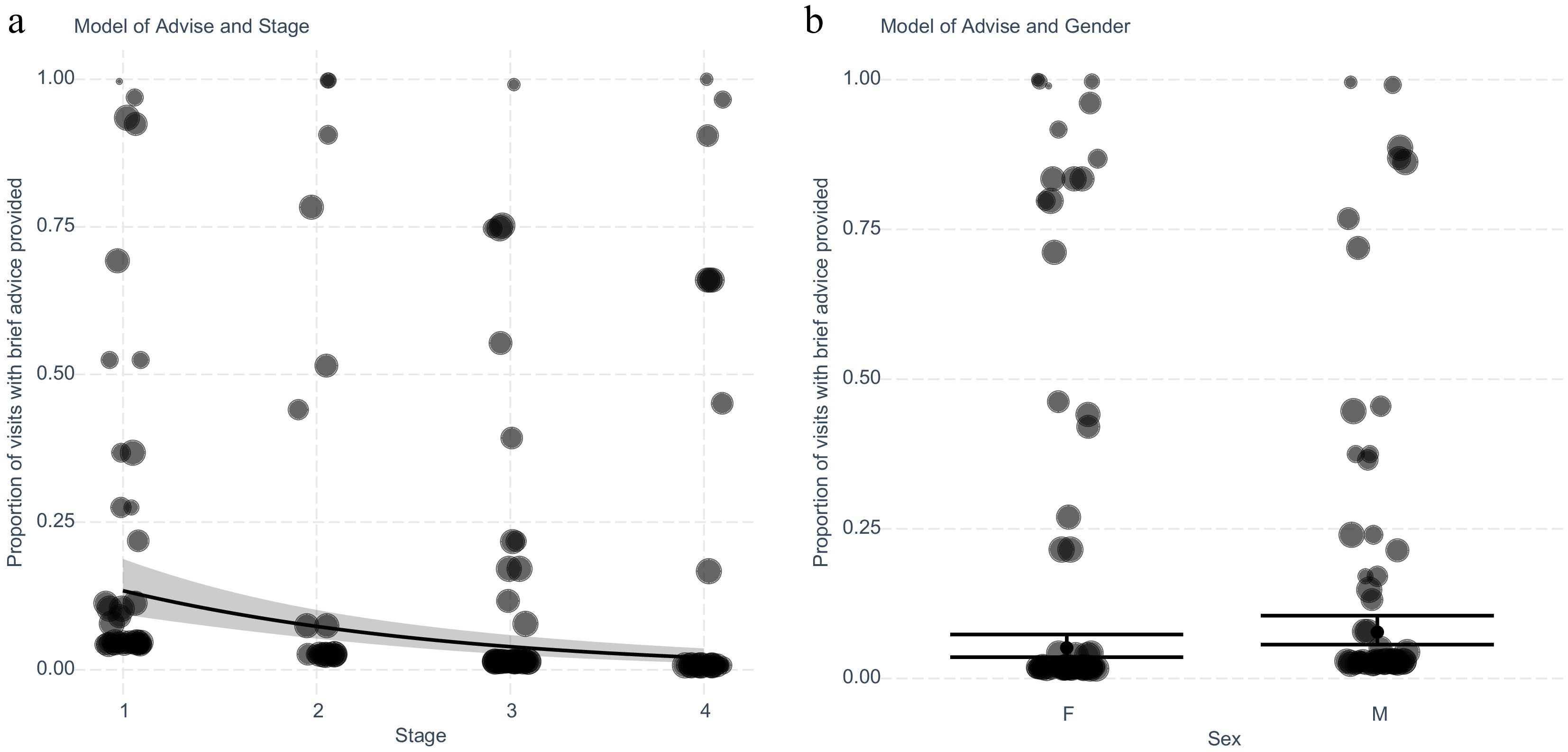
Figure 2.
Exploring the intervention 'Advise' for smoking cessation in patients with lung cancer adjusting for significant variables stage and gender identified after stepwise elimination. (a) Generalised linear model with predicted and actual values shown for each cancer stage. Values shown are separated by patient (n = 181), and weighted for the number of encounters (n = 1,083) recorded by the size of the marker. (b) Plot of generalised linear model with predicted and actual values for encounters with the intervention separated by gender. Values shown are separated by patient and weighted for the number of encounters recorded.
-
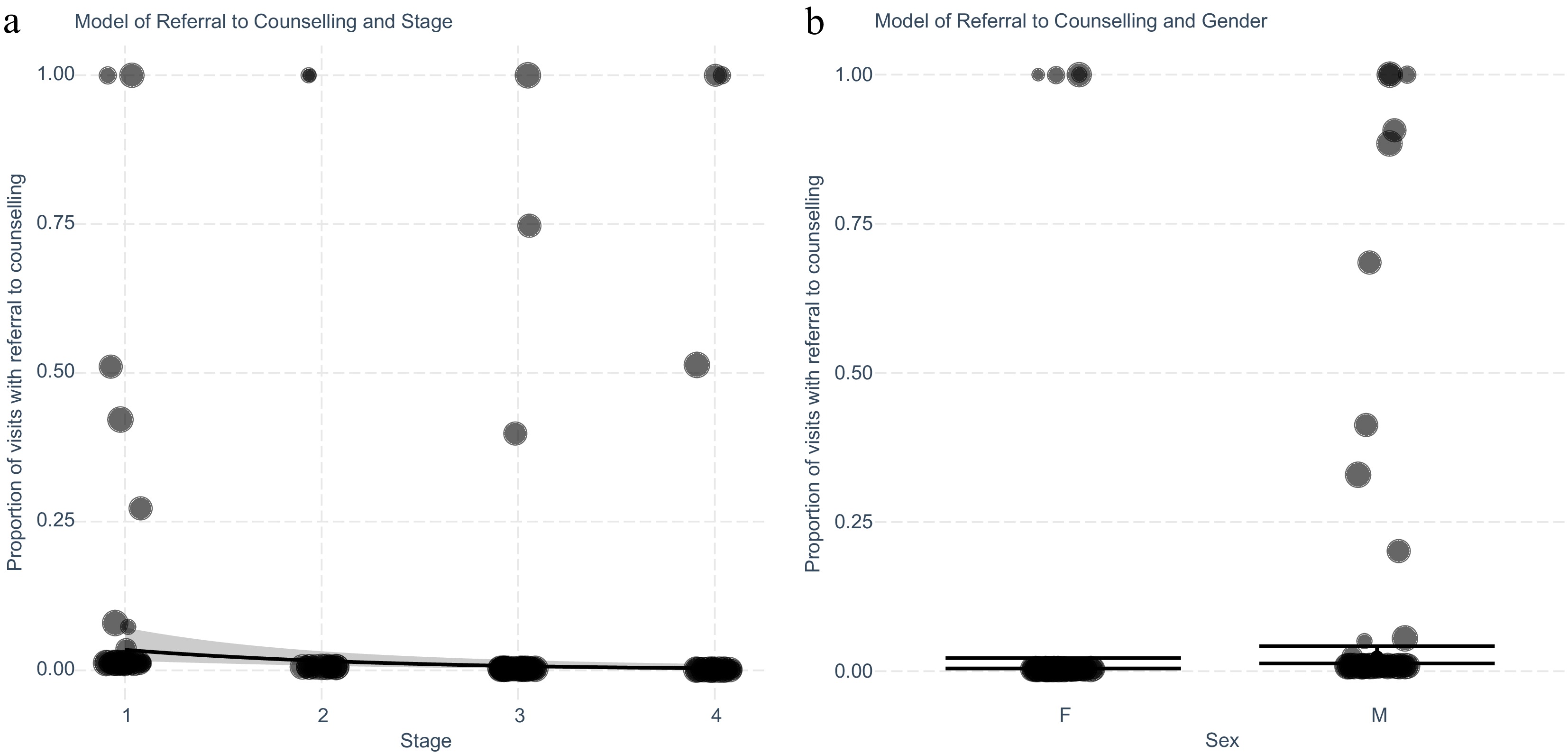
Figure 3.
Exploring the intervention 'Help' for smoking cessation with referral to counselling in patients with lung cancer adjusting for significant variables stage and gender identified after stepwise elimination n. (a) Generalised linear model with predicted and actual values shown for each cancer stage. Values shown are separated by patient (n = 181), and weighted for the number of encounters (n = 1,076) recorded by size of marker. (b) Plot of generalised linear model with predicted and actual values for encounters with the intervention separated by gender. Values shown are separated by patient and weighted for the number of encounters recorded.
-
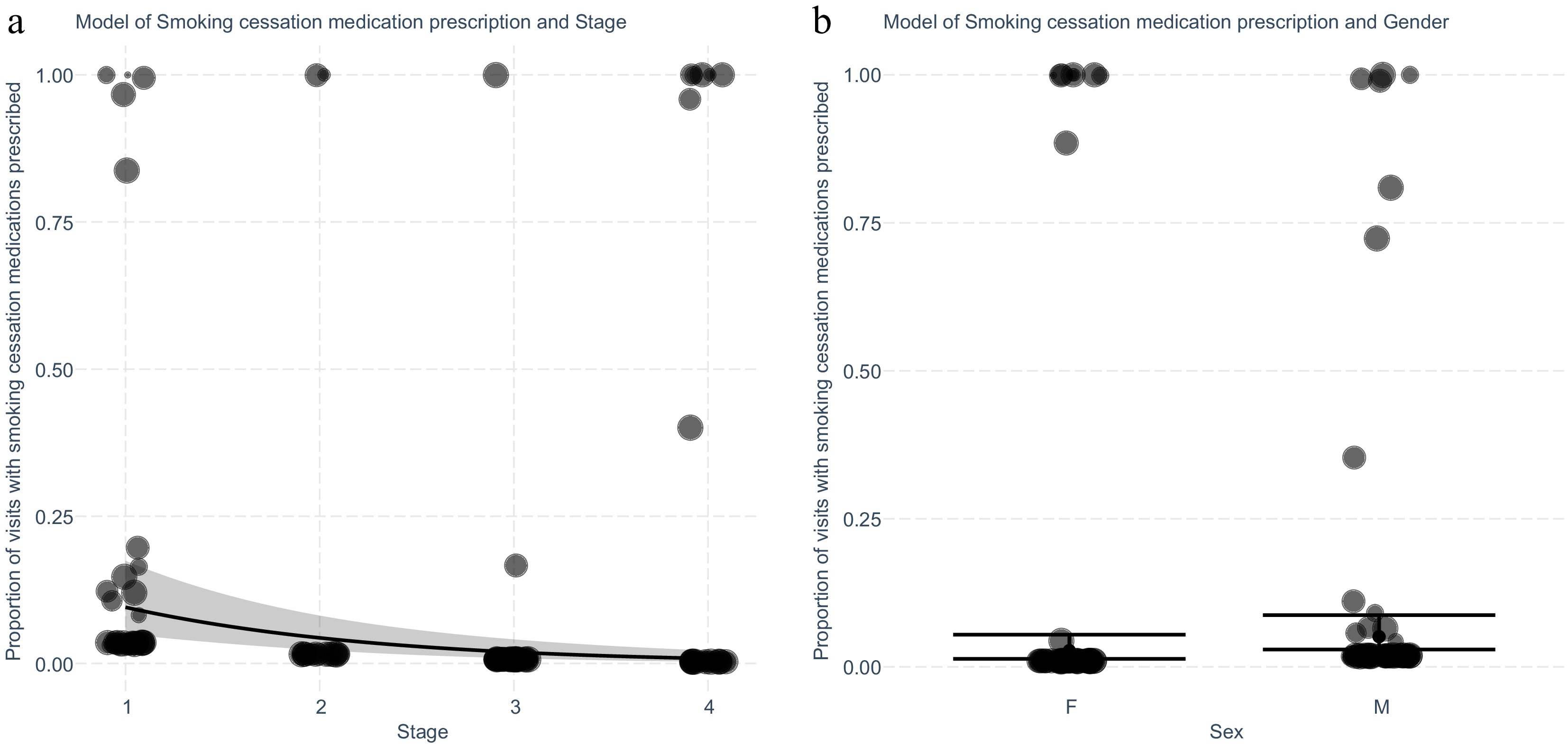
Figure 4.
Exploring the intervention 'Help' for smoking cessation for patients with lung cancer for prescription of smoking cessation medications adjusting for significant variables stage and gender identified after stepwise elimination. (a) Generalised linear model with predicted and actual values shown for each cancer stage. Values shown are separated by patient (n = 181), and weighted for the number of encounters (n = 1,077) recorded by the size of the marker. (b) Plot of generalised linear model with predicted and actual values for encounters with the intervention separated by gender. Values shown are separated by patient and weighted for the number of encounters recorded as demonstrated by the size of the marker.
-
Characteristic N = 213* Age at diagnosis 65 (60, 70) Clinical stage 1 48 (23%) 2 24 (12%) 3 70 (34%) 4 64 (31%) Unknown 7 COPD 140 (68%) Unknown 7 COPD severity Very severe 2 (1.2%) Severe 20 (12%) Moderate 100 (58%) Mild 51 (29%) Unknown 40 Gender F 105 (49%) M 108 (51%) Intent Curative 35 (60%) Palliative 23 (40%) Unknown 155 Indigenous status Aboriginal but not Torres Strait Islander origin 8 (3.8%) Neither Aboriginal nor Torres Strait Islander origin 205 (96%) * Median (IQR); n (%). Table 1.
Cohort characteristics at time of lung cancer diagnosis.
-
Subspecialty Steps Respiratory (N = 449*) Medical oncology (N = 450*) Radiation oncology (N = 216*) Thoracic surgery (N = 73*) Palliative care (N = 64*) Overall encounters (N = 1,252*) χ2 (df) p-value Ask - smoking status documented 174.32(4) < 0.0001 Yes 274 (62%) 109 (24%) 48 (22%) 30 (41%) 18 (28%) 479.0 (38%) No 171 (38%) 341 (76%) 168 (78%) 43 (59%) 46 (72%) 769.0 (62%) Missing 4 0 0 0 0 4 Advise - brief advice given 79.10(4) < 0.0001 Yes 65 (19%) 7 (2%) 3 (2%) 1 (2%) 2 (3%) 78.0 (7%) No 267 (81%) 421 (98%) 198 (98%) 61 (98%) 58 (97%) 1,005 (93%) Missing 3 1 0 1 0 5 Help - referred to counselling 38.93(4) < 0.0001 Yes 23 (7%) 0 (0%) 1 (0.5%) 0 (0%) 0 (0%) 24.0 (2%) No 311 (93%) 419 (100%) 199 (99%) 63 (100%) 60(100%) 1,052.0 (98%) Missing 1 2 1 0 0 4 Help - prescribed smoking cessation medication 64.24(4) < 0.0001 Yes 40 (12%) 2 (0%) 1 (0%) 0 (0%) 0 (0%) 43.0 (4%) No 294 (88%) 417 (100%) 200 (100%) 63 (100%) 60 (100%) 1034 (96%) Missing 1 2 0 0 0 3 * Number of outpatient encounters (%). Table 2.
Provision of 'Ask, Advise, Help' intervention at out-patient encounters by speciality.
-
Covariate Ask Advise Help - referred to counselling Help - prescribed smoking
cessation medicationStage 1 − − − − 2 0.88 (0.61, 1.26), p = 0.5 0.62 (0.32, 1.13), p = 0.13 0.24 (0.04, 0.86), p = 0.059 0.17 (0.04, 0.50), p = 0.005 3 0.37 (0.28, 0.50), p ≤ 0.001 0.24 (0.13, 0.43), p ≤ 0.001 0.18 (0.05, 0.51), p = 0.003 0.06 (0.01, 0.17), p ≤ 0.001 4 0.46 (0.33, 0.65), p ≤ 0.001 0.21 (0.09, 0.43), p ≤ 0.001 0.24 (0.05, 0.72), p = 0.023 0.27 (0.11, 0.57), p = 0.001 Sex Female − − − − Male 1.31 (1.04, 1.66), p = 0.024 1.65 (1.05, 2.62), p = 0.032 2.40 (1.05, 5.94), p = 0.045 2.00 (1.07, 3.85), p = 0.033 Table 3.
Relationship between lung cancer stage and sex with documented Ask, Advise, and Help step. Stage 1 and female sex were used as reference categories. Odds ratio (95% CI).
Figures
(4)
Tables
(3)