-
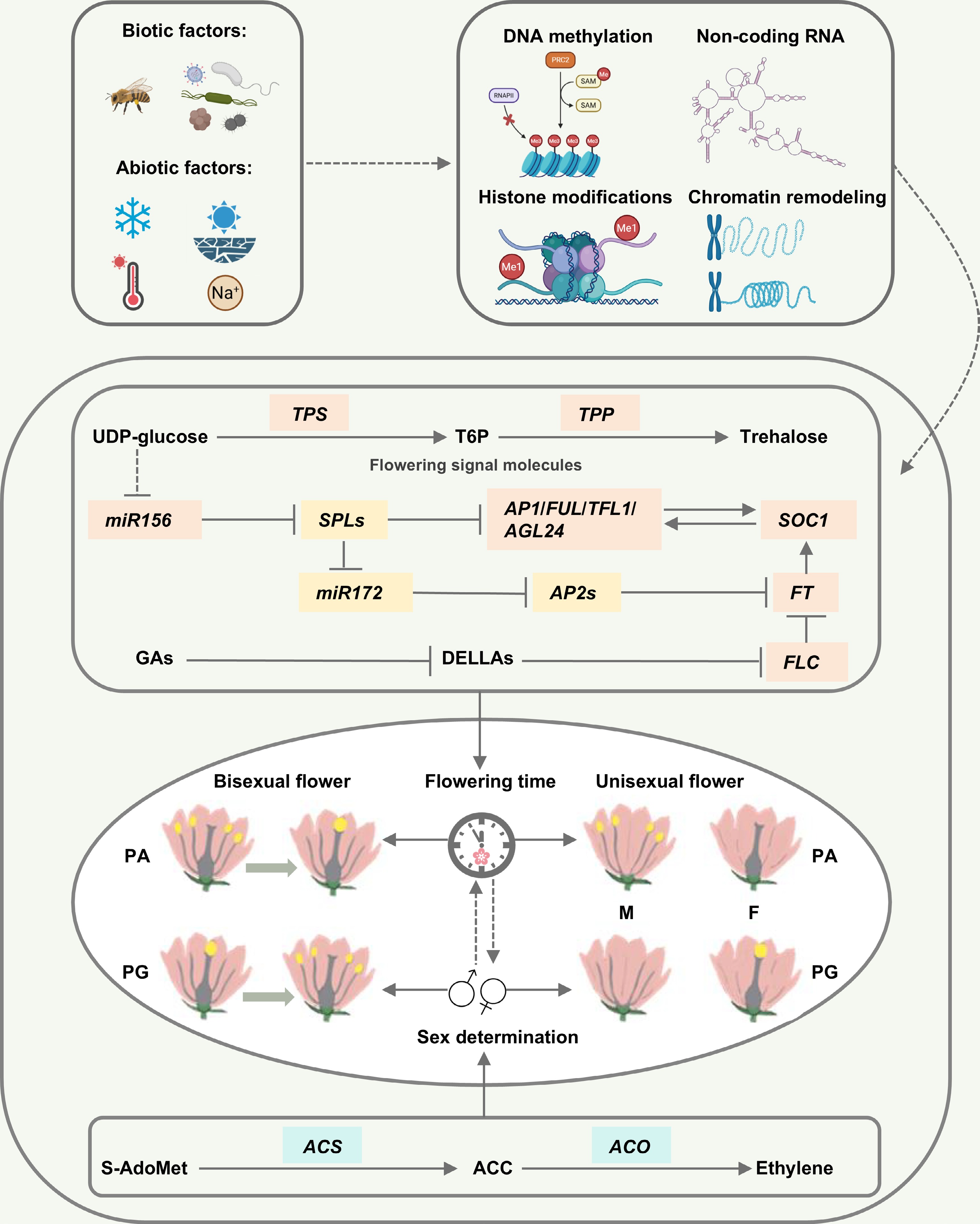
Figure 1.
Summary diagram of the factors affecting dichogamy in plants. PG, protogyny; PA, protandry; F, female; M, male; T6P, trehalose-6-phosphate. The yellow parts in the central morphological diagram represent the maturation of pistils and stamens; the clock represents flowering time; the gender symbols represent sex differentiation. Pink squares represent genes that affect flowering time, green squares represent genes that affect sex differentiation, and yellow squares represent genes that affect both flowering time and sex differentiation. Solid lines indicate direct interactions or regulatory relationships between two molecules, dashed lines typically indicate indirect interactions or regulatory relationships between two molecules, and T-shaped lines represent inhibition.
-
Family Genus Species Flowering characteristics Ref. Pollinating vector Male–Female
separationCompatibility Sapindaceae Acer Acer pseudoplatanus Thysanoptera 24−48 h SC [30] Acer japonicum Insects [31] Acer grandidentatum [32] Acer saccharum [33] Acer opalus [10] Acer mono [9] Circaeasteraceae Kingdonia Kingdonia uniflora Unknown 1 d Unknown [34] Amaranthaceae Grayia Grayia brandegei Wind 14−21 d SIC [8] Spinacia Spinacia oleraacea var. americanna Wind 24−48 h SC [8] Lauraceae Aniba Aniba rosaeodora Apis 6–12 h SIC [35] Cinnamonum Cinnamonum camphora Apis 6–12 h SIC [35] Cinnamonum zeylanicum [35] Licaria Lcaria guianensis Apis 6–12 h SIC [35] Mezilaurus Mezilaurus thoroflora Apis 6–12 h SIC [35] Persea Persea americana Apis 24 h SIC [35] Persea caerulea [35] Thymelaeaceae Thymelaea Thymelaea hirsuta Wind 8−12 d Unknown [29] Trochodendraceae Trochodendron Trochodendron aralioides Musca domestica 10−28 d SC [36] Annonaceae Annona Annona squamosa Coleoptera 12 h SC [36] Betulaceae Corylus Corylus avellana Wind A few days varies SIC [27] Lamiaceae Lepechinia Lepechinia floribunda Bombus and Xylocopa aeratus 6 h SC [37] Juglandaceae Carya Carya illinoensis Koch Wind 1−2 d SC [26] Carya ovata [38,39] Carya tomentosa [38,39] Carya laciniosa [38,39] Juglans Juglans hindsii Wind 7 d SC [40] Juglans nigra [27] Juglans mandshurica [41] Juglans ailanthifolia [42] Juglans regia [43] Juglans cinerea [38] Juglans cordiformis [36] Cyclocarya Cyclocarya paliurus Wind 14 d SC [38,39] Lauraceae Sassafras Sassafras randaiense Rehd Beetles and Apis 1−2 h SIC [25] Campanulaceae Platycodon Platycodon grandiflorus Unknown Unknown SIC [4,23] Rhamnaceae Ziziphus Ziziphus mauritiana Wasps, flies, butterflies and bees 3−12 h SIC [24] Araliaceae Stilbocarpa Stilbocarpa polaris Drosophilidae 10 d SC [44] Meliaceae Toona Toona sinensis Unknown 17−24 d Unknown [45] Lamiaceae Ajuga Ajuga decumbens Apis and Megachile 1−2 d SC [46] Salvia Salvia elegans Trochilidae 1−2 d SC [47] Verbenaceae Clerodendrum Clerodendrum infortunatum Papilionoidea 11 h SC [20] Onagraceae Clarkia Clarkia pulchella Pursh Halictidae 1−2 d SC [48] Alismataceae Sagittaria Sagittaria latifolia Apis, wasps, and beetles 1 d SC [49] Asteraceae Helianthus Helianthus annuus Apis 3−7 d SC [2] Amaryllidaceae Narcissus Narcissus broussonetii Long-tongued pollinators 3 d SIC [50] Brassicaceae Brassica Brassica napus Apis and wind 1−3 d SIC [51] Amaranthaceae Beta Beta vulgaris Wind 1−2 d SIC [52] Rosaceae Malus Malus domestica Apis and wind Unknown SIC [53] Poaceae Zea Zea mays Wind 2−7 d SC [54] Cucurbitaceae Cucumis Cucumis sativus Unknown Unknown Unknown [55] Zingiberaceae Lanxangia Lanxangia tsaoko Unknown 2−4 h SIC [56] Note: SC represents self-compatibility and SIC represents self-incompatibility. Table 1.
Attributes of currently known dichogamous flowering plants.
Figures
(1)
Tables
(1)