-
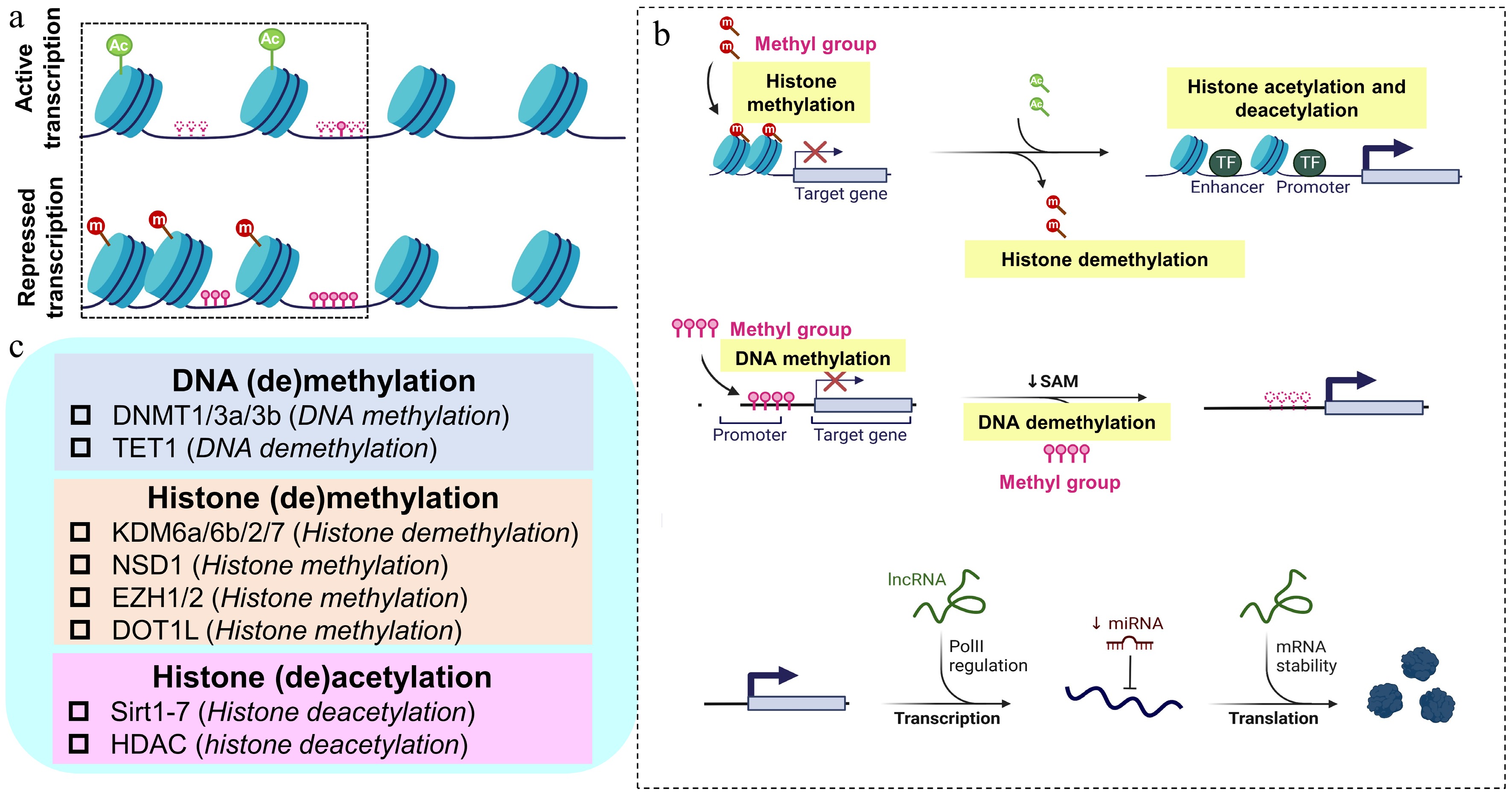
Figure 1.
Summary of DNA methylation, histone modifications, and non-coding RNA in OA. (a) Dynamic changes of chromatin and the resultant gene expression in OA. Upper panel: regions of chromatin with activate transcription; lower panel: regions of chromatin with repressed transcription. (b) The epigenetic modulatory process of histone modifications, DNA methylation, and non-coding RNA; upper panel: histone modifications (histone modifications included methylation and acetylation); middle panel: DNA methylation (DNA methylation is dynamically maintaining the balance by adding methyl groups and deleting methyl groups in normal chondrocytes, and abnormal changes in DNA methylation occur in the promoter regions of related genes and signaling pathways in OA chondrocytes); lower panel: non-coding RNAs including lncRNA and miRNA modulate the gene expression during and post transcription. (c) Different classes of epigenetic enzymes responsible for the structural modification of chromosomes (DNA and histone) and its regulation effects. Ac: acetylation; DNMT: DNA methyltransferase; DOT1L: Disruptor of telomeric silencing 1-like; m: methylation; EZH: enhancer of zeste homolog; HDAC: histone deacetylase; KDM: histone lysine demethylase; NSD: H3K36 methyltransferase; Sirtuins: Sirt; TET: ten–eleven translocation enzyme.
-
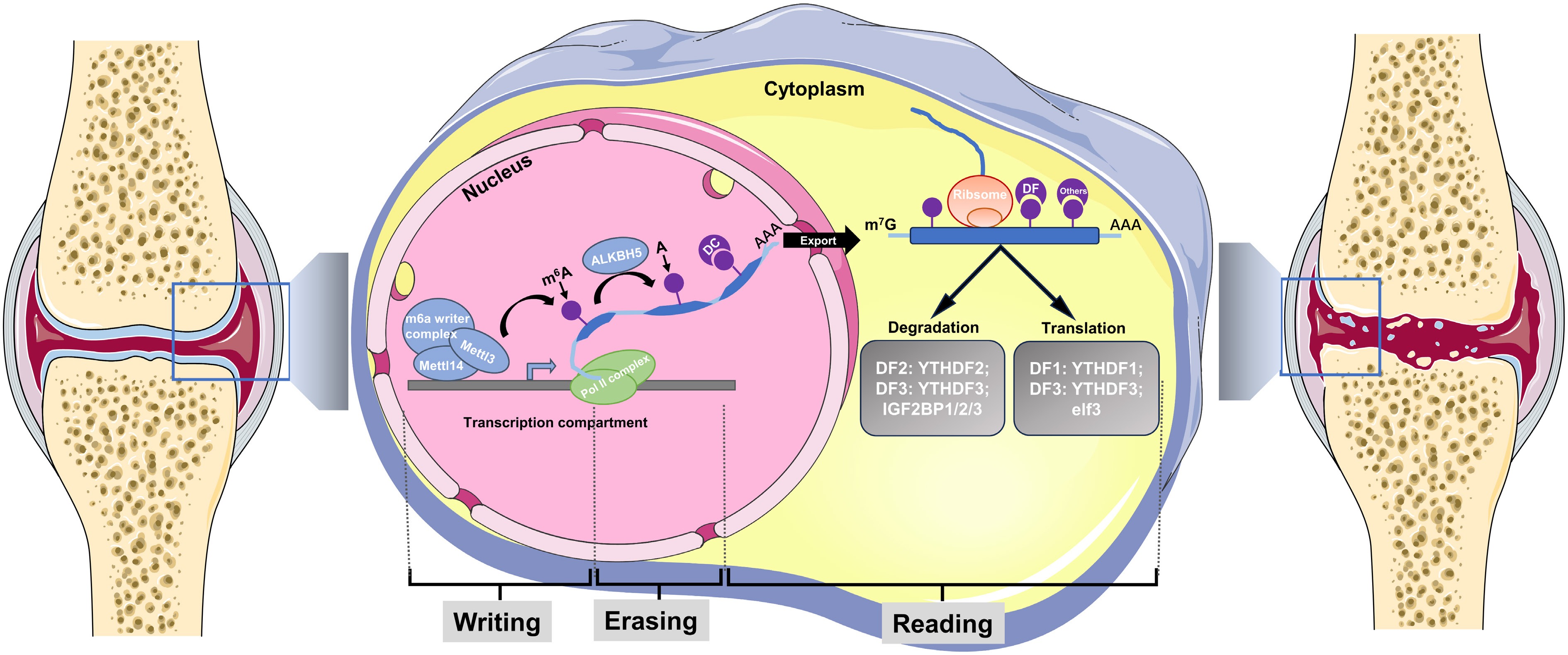
Figure 2.
Schematic diagram of RNA methylation in OA. OA is featured by cartilage degeneration, inflammatory synovium, periarticular bony changes (subchondral bone cyst, subchondral bone loss and sclerosis, osteophytes formation), accompanied by senescence of chondrocytes and cartilage debris. During OA progression, the function and fate of cells within the joint is regulated by N6-methyladenosine (m6A) methylation. The m6A mRNA 'life cycle': The m6A mRNA starts in the nucleus from in the nucleus during transcription. The m6A writer complex (box 1), which comprises the core methyltransferase-like protein 3 (METTL3) and its adaptors, is located in the nucleus, where it adds m6A co-transcriptionally. The m6A erasers are also largely localized in the nucleus. The main m6A eraser acting on m6A in mRNAs is ALKBH5. Fat mass and obesity-associated protein (FTO) has recently been found to preferentially target m6Am, not m6A, with its major target being m6Am in small nuclear RNAs (snRNAs). While in the nucleus, m6A can bind specific nuclear reader proteins, mainly YTHDC1 (DC1), which may affect splicing or other nuclear processes such as mRNA export. Upon mRNA export to the cytoplasm, m6A binds to specific reader proteins that affect the stability, translation and/or localization of the mRNA. In the cytoplasm, the m6A readers YTHDF1 (DF1), YTHDF3 (DF3), the eukaryotic translation initiation factor eIF3, and METTL3 all favour the translation of m6A mRNAs. YTHDF2 (DF2) and DF3 mediate the degradation of m6A mRNAs, while the insulin- like growth factor 2 mRNA-binding proteins (IGF2BP1/2/3), and the synaptic regulator FMRP (a polyribosome-associated RNA-binding protein known to have a central role in neuronal development and synaptic plasticity) enhance m6A mRNA stability. Am, methylated A; m6Am, N6, 2′-O- dimethyladenosine.
-
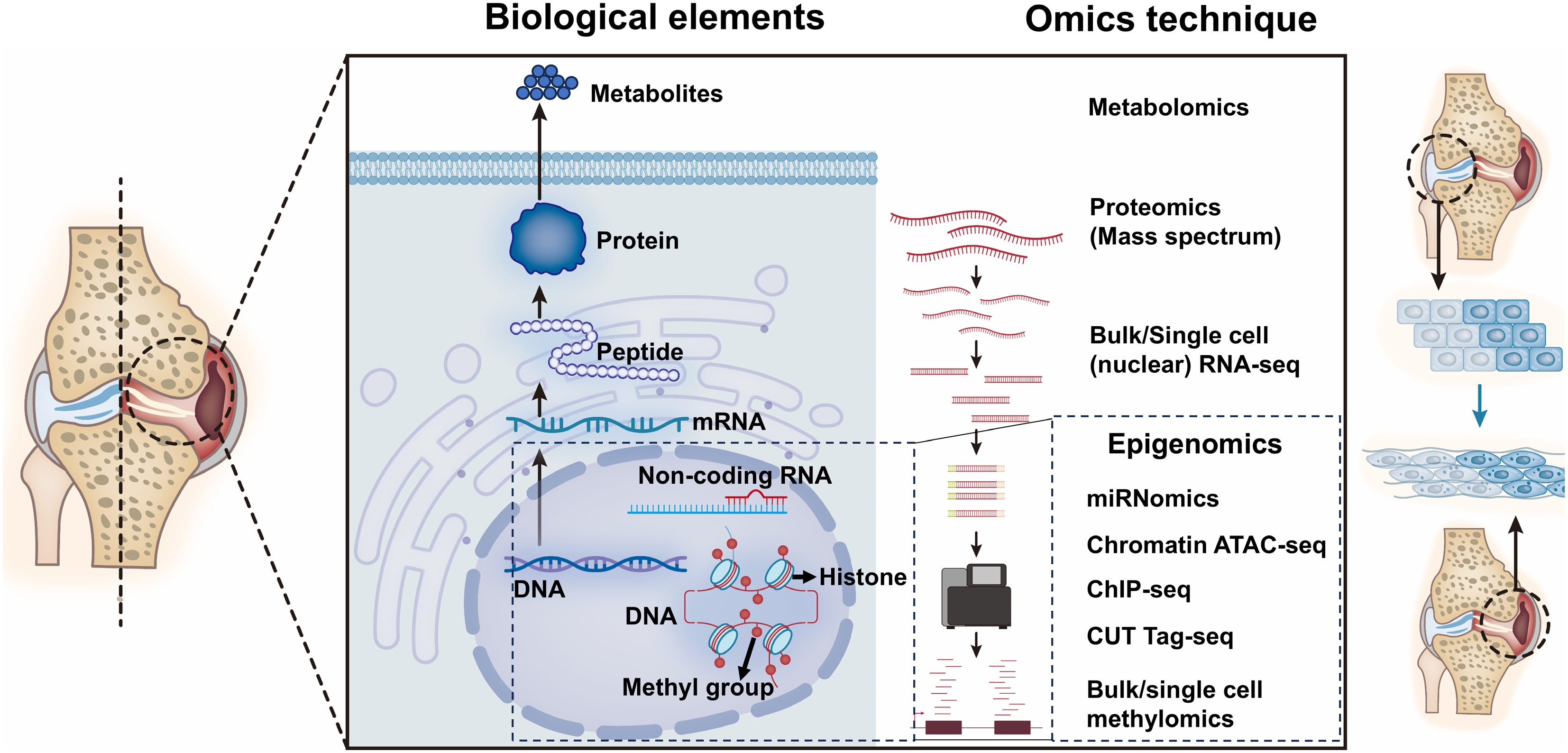
Figure 3.
Overview of current multi-omics techniques in OA epigenetic research. An overview of the advanced multi-omics techniques used in OA research. Cleavage under targets and tagmentation: CUT Tag; Assay for Transposase Accessible Chromatin: ATAC; Chromatin Immunoprecipitation: ChIP.
-
Drug name FDA approval date Clinical indication Epigenetic target Clinical use Decitabine/5Aza 2010 ( www.drugs.com/history/dacogen.html )Myelodysplastic syndrome; Leukemia Dnmt inhibition Diacerein 2008[98] Anti-inflammation Dnmt inhibition Melatonin Non approval (recommended as a
supplement, not for medical administration)Sleep disorders Tet inhibition Trichostatin A Non approval (Phase I Trial: NCT03838926) Relapsed hematologic malignancies HDAC inhibition Panobinostat Approved, but finally withdrawn ( www.drugs.com/history/farydak.html )Relapsed multiple myeloma HDAC inhibition Honokiol Non approval (traditional Chinese
medicine, widely used in China)Anti-bacterial Sirt3 activation Non-clinical
useDaminozide N/A N/A Kdm2/7 inhibition IOX2 N/A N/A DOT1L activation (hypoxia mimetic) S-adenosylhomocysteine N/A N/A Mettl3 inhibition (metobolites) β-aminopropionitrile N/A N/A Dnmt inhibition 2-hydroxyglutarate N/A N/A Tet inhibition Table 3.
Potential epi-DMOADs in the pipeline.
-
Epigenetic regulation Animal model Intervention method Drug Ref. DNA methylation Dnmts (Dnmt1/3a) DMM-induced OA (mouse) I.P. injection Decitabine (5Aza) [14] Dnmts (Dnmt1/3a) DMM-induced OA (mouse) Oral gavage Diacerein [17] Dnmts (DNMT1/3a) PDE-induced TMJOA (rat) I.P. injection Decitabine (5Aza) [15] Dnmts (Dnmt1) Age-related OA (mouse) Subcutaneous injection β-aminopropionitrile (BAPN) [26] Dnmts (Dnmt3b) DMM-induced OA (mouse) Deletion of STAT3
in chondrocytesN/A [25] TET (TET1) DMM-induced OA (mouse) I.A. injection 2-hydroxyglutarate (2-HG) [30] Histone modification HDACs (Histone deacetylases) MIA-induced OA and DMM-induced OA model (mouse) Subcutaneous injection TSA (HDAC inhibitor) [34] HDACs (Histone deacetylases) ACLT-induced OA model (rat) I.A. injection Panobinostat (LBH589, HDAC inhibitor) [36] HDACs (Histone deacetylases) DMM-induced OA (mouse) I.P. Injection Panobinostat (LBH589) [35] Sirt3 (Histone deacetylases) DMM-induced OA(mouse) I.A. injection Honokiol (derived from Houpu) [45] Sirt6 (Histone deacetylases) DMM-induced OA (mouse) I.A injection tgg2-PP-MDL-800 NP [41] JMJD3/Kdm6b (Histone demethylase) ACLT-induced OA (mouse) I.A. injection GSK-J4 (Kdm6b inhibitor) [51] UTX/Kdm6a (H3K27 demethylase) Aging-related OA model (mouse) I.A. injection Lenti-virus UTX [52] Kdm6a (Histone demethylases) DMM-induced OA (mouse) I.A. injection GSK-J4 (Kdm6a inhibitor) [53] Kdm7a/b (Histone demethylases) DMM-induced OA (mouse) I.A. injection Daminozide [55] DOT1L (Histone demethylases) DMM-induced OA (mouse) I.A. injection IOX2 (2 Ref) [57] NSD1 (H3K36 methyltransferase) Age-related OA (mouse) I.A. injection adenovirus Osr2 [47] RNA methylation ALKBH5 (m6A demethylation) MIA-induced OA (mouse) I.A. injection AAV-IT1 [79] Mettl3 (m6A methylation) MIA-induced TMJ OA (mouse) I.A. injection S-adenosylhomocysteine (Mettl3 inhibitor) [73] Mettl3 (m6A methylation) DMM-induced OA (mouse) I.A. injection Sh-Mettl3 [72] Mettl3 (m6A methylation) ACLT-induced OA (rat) I.A. injection S-adenosylhomocysteine (Mettl3 inhibitor) [81] Mettl3 (m6A methylation) DMM-induced OA (mouse) I.A. injection rAAV9.HAP-1-si-METTL3 [75] Mettl3 (m6A methylation) DMM-induced OA (mouse) I.A. injection human umbilical cord MSCs-derived exsomes [76] WTAP (m6A methylation) DMM-induced OA (mouse) I.A. injection siRNA (si-WTAP) [74] Table 1.
Epigenetic drugs and related targets in different animal studies.
-
Epigenetic regulation OA subtype (affected organ) Targets Trigger process Ref DNA methylation Knee OA Dnmt1/3a-PPARγ Inflammation and oxidative stress [14,17] Knee OA Dnmt1-α-Klotho-PI3K/Akt Senescence and mechanical force [26] Hip FAI (Pre-Hip OA) Dnmt3b-ABAT Inflammation and mechanical force [24] TMJ OA Dnmt1/3a-PPARγ Inflammation [15] Knee OA Phlpp1 Inflammation [21] Histone modification Knee OA Kdm7a/b-H3K79 Inflammation [55] Knee OA Sirt3-COX412 Mitochondria metabolism [45] Knee OA Sirt6-IGF1-Col2 ECM remodeling [40] Knee OA Sirt6-IL15/JAK3/ STAT5 Senescence [41] Knee OA DOT1L-Sirt1-Wnt Senescence [56,57] Knee OA Ezh2-TNFSF13b Inflammation [54] Knee OA FoxO1-PRG4 Inflammation and ECM remodeling [35] Knee OA H3K27me-Kdm6a-Wnt10a Osteogenesis (ossification) [53] Knee OA H3K36me-NSD1-OSR2 Senescence [47] RNA methylation Knee OA Mettl3-ATG7-SASP Senescence [75] Knee OA ALKBH5- HS3ST3B1-IT1- YTHDF2 Inflammation [79] Spine OA Mettl3-Sox9 Senescence and inflammation [70] TMJ OA Mettl3-Ythdf1-Bcl2 Apoptosis [73] Knee OA Mettl3-Dnmt1/3a-IGFBP7 ECM degradation and apoptosis [84] Knee OA Mettl3-IGF2BP2-STAT1 Inflammation [81] Knee OA Mettl3-ALKBH5-CYP1B1 Senescence and inflammation [78] Knee OA WTAP-YTHDF2-TIMP Inflammation [97] Knee OA WTAP-FRZB-Wnt/β-catenin Inflammation [74] Table 2.
Epigenetic modifications and related signaling pathway in different OA subtypes.
Figures
(3)
Tables
(3)