-
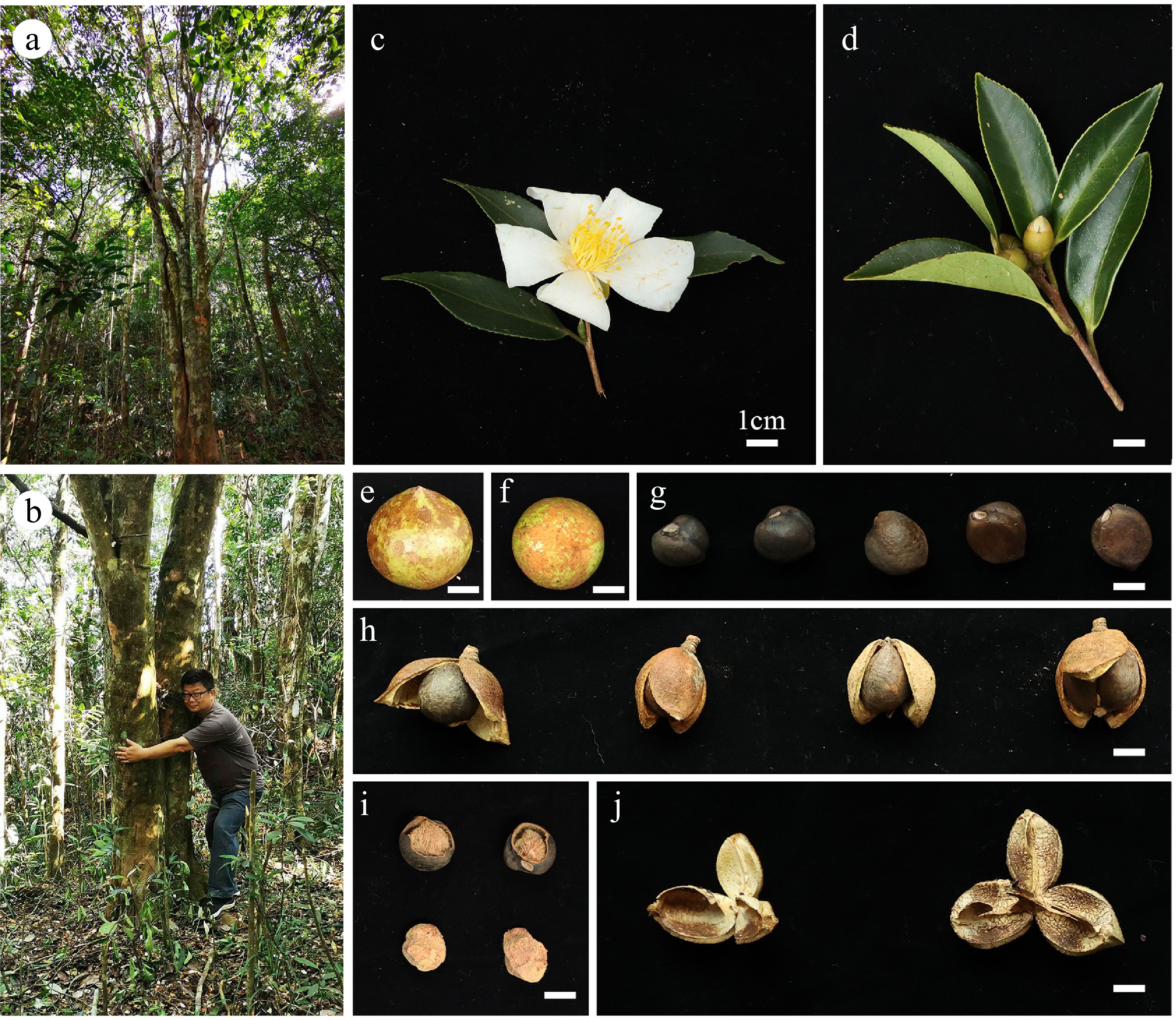
Figure 1.
Camellia wuzhishanensis. (a), (b) Habitat. (c) Flowering branch. (d) Terminal buds. (e) Side view of the capsule. (f) Front view of the capsule. (g) Seeds. (h) Dry capsules. (i) Interior of dry seeds. (j) Loculicidal pericarps.
-
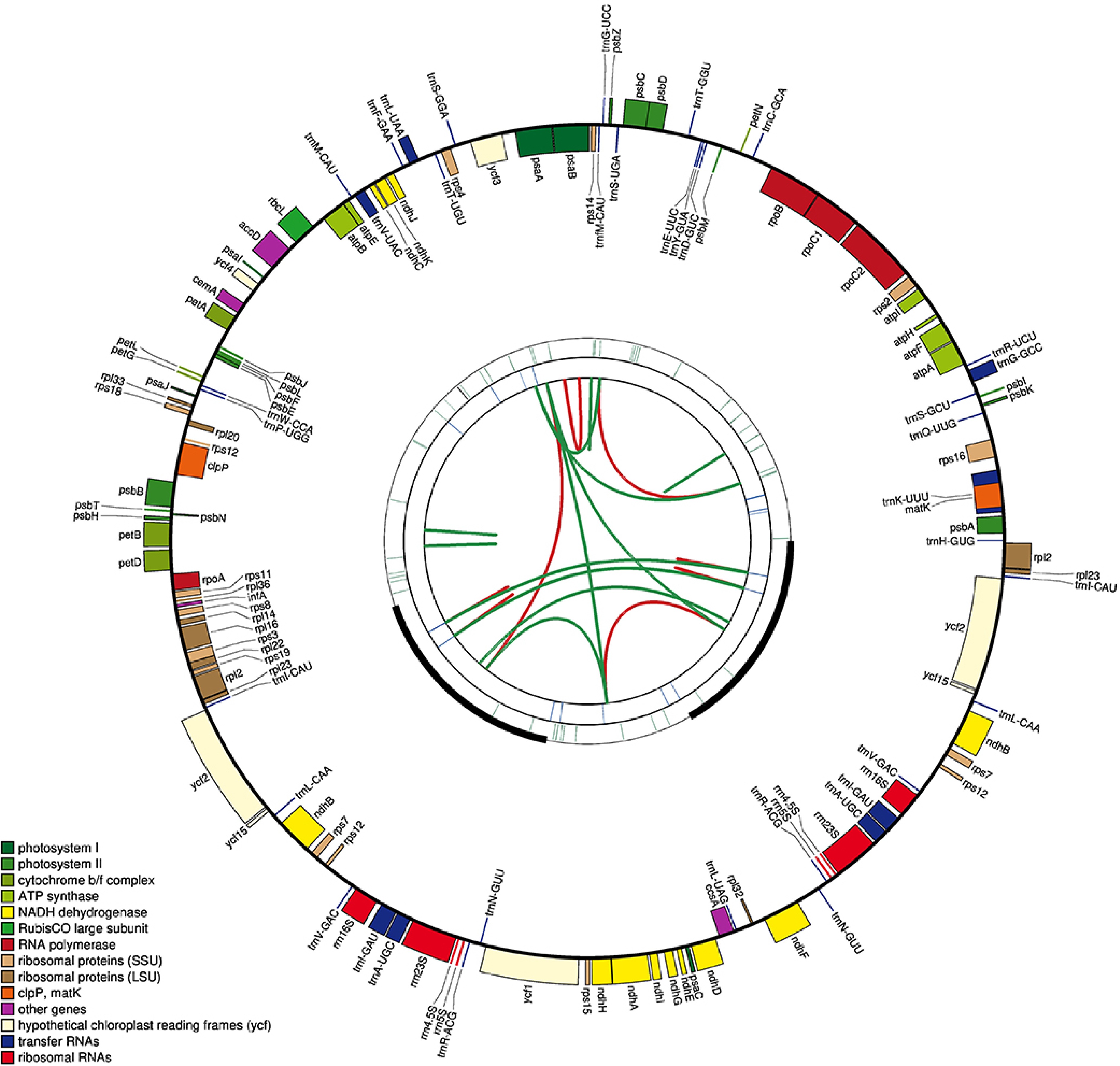
Figure 2.
Chloroplast genome of Camellia wuzhishanensis.
-
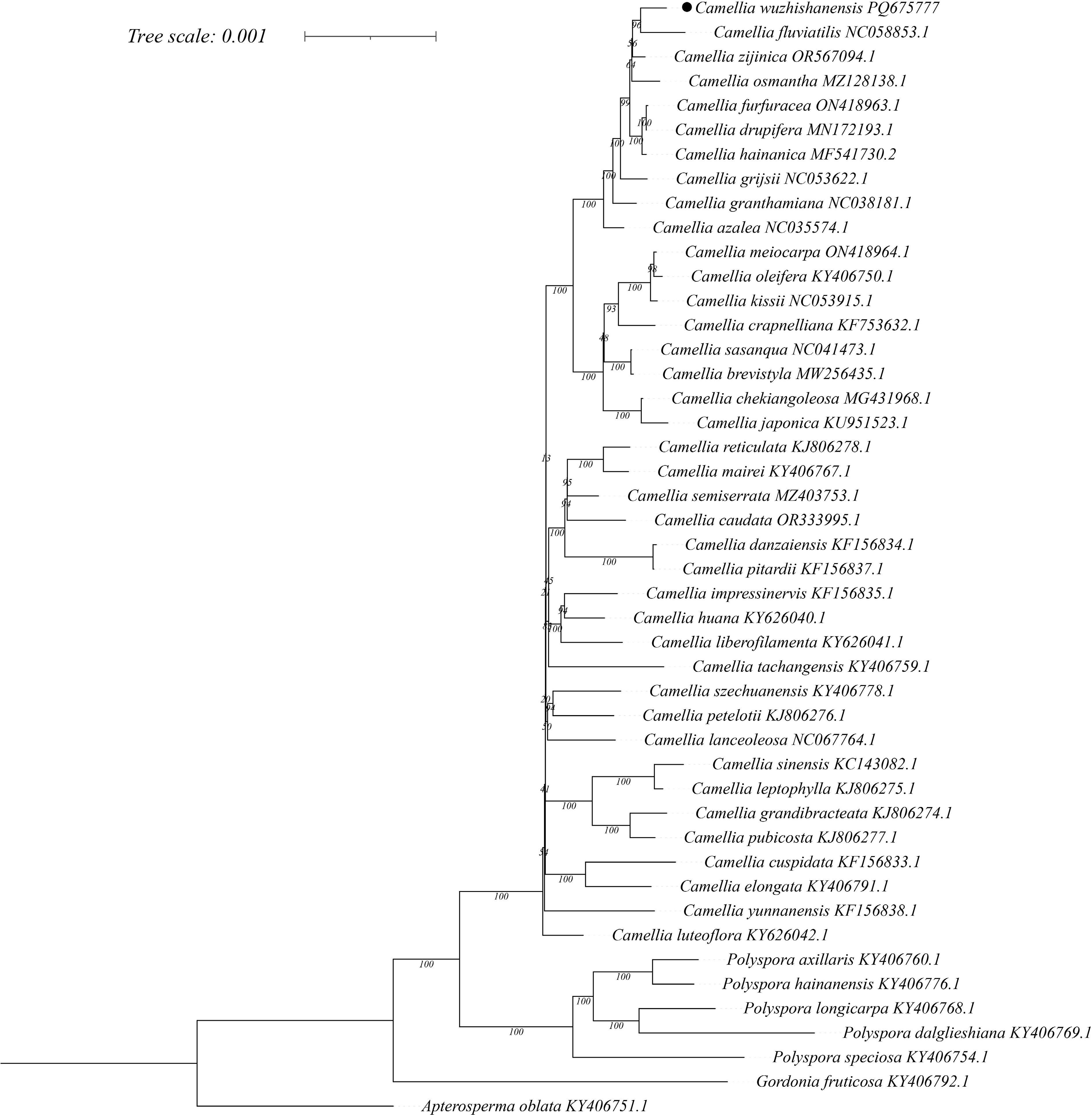
Figure 3.
Phylogenetic relationships of Camellia wuzhishanensis and related species inferred from maximum likelihood analysis based on complete chloroplast genome sequences.
-
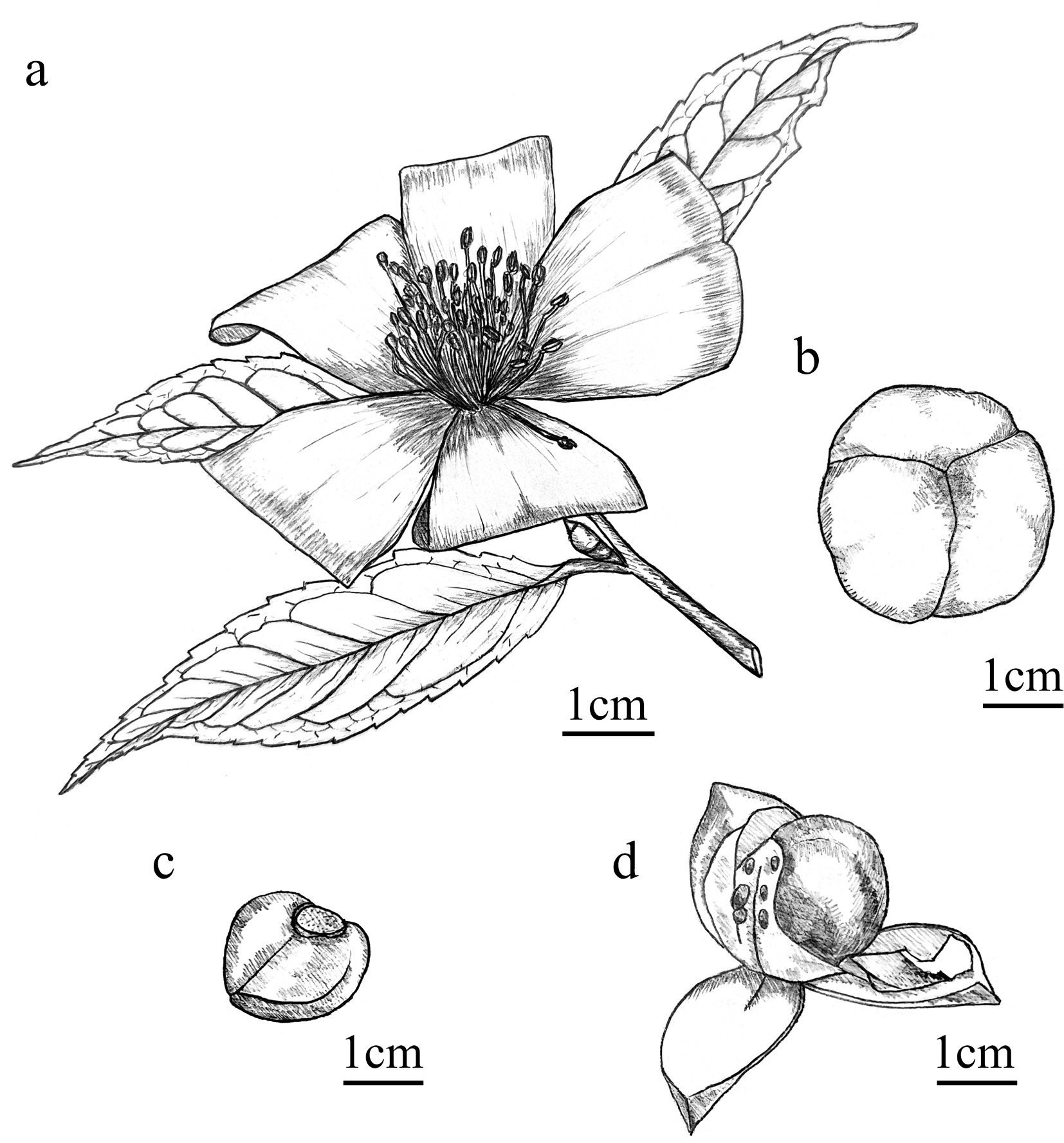
Figure 4.
Camellia wuzhishanensis. (a) Flowering branch. (b) Front view of the capsule. (c) Seed. (d) Loculicidal capsule. Illustration by Cheng-Zhi Xie.
-
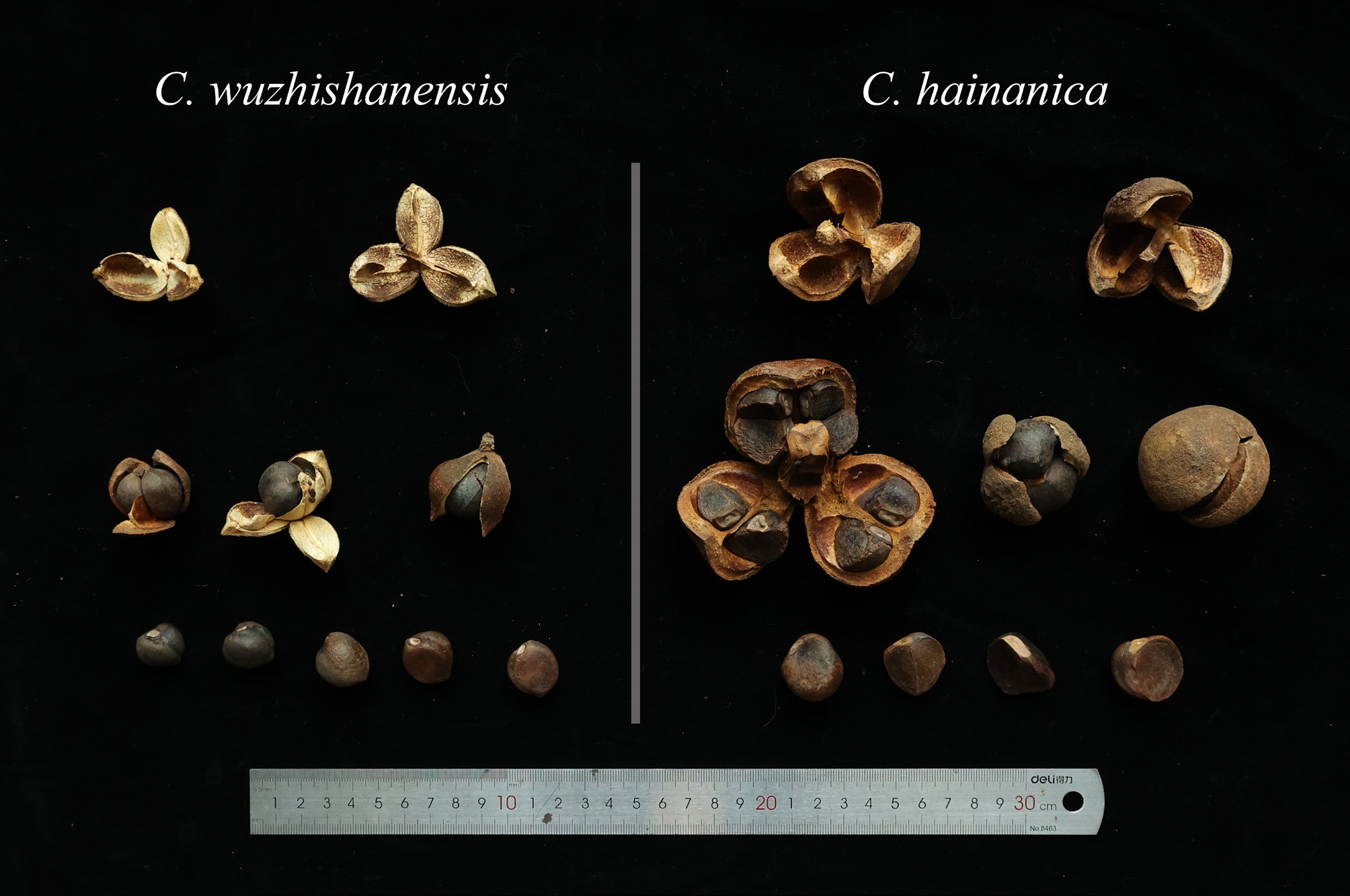
Figure 5.
Comparison of loculicidal pericarps, loculicidal capsules, and seeds between C. wuzhishanensis and C. hainanica.
-
Characteristics C. wuzhishanensis C. hainanica C. drupifera C. osmantha C. fluviatilis Ploidy 10 10 8 6 2 Life form Tree, 12–18 m tall Shrub or small tree,
3–5 m tallShrub or small tree,
2–8 m tallShrub, 3–4.5 m tall Shrub, 1.5–3.5 m tall Branchlets Reddish brown, young pubescent, old glabrous Reddish brown, pubescent Grayish brown, young pubescent, old glabrous Grayish brown, young pubescent, old glabrous Reddish brown, pubescent Leaf shape Obovate or obovati-elliptic Elliptic or oblong-elliptic Elliptic or oblong-elliptic Obovate, obovati-elliptic or oblong Lanceolate to narrowly lanceolate Leaf size 3.5–5.5 × 1.5–2.5 cm 5–8 × 2–3 cm 5–10 × 2–5 cm 3.5–6 × 1.8–3.5 cm 5–8.5 × 1–2.2 cm Flower size 3.5–4.5 cm in diam. 6–9.3 cm in diam. 6–10 cm in diam 2.5–3 cm in diam. 1.5–6 cm in diam. Bracteoles
and sepals8–9 10–12 or more 9 10–12 or more 8–9 Petals 5–6, 1.5–2.5 × 0.9–2.2 cm 5–7, 3–4.5 × 1.5–3 cm 9, 4.5–6 × 3–4.5 cm 6–8, 1.2–2.2 × 0.9–1.5 cm 5–6, 0.8–3 × 0.4–2 cm Stamens 0.8–1.4 cm, glabrous;
outer filament whorl
basally connate1.2–1.5 cm, glabrous;
outer filament whorl basally connate1.2–1.7 cm, glabrous,
outer filament whorl basally connate0.5–1.1 cm, glabrous;
outer filament whorl basally connate0.5–0.7 cm, glabrous;
outer filament whorl basally connateOvary Tomentose, 3-loculed Tomentose, 3-4-loculed Tomentose, 3-5-locular Tomentose, 3-loculed Tomentose, 3-loculed Styles Apically 3-lobed to 3-parted, base tomentose 3-4, apically 3-4-parted or distinct nearly to base glabrous or base tomentose Apically 3-lobed to 3-parted, glabrous or base tomentose Apically 3-lobed to 3-parted, base tomentose 3, glabrous, distinct
nearly to baseCapsules 1.8–4 cm in diam., pericarp brown, glossy 3–6 cm in diam., pericarp brown, rough 4–6 cm in diam., pericarp green, surface rough and brownish furfuraceous 1.8–2.3 cm in diam., pericarp brown, glossy 1.5–1.7 cm in diam., pericarp brown, glossy Distribution within China Hainan, Wuzhishan Hainan Guangxi, Guangdong, and Hainan Guangxi Guangdong, Guangxi, and Hainan Table 1.
A comparison among C. wuzhishanensis and similar species.
-
Parameter C. wuzhishanensis C. hainanica Mean fresh capsules weight (g) 10.5 46.7 Fresh capsules weight range (g) 3.8–32.3 17.6–107.1 Mean fresh capsules diameter (cm) 2.6 4.4 Fresh capsules diameter range (cm) 1.8–4.0 3.3–5.9 Fresh pericarps thickness range (mm) 1.5–3.0 3.0–7.0 Mean dry capsules weight (g) 5.1 27.1 Dry capsules weight range (g) 2.5–14.8 11.9–66.5 Mean number of seeds per capsule 1.4 5.3 Number of seeds per capsule range 1–6 1–12 Mean dry pericarps weight (g) 2.6 13.2 Dry pericarps weight range (g) 1.0–6.9 5.4–37.9 Mean total seed weight per dry capsules (g) 2.5 13.9 Total seed weight per dry capsules range (g) 1.0–9.5 4.8–28.7 Mean individual dry seeds weight (g) 1.9 2.9 Individual dry seeds weight range (g) 0.8–3.3 1.2–6.3 Mean seed proportion of total dry capsules weight (%) 49.5 51.7 Seed proportion of total dry capsules weight range (%) 26.4–67.0 26.5–77.3 Mean pollen length (μm) 51.9 57.2 pollen length range (μm) 41.9–57.8 48.5–64.2 Table 2.
Comparison of capsules, seeds, pericarps, and pollens between C. wuzhishanensis and C. hainanica.
Figures
(5)
Tables
(2)