-
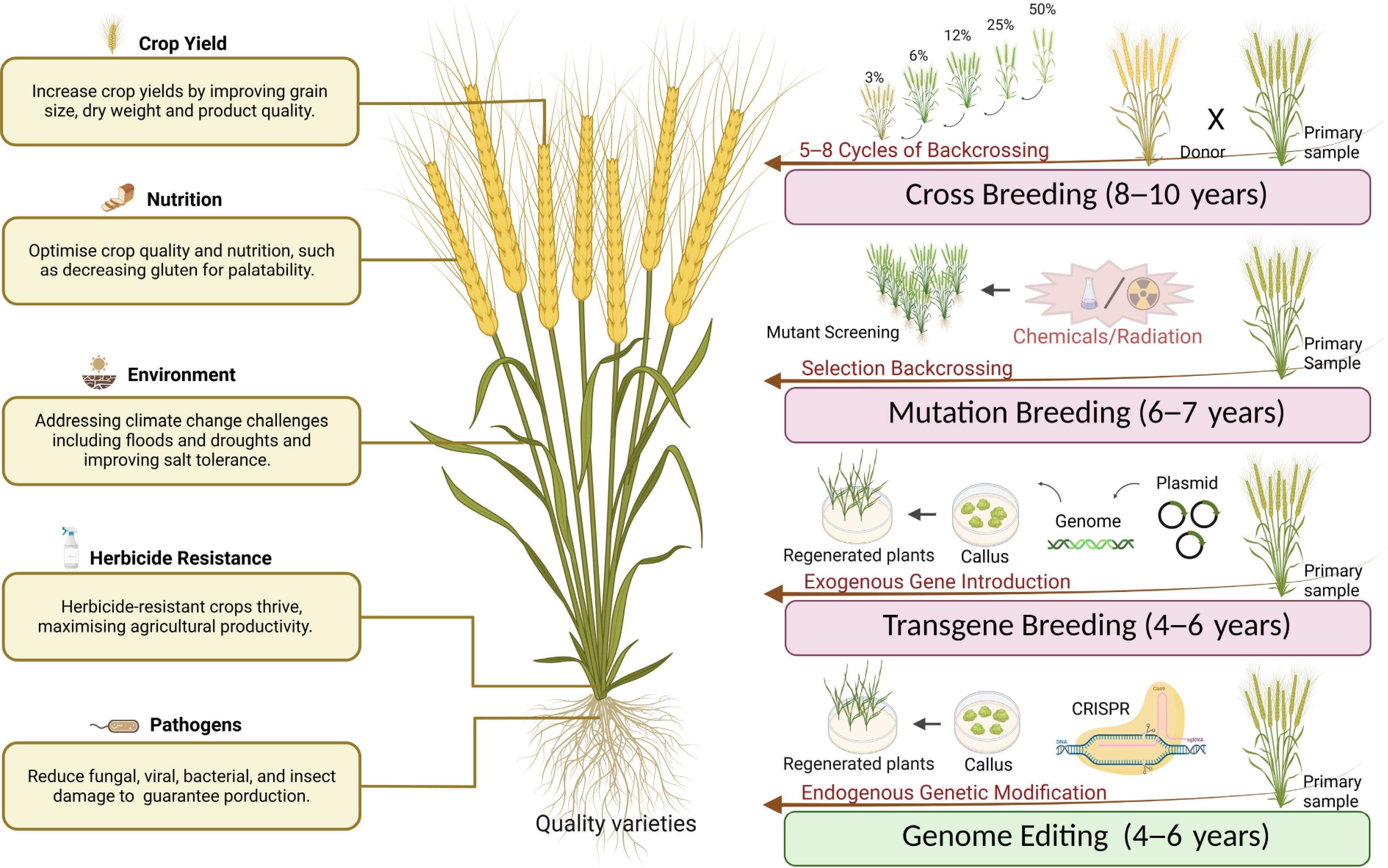
Figure 1.
Four major crop improvement methods: cross breeding, mutation breeding, transgene breeding, and genome editing. These methods enhance key agronomic traits including yield, nutritional quality, environmental resilience, herbicide resistance, and pathogen defence. (Created with BioRender.com. Publication license obtained).
-
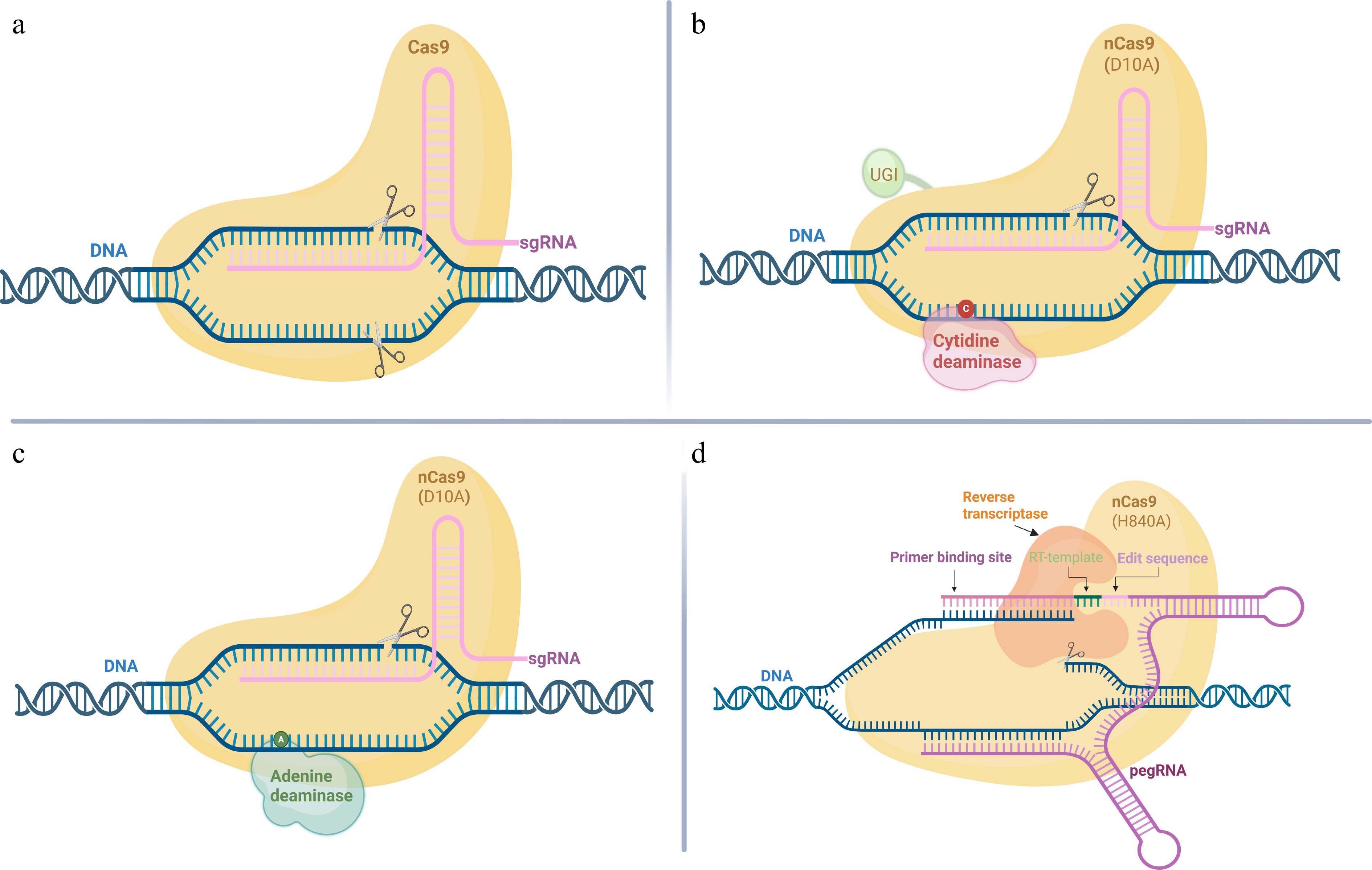
Figure 2.
CRISPR-Cas9, base editing, and prime editing. (a) CRISPR-Cas9 creates double-strand breaks (DSBs) in DNA and relies on the cell's repair mechanisms—NHEJ (error-prone), or HDR (precise but less efficient)—to introduce changes. (b) Cytosine base editors (CBEs) mediate C-to-T conversions via deamination of cytosine (C) to uracil (U). (c) Adenine base editors (ABEs) catalyse A-to-G conversions through deamination of adenosine (A) to inosine (I). (d) Prime editing system employs a Cas9 nickase-reverse transcriptase fusion and a prime editing guide RNA (pegRNA) to directly introduce programmed edits without requiring DSBs or donor DNA templates. (Created with BioRender.com. Publication license obtained).
-
Crops Ploidy Edit method Targeted genes Enhancement and references Tobacco Tetraploid (4 x) ZFNs SuR genes Herbicide resistance[28] Wheat Hexaploid (6 x) TALEN and CRISPR-Cas9 MLO/ MLO-B1 genes Resistance to powdery mildew[40,41] CRISPR-Cas9 Alpha-Fetoprotein genes Low gluten[67] CRISPR-Cas9 TaQsd1 genes Extend the dormancy[39] CRISPR-Cas9 TaWaxy genes Enhance quality[42] ZFNs Acetohydroxyacid synthase genes Resistance herbicides[29] MNs DsRed fluorescent protein genes Facilitates marker gene deletion[25] CBE TaALS genes Herbicide tolerance[57] ABE TS60-A genes Efficient editing system[59] PE TaUbi10 genes Precise mutation[64] PE TaWTK3 gene Increase resistance[66] Wheat Tetraploid (4 x) CRISPR-Cas9 TtMTL genes Haploid induction[68] Cotton Tetraploid (4 x) CRISPR-Cas9 GhFAD2 genes Improve cottonseed oil[47] CRISPR-Cas9 GhCPK genes Insect resistance[50] MNs Hppd, Epsps genes Herbicide resistance[69−71] Strawberry Octaploid (8 x) CRISPR/Cas9 FaPG1 genes Increase fruit firmness[48] Sugarcane Highly polyploid (8 x–12 x) CRISPR/Cas9 Lg1 genes Blade angle adjustment[49] Banana Triploid (3 x) CRISPR/Cas9 MaC2H2-IDD genes Enhancing fruit quality[46] Potato Tetraploid (4 x) TALENs Vacuolar invertase genes Lower levels of reducing sugars[36] CRISPR-Cas9 GBSS genes Starch devoid of amylose[70] CRISPR-Cas9 StDMR6-1 genes Phytophthora resistance[43] CRISPR-Cas9 StNPR3 genes CLso pathogen resistance[44] CRISPR-Cas9 StCBP80 genes Enhanced drought resistance[72] TALENs VInv, AS1 genes Less acrylamide[71] PE StALS1 genes Herbicide resistance[63] Table 1.
Gene editing for polyploid crop enhancement.
Figures
(2)
Tables
(1)