-
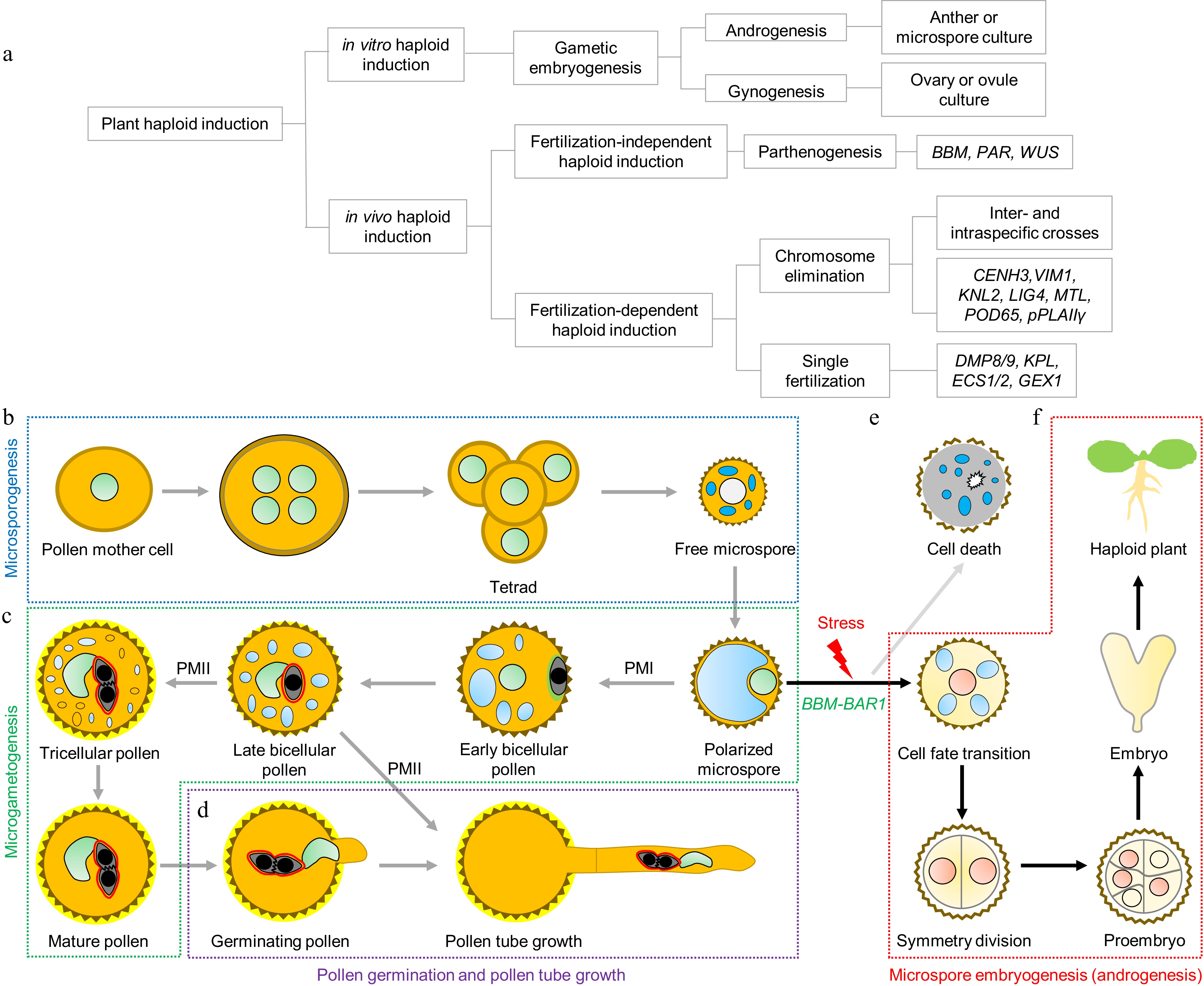
Figure 1.
Haploid induction (HI) strategies and BBM-BAR1-mediated androgenesis. (a) Plant HI methods and classification. Plant HI approaches are broadly divided into in vivo and in vitro strategies. In vivo HI typically relies on haploid inducer lines generated through genetic manipulation or mutation of key genes, triggering the development of haploid embryos after fertilization. This category includes (i) parthenogenesis-based methods (via ectopic expression of transcription factors such as BABY BOOM [BBM], PARTHENOGENESIS [PAR], or WUSCHEL [WUS]), (ii) chromosome elimination-based methods (via inter- or intraspecific crosses or gene knockout), and (iii) single fertilization-based methods (via gene knockout). In vitro HI employs tissue culture to induce embryogenesis from gametophytic cells, including anther or microspore culture (androgenesis) and ovary or ovule culture (gynogenesis). (b) Microsporogenesis. Pollen mother cells undergo meiosis to form tetrads of four haploid microspores that are synchronously released. (c) Microgametogenesis. Free microspores develop into polarized microspores and undergo PM I to produce a large vegetative cell and a smaller generative cell that subsequently undergoes PM II to yield two sperm cells. (d) Pollen germination and tube growth. (e) Microspores that fail to transition to the proper developmental fate undergo programmed cell death. (f) Androgenesis. Under specific stress conditions, a subset of microspores can be reprogrammed toward embryogenesis, forming haploid embryos, depending on the BBM–BAR1 module.
Figures
(1)
Tables
(0)