-

Figure 1.
Regional threshold target setting framework.
-
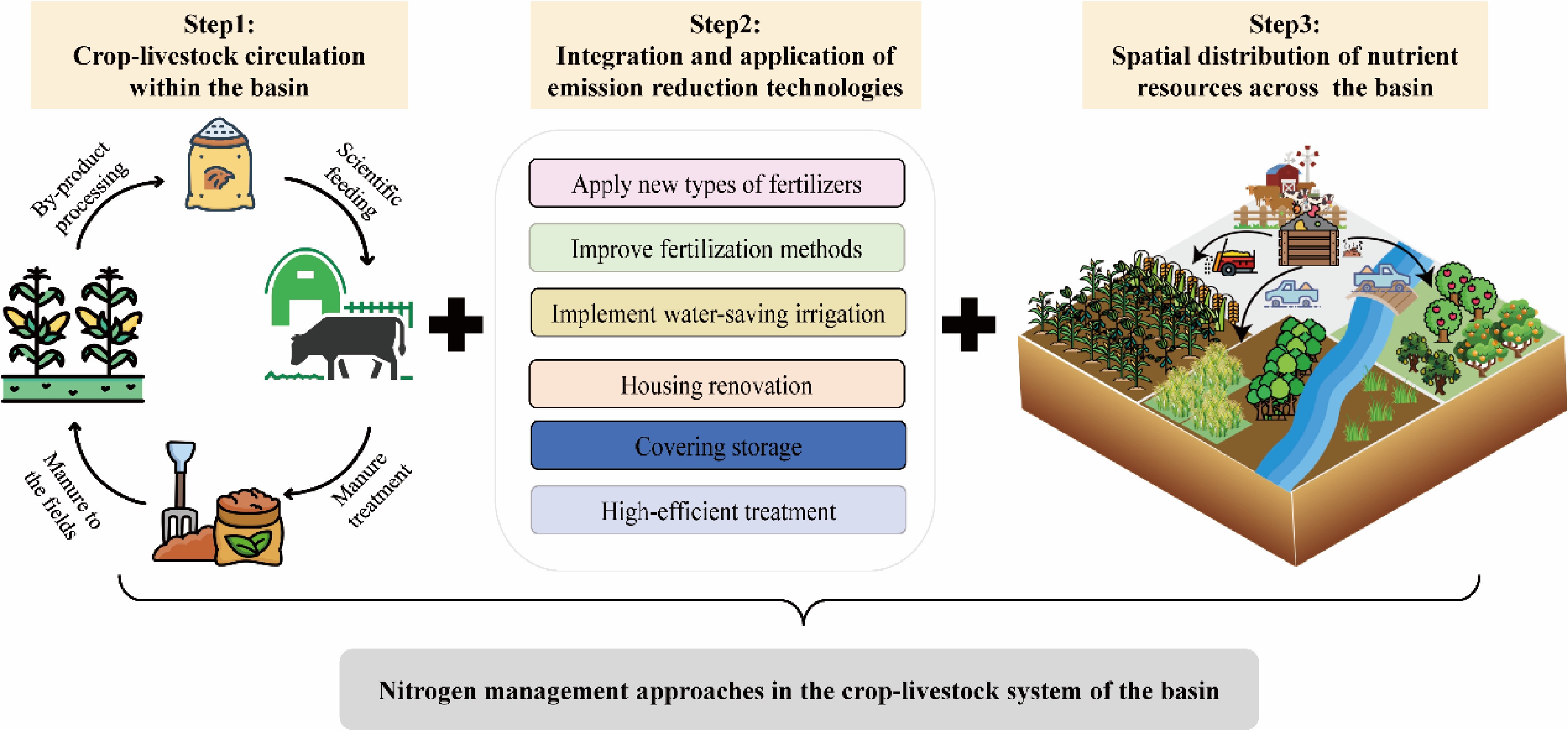
Figure 2.
Management pathways for nitrogen in basins.
-

Figure 3.
Integrated management framework for nitrogen in basins.
-
Model Scale and type Advantages Disadvantages VEMALA A national scale nutrient loading model for Finnish catchments. The detailed information such as the soil type, slope and crop distribution of the farmland
can precisely quantify the contribution of agricultural non-point source pollution.Simulation deviation under complex environmental conditions, high reliance on real-time water quality data, with limited application. WMS A simulating the hydrology and hydraulics
of a river basing model.Support multi-level simulation from sub-basins to the entire basin, which can quantify the impact of agricultural non-point source pollution on downstream water quality. The core of WMS lies in hydrological process simulation, but it is relatively weak in depicting the key elements of agricultural production. SWAT A distributed hydrological model in which the watershed is used as a scale and a daily time unit. Comprehensive process simulation of hydrology - water quality - vegetation in the basin. The model mainly focuses on the simulation of hydrology and water quality, but it lacks in the simulation of various aspects of agricultural production. MARINA A multi-domain and multi-version environmental assessment model that quantifies the migration process of pollutants from land to water bodies. Identify the sources of pollutants and predict the environmental impacts. Insufficient detailed analysis of the entry of nutrients into the water body's front end. WOFOST A crop growth model based on physiological and ecological mechanisms, applicable to global, regional, and field-scale. Predict the impacts of climate change and field management on crop production. The model focuses on the study of crop mechanism growth and requires the integration of other models to assess the impact of the crop production environment. NUFER A model that covers different levels such as global, national, river basin, and farmers, and quantifies the entire nutrient flow of the food system. The full-chain simulation of nutrients can identify the key links where nutrients are inefficiently utilized. Specialized modules can
be developed for different crops and animals production.The model does not incorporate a multi-factor synergy algorithm and ignores the interaction effects of multiple nutrients. GCM A simulating global climate change model. The model can understand the mechanisms of climate change, predict future climate scenarios, and assess the impacts of climate change. It is necessary to couple with models from other industries in order to assess the impact of climate change on multiple fields. CHANS-CN A comprehensive model for quantifying the historical evolution and future trends of carbon and nitrogen emissions in China. It integrates 16 subsystems related to humans and nature, covering the entire chain of the carbon and nitrogen cycles. Applied to large-scale studies, but insufficient for detailed analysis on smaller scales. Table 1.
Overview of nutrient flow model.
Figures
(3)
Tables
(1)