-
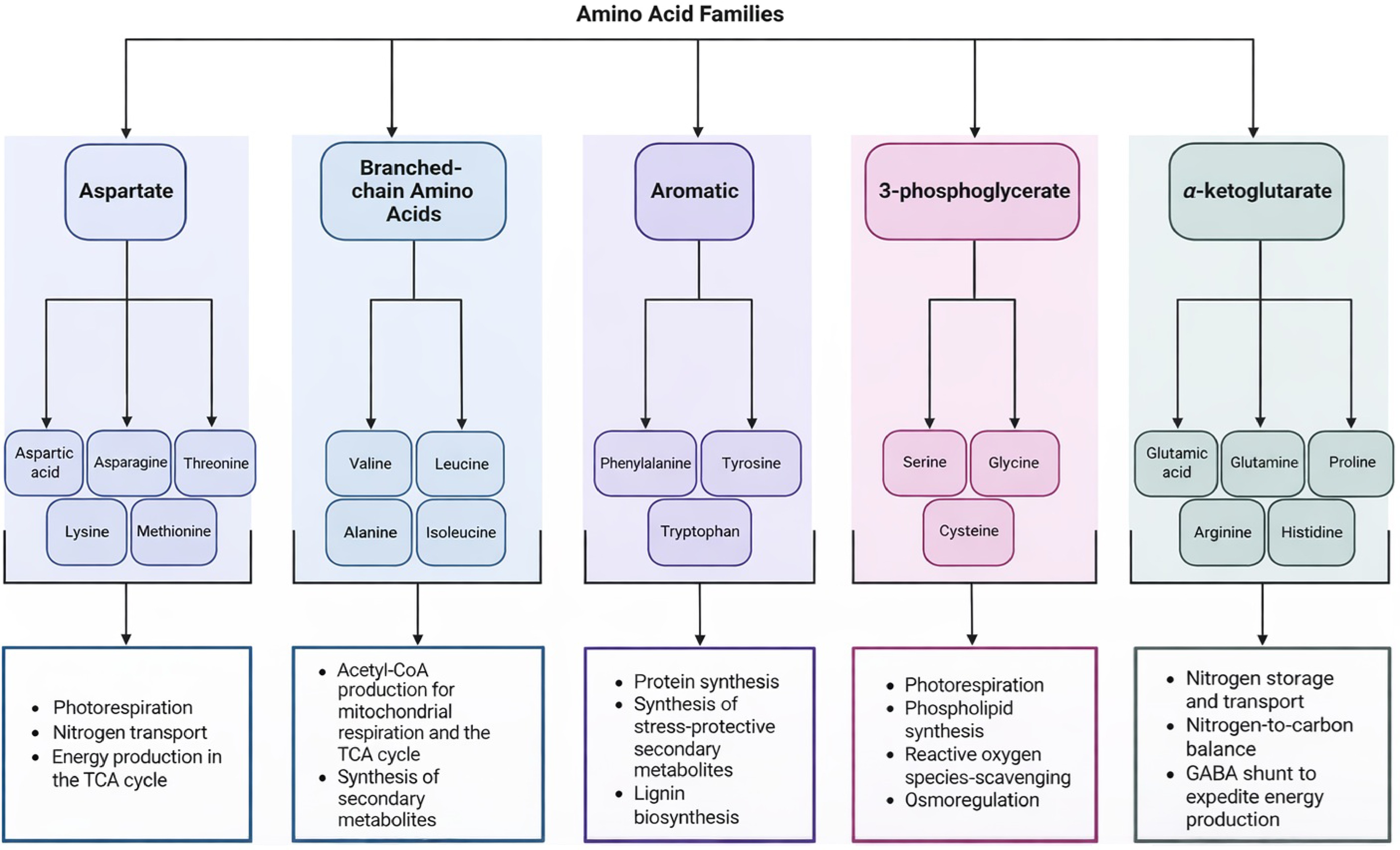
Figure 1.
Biological functions of amino acids in five families and metabolic pathways: (i) aspartate, (ii) branched-chain amino acids (BCAAs), (iii) aromatic, (iv) 3-phosphoglycerate, and (v) α-ketoglutarate.
-
Amino acid applied Plant Property altered Ref. I. Water relations and osmotic adjustment Arginine Sugarcane (S. officinarum) Increased: Transpiration rate, stomatal conductance, carboxylation efficiency, CO2 assimilation [80] Wheat (T. aestivum) Increased: RWC [86] Betaine Barley (H. vulgare) Increased: Transpiration rate, stomatal conductance, intercellular CO2 concentration [82] GABA Creeping bentgrass (A. stolonifera) Increased: Osmotic adjustment, RWC [61−66] Perennial ryegrass (L. perenne) Increased: RWC [67]
Glycine betaineMaize (Z. mays) Increased: Transpiration rate, stomatal conductance, intercellular CO2 concentration [83] Rice (O. sativa) Increased: RWC [55] Sugarcane (S. officinarum) Increased: RWC, stomatal conductance, transpiration rate, water use efficiency [53] Wheat (T. aestivum) Increased: Stomatal conductance, transpiration rate, CO2 assimilation, intercellular CO2 concentration, water use efficiency, RWC, osmotic potential, pressure potential, leaf water potential [47−52] Isoleucine Rice (O. sativa) Increased: RWC [69] Leucine Rice (O. sativa) Increased: RWC [69] Methionine Wheat (T. aestivum) Increased: CO2 assimilation, intercellular CO2 concentration, stomatal conductance, water use efficiency [71] Proline Maize (Z. mays) Increased: Oleic and linoleic acid contents [78] Rice (O. sativa) Increased: RWC [69] Tryptophan Maize (Z. mays) Increased: RWC [70] Valine Rice (O. sativa) Increased: RWC [69] II. Photosynthesis Arginine Maize (Z. mays) Increased: Photochemical efficiency, photosynthetic rate, chlorophyll content [79] Wheat (T. aestivum) Increased: Chlorophyll a, chlorophyll b, carotenoids [72] GABA Creeping bentgrass (A. stolonifera) Increased: Photochemical efficiency, photosynthetic rate, chlorophyll content [62−66] Wheat (T. aestivum) Increased: Chlorophyll content [77] Glycine betaine Barley (H. vulgare) Increased: Chlorophyll content, photosynthetic rate [82] Carpet grass (A. compressus) Increased: Chlorophyll a, chlorophyll b, total chlorophyll, carotenoid content [85] Creeping bentgrass (A. stolonifera) Increased: Chlorophyll content [84] Maize (Z. mays) Increased: Photosynthetic rate, chlorophyll a, b, total chlorophyll, carotenoids [83] Rice (O. sativa) Increased: Chlorophyll a, total chlorophyll, carotenoids, photosynthetic rate, photochemical efficiency, photon yield of photosystem II [55,76] Sugarcane (S. officinarum) Increased: Photosynthetic rate, carboxylation efficiency, photochemical efficiency, effective quantum yield of photosystem II
Decreased: Photoinhibition, relative excess energy in photosystem II[53] Wheat (T. aestivum) Increased: Leaf area, chlorophyll content, photosynthetic rate [47,51] Methionine Wheat (T. aestivum) Increased: Chlorophyll and carotenoid content [71] Phenylalanine Rice (O. sativa) Increased: Chlorophyll content [81] Proline Wheat (T. aestivum) Increased: Chlorophyll content [77] Tryptophan Maize (Z. mays) Increased: Chlorophyll content [70] III. Carbohydrate synthesis Arginine Wheat (T. aestivum) Increased: Soluble sugars [72] GABA Creeping bentgrass (A. stolonifera) Increased: Soluble carbohydrates, proteins involved in carbohydrate transport [62,64] Carpet grass (A. compressus) Increased: Soluble sugars [85] Maize (Z. mays) Increased: Soluble sugars [75] Rice (O. sativa) Increased: α-amylase activity, total soluble sugars [55,74] Wheat (T. aestivum) Increased: Soluble sugars, endogenous proline [51] Methionine Wheat (T. aestivum) Increased: Total soluble proteins [71] Proline Maize (Z. mays) Increased: Sugar content (seed) [78] IV. Amino acid metabolism Alanine Rice (O. sativa) Increased: Total endogenous amino acids [69] Arginine Sugarcane (S. officinarum) Increased: Endogenous arginine and glutamate content [80] Wheat (T. aestivum) Increased: Free amino acids, endogenous proline [72] GABA Creeping bentgrass (A. stolonifera) Increased: Endogenous GABA content [65,66] Glycine betaine Carpet grass (A. compressus) Increased: Endogenous proline content [85] Maize (Z. mays) Increased: Endogenous proline content, soluble proline, endogenous glycine betaine content [54,75] Rice (O. sativa) Increased: Endogenous glycine betaine and proline content [55,74,76] Wheat (T. aestivum) Increased: Endogenous proline content [49] Isoleucine, leucine, proline, valine Rice (O. sativa) Increased: Total endogenous amino acids [69] V. Antioxidant metabolism Arginine Maize (Z. mays) Increased: Enzymatic antioxidants (SOD, POD, CAT, GST, GR, APX)
Decreased: MDA content, oxidative species (H2O2, O2•−)[79] Sugarcane (S. officinarum) Increased: Enzymatic antioxidants (SOD, CAT) [80] Wheat (T. aestivum) Increased: Enzymatic antioxidants (CAT, glutathione S-transferase, GPX); Non-enzymatic antioxidants (ascorbate, glutathione) (increased) [86] GABA Creeping bentgrass (A. stolonifera) Increased: Enzymatic antioxidants (SOD, POD, CAT, GR, MDAR, DHAR)
Decreased: Electrolyte leakage, oxidative species (H2O2, O2•−)[62,63,65,66] Perennial ryegrass (L. perenne) Increased: Enzymatic antioxidants (POD
Decreased: MDA content, electrolyte leakage[67] Triticale (x Triticosecale) Increased: Enzymatic antioxidants (SOD, CAT)
Decreased: MDA content, oxidative species (H2O2, O2•−)[87] Glycine betaine Barley (H. vulgare) Increased: Enzymatic antioxidants (SOD, POD, CAT, APX) [82] Carpet grass (A. compressus) Increased: Enzymatic antioxidants (SOD, POD, CAT, APX), membrane stability index
Decreased: MDA content, oxidative species (H2O2), electrolyte leakage[85] Creeping bentgrass (A. stolonifera) Increased: Enzymatic antioxidants (SOD, POD, CAT)
Decreased: MDA content, oxidative species (O2•−)[84] Rice (O. sativa) Increased: Enzymatic antioxidants (SOD, CAT, APX)
Decreased: MDA content, oxidative species (H2O2)[55] Wheat (T. aestivum) Increased: Enzymatic antioxidants (SOD, POD, CAT), membrane stability index
Decreased: MDA content, oxidative species (H2O2), electrolyte leakage[47,51] Maize (Z. mays) Increased: Enzymatic antioxidant (POD) [54] Methionine Wheat (T. aestivum) Increased: Enzymatic antioxidants (SOD, POD, CAT)
Decreased: MDA content, oxidative species (H2O2)[71] Phenylalanine Rice (O. sativa) Increased: Enzymatic antioxidants (SOD) [81] Proline Maize (Z. mays) Increased: Enzymatic antioxidant (DPPH)
Non-enzymatic antioxidants (carotenoids, flavonoids, tocopherols)[78] Tryptophan Maize (Z. mays) Increased: Membrane stability index [70] Rice (O. sativa) Increased: Enzymatic antioxidants (SOD) [81] Tyrosine Rice (O. sativa) Increased: Enzymatic antioxidants (SOD) [81] Table 1.
Amino acids that improve grass water relations, photosynthesis, carbohydrate synthesis, amino acid metabolism, and antioxidant metabolism when exogenously applied under drought stress.
-
Amino acid applied Plant Property altered Ref. I. Photosynthesis Aspartic acid Perennial ryegrass (L. perenne) Increased: Chlorophyll content [96] GABA Rice (O. sativa) Increased: Chlorophyll content, photochemical efficiency [92] Creeping bentgrass (A. stolonifera) Increased: Photochemical efficiency, photosynthetic rate, chlorophyll content [62,63,93−95] Proline Barley (H. vulgare) Increased: Photochemical efficiency [91] II. Carbohydrate metabolism Aspartic acid Perennial ryegrass (L. perenne) Increased: Sugars (Glucose-6-phosphate, glucose, UDP-glucose, glucuronic acid, sucrose, sorbitol); organic acids (pyruvate, oxaloacetate, citrate, malate, α-ketoglutarate, succinate, shikimate) [96] GABA Rice (O. sativa) Increased: Sugars (trehalose) [92] Creeping bentgrass (A. stolonifera) Increased: Soluble carbohydrates, organic acids (aconitate, malate, succinate, oxalic acid, threonic acid); soluble sugars (sucrose, fructose, glucose, galactose, maltose) [62,95] III. Osmotic adjustment GABA Rice (O. sativa) Increased: Stomatal conductance, RWC [92] Creeping bentgrass (A. stolonifera) Increased: Osmotic adjustment, stomatal conductance, transpiration rate, RWC, water use efficiency [62,63,93−95] IV. Amino acid metabolism and protein retention Aspartic acid Perennial ryegrass (L. perenne) Increased: Amino acid content [96] Arginine Wheat (T. aestivum) Increased: Amino acid content, protein synthesis [97,98] GABA Creeping bentgrass (A. stolonifera) Increased: Endogenous GABA content, endogenous proline content [62,63,94] Creeping bentgrass (A. stolonifera) Increased: Amino acid content [95] V. Antioxidant metabolism Aspartic acid Perennial ryegrass (L. perenne) Increased: Enzymatic antioxidants (SOD, CAT, POD, APX)
Decreased: MDA content, oxidative species (H2O2, O2•−), electrolyte leakage[96] Arginine Wheat (T. aestivum) Increased: Enzymatic antioxidants (SOD, CAT)
Decreased: MDA content[98] GABA Rice (O. sativa) Increased: Enzymatic antioxidants (SOD, CAT, APX, GR); Non-enzymatic antioxidants (Ascorbate, glutathione)
Decreased: MDA content, oxidative species (H2O2)[92] Creeping bentgrass (A. stolonifera) Increased: Enzymatic antioxidants (SOD, POD, CAT, APX, DHAR, GR); Non-enzymatic antioxidants (ascorbate, DHA, glutathione, oxidized glutathione)
Decreased: Electrolyte leakage, MDA content, carbonyl content, oxidative species (H2O2, O2•−)[62,63,93−95] Table 2.
Exogenous amino acids that improve grass photosynthesis, carbohydrate metabolism, osmotic adjustment, amino acid metabolism and protein retention, and antioxidant metabolism under heat stress.
Figures
(1)
Tables
(2)