-
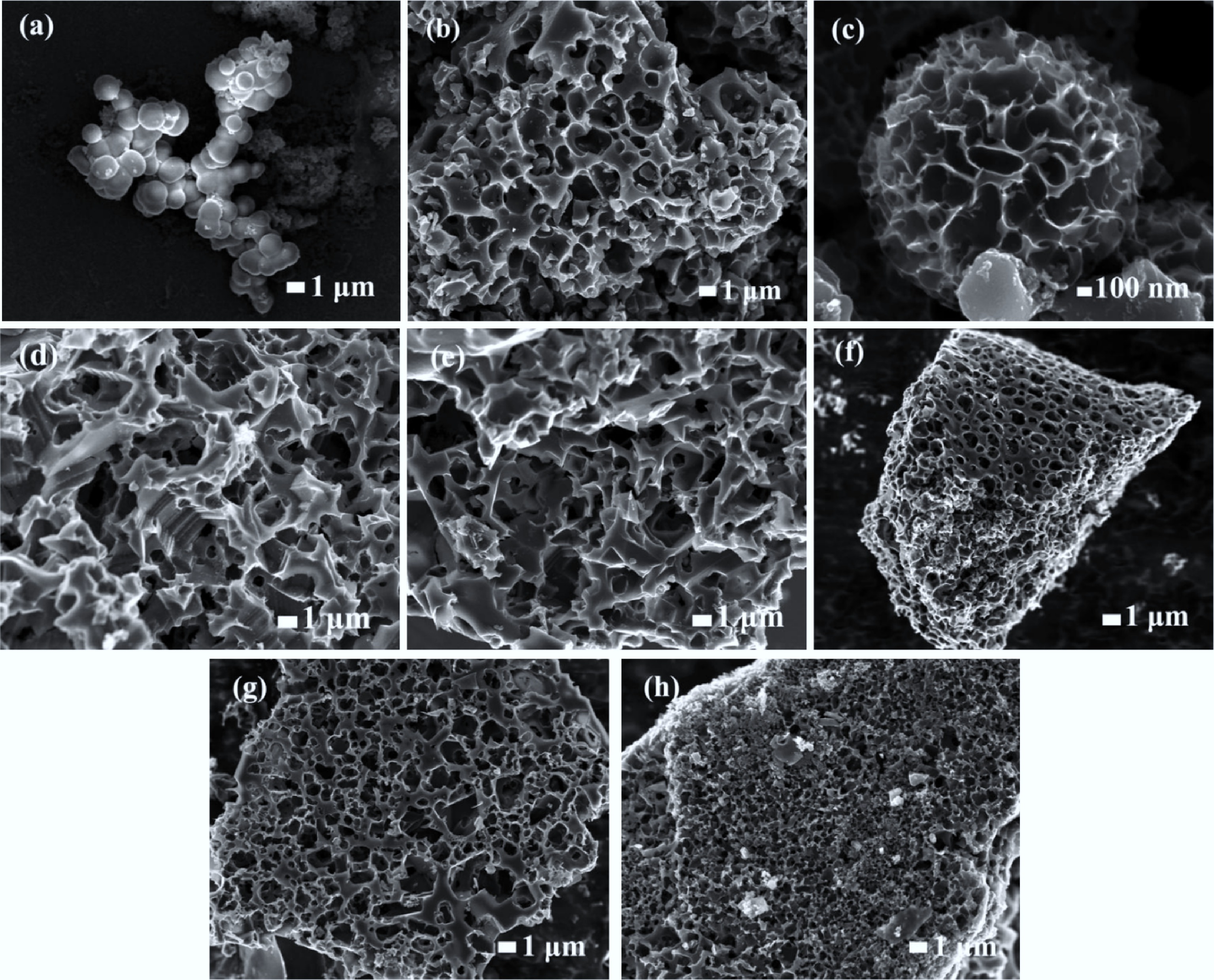
Figure 1.
SEM images of (a) H-hydrochar, (b) CNPB-600-4, (c) CNPB-700-1, (d) CNPB-700-2, (e) CNPB-700-3, (f) CNPB-700-4, (g) CNPB-800-4, (h) CNPB-900-4.
-
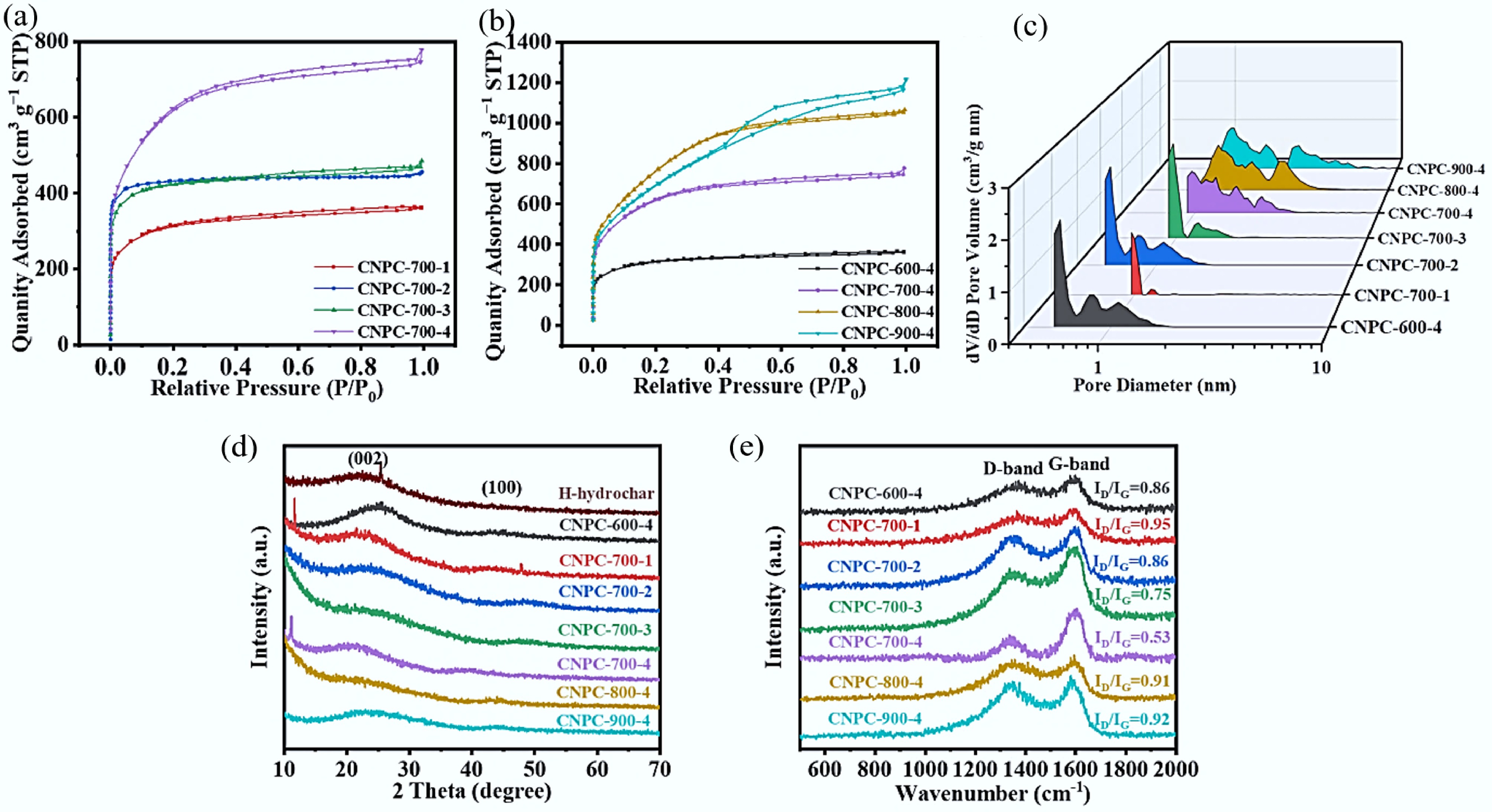
Figure 2.
(a), (b) N2 adsorption-desorption isotherms, (c) pore size distribution, (d) XRD patterns, and (e) Raman spectra of CNPBs prepared under different activation conditions.
-
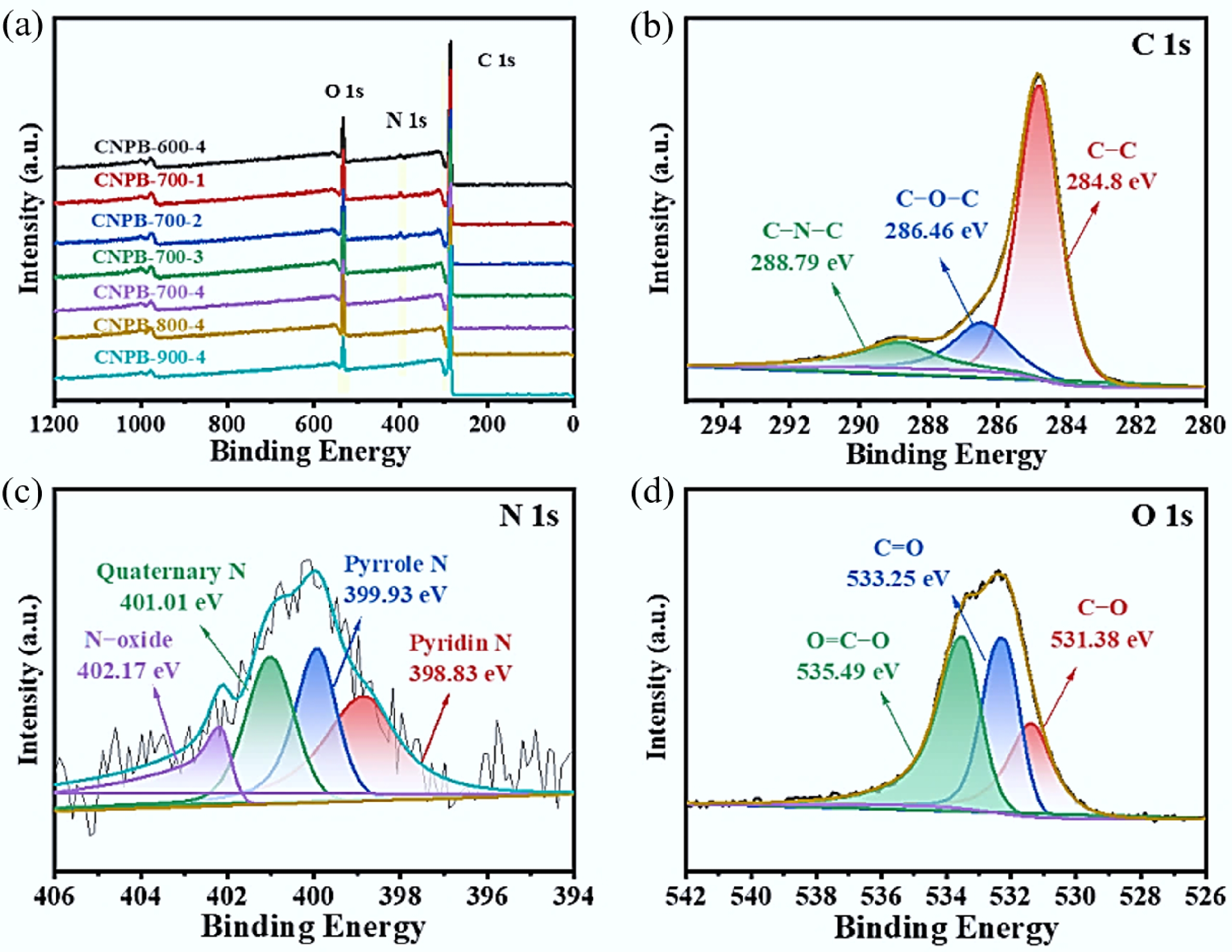
Figure 3.
(a) XPS measurement spectra of CNPBs prepared under different activation conditions; (b), (c), and (d) fine spectra of C 1s, N 1s, and O 1s of sample CNPB-700-4.
-
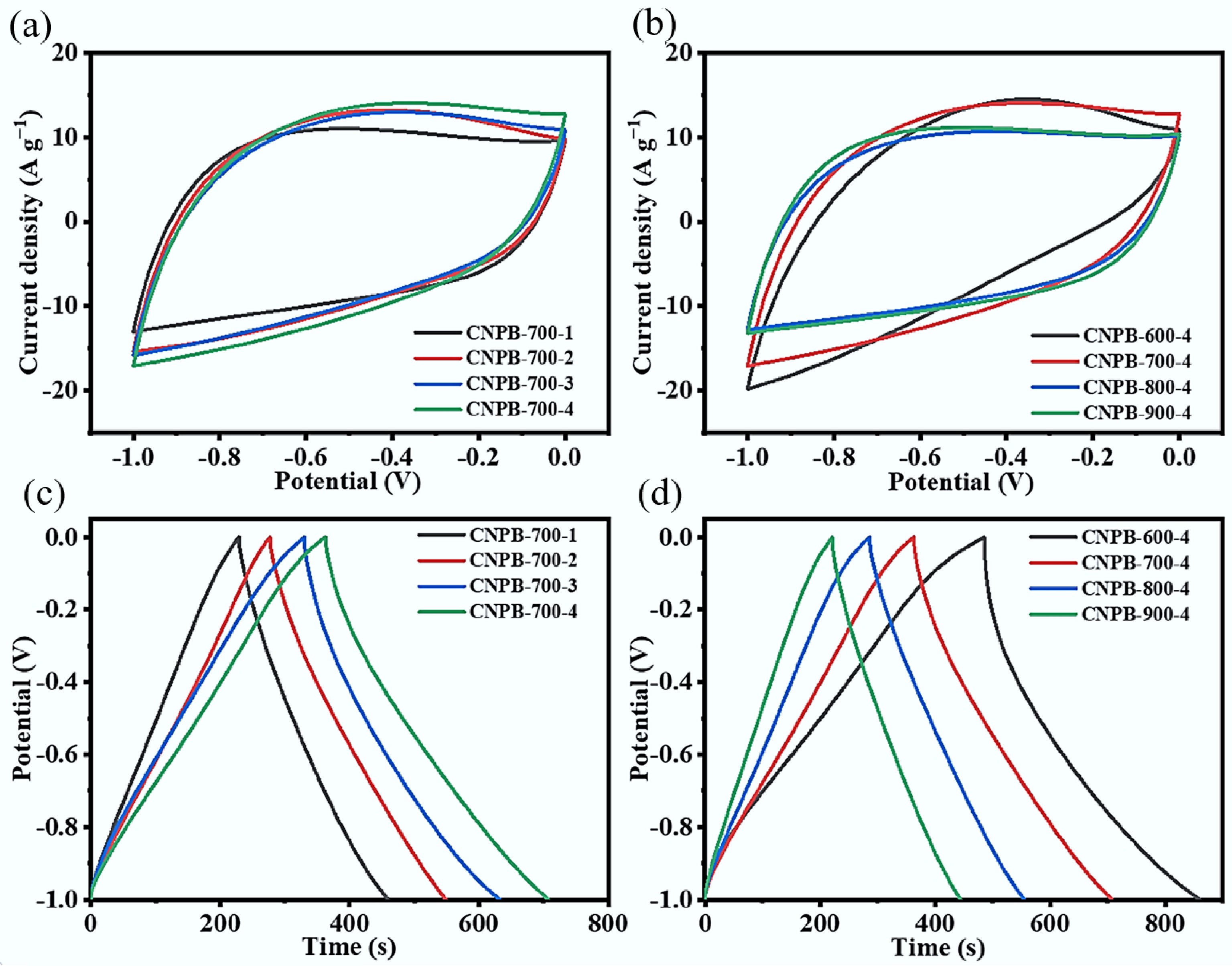
Figure 4.
(a), (b) CV curves of prepared CNPBs under different activation conditions at a sweep rate of 50 mV s−1; (c), (d) GCD curves of prepared CNPBs under different activation conditions at a current density of 1 A g−1.
-
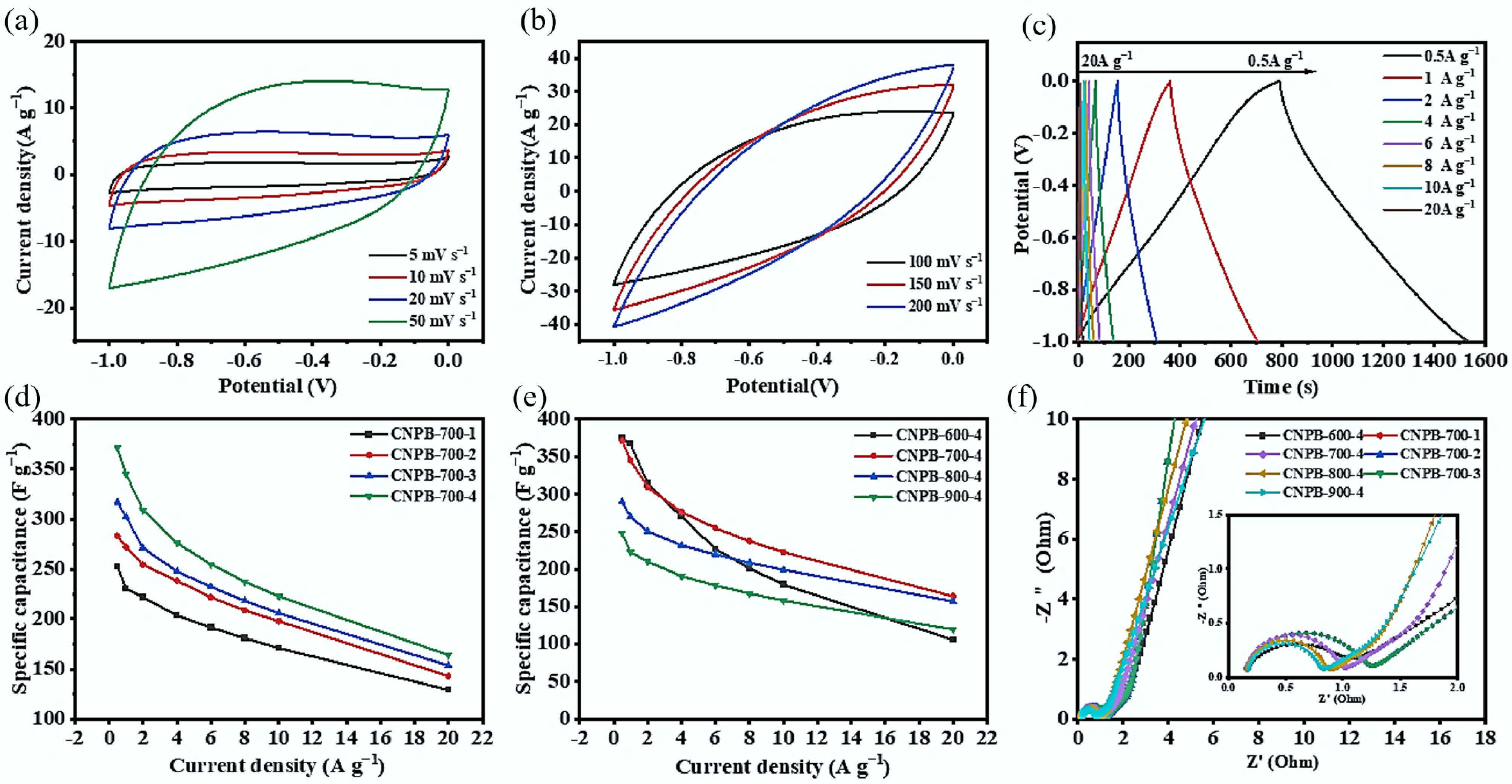
Figure 5.
(a), (b) CV curves of CNPB-700-4 at 5~200 mV s−1; (c) GCD curves of CNPB-700-4 at 0.5~10 A g−1; (d) specific capacitance of different CNPBs prepared at the same activation temperature (700 °C) with different activator ratios; (e) specific capacitance of different CNPBs prepared with the same activator ratio (4:1) at different activation temperatures; (f) impedance profiles of CNPBs.
-
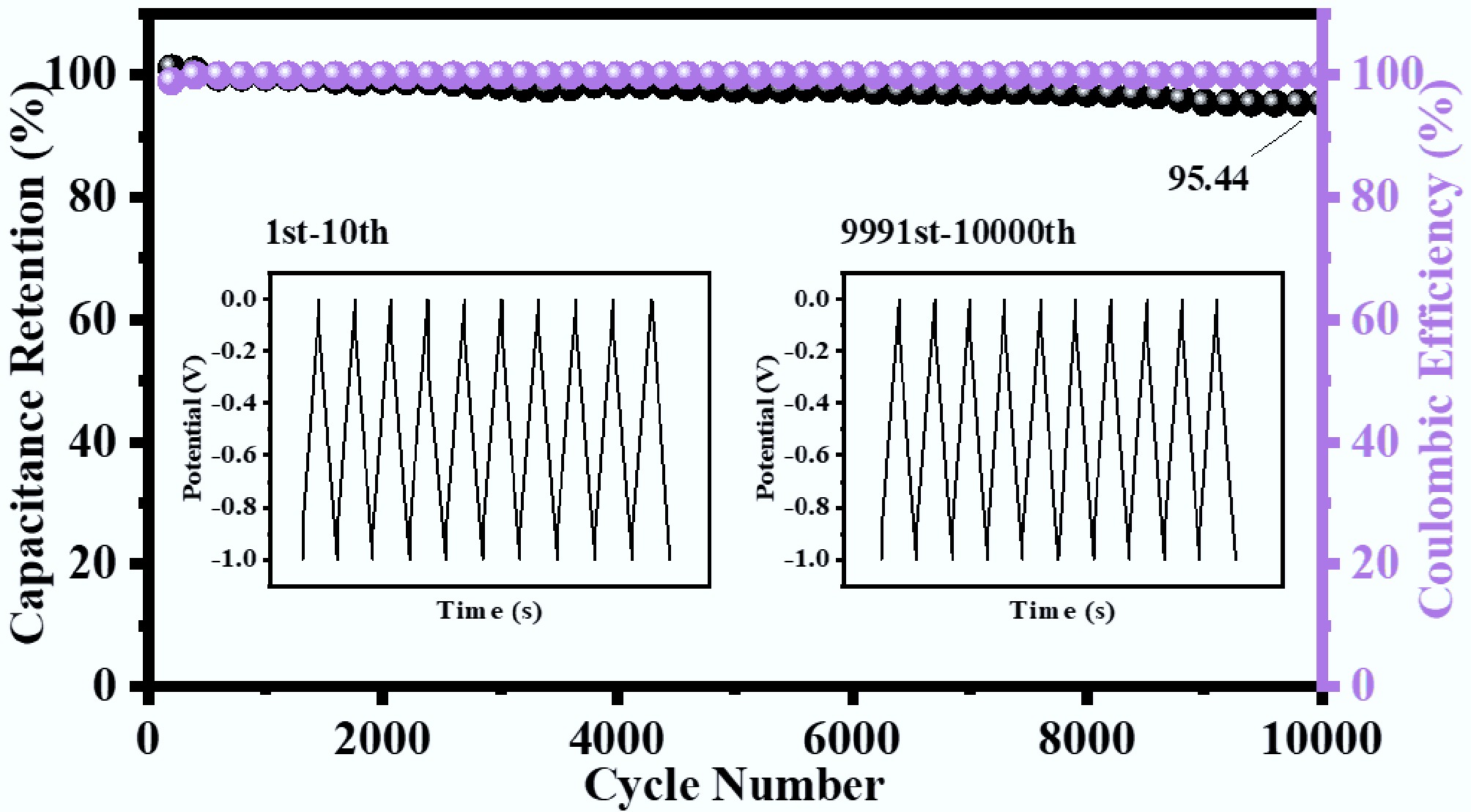
Figure 6.
Cycling stability and coulomb efficiency plots of CNPB-700-4 in the three-electrode system.
-
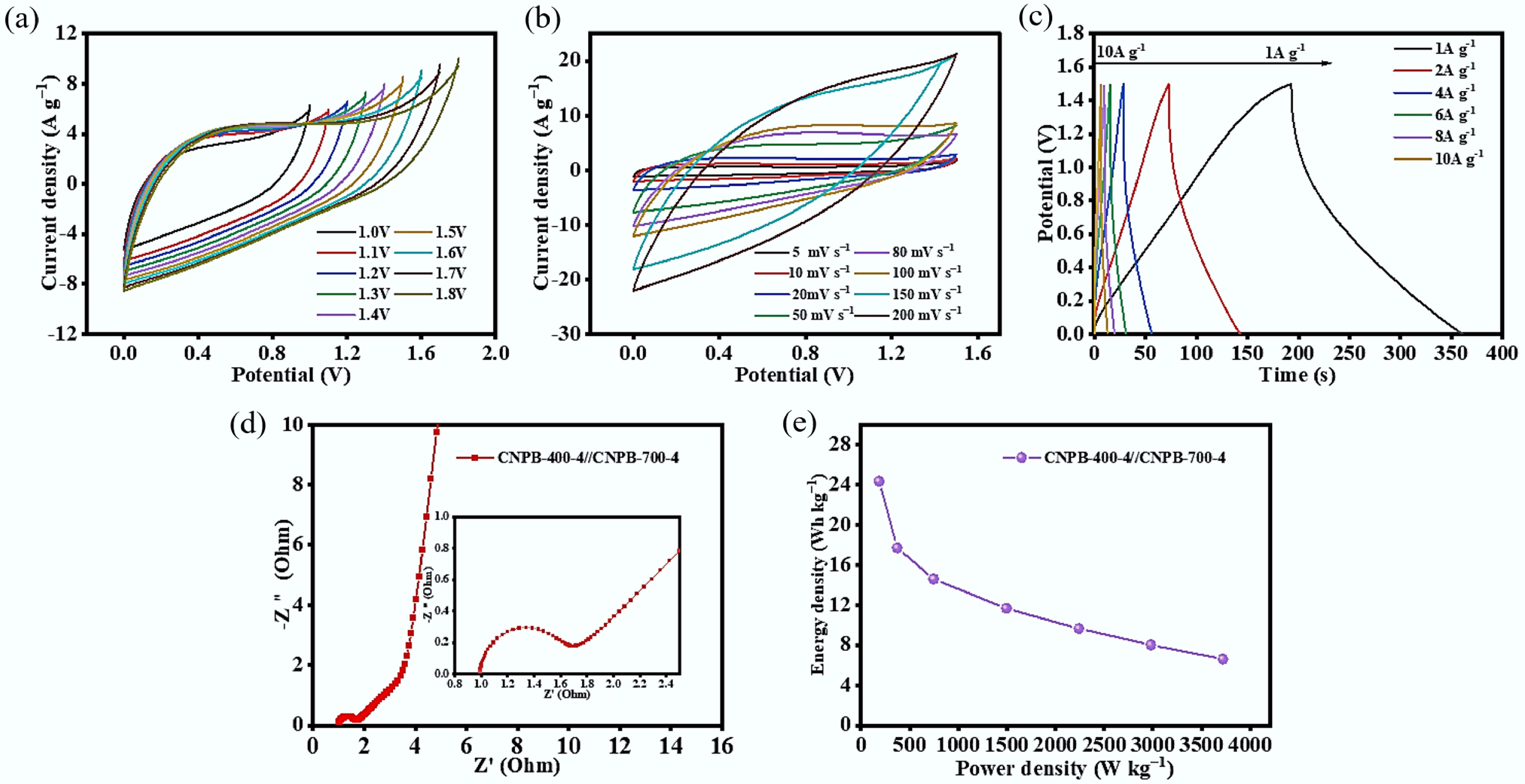
Figure 7.
Electrochemical performance of CNPB-700-4//CNPB-700-4 symmetric supercapacitor: (a) CV curves for a scan rate of 50 mV s−1 at different voltage windows; (b) CV curves for a scan rate of 5~200 mV s−1 in a 0–1.5 V window; (c) GCD curves for a current density of 1~10 A g−1 in a 0–1.5 V window; (d) impedance profiles; (e) energy-power density Ragone plot.
-
Sample Yield (%) C (%) H (%) N (%) O (%) H/Cc O/Cc (O+N)/Cc Hydrochar 22.88a 67.11 4.38 0.11 28.40 0.782 0.317 0.319 N-hydrochar 23.67 67.70 5.09 4.77 22.44 0.902 0.248 0.309 CPB-700-4 10.16a/44.41b 77.79 2.82 0.04 18.45 0.436 0.178 0.178 CNPB-600-4 12.95/54.71 57.77 4.39 1.50 36.35 0.911 0.472 0.494 CNPB-700-1 19.18/81.03 76.30 4.43 2.93 15.34 0.697 0.161 0.194 CNPB-700-2 16.32/68.95 75.25 3.03 2.73 18.99 0.484 0.189 0.220 CNPB-700-3 13.26/56.02 73.60 2.44 2.39 21.57 0.560 0.210 0.237 CNPB-700-4 11.25/47.53 77.56 2.59 1.96 23.11 0.401 0.224 0.245 CNPB-800-4 9.86/41.66 82.76 1.86 1.78 13.61 0.270 0.123 0.142 CNPB-900-4 7.22/30.50 87.69 2.63 1.07 8.61 0.360 0.074 0.084 a Calculated based on dried OFR; b Calculated based on dried hydrochar or N-hydrochar; c Atomic ratio. Table 1.
Yields and elemental analysis of hydrochar, N-hydrochar, CPB-700-4, and CNPBs derived from CBs
-
Sample SBETa (m2 g−1) Smicb (m2 g−1) Vmicc (cm3 g−1) Vtd (cm3 g−1) Vmic/Vt (%) Pore sizee (d, nm) N-hydrochar 7.8 − 0.003 − − 2.51 CNPB-600-4 1,136.9 770.0 0.319 0.560 57.03 2.24 CNPB-700-1 772.3 668.9 0.271 0.407 66.53 2.24 CNPB-700-2 1,683.5 1,529.7 0.599 0.693 86.58 2.22 CNPB-700-3 1,598.8 1,376.5 0.554 0.751 73.72 2.24 CNPB-700-4 2,133.5 903.2 0.401 1.203 33.29 2.24 CNPB-800-4 2,787.2 534.5 0.237 1.649 14.34 2.23 CNPB-900-4 2,492.9 203.6 0.060 1.880 3.21 2.25 a Specific surface area; b Surface area of micropores calculated by the t-plot method; c Micropore volume calculated by the t-plot method; d Total pore volume at P/P0 = 0.99; e Average pore size value. Table 2.
Pore structure parameters of N-hydrochar and CNPBs derived from CBs
-
Biomass electrode
materialsSSA
(m2 g−1)Specific capacitance
(F g−1)Current density
(A g−1)Energy density
(Wh kg−1)Power density
(W kg−1)Cycle stability
(%)Ref. CNPB-700-4 2,133.5 344.91 1 24.33 373.71 95.44/10,000 cycles This work Baby diaper 2,399 353 1 7.22 125 87.65/10,000 cycles [47] Peanut shells 17.8 240 1 4.08 101.3 90/1,200 cycles [48] Platycladus oriental leaves 1,140.2 156 0.5 11 65 96.3/10,000 cycles [49] Buckwheat core 805.91 330 0.5 6.1 250 90/5,000 cycles [50] Table 3.
Comparison of SSA and electrochemical properties between CNPB-700-4 and other biomass electrode materials
Figures
(7)
Tables
(3)