-
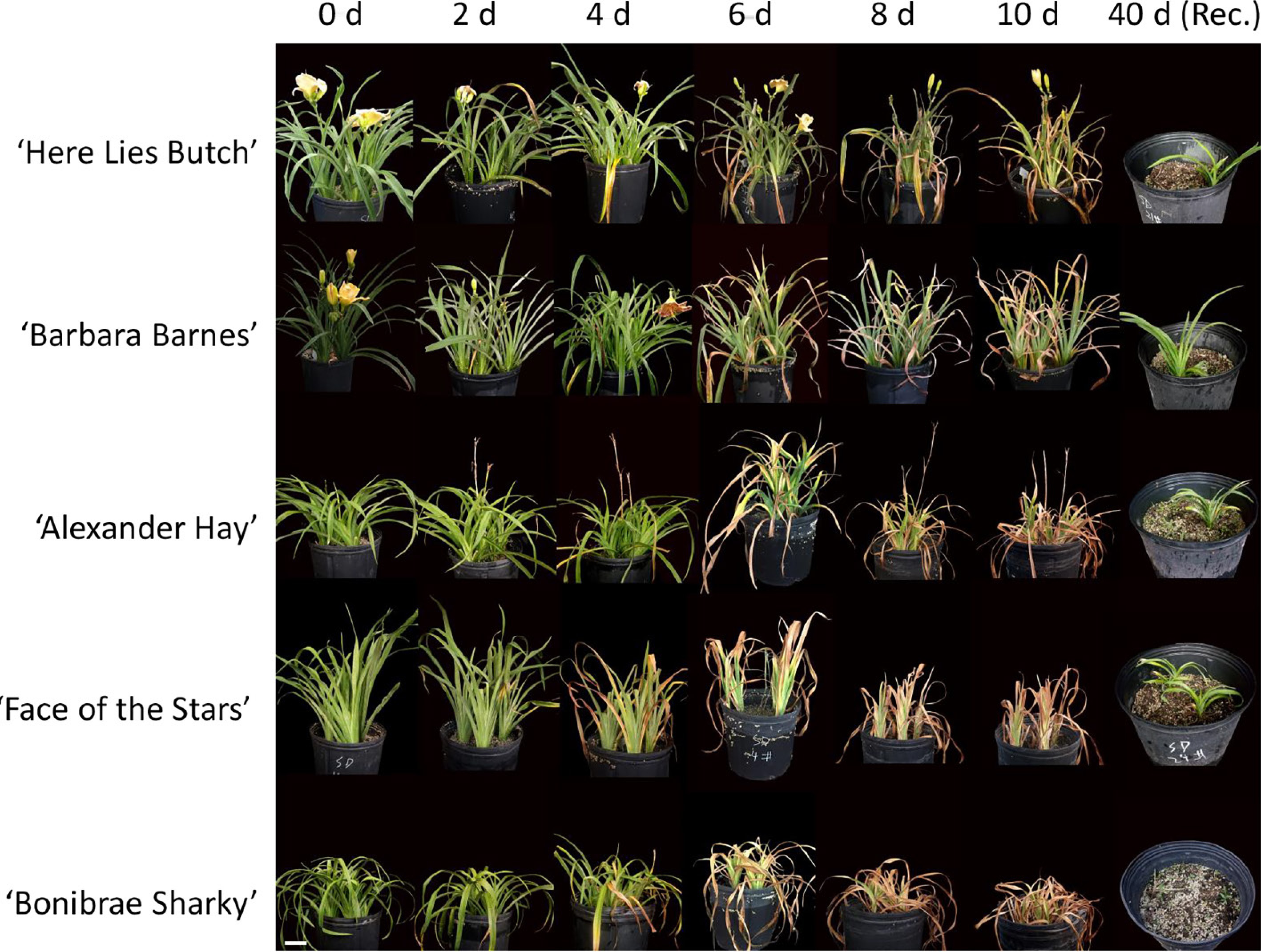
Figure 1.
Representative symptoms of different daylily cultivars at different days after waterlogging treatment. The symptoms were recorded every two d post treatment. After waterlogging for 10 d, each daylily cultivar was subjected to recovery (Rec.) for 40 d of normal maintenance.
-
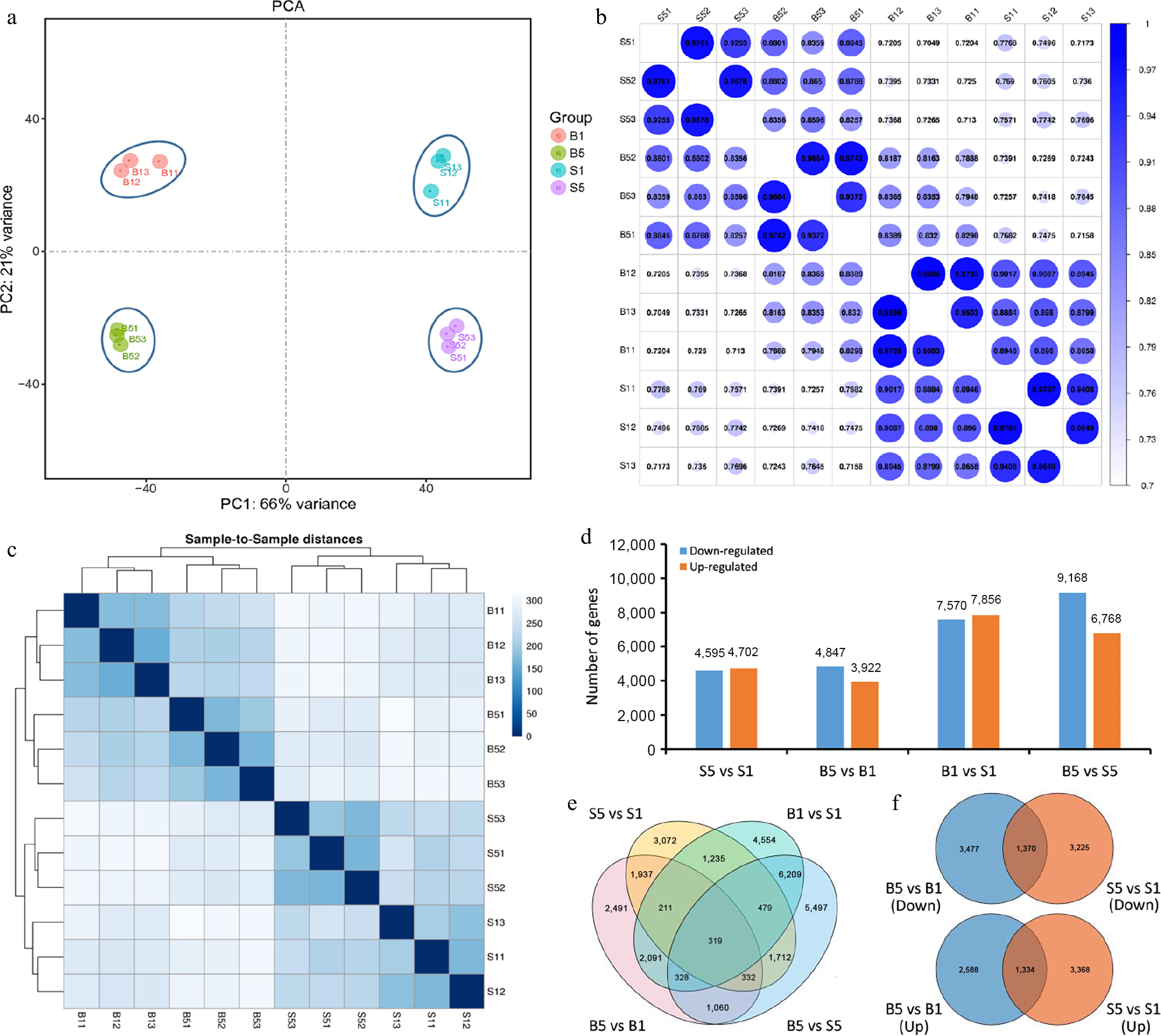
Figure 2.
Transcriptome analysis of daylily roots under waterlogging treatment. (a) Principal component analysis (PCA) of daylily root transcriptome data for each sample. B1 and B5, 'Here Lies Butch' root samples at 0 and 24 h after waterlogging; S1 and S5, 'Bonibrae Sharky' root samples at 0 and 24 h after waterlogging. (b) The correlation test among samples in daylily root transcriptome data. (c) Cluster analysis of all samples based on sample-to-sample distances. (d) Number of differentially expressed genes (DEGs) for different pairwise comparisons. (e), (f) Venn diagrams of DEGs for different pairwise comparisons.
-
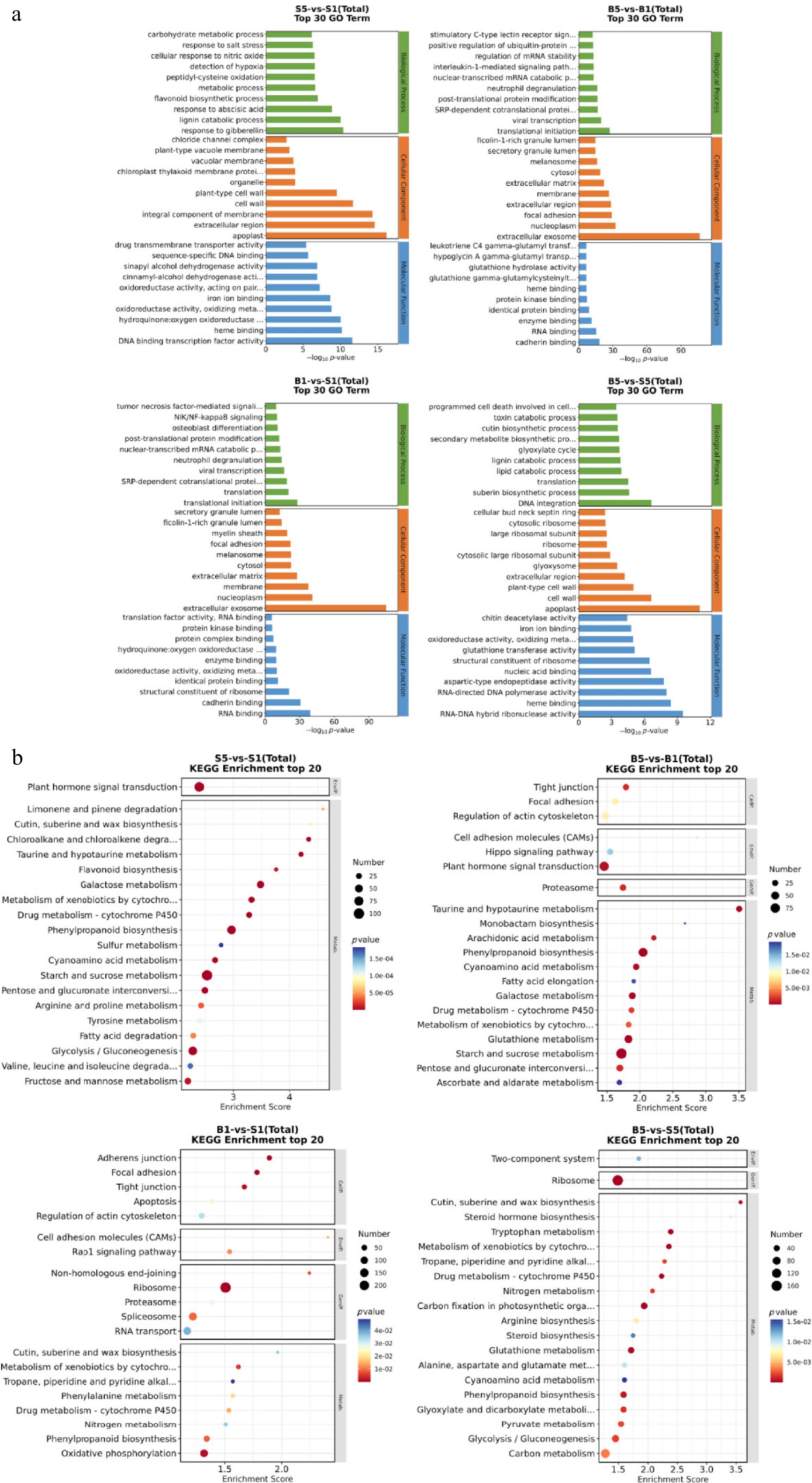
Figure 3.
GO and KEGG analysis of daylily root transcriptome data in response to waterlogging stress. (a) The GO functional classification of differentially expressed genes (DEGs) in all pairwise comparisons. (b) KEGG pathway enrichment of DEGs between different groups.
-
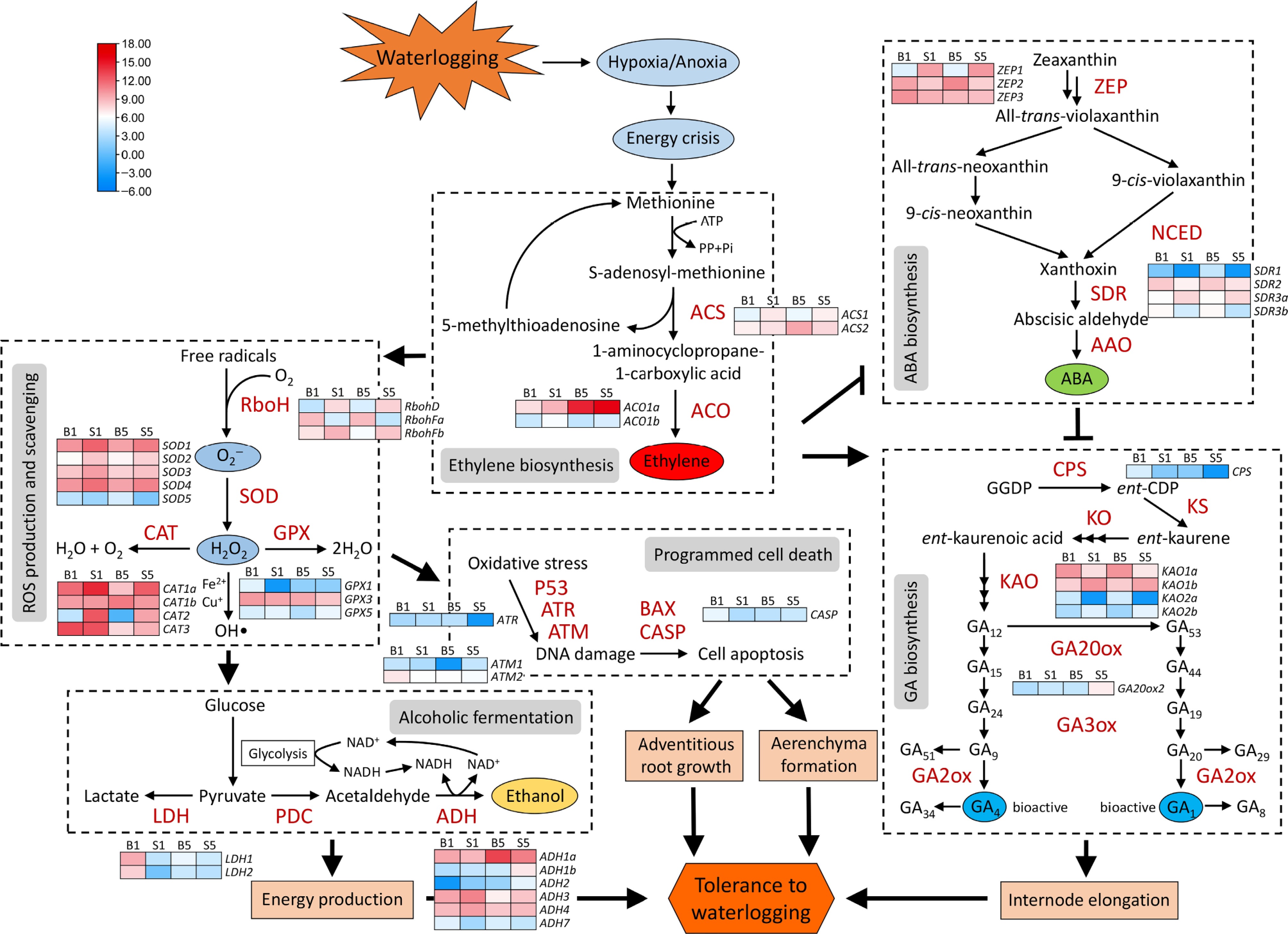
Figure 4.
Expression profiles of differentially expressed genes in various pathways associated with waterlogging stress responses through transcriptome analysis. These differentially expressed genes (DEGs) are indicated by italics. Different colors in the heatmap represent variable transcription ranged from low to high levels for each transcript. Transcript levels of DEGs were Log2-transformed. Solid lines ending with arrows indicate positive regulation, whereas the ones ending with short perpendicular lines represent negative regulation.
-
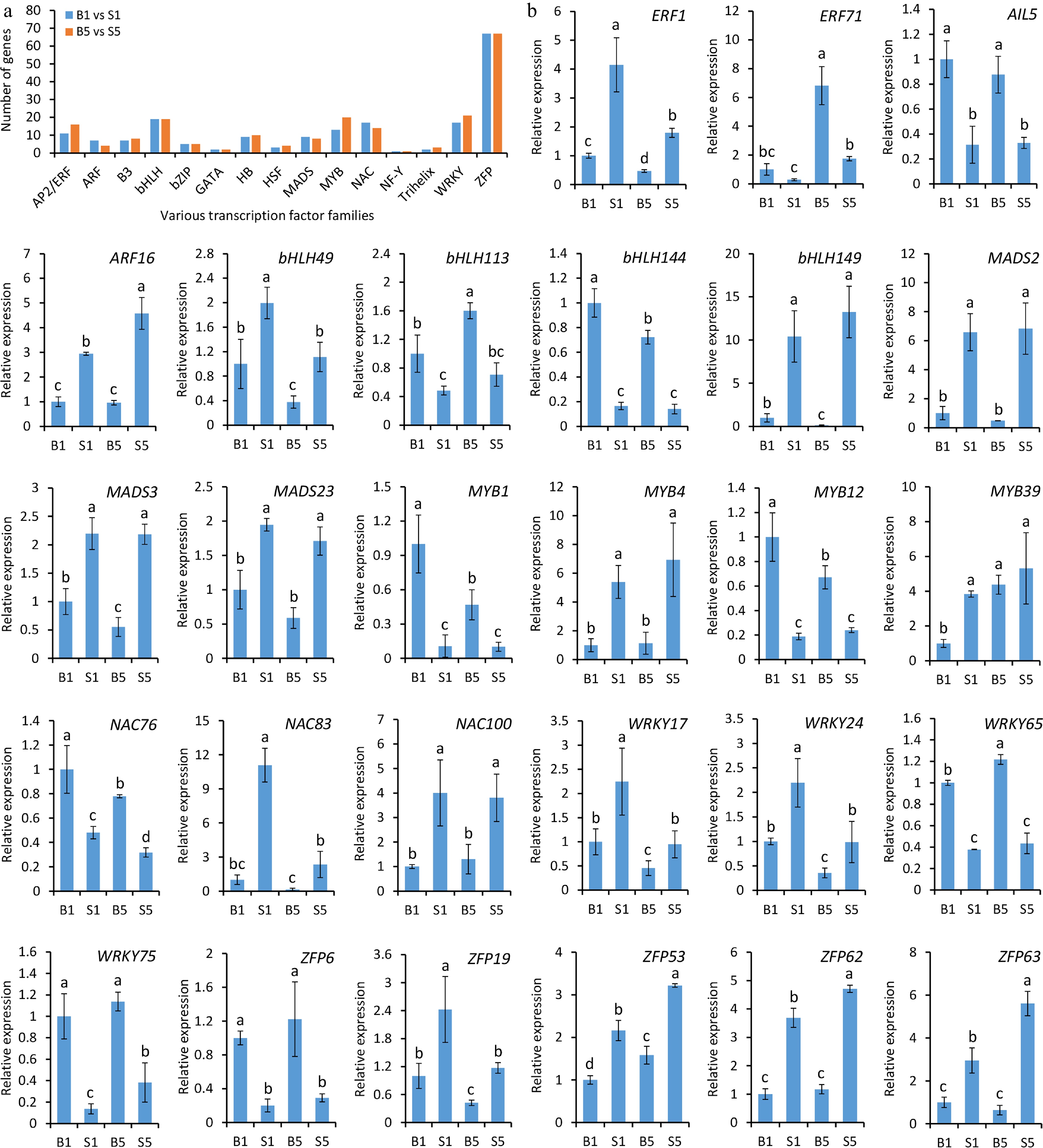
Figure 5.
Analysis of differentially expressed transcription factors in waterlogging-treated daylily roots through transcriptome analysis. (a) Number of differentially expressed transcription factors in response to waterlogging stress. (b) Transcript levels of a number of transcription factors from ERF, ARF, bHLH, MADS, MYB, NAC, WRKY, and ZFP families, in various samples under waterlogging treatment. Error bars indicate standard deviation (SD) of the means from three biological replicates. Different letters above the bars suggest statistical significance, which is determined by Duncan's multiple range test at p < 0.05.
-
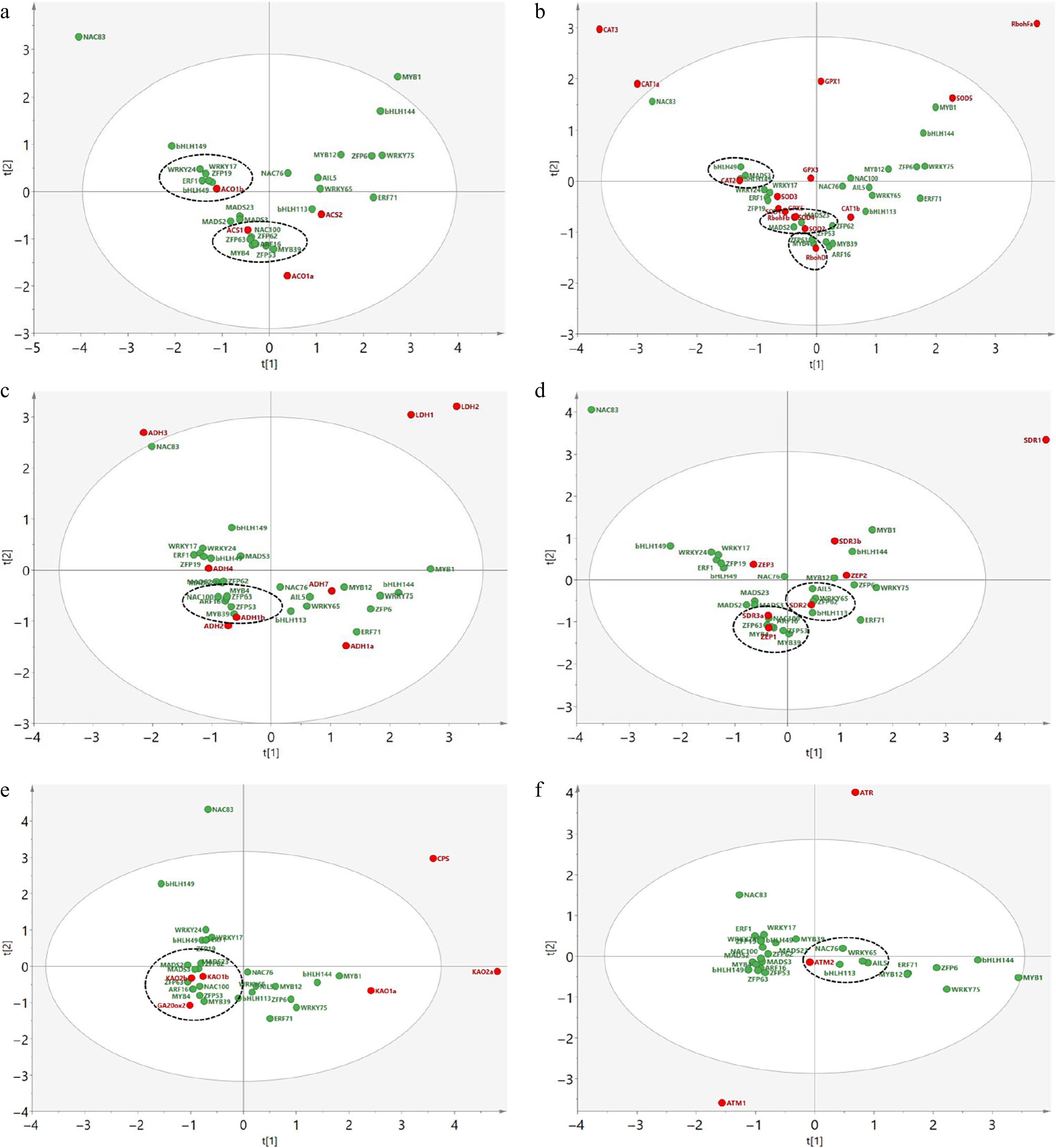
Figure 6.
Principle component analysis of the selected differentially expressed transcription factors with the genes in various pathways associated with waterlogging tolerance. The functional genes in various pathways of (a) ethylene biosynthesis, (b) reactive oxygen species (ROS) production and scavenging, (c) alcoholic fermentation, (d) abscisic acid (ABA) biosynthesis, (e) gibberellin (GA) biosynthesis, and (f) programmed cell death, are denoted by red solid circles, while the selected transcription factors from various families are marked by green solid circles. The genes with relatively close correlation distance are indicated by dashed circles.
-
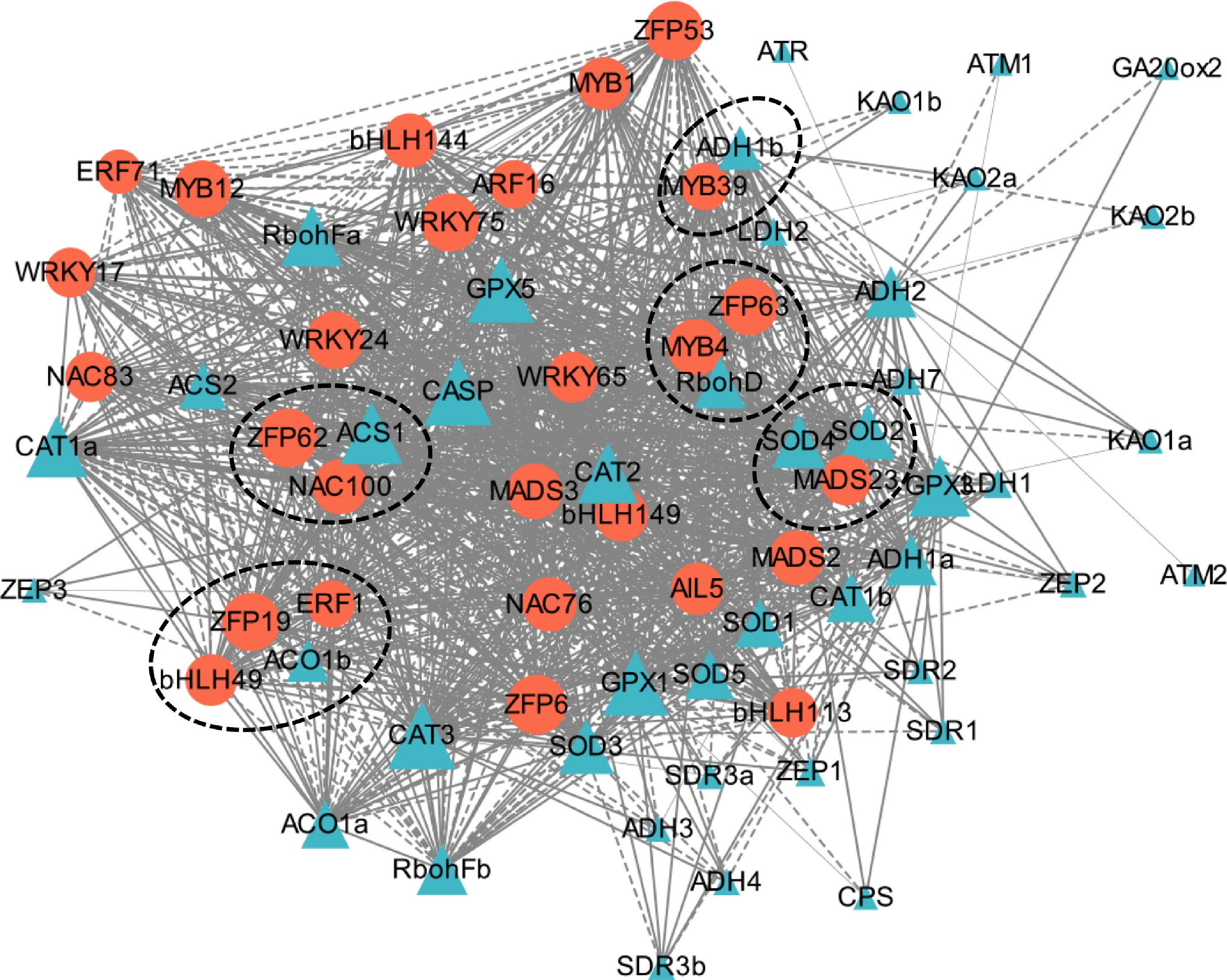
Figure 7.
An interaction network between the selected differentially expressed transcription factors with the genes in various pathways associated with waterlogging tolerance. Grey solid or dashed lines indicate positive or negative regulation, respectively. Larger circles or triangles with more nodes indicate more significant correlations, whereas smaller ones with less nodes represent the opposite correlations. The genes with relatively close correlation distance are indicated by dashed circles.
-
Grades Morphology I (18–20) The leaves naturally extend outward (5). All the leaves of plant are green (5). The color of stem segments in waterlogged area is natural (5). The newly grown seedlings are 11–15 cm high after 40 d of recovery (5). II (15–17) The middle leaves are curled inward (4). The lower leaves start drooping, and the leaves near the water surface turn yellow (4). The stems in the flooded area have a natural color (4). After 40 d of recovery, the newly grown seedlings are 6–10 cm high (4). III (11–14) The middle leaves are wilted and drooped (3). The lower leaves turn yellow and dry (3). The stems in waterlogged area turn grayish-green (3). After 40 d of recovery, the newly grown seedlings are 1–5 cm high (3). IV (7–10) The whole plant is wilted and curled (2). The lower leaves turn yellow and dry, accounting for half of the entire plant (2). The stem segments in waterlogged area lose green color (2). After 40 d of recovery, the newly grown seedlings are less than 1 cm high (2). V (4–6) The whole plant is severely wrinkled (1). Two-thirds of the plant leaves turn yellow and dry (1). The stem segments in waterlogged area turn white and emit a foul odor (1). After 40 d of recovery, no newly grown seedling emerges (1). Table 1.
The morphological damage index of daylily plants under waterlogging.
-
Name Estimate indexes Total score Grade Leaf shape Leaf color Stem color Morphological
changes after
recovery'Happy Hooligan' 5 3 5 3 16 II 'Face of the Stars' 2 2 3 1 8 IV 'Rosy Rhino' 5 4 3 2 14 III 'Water Dragon' 3 2 3 1 9 IV 'Alexander Hay' 4 3 3 2 12 III 'Big City Eye' 4 3 3 2 12 III 'Darla Anita' 5 4 5 4 18 I 'Chesapeake Crablegs' 5 4 5 4 18 I 'Here Lies Butch' 5 5 5 4 19 I 'Barbara Barnes' 4 4 5 3 16 II 'Bonibrae Sharky' 2 1 1 2 6 V 'Get Jiggy' 2 2 1 1 6 V 'Chicago Sunrise' 2 2 1 1 6 V 'Orange Crush' 1 1 1 1 4 V H. fulva 3 4 4 3 14 III 'Autumn Red' 3 3 3 2 11 III 'Marry Reed' 5 4 5 4 18 I 'Stella de Oro' 5 4 4 5 18 I 'Pardon Me' 2 3 2 3 10 IV 'Bela Lugosi' 3 3 4 3 13 III 'Chicago Apache' 2 3 3 3 11 III 'Strawberry Candy' 3 4 3 2 12 III 'Chicago Fire' 3 3 4 4 13 III Table 2.
The criteria and grades of waterlogging tolerance in 23 daylily cultivars and species.
Figures
(7)
Tables
(2)