-
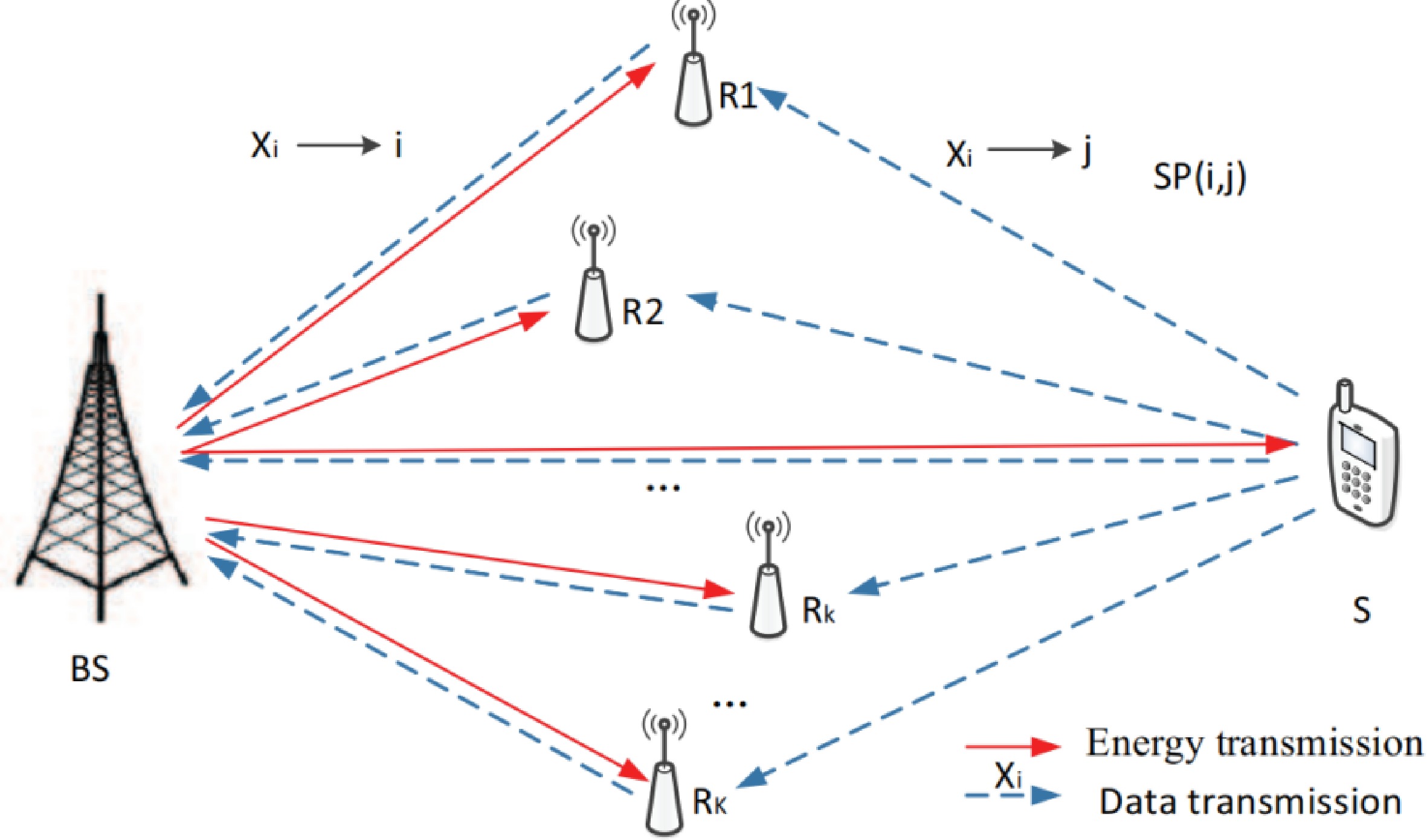
Figure 1.
Multi-relay network with an RF-EH scenario.
-
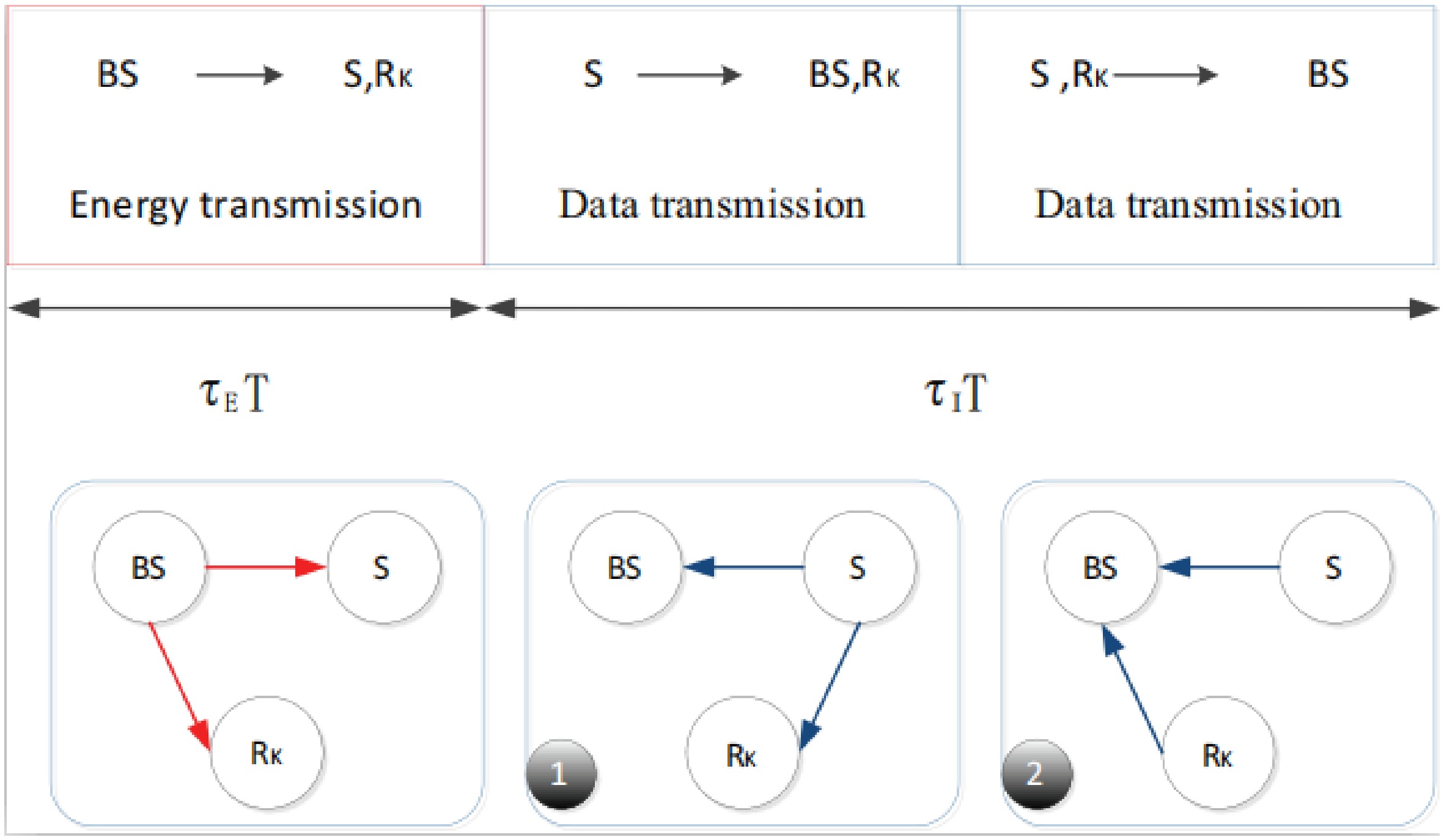
Figure 2.
Improved HTC protocol.
-
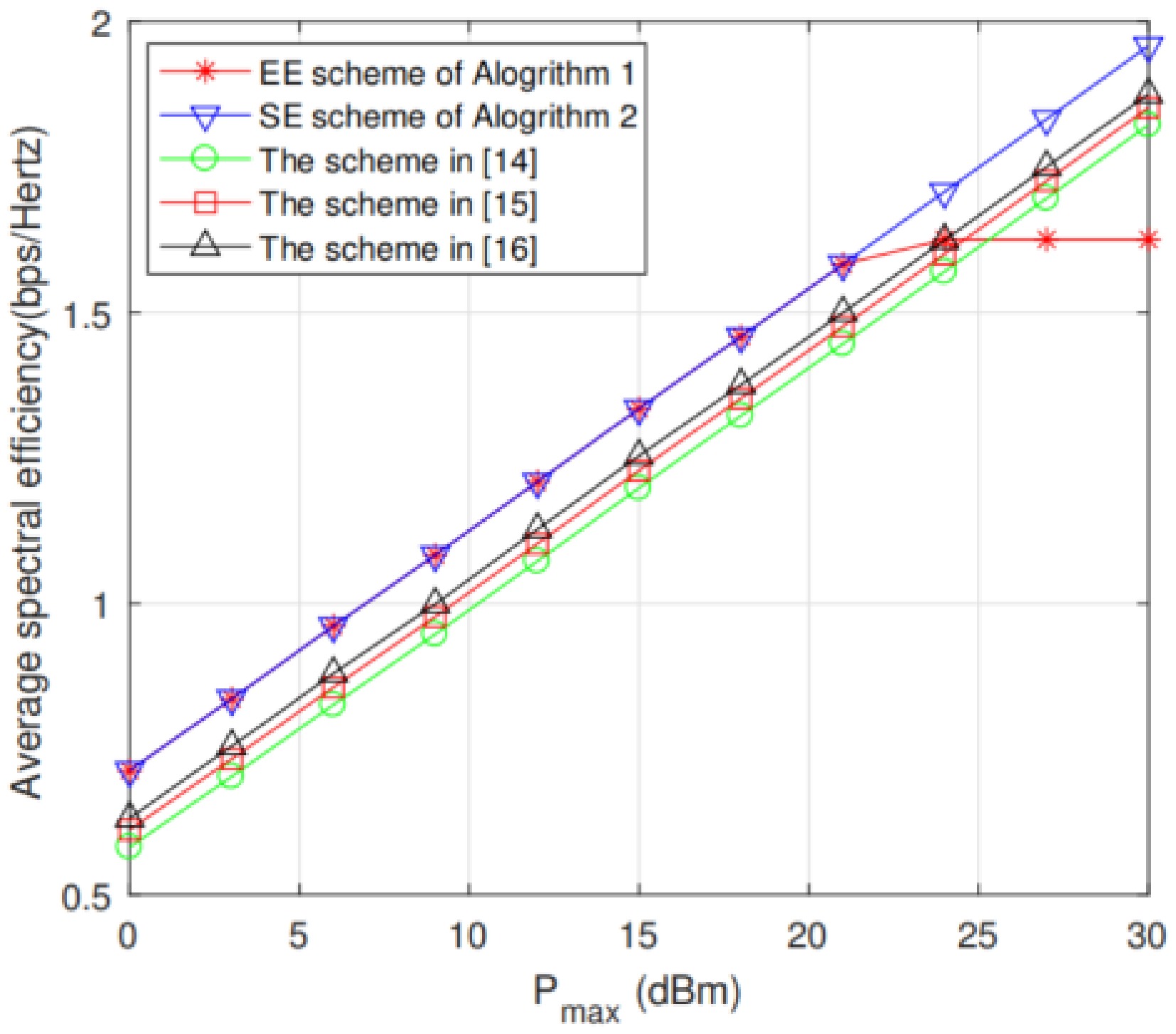
Figure 3.
Different resource allocation algorithms based on SE.
-
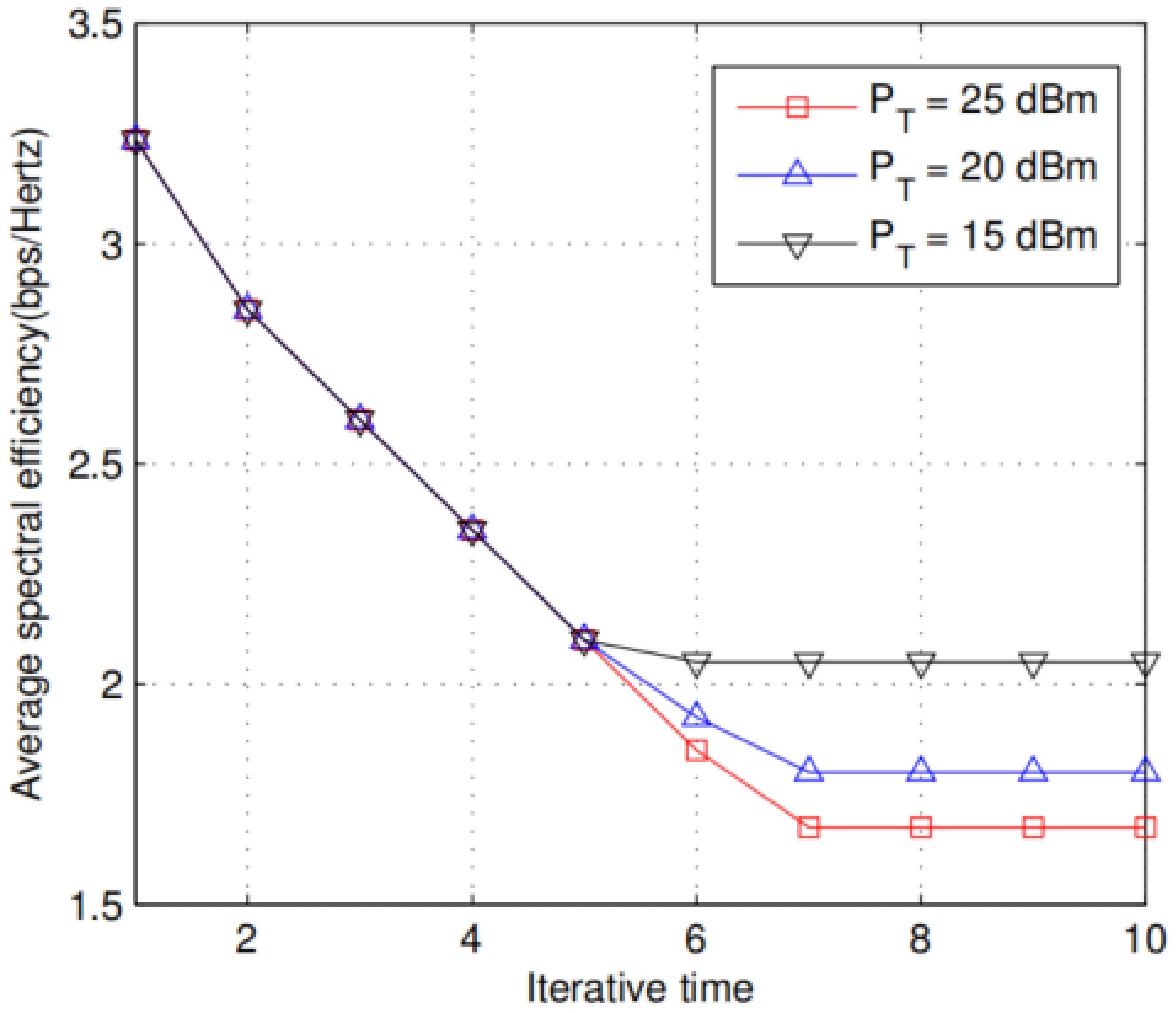
Figure 4.
The SE convergence of the proposed algorithm.
-
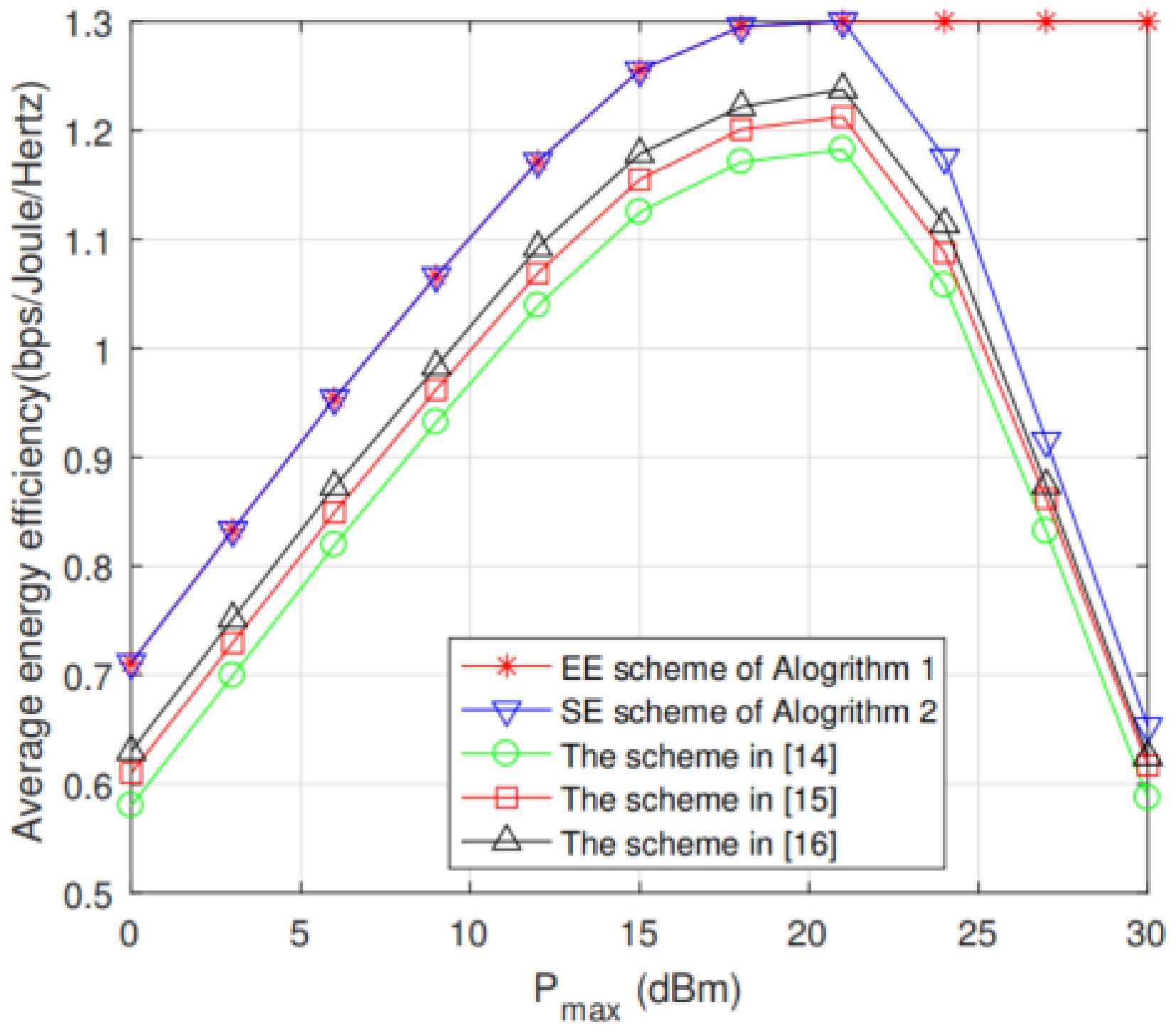
Figure 5.
Comparison of EE performance of different resource allocation algorithms.
-
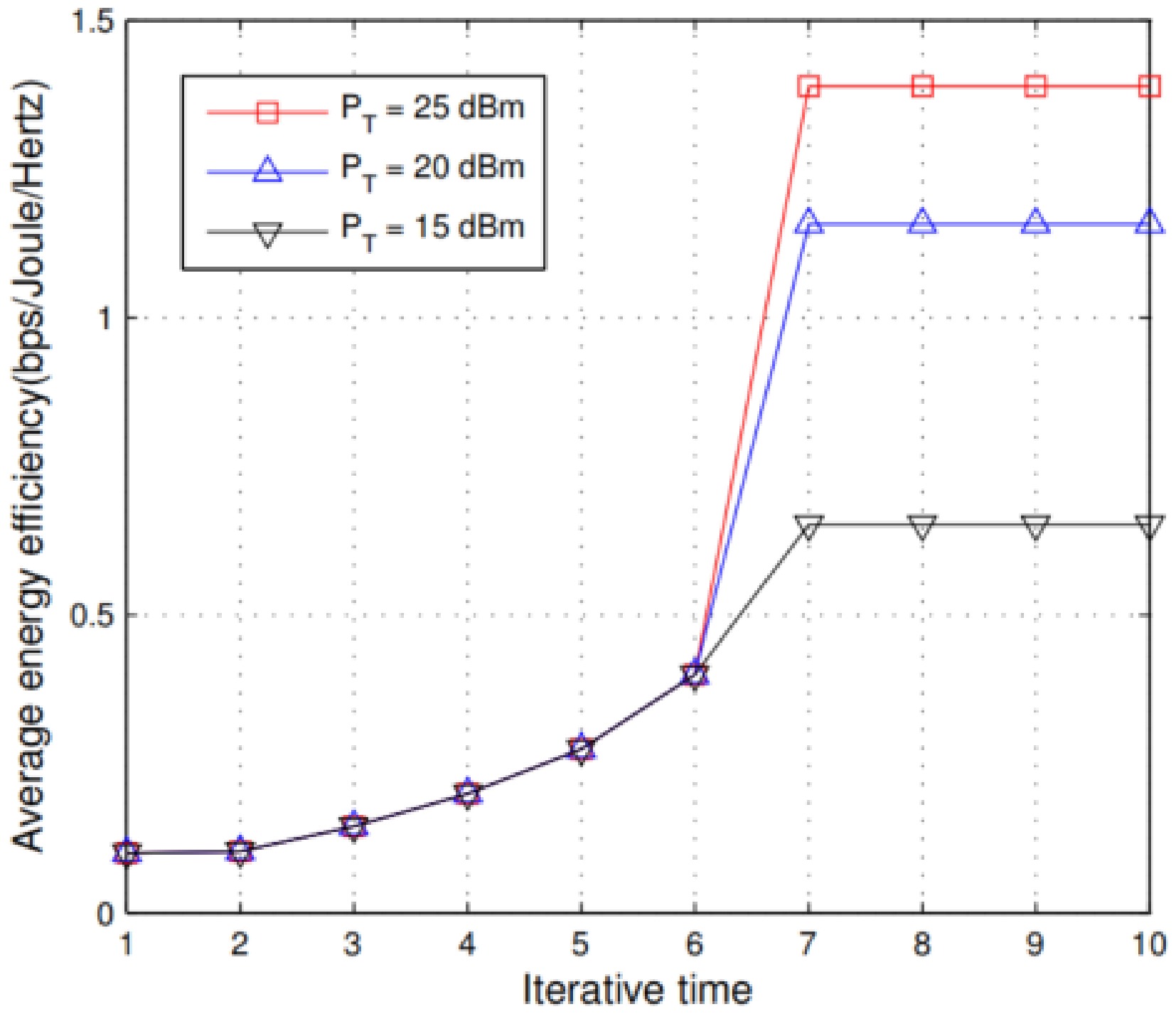
Figure 6.
The energy efficiency convergence of the proposed algorithm.
-
1. Initialize. 2. Set the iteration termination times $ N_{outer}^{max} $ $ {\varpi }_{outer} $ $ {\eta }_{0}=0 $ $ n=0 $ 3. Loop body: 4. Update iteration index $ n=n+1 $ 5. Solving the Optimization Problem $ F({\eta }_{n-1})=\underset{\mathbf{\Phi },\mathbf{P}}{\max }\left[{R}_{total}(\mathbf{\Phi },\boldsymbol{P})-{\eta }_{n-1}{\mathbf{P}}_{total}(\mathbf{\Phi },\mathbf{P})\right] $ $ \left\{{\mathbf{\Phi }}^{*},{\mathbf{P}}^{*}\right\} $ 6. Calculate the energy efficiency under the current iterative index using $ \left\{{\mathbf{\Phi }}^{*},{\mathbf{P}}^{*}\right\} $ $ {\eta }_{n}={R}_{total}({\mathbf{\Phi }}^{*},{\boldsymbol{P}}^{\text{*}})/{\mathbf{P}}_{total}({\mathbf{\Phi }}^{*},{\mathbf{P}}^{*}) $ 7. End Condition: $ \left| {\eta }_{n}-{\eta }_{n-1}\right| < {\varpi }_{outer} $ $ n > N_{outer}^{max} $ 8. Output optimal solution $ \left\{{\eta }^{*},{\mathbf{\Phi }}^{*},{\mathbf{P}}^{*}\right\} $ Table 1.
Energy efficiency optimization iterative algorithm.
-
1. Initialize: Set the maximum number of outer loop iterations Mmax, the dual variables $ \mu $ $ \lambda $ 2. Outer Loop: 3. Initialize the maximum number of inner loop iterations Nmax and $ {\tau _I} $ 4. According to Eq. (37) and ε(i, j), and using the golden section method, calculate A(i, j); 5. Inner Loop: 6. Calculate ϕ(i, j) according to Eq. (46) and Hungarian algorithm; 7. Update $ {\tau _I} $ 8. Through n = n + 1, update the inner loop iteration factor n; 9. End condition of inner loop: Inner loop convergence or n = Nmax. 10. According to Eq. (46), $ {\tau _I} $ 11. Use the sub-gradient method to update $ \mu $ $ \lambda $ $ {\tau _I} $ 12. Through m = m + 1, update the outer loop iteration factor m; 13. End condition of outer loop: Outer loop convergence or m = Mmax. 14. Calculate $ P_i^{S1} $ $ P_{i,j}^{S2} $ $ P_{i,j,k}^R $ 15. Calculate Pi,j using Eqs (31)−(33). 16. Output $ \Phi $ Table 2.
Energy-efficient inner resource allocation algorithm, solving the optimization problem F(ηn−1).
Figures
(6)
Tables
(2)