-
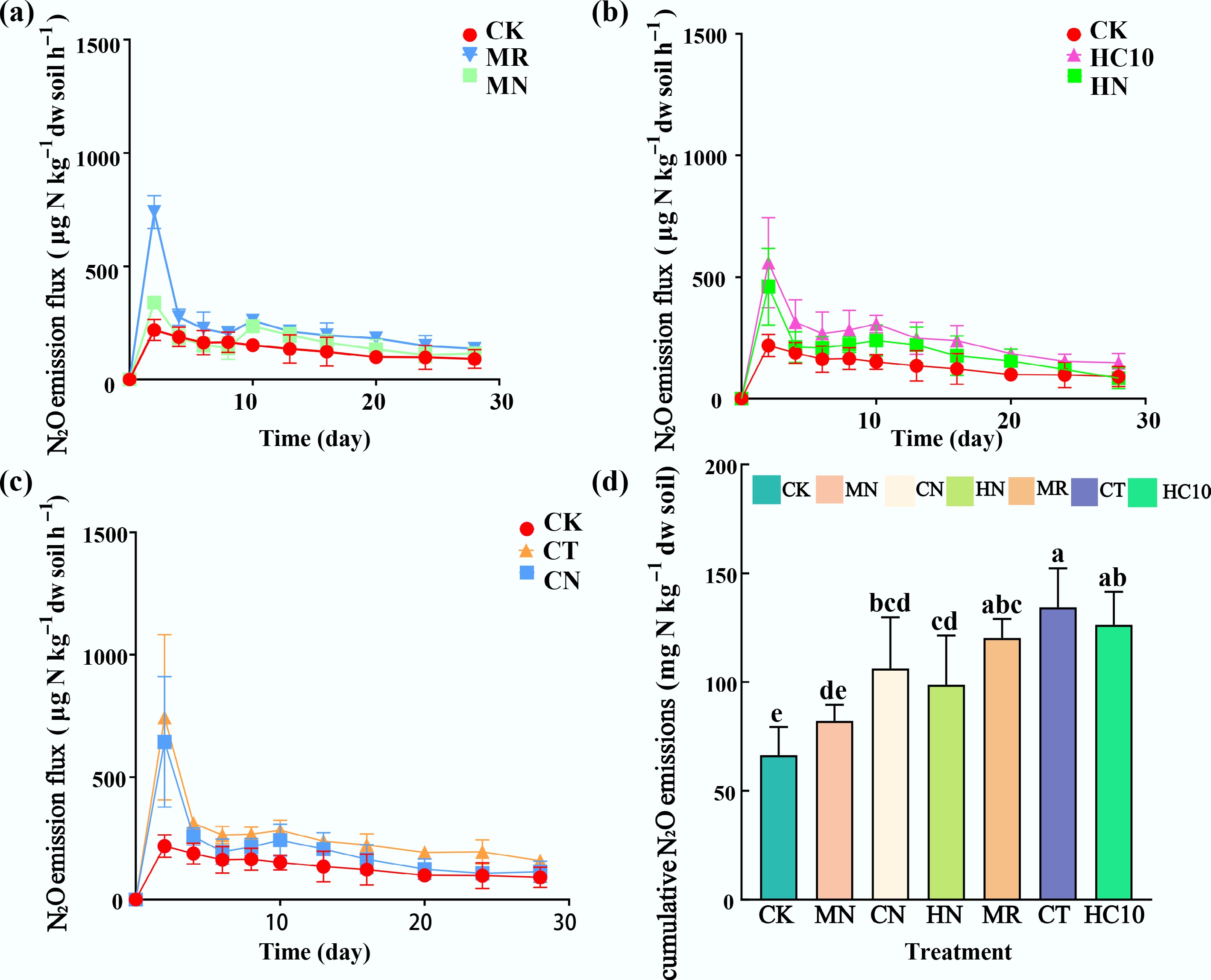
Figure 1.
(a)–(c) N2O emission flux, and (d) cumulative emission from soil. Different small letters above the bar indicated significant differences among treatments at the 5% level. CK: no fertilizer, MR: mushroom residue organic manure, CT: high-temperature pretreated compost, HC10: hydrothermal carbonized organic manure, MN: mushroom residue organic manure with NRCB010, CN: high-temperature pretreated compost with NRCB010, HN: hydrothermal carbonized organic manure with NRCB010.
-
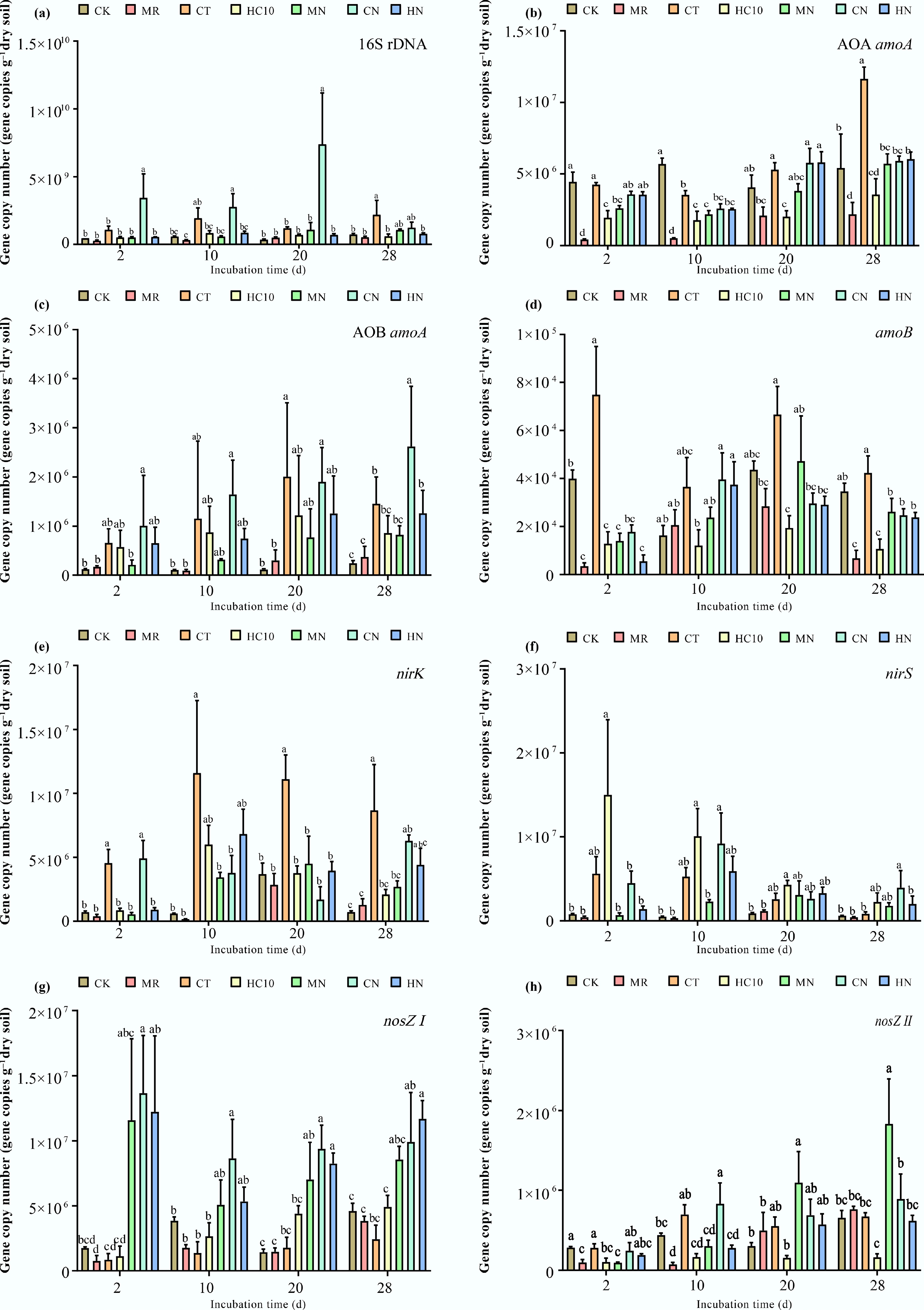
Figure 2.
Abundance of nitrogen cycling functional genes in soils. (a) The abundance of 16S rDNA in soils. (b) The abundance of AOA amoA genes in soils. (c) The abundance of AOB amoA genes in soils. (d) The abundance of amoB genes in soils. (e) The abundance of nirS genes in soils. (f) The abundance of f nirK genes in soils. (g) The abundance of nosZI genes in soils. (h) The abundance of nosZII genes in soils. Different lowercase letters above the bar indicated significant differences among treatments at the 5% level. CK: no fertilizer, MR: mushroom residue organic manure, CT: high-temperature pretreated compost, HC10: hydrothermal carbonized organic manure, MN: mushroom residue organic manure with NRCB010, CN: high-temperature pretreated compost with NRCB010, HN: hydrothermal carbonized organic manure with NRCB010.
-
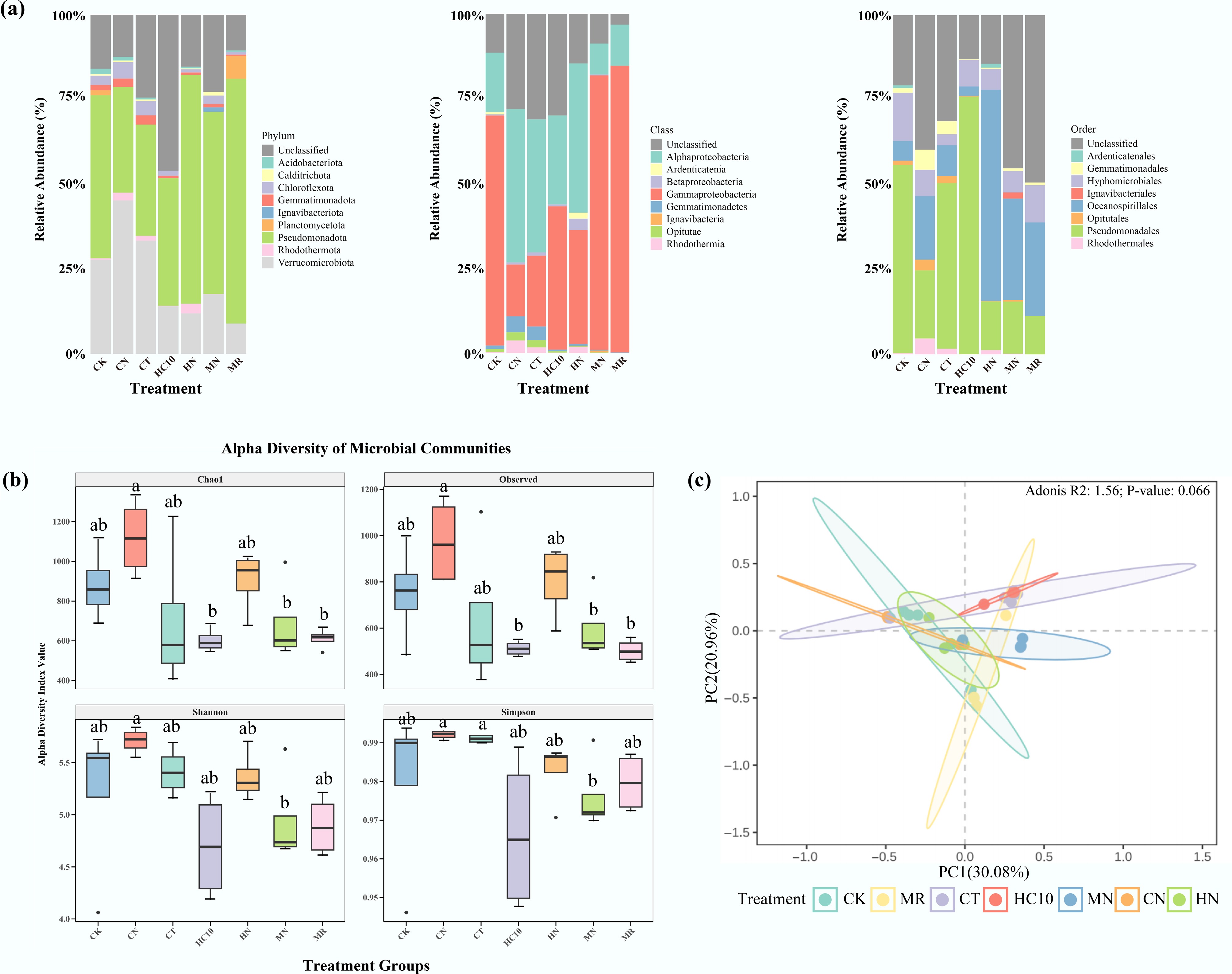
Figure 3.
Community composition of nosZI carrying microorganisms at (a) phylum, (b) class, and (c) order levels, and their (d) α diversity, and (e) β diversity in soils. CK: no fertilizer, MR: mushroom residue organic manure, CT: high-temperature pretreated compost, HC10: hydrothermal carbonized organic manure, MN: mushroom residue organic manure with NRCB010, CN: high-temperature pretreated compost with NRCB010, HN: hydrothermal carbonized organic manure with NRCB010.
-
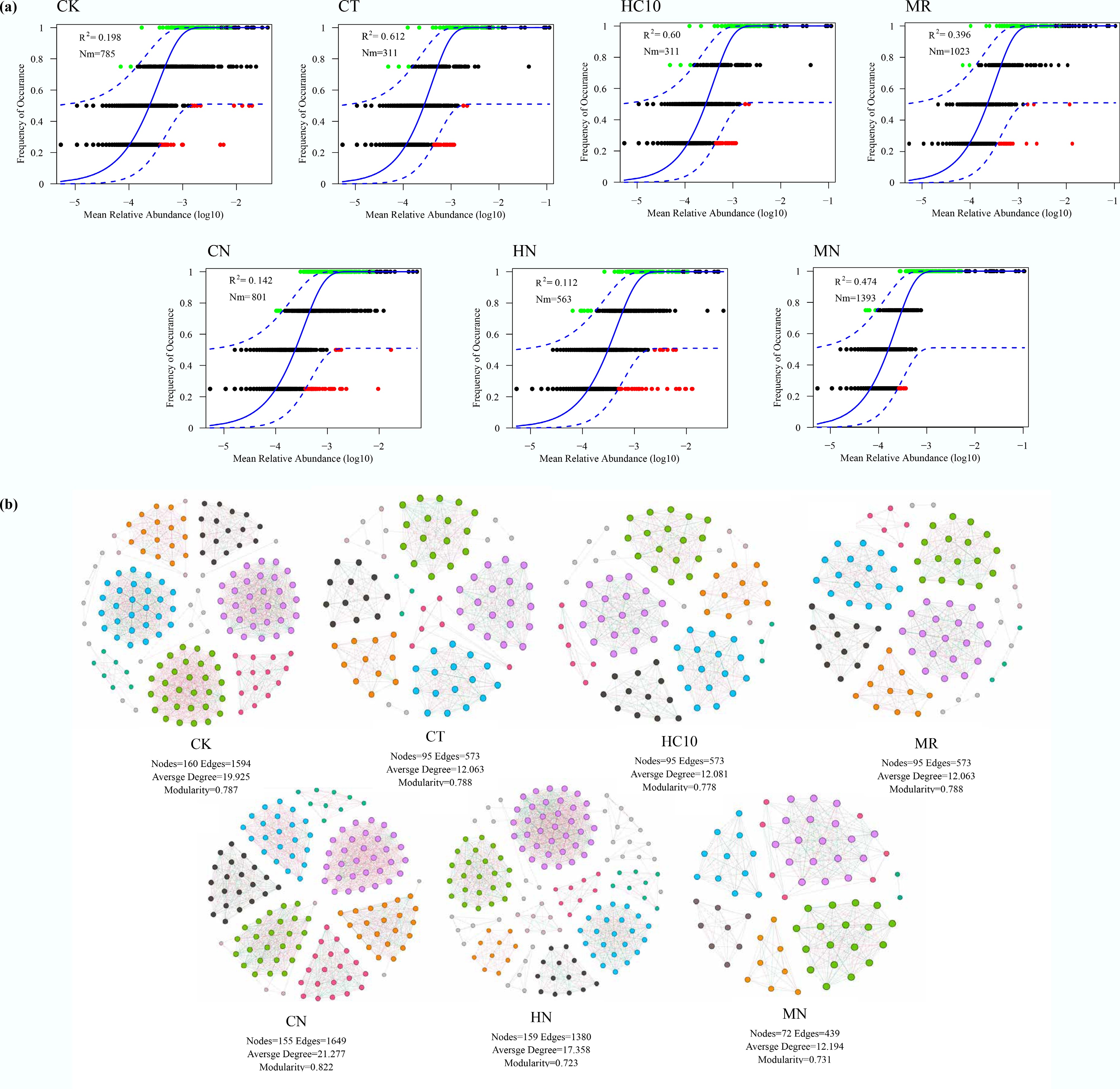
Figure 4.
The community assembly based on (a) neutral theory, and (b) co-occurrence network of nosZI carrying microorganisms. R2 indicates the model fit, and Nm represents the product of metacommunity size and migration time. CK: no fertilizer, MR: mushroom residue organic manure, CT: high-temperature pretreated compost, HC10: hydrothermal carbonized organic manure, MN: mushroom residue organic manure with NRCB010, CN: high-temperature pretreated compost with NRCB010, HN: hydrothermal carbonized organic manure with NRCB010.
-
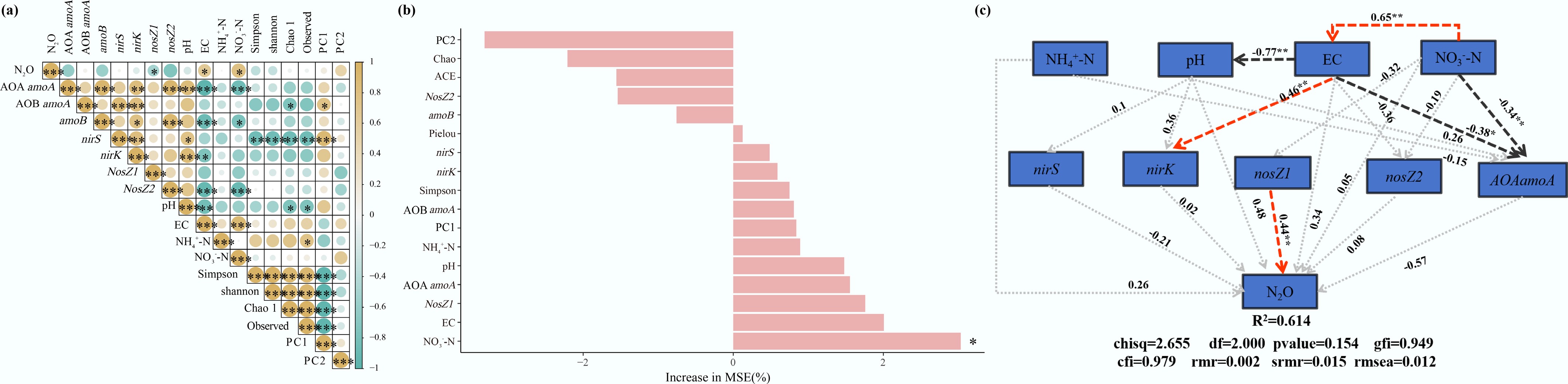
Figure 5.
(a) Correlation analysis, (b) random forest model, and (c) structural equation model analyses of environmental factors and N2O emissions from greenhouse vegetable soils. The red arrows and black arrows show positive and negative relationships, respectively. The numbers above the lines are standardized path coefficients. The width of the arrows is proportional to the strength of the path coefficients. * Significance at the p < 0.05 level, ** significance at the p < 0.01 level, and *** significance at the p < 0.001 level.
-
Time Treatment pH (H2O) EC (mS·cm−1) NO3−-N (mg·kg−1) NH4+-N (mg·kg−1) 2 d CK 7.11 ± 0.02abc 2.84 ± 0.34e 28.41 ± 2.97e 11.44 ± 0.33b MR 6.97 ± 0.07d 6.18 ± 0.23a 68.15 ± 8.22ab 49.39 ± 9.93a CT 7.10 ± 0.06abc 3.70 ± 0.34d 48.77 ± 5.17cd 43.71 ± 13.14a HC10 7.07 ± 0.07bc 5.25 ± 0.28b 82.96 ± 14.95a 13.74 ± 0.95b MN 7.02 ± 0.06cd 4.45 ± 0.25c 50.95 ± 3.36bcd 42.28 ± 18.05a CN 7.15 ± 0.07ab 3.34 ± 0.46d 42.65 ± 7.54de 43.76 ± 21.72a HN 7.18 ± 0.08a 3.77 ± 0.37d 64.31 ± 24.38bc 13.28 ± 2.82b 10 d CK 6.81 ± 0.10d 3.45 ± 0.62d 31.78 ± 7.40e 8.62 ± 0.61c MR 6.82 ± 0.10d 5.96 ± 0.44a 85.35 ± 6.43a 51.28 ± 15.77a CT 7.12 ± 0.06b 3.49 ± 0.15d 46.26 ± 3.69cde 54.40 ± 17.12a HC10 6.93 ± 0.02c 4.92 ± 0.41b 39.08 ± 4.16de 26.78 ± 17.36bc MN 7.12 ± 0.04b 4.14 ± 0.28c 55.68 ± 20.75b 41.97 ± 25.72ab CN 7.24 ± 0.06a 3.25 ± 0.21d 50.64 ± 8.50bcd 51.48 ± 7.24a HN 7.15 ± 0.04ab 3.09 ± 0.34d 61.88 ± 8.70b 32.22 ± 12.32ab 20 d CK 6.67 ± 0.1d 4.14 ± 0.5c 28.91 ± 4.9b 11.39 ± 9.9b MR 6.79 ± 0.1c 6.08 ± 0.3a 53.392 ± 10.6a 28.37 ± 13.1a CT 6.94 ± 0.02b 3.56 ± 0.3d 49.23 ± 11.6a 30.46 ± 7.7a HC10 6.88 ± 0.03bc 4.99 ± 0.6b 61.70 ± 9.5a 22.89 ± 6.4ab MN 7.05 ± 0.1a 4.44 ± 0.3c 50.64 ± 8.2a 34.76 ± 17.1a CN 7.12 ± 0.1a 3.22 ± 0.3d 48.33 ± 11.5a 26.58 ± 10.6ab HN 7.07 ± 0.1a 3.55 ± 0.2d 50.18 ± 9.4a 29.18 ± 2.6a 28 d CK 7.42 ± 0.1a 2.86 ± 0.5c 34.98 ± 2.5c 8.45 ± 1.6c MR 6.97 ± 0.1bc 5.77 ± 1.0a 60.02 ± 12.7a 12.13 ± 1.1c CT 7.06 ± 0.1b 3.01 ± 0.1c 51.38 ± 6.1a 43.23 ± 10.4a HC10 6.84 ± 0.04c 4.63 ± 0.2b 57.71 ± 4.4a 14.28 ± 1.8c MN 6.85 ± 0.1c 4.08 ± 0.4b 51.59 ± 3.8ab 32.18 ± 11.6b CN 6.86 ± 0.2c 2.95 ± 0.4c 44.21 ± 8.78bc 35.45 ± 9.3ab HN 6.91 ± 0.1bc 2.62 ± 0.2c 45.61 ± 9.4bc 16.63 ± 3.7ac CK: no fertilizer, MR: mushroom residue organic manure, CT: high-temperature pretreated compost, HC10: hydrothermal carbonized organic manure, MN: mushroom residue organic manure with NRCB010, CN: high-temperature pretreated compost with NRCB010, HN: hydrothermal carbonized organic manure with NRCB010. Different lowercase letters indicate significant differences among treatments at the 5% level. Table 1.
Physicochemical properties of soil
Figures
(5)
Tables
(1)