-
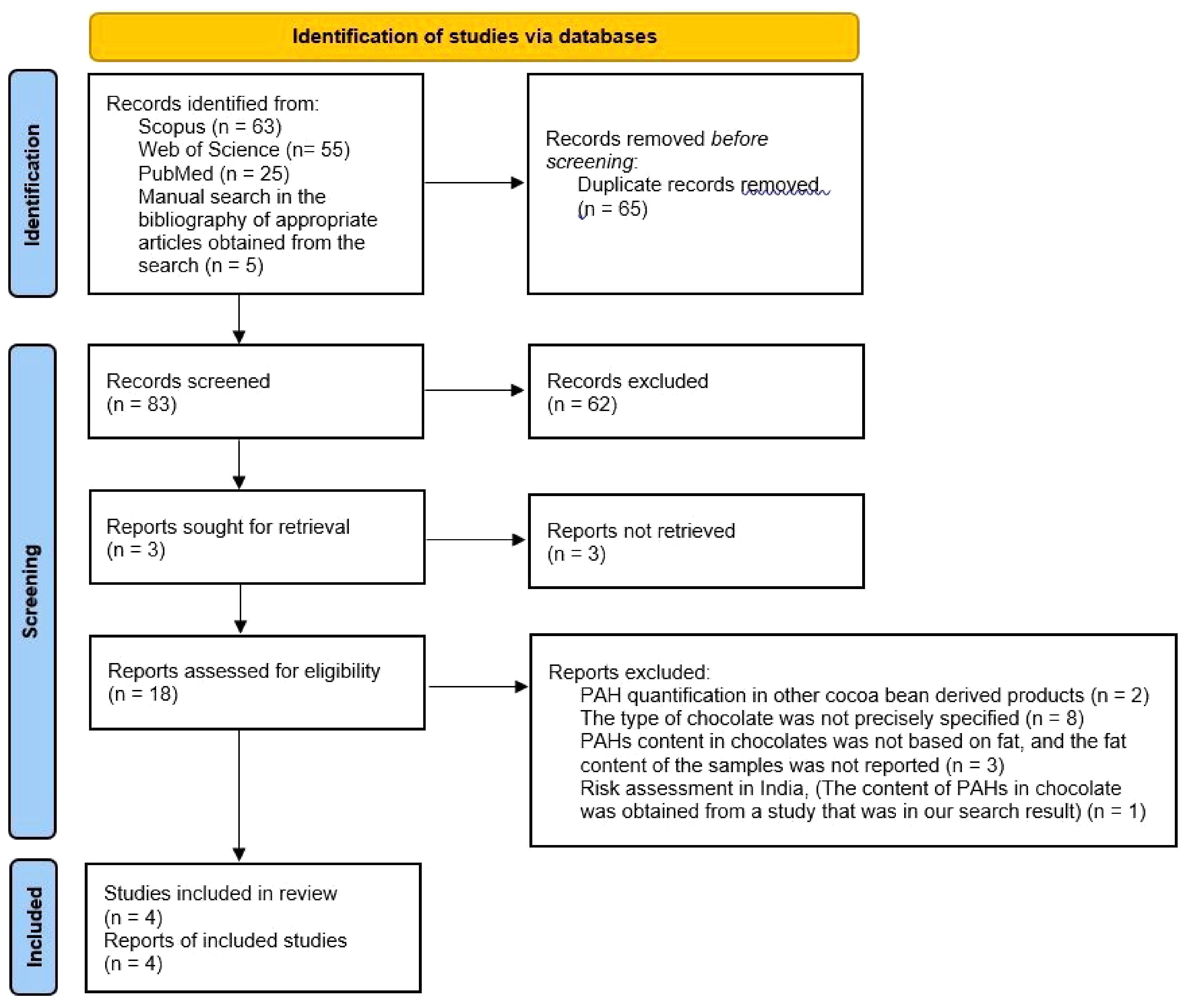
Figure 1.
The PRISMA flow diagram of the study.
-
Country Type of chocolate/s Sample
sizeFat content
(%)Detection method Mean content of PAH4 & B[a]P
(μg/kg fat)Max of B[a]P
& PAH4
(μg/kg fat)Comparing with
EC regulation
No. 2023/915Main findings Ref. Brazil White chocolate 10 32.26 HPLC/FLDa PAH4: 20.53 B[a]P: 2.31 PAH4: 46.24 B[a]P: 6.62 Two white chocolate samples and one 70 % cocoa chocolate sample exceeded the ML of PAH4 and B[a]P. The major PAH for all samples was Chr. Women and adolescents were more exposed to PAHs due to the high consumption of chocolate. Totally, according to findings chocolate consumption presents low potential
health risks.[24] Milk chocolate 14 32.10 PAH4: 14.46 B[a]P: 1.00 PAH4: 26.22 B[a]P: 2.61 40 % cocoa chocolate 4 26.90 PAH4: 15.73 B[a]P: 0.79 PAH4: 26.38 B[a]P: 1.87 53% to 60% cocoa chocolate 3 35.01 PAH4: 16.52 B[a]P: 1.64 PAH4: 24.16 B[a]P: 3.13 70% cocoa chocolate 4 36.56 PAH4: 27.24 B[a]P: 4.56 PAH4: 37.48 B[a]P: 7.94 Dark chocolate undeclared cocoa 3 47.28 PAH4: 13.12 B[a]P: 1.56 PAH4: 15.45 B[a]P: 3.32 Latvia Dark chocolate samples with cocoa content in a range of 41–77% 26 30−66 HPLC/HRMSb PAH4: 4.24 B[a]P: 0.71 PAH4: 16.07 B[a]P: 2.90 PAH4 and B[a]P of all samples were lower than the ML. In all of the chocolate samples, the concentration of Chr and B[a]A were relatively higher than B[a]P and B[b]F. Also, Chr was the predominant PAH (ranging from 0.37−7.39 μg/kg fat) while B[a]P was just detected in 77% of samples. [2] Germany Milk chocolate/chocolate coatings 27 − HPLC/FLD PAH4: 10.11 B[a]P: 0.70 PAH4:17.08 B[a]P: 1.96 PAH4 and B[a]P of all samples were lower than the ML. The lowest and highest PAH4 was for cocoa mass and cocoa butter, and the lowest and highest B[a]P was for cocoa mass and raw cocoa, respectively. Among cocoa and chocolate products B[a]P of cocoa powder and cocoa drink powder were higher than chocolates but totally all were below the ML. Among PAH4, Chr followed by B[a]A were higher than B[a]P and B[b]F in cocoa butter, cocoa mass,
and raw cocoa.[22] Dark chocolate/chocolate coatings 69 PAH4: 5.88 B[a]P: 0.57 PAH4: 17.42 B[a]P: 1.56 Polish chocolate factory Cocoa bean imported from: Dominican Republic (Varc. Trinitario) Roasted at 160 °C Dark chocolate 9 chocolate samples of every kind of cocoa bean and roasting condition 32−43 HPLC/FLD ndd − PAH4 of all samples was way lower than the ML. B[a]P and B[b]F were not detected in any of the samples. Chr was slightly higher than B[a]A. The highest contents of PAH4 were for roasted cocoa beans, cocoa mass, and cocoa butter, and the lowest contents were for raw cocoa beans and chocolate. Light PAHs were predominant in any kind of cocoa bean products. Cocoa beans and their derived products especially chocolate are stated to be not a threat to consumer's health. [6] Ecuador (Var. Nacional) Roasted at 160 °C 1.24 ± 0.12 Ghana (Var. Forastero) Roasted at 160 °C 1.29 ± 0.14 Ivory Coast (Var. Forastero) Roasted at 160 °C 0.47 ± 0.16 Nicaragua (Var. Trinitario) Roasted at 160 °C nd Nicaragua (Var. Trinitario) Roasted at 140 °C nd Venezuela (Var. Criollo) Roasted at 160 °C 1.03 ± 0.16 Venezuela (Var. Criollo) Roasted at 140 °C 0.91 ± 0.18 a FLD (fluorescence detector); b HRMS (high-resolution mass spectrometer); c Var. (variety); d nd (not detected). Table 1.
Intended data extracted from selected papers.
Figures
(1)
Tables
(1)