-

Figure 1.
The relationship between the molar ratio of H/C and O/C and pyrolysis temperature (Van Krevelen Diagram)[49].
-
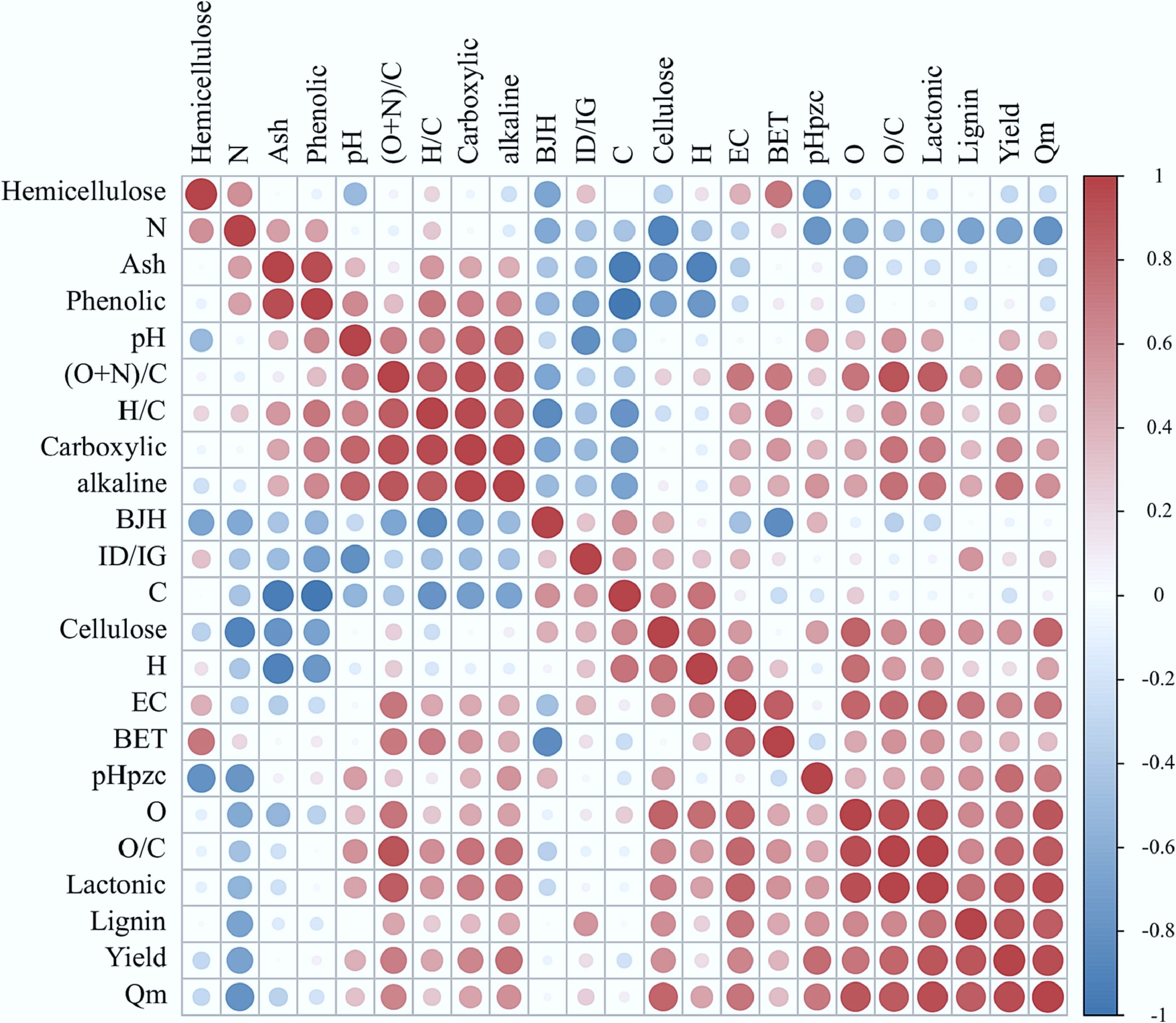
Figure 2.
The Spearman correlation matrix of physicochemical properties of the TCMHR biochar[31].
-
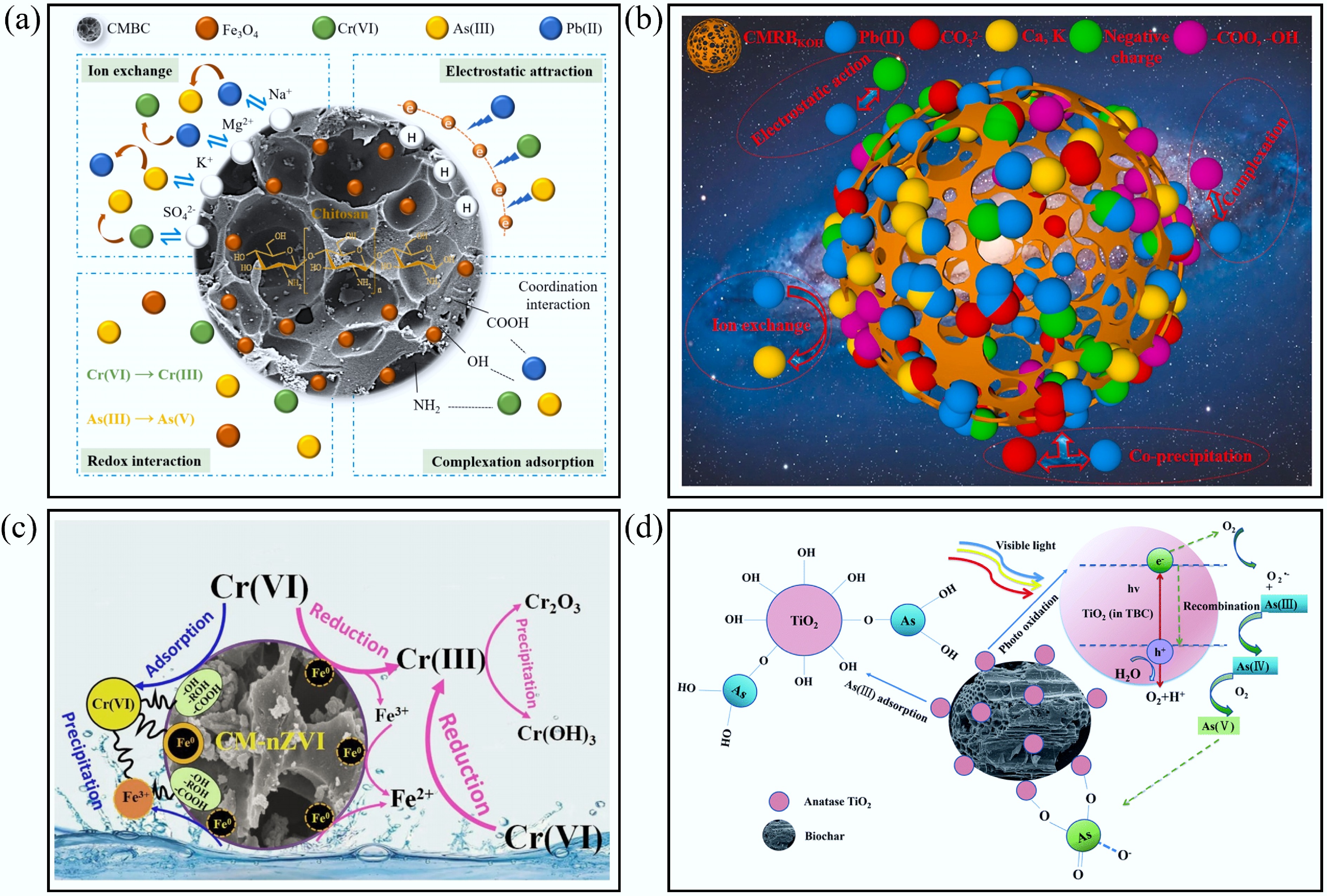
Figure 3.
Typical adsorption mechanisms of heavy metal ions by biochar composites. (a) The mechanism of adsorption of As(III), Pb(II), and Cr(VI) by CMBC[30]. (b) Possible mechanisms of Pb(II) sorption onto CMRBKOH[75]. (c) The reaction mechanism for the removal of Cr(VI) by CM-nZVI[78]. (d) The removal mechanisms of As(III) from aqueous solution by TBC[29].
-
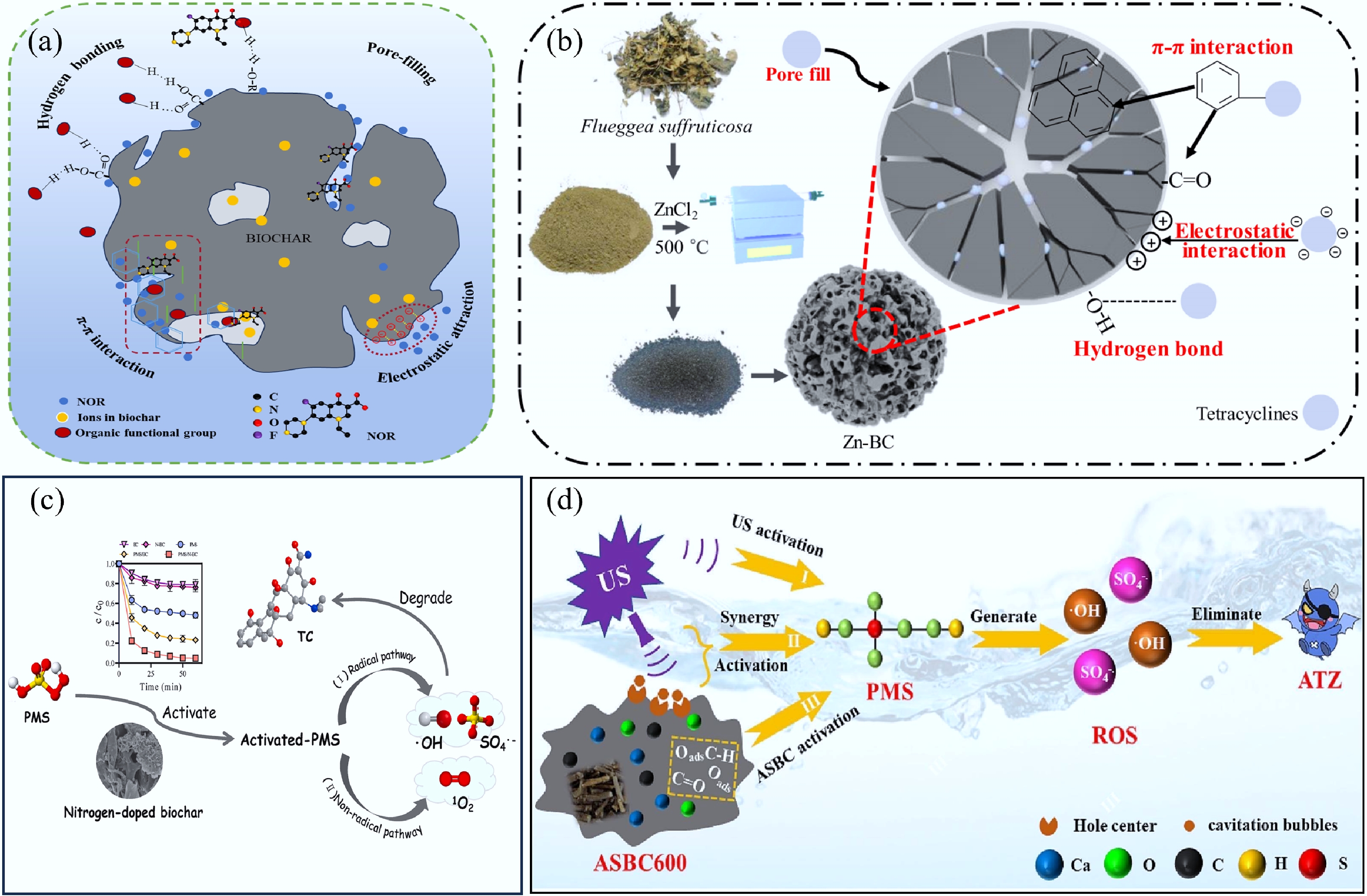
Figure 4.
Typical adsorption mechanisms of organic pollutants by biochar composites. (a) The NOR adsorption mechanisms of ABLB4[63]. (b) Diagram of the Zn-BC preparation and adsorption mechanism[73]. (c) The mechanism of tetracycline removal by N-BC[87]. (d) The mechanism of atrazine removal by ASBC[88].
-
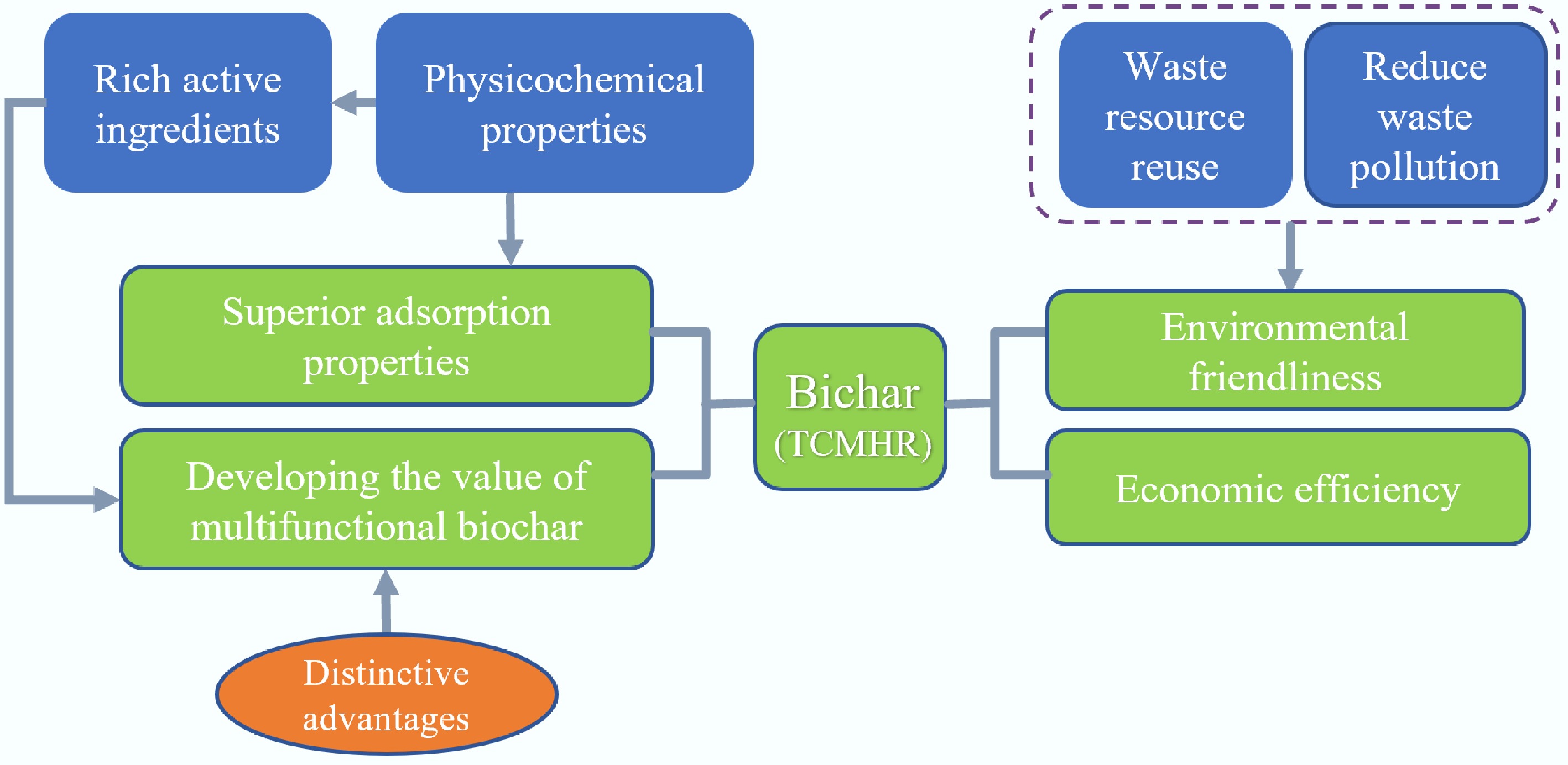
Figure 5.
Advantages and characteristics of TCMHR biochar in pollutant removal.
-
Biomass Pyrolysis temperature (°C) Residence time (h) Heating rate (°C/min) Pyrolysis mode Target pollutant Related TCM* Ref. Saussurea involucrata 200–600 2 5 Mild pyrolysis and
high pyrolysisMethyl red (MR) and methyl orange (MO) SAUSSUREAE INVOLUCRATAE HERBA [60] TCM raw material (Forsythia suspensa, Honeysuckle, combination) 700 2 h 5 High pyrolysis Tetracycline (TC) LONICERAE JAPONICAE FLOS, FORSYTHIA FRUCTUS [61] Chrysanthemum residues
(Chuju, Chrysanthemum morifolium)300–700 2 5 Mild pyrolysis and
high pyrolysisQuercetin (QR) CHRYSANTHEMI FLOS [62] Atropa belladonna L. (ABL) 899.85 1–5 5 High pyrolysis Norfloxacin (NOR) BELLADONNAE HERBA [63] Ligusticum chuanxiong Hort. 500 2 10 Mild pyrolysis Cr(VI), As(III),
and Pb(II)CHUANXIONG RHIZOMA [30] Codonopsis pilosula (DGS), Astragalus membranaceus (HQ), Angelica sinensis (DG),
Ligusticum striatum (CX),
Salvia miltiorrhiza (DNS).500 2 − Mild pyrolysis Pb(II) SALVIAE MILTIORRHIZAE RADIX ET RHIZOMA, CHUANXIONG RHIZOMA, ANGELICAE SINENSIS RADIX, CODONOPSIS RADIX, ASTRAGALI RADIX [31] Danshen residue
(dried root of Salvia miltiorrhiza Bunge.)250–800 3 − Mild pyrolysis and
high pyrolysisSulfamethoxazole (SMX) SALVIAE MILTIORRHIZAE RADIX ET RHIZOMA [3] The root of Clematis chinensis Osbeck 500 2 5 Mild pyrolysis Tetracycline (TC) CLEMATIDIS RADIX ET RHIZOMA [2] Codonopsis pilosula (Dangshen) and Angelica sinensis (Danggui) 300–750 2 3–6 Mild pyrolysis and
high pyrolysisMetolachlor CODONOPSIS RADIX, ANGELICAE SINENSIS RADIX [5] Astragalus mongholicus residues 400 3 − Mild pyrolysis Cr(VI) ASTRAGALI RADIX [53] Astragalus membranaceus residue 700 3 − High pyrolysis Ciprofloxacin (CIP) ASTRAGALI RADIX [23] Waste Chinese traditional medicine dregs containing Acanthopanax senticosus, ginseng and Astragalus 450 1 10 Mild pyrolysis As(III) ACANTHOPANACIS SENTICOSI RADIX ET RHIZOMA SEU CAULIS, GINSENG RADIX ET RHIZOMA, ASTRAGALI RADIX [29] Forsythia and honeysuckle 400–600 1 10 Mild pyrolysis and
high pyrolysisChlortetracycline (CTC) FORSYTHIAE FRUCTUS, LONICERAE JAPONICAE FLOS [48] Chinese medicine residues (CMR) contained Polygonum multiflorum, Uncaria, etc. 450–650 2 − Mild pyrolysis and
high pyrolysisAmmonium (NH4+−N) POLYGONI MULTIFLORI RADIX, UNCARIAE RAMULUS CUM UNCIS [64] Raw medicinal residues contained folium eriobotryae, liquorice, platycodon grandiflorum, rhizome typhonii flagelliformis, etc. 600 1 20 High pyrolysis Element mercury (Hg) ERIOBOTRYAE FOLIUM, GLYCYRRHIZAE RADIX ET RHIZOMA, etc. [65] The mixture of polygonatum sibiricum and other herb residues 300–600 2 − Mild pyrolysis and
high pyrolysisPb(II) POLYGONATI RHIZOMA [66] Honeysuckle residue (HR) 400 3 − Mild pyrolysis Cr(VI) LONICERAE JAPONICAE FLOS [67] Chinese medicine residues (CMRs) mainly contain Astragalus, Panax ginseng, licorice, Chen Pi, dry ginger, Ginkgo biloba, etc. 300–700 2 10 Mild pyrolysis and
high pyrolysisHeavy metals
(Cu, Cd and Pb)GINSENG RADIX ET RHIZOMA, ASTRAGALI RADIX, GLYCYRRHIZAE RADIX ET RHIZOMA, ZINGIBERIS RHIZOMA, GINKGO FOLIUM, etc. [68] 100–300 °C: Low pyrolysis; 300–500 °C: Mild pyrolysis; 500–900 °C: High pyrolysis. * Pharmacopoeia of the People's Republic of China (Edition 2020) related Traditional Chinese Medicine (TCM). Table 1.
Biochar preparation method from TCMHR
-
Raw material T (°C) Yield (%) Ash (%) BET (m2/g) Vtotal (cm3/g) pH H/C O/C Ref. Saussurea involucrata 200 95.77 ± 0.77 − 1.6525 0.009217 − − − [60] 300 94.18 ± 0.92 − 1.8538 0.005995 − − − 400 93.23 ± 1.12 − 2.1093 0.005432 − − − 500 92.34 ± 0.88 − 3.0227 0.011160 − − − 600 91.48 ± 0.79 − 1.9364 0.005603 − − − Chrysanthemum residues (Chuju, Chrysanthemum morifolium) 300 52.13 14.85 0.427 0.001943 − 0.074 0.795 [62] 500 38.65 28.52 1.397 0.007105 − 0.063 0.690 700 27.55 31.02 2.390 0.007992 − 0.051 0.516 Danshen residues (dried root of Salvia miltiorrhiza Bunge.) 250 91.90 14.70 3.80 − 6.7 0.240 0.641 [3] 400 37.90 28.30 49.20 0.0420 10.2 0.108 0.165 600 31.20 31.10 51.30 0.0510 10.1 0.039 0.052 800 29.10 37.10 70.30 0.0680 10.6 0.007 0.064 Angelica sinensis (Danggui) and Codonopsis pilosula (Dangshen) 300 − 49.46 3.24 0.0116 7.4 0.870 0.310 [5] 500 − 54.70 54.28 0.0534 9.7 0.480 0.180 750 − 57.65 85.30 0.0803 9.8 0.240 0.170 Radix Isatidis residues 300 − 18.37 4.45 0.0075 7.5 0.079 0.240 [44] 500 − 19.66 8.50 0.0125 7.8 0.033 0.116 700 − 23.42 11.80 0.0178 8.1 0.023 0.055 Chinese medicine residues (CMR) contained Polygonum multiflorum, Uncaria, etc. 450 − 25.64 13.46 0.0072 − 0.060 0.280 [64] 550 − 17.59 12.07 0.0112 − 0.040 0.250 650 − 22.17 14.67 0.0132 − 0.030 0.200 Table 2.
Effects of pyrolysis temperature on the physicochemical properties of biochar derived from TCMHR
-
Type Material Synthesis method Composite particle Contaminant Best fit
kinetic modelBest fit isotherm model Ref. Loading magnetic compositions Astragalus membranaceus residue Biochar was added to a solution containing ferric chloride hexahydrate and ferrous sulphate, then NaOH solution (10 mol/L) was added to raise the pH to 10.5, finally stirred at 25 °C, 1 h under nitrogen atmosphere Fe3O4 Cr(VI) Pseudo-second-order Langmuir [53] Astragalus membranaceus residue Added biochar into Ferric and ferrous (Fe3+/Fe2+) mixed solutions, then stirred for 60 min at 25 °C, under a N2 atmosphere at 10.5 pH adjusting by NaOH solution Fe2O3, Fe3O4 Ciprofloxacin (CIP) Pseudo-second-order Langmuir [23] The root of Clematis chinensis Osbeck Chemical co-precipitation method: added BC into a solution containing Mn2+ and MnO4−, then exposed to outdoor conditions for a period of 24 h MnO2 Tetracycline (TC) Pseudo-second-order Langmuir and Freundlich [2] Herb residue Biomass powder was immersed in diluted waste liquor from the pickling of steel, then slow stirring for 12 h, finally pyrolyzed at 600 °C in an N2 atmosphere for
2 h at a timeFe3O4 and
γ-Fe2O3Hexavalent chromium
(Cr(VI))Pseudo-second-order Langmuir [70] Chinese medicine residue (CMR) from a pharmacy in Zhengzhou, China The magnetic biochar was obtained from Fe2+/Fe3+ co-precipitation method, then added the magnetic biochar into Al(NO3)3 solution (0.5 mol/L), next, added NaOH solution (3 mol/L) to the mixture until the pH = 5, finally stirred for 30 min for complete reaction Al/Fe3O4 Aqueous fluoride Pseudo-second-order Freundlich [72] Astragalus membranaceus residues Herb biochar was dissolved in Fe2+ solution and stirred 2 h under N2, then added dropwise the NaBH4 solution, finally stirred another 60 min under N2 n-ZVI particles Cr(VI) Pseudo-second-order − [24] Nanoscale-metal assistant Honeysuckle residue (HR) Added biochar into a solution containing ferric chloride with the solid–liquid ratio 1:20 (W/V), then stirred for 8 h at 150 rpm Fe3C particles Cr(VI) Pseudo-second-order Langmuir [67] Waste Chinese traditional medicine dregs containing Acanthopanax senticosus, ginseng and Astragalus TiO2−loaded biochar (TBC) was synthesized by a modified solgel method: BC was added into a solution containing concentrated hydrochloric acid, butyl titanate and anhydrous ethanol, anhydrous ethanol was added dropwise into the mixture and the solution was slowly stirred until it had formed a gel. Finally, aging at 25 °C for 24 h without light and dried at 60 °C for 24 h TiO2 Arsenic (III) Pseudo-
second-orderSips [29] The residue of Flueggea suffruticosa Biomass was impregnated with ZnCl2
(2.75 mol/L), then stirred for 1 h and dried, finally pyrolyzed at 500 °C for 90 minZinc chloride (ZnCl2) Tetracycline (TC), chlortetracycline (CTC) and oxytetracycline (OTC) Pseudo-
second-orderLangmuir
(TC, CTC, OTC)[73] Surface modification A membranaceus residue Biomass was impregnated with Na2CO3
(10 wt%) for 24 h and dried at 105 °C, finally pyrolyzed at 800 °C for
1.5 h under N2 atmosphereNa2CO3 Cefradine (CF) in wastewater Pseudo-
second-orderFreundlich [74] Glutinous Rehmannia, Codonopsis pilosula,
Pseudo-ginseng,
Rhizoma GastrodiaeHerbal dregs biochar and potassium hydroxide solids were blended at various ratios, added deionized water, stirred and placed in an oven to dry, then heated in a tube furnace, 150 mL of 30% hydrochloric acid solution was slowly mixed with 10 g of the above product, stirred for 3 h at
70 °C and washed to neutralityKOH Pb(II) Pseudo-second-order Langmuir [75] Saussurea involucrata The drug residue was impregnated in a 10% Na2CO3 solution (1:8) for 24 h. The drug residue was accurately weighed, and the modified carbon was washed with
0.1 mol of HClNa2CO3 Methyl red and methyl orange Pseudo-second-order − [60] Table 3.
Diverse techniques for modifying composite biochar derived from TCMHRs
-
Material Contaminants Modification method pH Best fit kinetic model Best fit isotherm model Adsorption capacity
(mg/g)Sorption mechanism Ref. The TCMHR were collected from a pharmacy Cr(VI) Zinc chloride (ZnCl2) and Iron based waterworks sludge (IBWS) pH = 2 Pseudo-second-order Langmuir 27.04 Physisorption, chemisorption reduction [79] Chinese medicine residue Pb(II) HCl/KOH pH = 5 Pseudo-second-order Langmuir 74.38 Coordination, co-precipitation, surface complexation, electrostatic attraction, ion exchange [75] Astragalus membranaceus (HQ), Codonopsis pilosula (DGS), Angelica sinensis (DG), Ligusticum striatum (CX), Salvia miltiorrhiza (DNS) Pb(II) − − Pseudo-second-order Langmuir 36.42 Complexation with oxygen-containing functional groups, ion exchange,
precipitation[31] Ligusticum chuanxiong Hort. residues Cr(VI)
As (III)
Pb(II)Fe3O4/
Chitosan (CTS)pH = 4 Pseudo-second-order Langmuir 65.74
49.32
69.45Redox interactions, complexation adsorption. Ion exchange, electrostatic attraction. [30] Astragalus membranaceus residue Cr(VI) Fe3O4 pH = 2 Pseudo-second-order Langmuir 45.45 − [53] Astragalus membranaceus residue Cr(VI) nZVI pH = 2 Pseudo-second-order − − Reduction and coprecipitation [24] The TCMHR mainly included acanthopanax senticosus, ginseng and Astragalus As(III) Nano-TiO2 − Pseudo-second-order Langmuir 58.46 O2 acted as an electron accepter and O2•− dominated the oxidation of As(III). [29] Chicken manure and Chinese medicine residue Pb(II) KH2PO4 pH = 6 Pseudo-second-order Langmuir 599.40 Surface complexation,
ions exchange, coprecipitation,[76] Turkish gall (TG) residue Pb(II) − − Pseudo-second-order − − − [56] Honeysuckle residue Cr(VI) FeCl3 pH = 2 Pseudo-second-order Langmuir 13.70 Physical adsorption,
chemical adsorption[67] Herb residue Cr(VI) Fe3O4 and
γ-Fe2O3Pseudo-second-order Langmuir 11.73 Reduction, complexed [70] Chinese medicine residue was collected in a hospital Cu(II) Nano-hydroxyapatite (nHAP) − − Freundlich 61.96 − [80] Table 4.
Removal of inorganic pollutions by biochar derived from TCMHRs
-
Biomass Contaminant Modification method pH Qm (mg/g) Sorption mechanism Ref. Chinese herbal medicine Tetracycline (TC) MnO2 pH = 3 131.49 Physical adsorption and chemical interactions [2] Salvia miltiorrhiza Bge residue Methylene blue (MB) Citric acid and Na2CO3 pH = 7 161.29;
178.57− [4] Astragalus membranaceus residue Ciprofloxacin (CIP) Fe3O4 pH = 6 68.93 − [23] Astragalus mongholicus residue Ciprofloxacin (CIP) − pH = 7 43.67 − [81] Astragalus membranaceus residue Cefradine (CF) Na2CO3 pH = 3 64.76 Ion exchange, electrostatic adsorption, π-π EDA interaction and hydrogen bonding [74] Astragali radix Tetracycline (TC) ZnCl2 pH = 6 930.3 π-π interaction, electrostatic attraction, hydrogen bonding and pore diffusion [82] Flueggea suffruticosa residue Oxytetracycline (OTC) ZnCl2 pH = 7 129.90 Hydrogen bonding and electrostatic interaction [73] Chinese medicine residue was collected in a hospital Tylosin (TYL) Nano-hydroxyapatite (nHAP) pH = 6 50.02 − [80] Honeysuckle residue Chlortetracycline (CTC) Biochar-microbial (Bacillus subtilis) complexes pH = 7 − Biochar adsorption and microbial degradation [48] Chinese medicine residue was collected in a hospital Tylosin (TYL), sulfamethoxazole (SMX) Nano-hydroxyapatite (nHAP) − TYL: 52.02;
SMX: 51.22Surface adsorption [96] Forsythia suspensa, Honeysuckle, combination Tetracycline (TC) − − 36.92 Electrostatic interaction, π–π interaction, pore filling and hydrogen bonding [61] Atropa belladonna L. Norfloxacin (NOR) − pH = 7.4 − Electrostatic interaction, hydrogen bonding, pore diffusion and π–π interaction [63] Mulberry waste
(Chinese medicine residue)Tetracycline hydrochloride (TC) Ball milling pH = 4 103.7 − [97] Table 5.
Removal of organic pollutants by biochar derived from TCMHRs
Figures
(5)
Tables
(5)