-
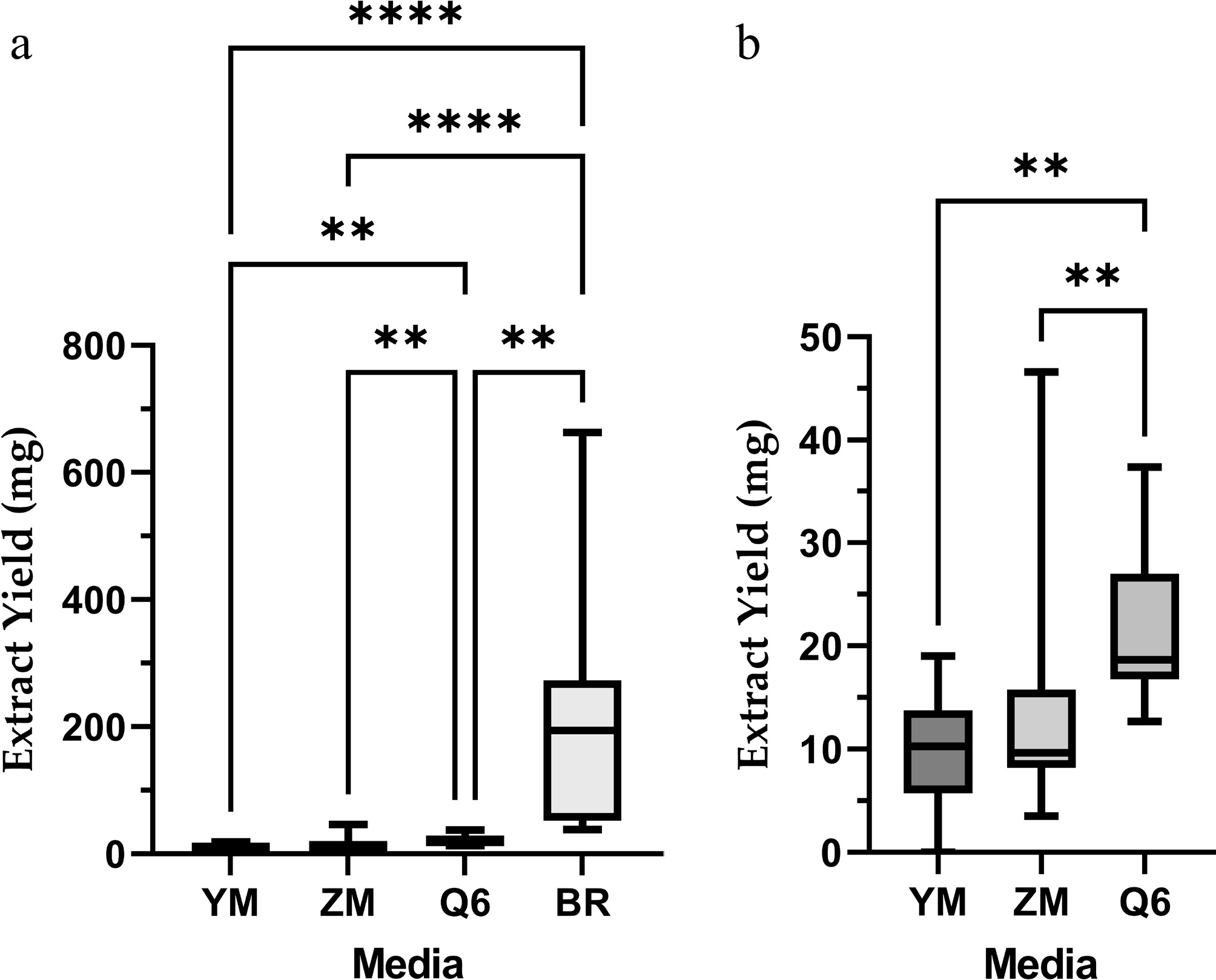
Figure 1.
(a) Mass of secondary metabolites produced by 12 fungal isolates cultivated in different media: YM = yeast malt medium; ZM = ZM ½ media; Q6 = Q6 ½ media; BR = brown rice media. (b) Enlarged view of panel (a) showing YM, ZM, and Q6. Statistical significance is denoted as follows: ** p < 0.01; **** p < 0.0001.
-
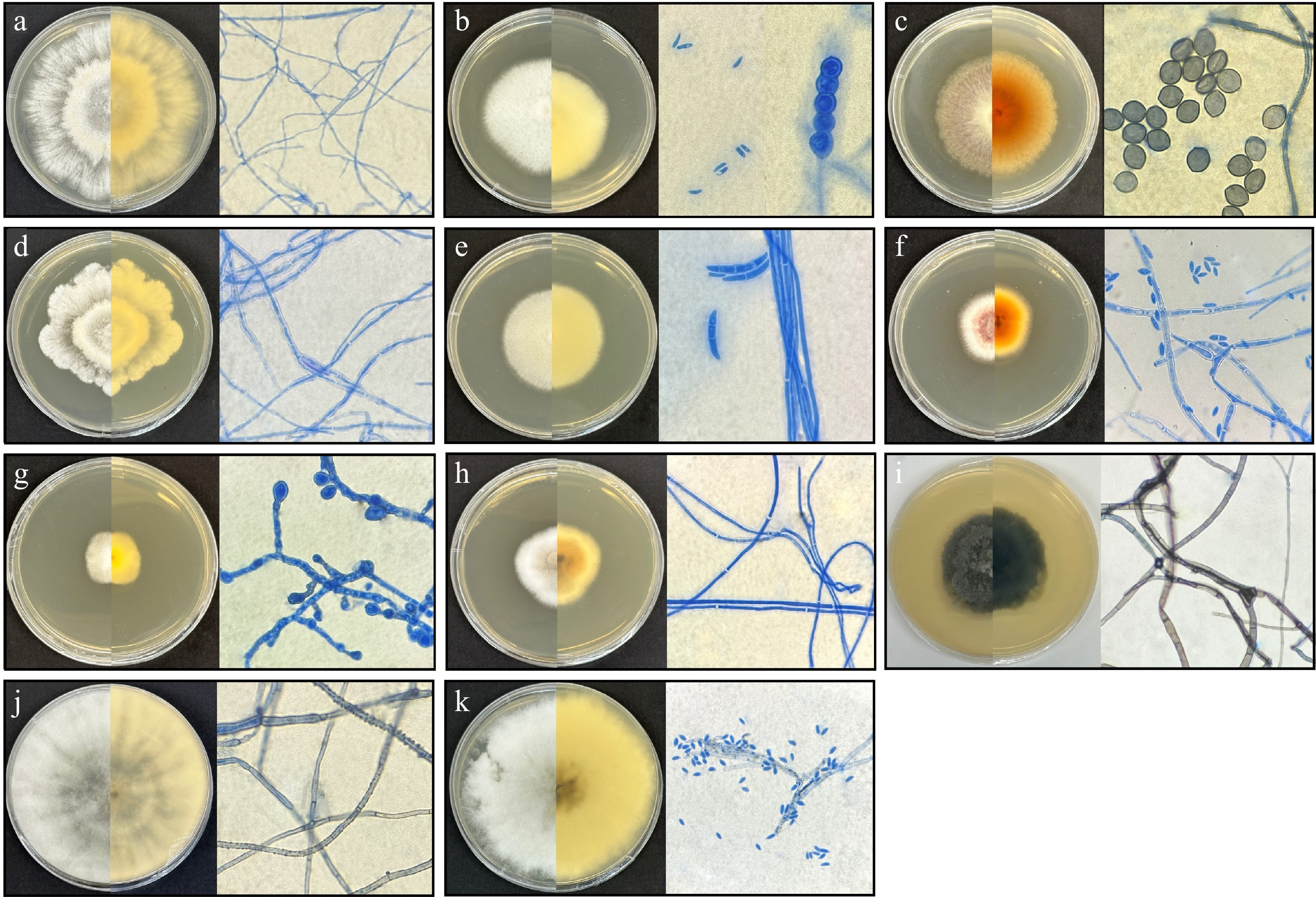
Figure 2.
Culture morphology and microscopic morphology of active endophytic fungi observed under a compound light microscope at 1,000× magnification (oil immersion objective). (a) NA-001-Lv-C. (b) NA-001-Lv-D. (c) NA-001-Lv-E. (d) NA-001-Lv-F. (e) NA-001-Lv-G. (f) NA-001-St-B. (g) NA-001-St-D. (h) NA-001-St-H. (i) NA-002-Lv-X. (j) NA-002-St-C. (k) NA-003-St-C.
-
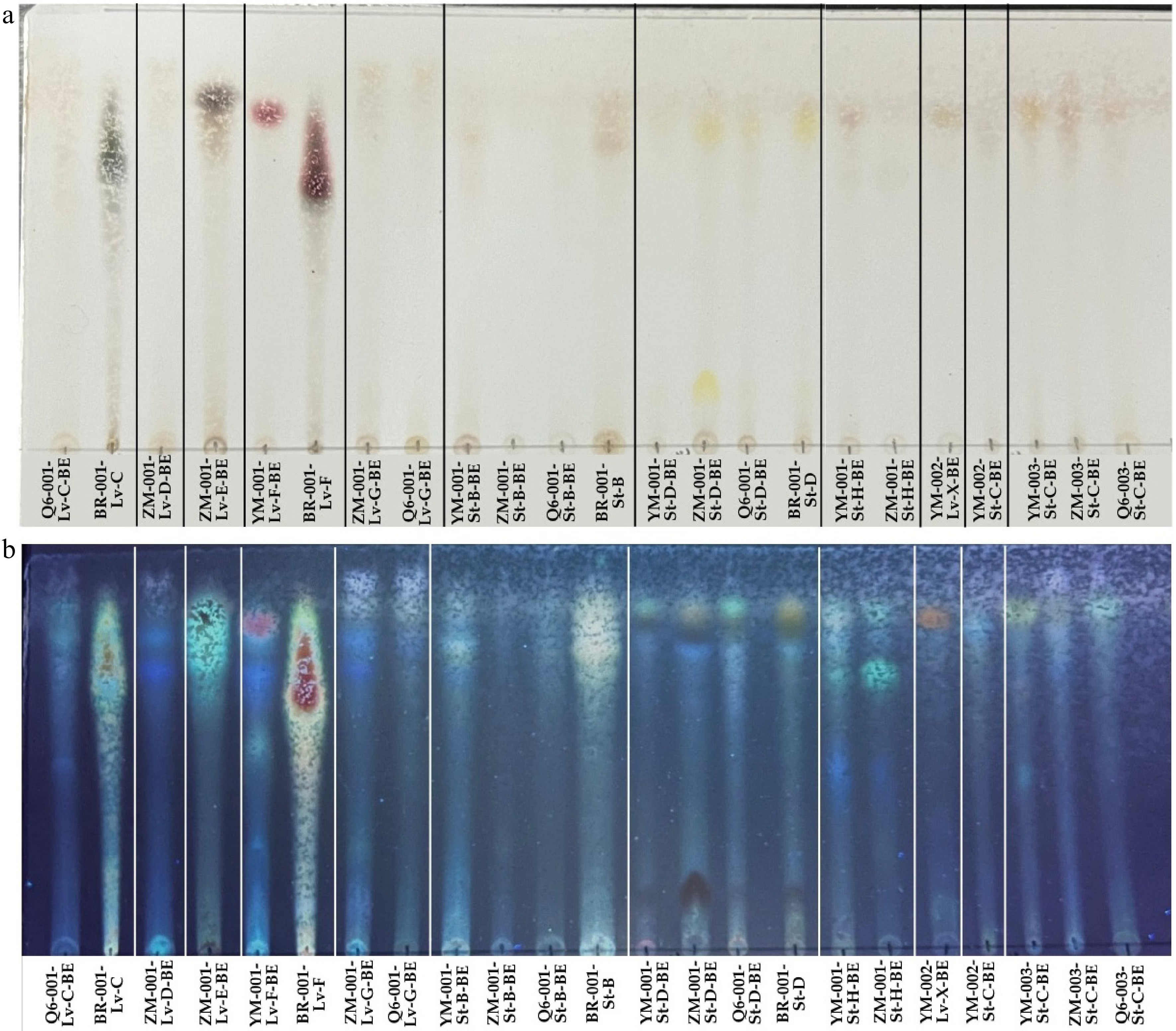
Figure 3.
TLC profile of active crude fungal extracts. The TLC plate was viewed under (a) visible light, and (b) 365 nm using 7:2 EtOAc-MeOH solvent system and ethanol sulfuric acid spray reagent for derivatization. Active extracts were separated per fungal isolates by solid lines.
-
Plant code Host plant Plant part Total number of isolates Endophytic fungus code of selected isolates 001 O. cumingiana Leaves 7 NA-001-Lv-C NA-001-Lv-D NA-001-Lv-E NA-001-Lv-F NA-001-Lv-G Stem 7 NA-001-St-B NA-001-St-D NA-001-St-H 002 A. cagayanensis Leaves 6 NA-002-Lv-X Stem 6 NA-002-St-C 003 P. arborea Leaves 3 − Stem 4 NA-003-St-C 017 D. clusiflorum var. megalanthum Leaves 7 KA-017-Lv-A Stem 2 − Total 42 12 − indicates none. Table 1.
Endophytic fungi isolated from the leaves and stems of Philippine endemic Annonaceae species.
-
Isolate code Extract code Extract yield (mg) MIC (µg/mL) Ef Sa Kp Ab Pa Eh NA-001-Lv-C YM-001-Lv-C-BE 7.3 − − − − − − ZM-001-Lv-C-BE 3.5 u u u u u u Q6-001-Lv-C-BE 37.4 − − − − 1,000 62.5 BR-001-Lv-C 54.3 − 62.5 − − − − NA-001-Lv-D YM-001-Lv-D-BE 5 u u u u u u ZM-001-Lv-D-BE 9.8 − − − 1,000 500 − Q6-001-Lv-D-BE 16.7 − − − − − − BR-001-Lv-D 38.2 − − − − − − NA-001-Lv-E YM-001-Lv-E-BE No growth u u u u u u ZM-001-Lv-E-BE 46.6 − − 7.81 1,000 − − Q6-001-Lv-E-BE 16.9 − − − − − − BR-001-Lv-E 195.7 − − − − − − NA-001-Lv-F YM-001-Lv-F-BE 13.1 − − − − − 250 ZM-001-Lv-F-BE 10.3 − − − − − − Q6-001-Lv-F-BE 18.4 − − − − − − BR-001-Lv-F 193.3 − 62.5 − − − − NA-001-Lv-G YM-001-Lv-G-BE 5.2 u u u u u u ZM-001-Lv-G-BE 9.1 − − − − 250 − Q6-001-Lv-G-BE 17.1 − − − − 500 − BR-001-Lv-G 41.9 − − − − − − NA-001-St-B YM-001-St-B-BE 12.1 − − − − 500 − ZM-001-St-B-BE 9.5 − − − 500 1,000 − Q6-001-St-B-BE 14.7 − − − 1,000 125 − BR-001-St-B 296.2 − − − − 250 − NA-001-St-D YM-001-St-D-BE 14 − 1,000 − 250 1,000 − ZM-001-St-D-BE 17.2 − 1,000 − 7.81 62.5 − Q6-001-St-D-BE 18.9 − − − 500 62.5 − BR-001-St-D 202.3 − 125 15.63 250 7.81 250 NA-001-St-H YM-001-St-H-BE 10.5 − − 15.63 500 1,000 − ZM-001-St-H-BE 8.5 1,000 1,000 7.81 500 − − Q6-001-St-H-BE 23.6 − − − − − − BR-001-St-H 51.4 − − − − − − NA-002-Lv-X YM-002-Lv-X-BE 18.3 1,000 125 − − 1,000 − ZM-002-Lv-X-BE 7.9 − − − − − − Q6-002-Lv-X-BE 12.7 − − − − − − BR-002-Lv-X 122.5 − − − − − − NA-002-St-C YM-002-St-C-BE 7.3 − − − 250 − 500 ZM-002-St-C-BE 8.1 − − − − − − Q6-002-St-C-BE 28.1 − − − − − − BR-002-St-C 195.9 − − − − − − NA-003-St-C YM-003-St-C-BE 28.2 500 62.5 − 125 1,000 1,000 ZM-003-St-C-BE 13.7 − − − 500 500 − Q6-003-St-C-BE 14.5 − 62.5 − 250 1,000 − BR-003-St-C 196.4 − − − − − − KA-017-Lv-A YM-017-Lv-A-BE 19.1 − − − − − − ZM-017-Lv-A-BE 12 − − − − − − Q6-017-Lv-A-BE 21.1 − − − − − − BR-017-Lv-A 663.1 − − − − − − Culture media: YM = yeast malt medium; ZM = ZM ½ media; Q6 = Q6 ½ media; BR = brown rice media. ESKAPE pathogens: Ef = E. faecium; Sa = S. aureus; Kp = K. pneumoniae; Ab = A. baumannii; Pa = P. aeruginosa; Eh = E. hormaechei; − = no antibacterial activity; u = untested; Amikacin (28 µg/mL) was used as positive control for E. faecium and ciprofloxacin (28 µg/mL) was used as positive control for other ESKAPE pathogens. The extract with the most promising antibacterial activity is in bold. Table 2.
Extract yield and minimum inhibitory concentrations (MIC, µg/mL) of selected endophytic fungal isolates of Annonaceae species against ESKAPE pathogens.
-
Extract code IC50 (µg/mL) %RSA ± SD Q6-001-Lv-C-BE − 13.52 ± 2.28 BR-001-Lv-C − 31.26 ± 5.99 ZM-001-Lv-D-BE 102.7 72.31± 0.94 ZM-001-Lv-E-BE 56.03 77.06 ± 0.27 YM-001-Lv-F-BE − 48.77 ± 2.23 BR-001-Lv-F − 28.36 ± 2.92 ZM-001-Lv-G-BE 65.85 68.74 ± 1,74 Q6-001-Lv-G-BE 87.47 58.67 ±2.86 YM-001-St-B-BE ND 54.34 ± 0.58 ZM-001-St-B-BE ND 56.65 ± 0.62 Q6-001-St-B-BE 200.9 58.02 ± 4.49 BR-001-St-B ND 52.04 ± 0.82 YM-001-St-D-BE ND 62 ± 1.67 ZM-001-St-D-BE 133.6 61.46 ± 0.52 Q6-001-St-D-BE 205.2 74.28 ± 1.34 BR-001-St-D 443.6 82.31 ± 1.28 YM-001-St-H-BE 435.7 88.99 ± 2.12 ZM-001-St-H-BE ND 53.16 ± 0.89 YM-002-Lv-X-BE 213.5 98.85 ± 0.23 YM-002-St-C-BE 121 59.85 ± 0.94 YM-003-St-C-BE ND 91.73 ± 1.11 ZM-003-St-C-BE − 11.33 ± 3.31 Q6-003-St-C-BE 63.29 61.32 ± 4.39 AA 1.18 76.79 ± 1.04 BHT 24.57 78.59 ± 0.82 − = no antioxidant activity; ND = not determined; BHT= Butylated hydroxytoluene; AA= Ascorbic acid The extract with the most promising antioxidant activity is in bold. Table 3.
IC50 values (µg/mL), and radical scavenging activity of anti-ESKAPE active extracts (at 1,000 µg/mL), AA, and BHT in DPPH assay.
-
Extract code % Inhibition Q6-001-Lv-C-BE 0 BR-001-Lv-C 0 ZM-001-Lv-D-BE 16% ZM-001-Lv-E-BE 24% YM-001-Lv-F-BE 34% BR-001-Lv-F 90% ZM-001-Lv-G-BE NT Q6-001-Lv-G-BE 32% YM-001-St-B-BE 22% ZM-001-St-B-BE 17% Q6-001-St-B-BE NT BR-001-St-B 16% YM-001-St-D-BE 20% ZM-001-St-D-BE 21% Q6-001-St-D-BE 2% BR-001-St-D 0 YM-001-St-H-BE 4% ZM-001-St-H-BE NT YM-002-Lv-X-BE 96% YM-002-St-C-BE NT YM-003-St-C-BE 21% ZM-003-St-C-BE 11% Q6-003-St-C-BE 19% NT= not tested; Most promising extracts are highlighted in bold. Table 4.
Percent inhibition activity of anti-ESKAPE fungal extracts (64 µg/mL) against M. tb. H37Rv in MABA.
-
Extract code ALK ANQ ANT C TS IN Q6-001-Lv-C-BE − − − − − − BR-001-Lv-C − − + − ++ ++ ZM-001-Lv-D-BE − − − − − − ZM-001-Lv-E-BE − − ++ − + ++ YM-001-Lv-F-BE − − − − − + BR-001-Lv-F − − + − + + ZM-001-Lv-G-BE − − − − − − Q6-001-Lv-G-BE − − − − − − YM-001-St-B-BE − − − − + − ZM-001-St-B-BE − − − − − − Q6-001-St-B-BE − − − − − − BR-001-St-B − − − − + − YM-001-St-D-BE − − − + − − ZM-001-St-D-BE − − + − − − Q6-001-St-D-BE − − − − − − BR-001-St-D − − ++ − − − BR-001-St-E − − − − − − ZM-001-St-H-BE − − − + − − Q6-001-St-H-BE − − − − − − YM-002-Lv-X-BE − − + − − − YM-002-St-C-BE − − − + − − YM-003-St-C-BE − − + − + − ZM-003-St-C-BE − − + − + − Q6-003-St-C-BE − − + − + − ALK = alkaloids; ANQ = Anthraquinones; ANT = Anthrones; C = Coumarins; TS = Terpenes and sterols; IN = indoles; + indicates the relative abundance of certain mycoconstituent; − = absence; The most promising extract is highlighted in bold. Table 5.
Mycoconsitutents present in the active crude fungal extracts.
Figures
(3)
Tables
(5)