-
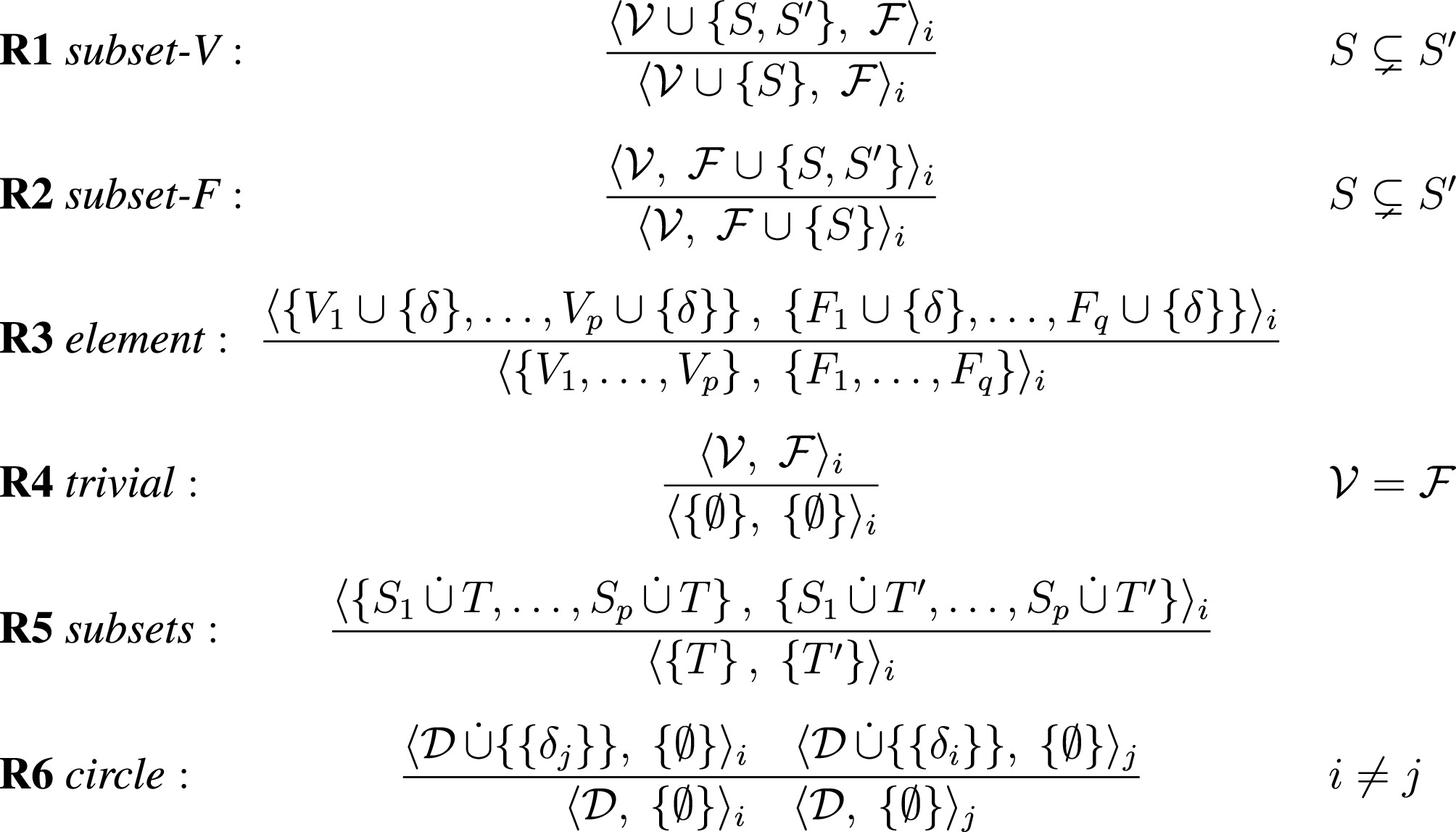
Figure 1.
Transformation rules for simplifying the constraint satisfaction problem
$ {\mathrm{CSP}}(\Delta) $ ${\langle { {\cal{V}}},\; { {\cal{F}}} \rangle_{{i}}} $ $ i $ $ \delta_i \in \Delta $ $ C_i \in {\mathrm{CSP}}(\Delta) $ $ \delta_i $ -
$ \omega $ $ {\mathrm{ver}}_{\Delta_{\mathrm{ex}}}(\omega) $ $ {\mathrm{fal}}_{\Delta_{\mathrm{ex}}}(\omega) $ $ \omega $ $ {\mathrm{ver}}_{\Delta_{\mathrm{ex}}}(\omega) $ $ {\mathrm{fal}}_{\Delta_{\mathrm{ex}}}(\omega) $ $ abc $ $ \{\delta_1,\delta_4\} $ $ \{\delta_3,\delta_5\} $ $ {\overline a b}c $ $ \{\delta_3\} $ $ \{\delta_4\} $ $ ab{\overline c } $ $ \{\delta_1,\delta_5\} $ $ \{\delta_3\} $ $ {\overline a b}{\overline c } $ $ \{\delta_3\} $ $ \emptyset $ $ a{\overline b }c $ $ \emptyset $ $ \{\delta_1,\delta_2,\delta_3\} $ $ {\overline a \overline b }c $ $ \{\delta_2,\delta_3\} $ $ \emptyset $ $ a{\overline b }{\overline c } $ $ \emptyset $ $ \{\delta_1, \delta_2\} $ $ {\overline a \overline b }{\overline c } $ $ \{\delta_2\} $ $ \emptyset $ Table 1.
Verified and falsified conditionals from
$ \Delta_{\mathrm{ex}} $ -
$ \delta_i $ $ V_i $ $ F_i $ $ \hat{V}_i $ $ \hat{V}_i $ $ \delta_1 = (b|a) $ $ \{ \{\delta_3\}, \{\delta_3, \delta_5\} \} $ $ \{ \{\delta_2\}, \{\delta_2, \delta_3\} \} $ $ \{ \{\delta_3\} \} $ $ \{ \{\delta_2\} \} $ $ \delta_2 = ({\overline a }|{\overline b }) $ $ \{ \emptyset \} $ $ \{ \{\delta_1\}, \{\delta_1, \delta_3\} \} $ $ \{ \emptyset \} $ $ \{ \{\delta_1\} \} $ $ \delta_3 = ({\overline a }|b \lor c) $ $ \{ \emptyset, \{\delta_4\} \} $ $ \{ \emptyset, \{\delta_5\}, \{\delta_1, \delta_2\} \} $ $ \{ \emptyset \} $ $ \{ \emptyset \} $ $ \delta_4 = (a|bc) $ $ \{ \{\delta_3, \delta_5\} \} $ $ \{ \emptyset \} $ $ \{ \{\delta_3, \delta_5\} \} $ $ \{ \emptyset \} $ $ \delta_5 = ({\overline c }|ab) $ $ \{ \{\delta_3\} \} $ $ \{ \{\delta_3\} \} $ $ \{ \emptyset \} $ $ \{ \emptyset \} $ Table 2.
(Reduced) constraint inducing sets of the conditionals in
$ \Delta_{\mathrm{ex}} $ -
Input: (Non-empty) consistent belief base $\Delta$ ${\mathrm{CSP}}^+(\Delta)$ Output: Canonical generalized tolerance partition ${\cal{Q}}^{mc}(\Delta)$ $\vec{\eta}^{mc}_\Delta$ 1 $m = 1$ 2 WHILE $\Delta \neq \emptyset$ 3 $\eta_{\min} = 0$ 4 $\Delta' = \emptyset$ 5 FOR $\delta_i \in \Delta$ 6 IF there is $S \in \hat{V}_i$ $S \subseteq \bigcup_{j=1}^m \Delta_j$ 7 $\eta_i = \min\{ \sum_{\delta_j \in S} \eta_j \mid S \in \hat{V}_i \colon S \subseteq \bigcup_{j=1}^m \Delta_j \} + 1$ 8 IF $\eta_{\min} = 0$ 9 $\eta_{min} \leftarrow \eta_i$ 10 $\Delta' \leftarrow \Delta' \cup \{ \delta_i \}$ 11 ELSE IF $\eta_i = \eta_{\min}$ 12 $\Delta' \leftarrow \Delta' \cup \{ \delta_i \}$ 13 ELSE IF $\eta_i \lt \eta_{\min}$ 14 $\eta_{\min} \leftarrow \eta_i$ 15 $\Delta' \leftarrow \{ \delta_i \}$ 16 $\Delta_m \leftarrow \Delta'$ 17 $\Delta \leftarrow \Delta \setminus \Delta_m$ 18 $m \leftarrow m+1$ 19 RETURN ${\cal{Q}}^{mc}(\Delta) = (\Delta_1, \ldots, \Delta_m)$ $\vec{\eta}^{mc}_\Delta = (\eta_1, \ldots, \eta_n)$ Table 1.
Computation of the canonical generalized tolerance partition
${\cal{Q}}^{mc}(\Delta)$ $\vec{\eta}^{mc}_\Delta$ $\Delta$ -
$ \omega $ $ {\mathrm{ver}}_{\Delta_{{\mathrm{ex}}2}}(\omega) $ $ {\mathrm{fal}}_{\Delta_{{\mathrm{ex}}2}}(\omega) $ $ \omega $ $ {\mathrm{ver}}_{\Delta_{{\mathrm{ex}}2}}(\omega) $ $ {\mathrm{fal}}_{\Delta_{{\mathrm{ex}}2}}(\omega) $ $ abc $ $ \{\delta_1\} $ $ \emptyset $ $ {\overline a b}c $ $ \emptyset $ $ \{\delta_5\} $ $ ab{\overline c } $ $ \{\delta_2\} $ $ \{\delta_1\} $ $ {\overline a b}{\overline c } $ $ \emptyset $ $ \{\delta_5\} $ $ a{\overline b }c $ $ \{\delta_1,\delta_4\} $ $ \{\delta_2\} $ $ {\overline a \overline b }c $ $ \{\delta_5\} $ $ \{\delta_4\} $ $ a{\overline b }{\overline c } $ $ \{\delta_3\} $ $ \{\delta_1\} $ $ {\overline a \overline b }{\overline c } $ $ \{\delta_5\} $ $ \{\delta_2,\delta_3\} $ Table 3.
Verified and falsified conditionals from
$ \Delta_{{\mathrm{ex}}2} $ -
$ \omega $ $ {\mathrm{ver}}_{\Delta'_{{\mathrm{ex}}3}}(\omega) $ $ {\mathrm{fal}}_{\Delta'_{{\mathrm{ex}}3}}(\omega) $ $ \kappa^{mc}_{\Delta_{{\mathrm{ex}}3}}(\omega) $ $ \kappa^{mc}_{\Delta'_{{\mathrm{ex}}3}}(\omega) $ $ abc $ $ \{\delta_1,\delta_2\} $ $ \{\delta_3\} $ 0 2 $ ab{\overline c } $ $ \{\delta_1,\delta_3\} $ $ \{\delta_2\} $ 1 1 $ a{\overline b }c $ $ \emptyset $ $ \{\delta_1,\delta_3\} $ 1 4 $ a{\overline b }{\overline c } $ $ \{\delta_3\} $ $ \{\delta_1\} $ 1 2 $ {\overline a b}c $ $ \{\delta_2\} $ $ \emptyset $ 0 0 $ {\overline a b}{\overline c } $ $ \emptyset $ $ \{\delta_2\} $ 1 1 $ {\overline a \overline b }c $ $ \emptyset $ $ \emptyset $ 0 0 $ {\overline a \overline b }{\overline c } $ $ \emptyset $ $ \emptyset $ 0 0 Table 4.
Minimal core c-representations of
$ \Delta_{{\mathrm{ex}}3} $ $ \Delta'_{{\mathrm{ex}}3} $ -
$ {\cal{I}}^P $ $ {\cal{I}}^Z $ $ {\cal{I}}^c $ $ {\cal{I}}^{mc} $ System P $ \checkmark$ $ \checkmark$ $ \checkmark$ $ \checkmark$ (wSM) $ \checkmark$ $ \checkmark$ $ \checkmark$ $ \checkmark$ (SM) $ \checkmark$ − − − (Rel) $ \checkmark$ $ \checkmark$ $ \checkmark$ $ \checkmark$ (Ind) − − $ \checkmark$ $ \checkmark$ (SynSplit) − − $ \checkmark$ $ \checkmark$ (CRel) $ \checkmark$ $ \checkmark$ $ \checkmark$ $ \checkmark$ (CInd) − − $ \checkmark$ $ \checkmark$ (CSynSplit) − − $ \checkmark$ $ \checkmark$ (CP) $ \checkmark$ $ \checkmark$ $ \checkmark$ $ \checkmark$ (wRM) − $ \checkmark$ $ \checkmark$ $ \checkmark$ (RM) − $ \checkmark$ − $ \checkmark$ Table 5.
Inference properties which are satisfied (
$ \checkmark$ $ {\cal{I}}^P $ $ {\cal{I}}^Z $ $ {\cal{I}}^c $ $ {\cal{I}}^{mc} $ -
$ \omega $ $ {\mathrm{ver}}_{\Delta_{\mathrm{bfpe}}}(\omega) $ $ {\mathrm{fal}}_{\Delta_{\mathrm{bfpe}}} (\omega) $ $ \kappa^Z_{\Delta_{\mathrm{bfpe}}}(\omega) $ $ \kappa^{\, mc}_{\Delta_{\mathrm{bfpe}}}(\omega) $ $ \kappa^{\vec{\eta}}_{\Delta_{\mathrm{bfpe}}}(\omega) $ $ bfpe $ $ \{ \delta_1, \delta_2, \delta_4 \} $ $ \{ \delta_3 \} $ 2 2 2 $ bfp{\overline e } $ $ \{ \delta_1, \delta_2 \} $ $ \{ \delta_3, \delta_4 \} $ 2 3 6 $ bf\,{\overline p }e $ $ \{ \delta_2, \delta_4 \} $ $ \emptyset $ 0 0 0 $ bf\,{\overline p }\,{\overline e } $ $ \{ \delta_2 \} $ $ \{ \delta_4 \} $ 1 1 4 $ b{\overline f }pe $ $ \{ \delta_1, \delta_3, \delta_4 \} $ $ \{ \delta_2 \} $ 1 1 1 $ b{\overline f }p{\overline e } $ $ \{ \delta_1, \delta_3 \} $ $ \{ \delta_2, \delta_4 \} $ 1 2 5 $ b{\overline f }\,{\overline p }e $ $ \{ \delta_4 \} $ $ \{ \delta_2 \} $ 1 1 1 $ b{\overline f }\,{\overline p }\,{\overline e } $ $ \emptyset $ $ \{ \delta_2, \delta_4 \} $ 1 2 5 $ {\overline b }fpe $ $ \emptyset $ $ \{ \delta_1, \delta_3 \} $ 2 4 4 $ {\overline b }fp{\overline e } $ $ \emptyset $ $ \{ \delta_1, \delta_3 \} $ 2 4 4 $ {\overline b }f\,{\overline p }e $ $ \emptyset $ $ \emptyset $ 0 0 0 $ {\overline b }f\,{\overline p }\,{\overline e } $ $ \emptyset $ $ \emptyset $ 0 0 0 $ {\overline b }\,{\overline f }pe $ $ \{ \delta_3 \} $ $ \{ \delta_1 \} $ 2 2 2 $ {\overline b }\,{\overline f }p{\overline e } $ $ \{ \delta_3 \} $ $ \{ \delta_1 \} $ 2 2 2 $ {\overline b }\,{\overline f }\,{\overline p }e $ $ \emptyset $ $ \emptyset $ 0 0 0 $ {\overline b }\,{\overline f }\,{\overline p }\,{\overline e } $ $ \emptyset $ $ \emptyset $ 0 0 0 Table 6.
Verified and falsified conditionals from
$ \Delta_{\mathrm{bfpe}} $ $ \kappa^Z_{\Delta_{\mathrm{bfpe}}} $ $ \kappa^{mc}_{\Delta_{\mathrm{bfpe}}} $ $ \kappa^{\vec{\eta}}_{\Delta_{\mathrm{bfpe}}} $ $ \vec{\eta} = (2,1,2,4) $ -
$ \delta_i $ $ V_i $ $ F_i $ $ \hat{V}_i $ $ \hat{F}_i $ $ \delta_1 = (b|p) $ $ \{\{\delta_2\},\{\delta_2,\delta_4\},\{\delta_3\},\{\delta_3,\delta_4\}\} $ $ \{\emptyset,\{\delta_3\}\} $ $ \{\{\delta_2\}, \{\delta_3\}\} $ $ \{\emptyset\} $ $ \delta_2 = (f|b) $ $ \{\emptyset,\{\delta_3\},\{\delta_3,\delta_4\},\{\delta_4\}\} $ $ \{\emptyset,\{\delta_4\}\} $ $ \{\emptyset\} $ $ \{\emptyset\} $ $ \delta_3 = ({\overline f }|p) $ $ \{\{\delta_1\},\{\delta_2\},\{\delta_2,\delta_4\}\} $ $ \{\emptyset,\{\delta_1\},\{\delta_4\}\} $ $ \{\{\delta_1\},\{\delta_2\}\} $ $ \{\emptyset\} $ $ \delta_4 = (e|b) $ $ \{\emptyset,\{\delta_2\},\{\delta_3\}\} $ $ \{\emptyset,\{\delta_2\},\{\delta_3\}\} $ $ \{\emptyset\} $ $ \{\emptyset\} $ Table 7.
(Reduced) constraint inducing sets of the conditionals in
$ \Delta_{\mathrm{bfpe}} $ -
$ \omega $ $ {\mathrm{ver}}_{\Delta_{{\mathrm{ex}}5}}(\omega) $ $ {\mathrm{fal}}_{\Delta_{{\mathrm{ex}}4}}(\omega) $ $ \omega $ $ {\mathrm{ver}}_{\Delta_{{\mathrm{ex}}5}}(\omega) $ $ {\mathrm{fal}}_{\Delta_{{\mathrm{ex}}4}}(\omega) $ $ abc $ $ \{\delta_1,\delta_2\} $ $ \emptyset $ $ {\overline a b}c $ $ \emptyset $ $ \emptyset $ $ ab{\overline c } $ $ \emptyset $ $ \{\delta_1,\delta_2\} $ $ {\overline a b}{\overline c } $ $ \emptyset $ $ \emptyset $ $ a{\overline b }c $ $ \{\delta_1,\delta_3\} $ $ \emptyset $ $ {\overline a \overline b }c $ $ \emptyset $ $ \emptyset $ $ a{\overline b }{\overline c } $ $ \emptyset $ $ \{\delta_1,\delta_3\} $ $ {\overline a \overline b }{\overline c } $ $ \emptyset $ $ \emptyset $ Table 8.
Verified and falsified conditionals from
$ \Delta_{{\mathrm{ex}}5} $
Figures
(1)
Tables
(9)