-
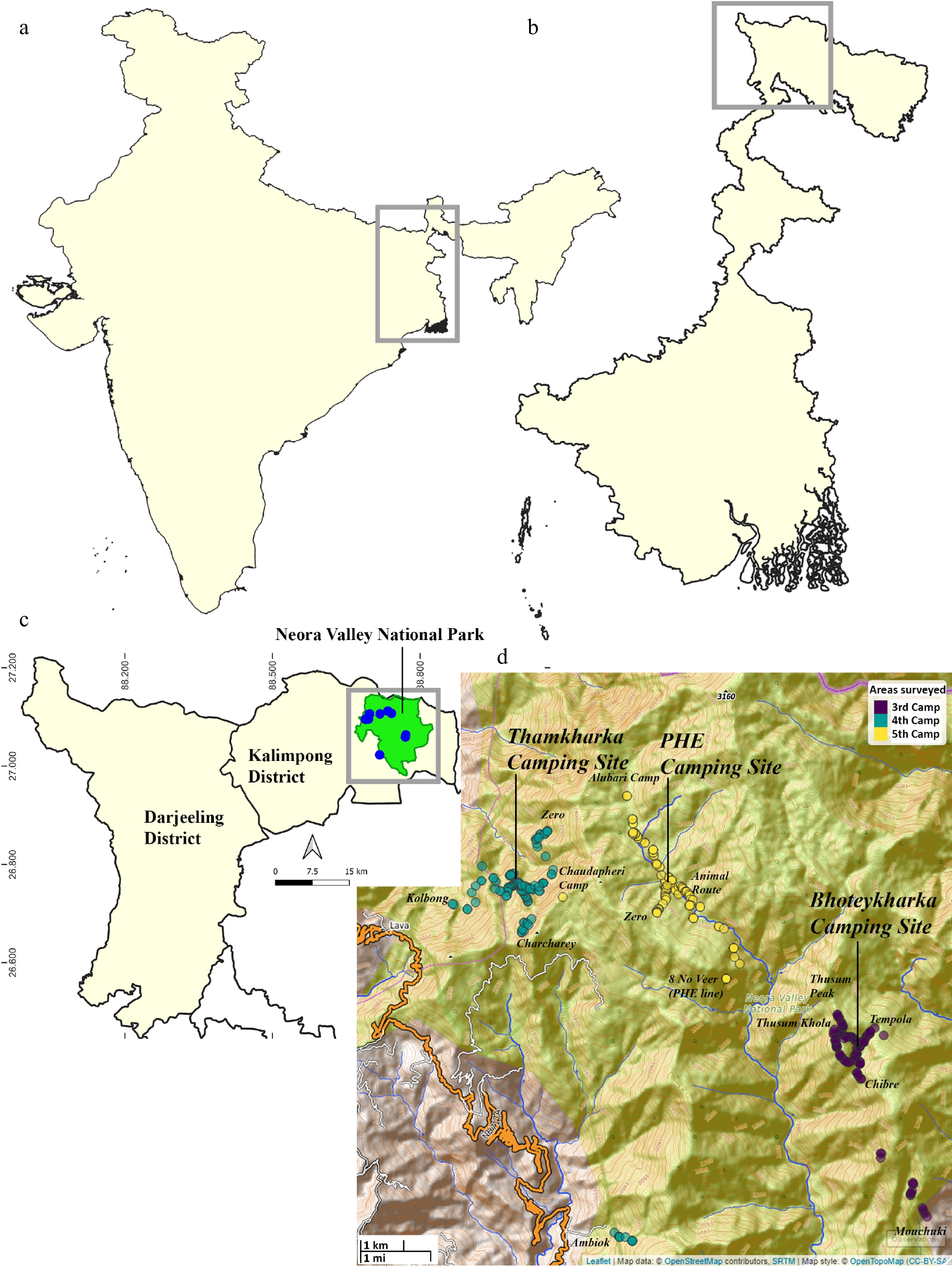
Figure 1.
(a) Map of India showing location of the state of West Bengal (in grey box). (b) Map of West Bengal showing location of Darjeeling and Kalimpong districts (in grey box). (c) Map of Kalimpong district with location of Neora Valley National Park (in green polygon), survey locations (blue dots) in Kalimpong District and area focused for figure d (in grey box). (d) Survey locations covered during 3rd (Purple dots), 4th (Aquamarine dots), and 5th (Yellow dots) ABACs. Maps (a−c) were prepared using QGIS (v. 3.26) and (d) using the mapview package in R (v. 4.2.1).
-
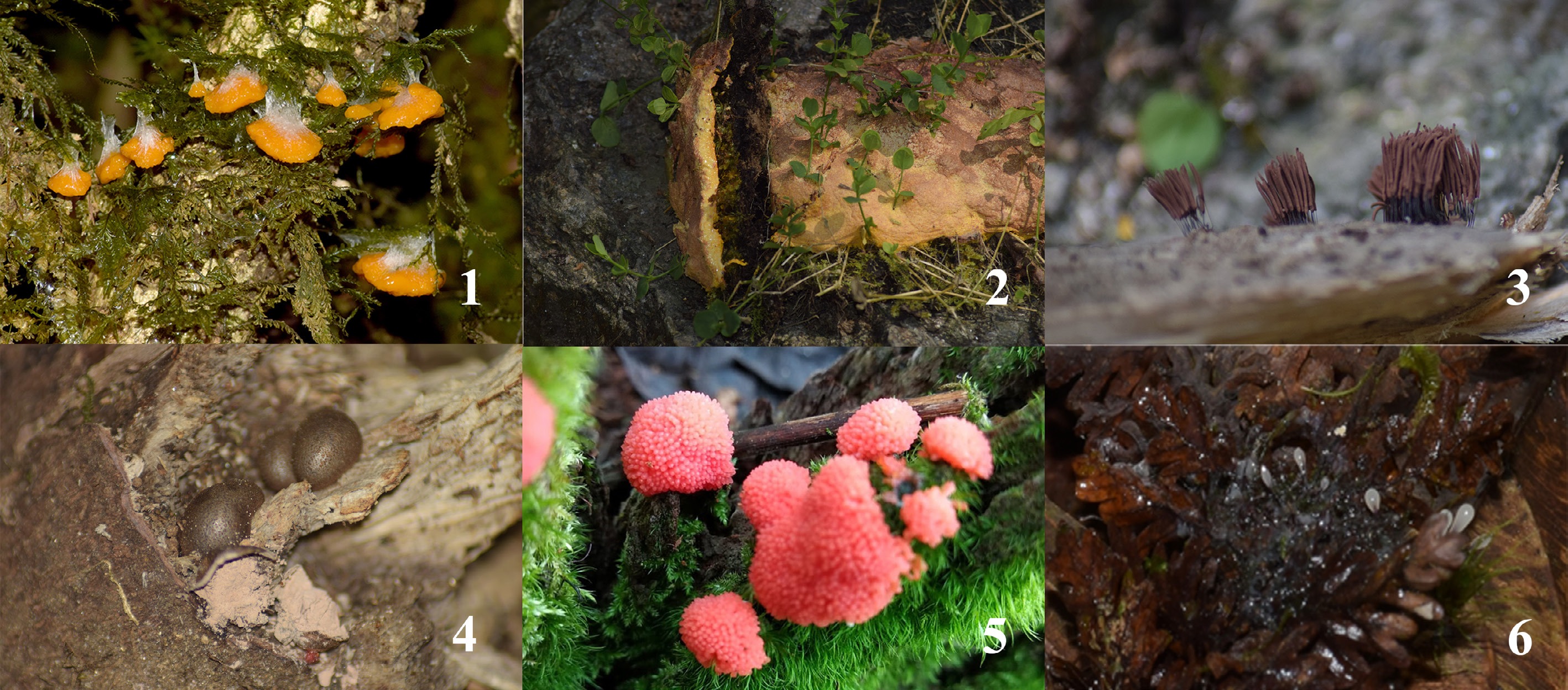
Figure 2.
(1) Fuligo muscorum. (2) Fuligo septica. (3) Stemonitis fusca. (4) Lycogala epidendrum. (5) Tubifera ferruginosa. (6) Trichia typhoides.
-
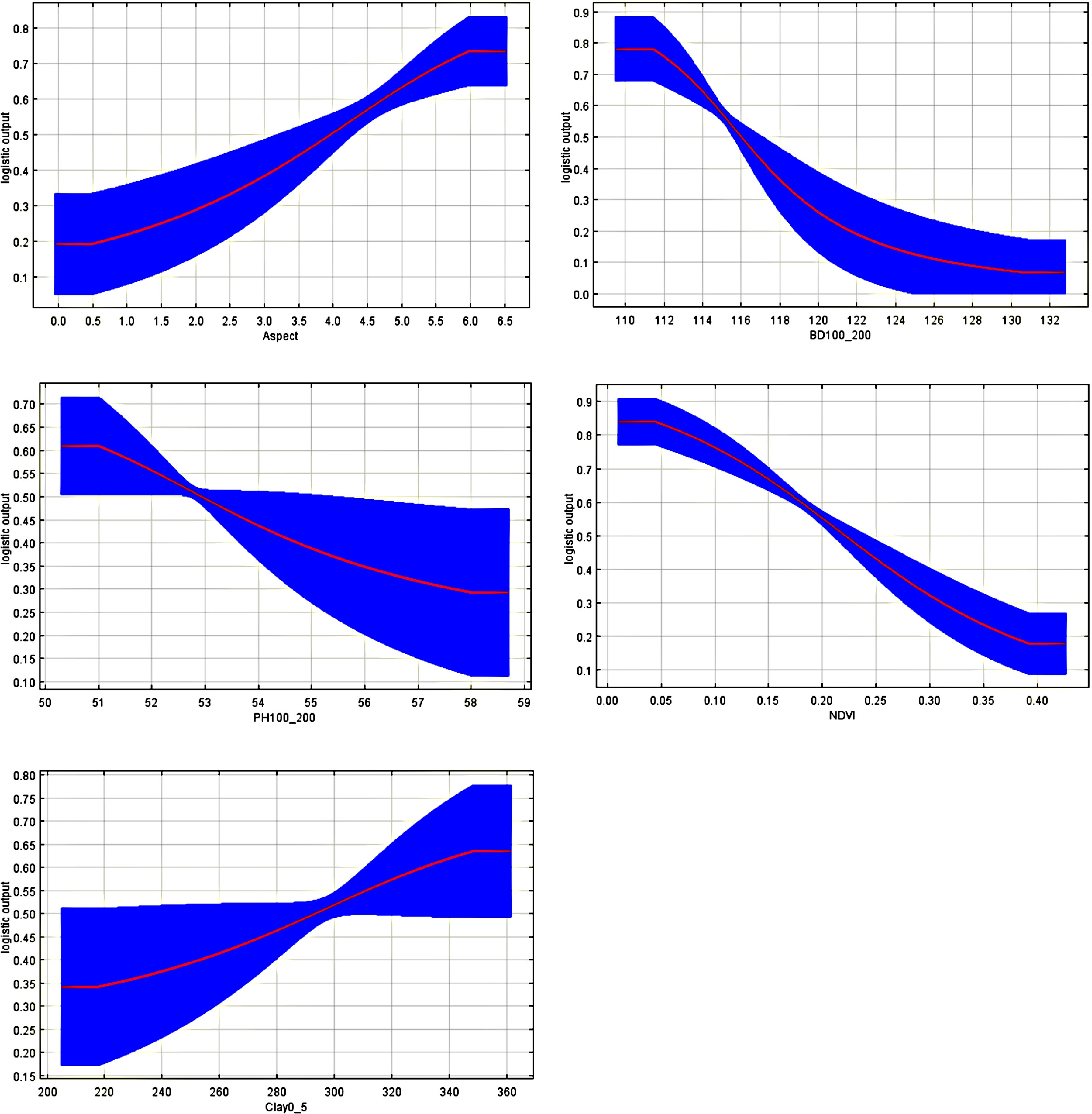
Figure 3.
The curves show the mean response of the 10,000 replicate MaxEnt runs (red), and the mean +/− one standard deviation (blue).
-
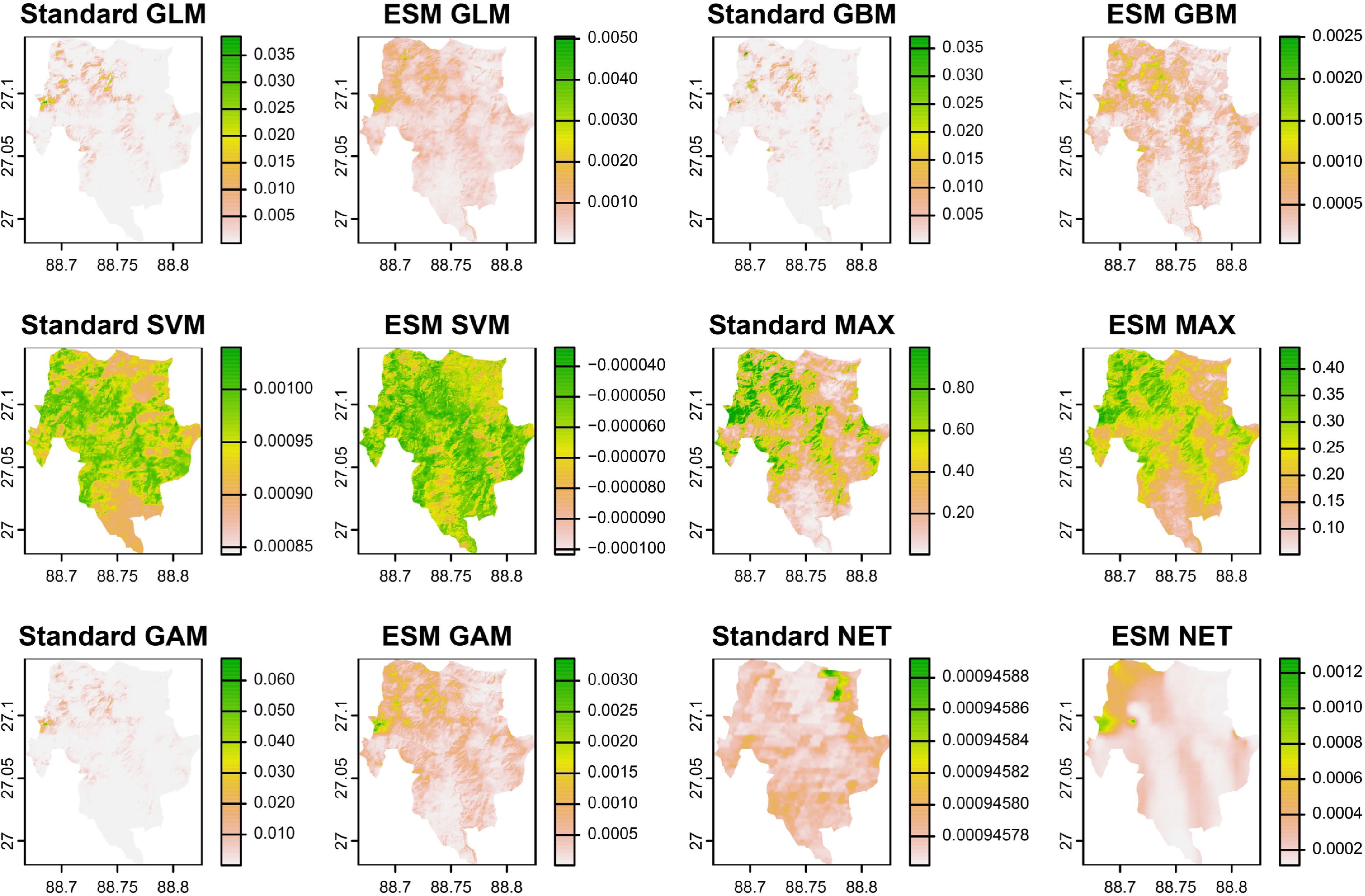
Figure 4.
Environmental suitability of the Myxomycetes from the output of standard and ESM versions of GLM, GBM, SVM, MAX, GAM, and NET performed through flexsdm package in R.
-
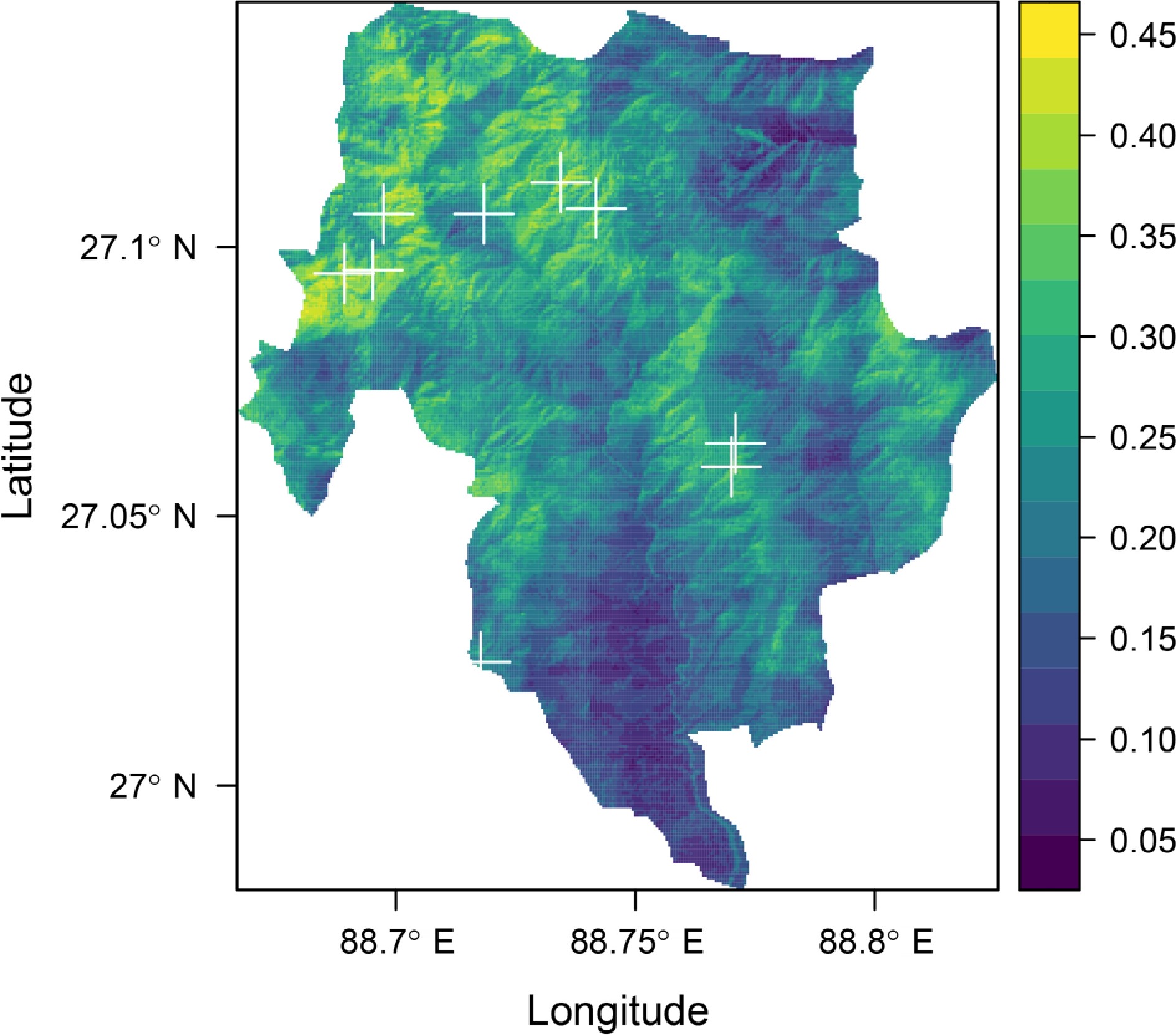
Figure 5.
Environmental suitability of the Myxomycetes from the output of ESM MaxEnt with threshold of maximum sensitivity and specificity in NVNP. (+) symbols indicate occurrence points.
-
Sl. No. Species Family Habitat Occurrence location Morphological characteristics and remarks 1 Stemonitis fusca Roth Stemonitidaceae Fallen log of Engelhardtia spicata (Mauwa) 27.02289° N, 88.71773° E; 27.10615° N, 88.69744° E; Fruitbodies gregarious, sporangium stiped, elongated, bundle in brown mass. It has been earlier reported from Darjeeling. 2 Trichia typhoides Bull. Stemonitidaceae Upon decaying fern 27.10616° N, 88.71839° E; Fruitbodies gregarious, whitish spathulate jelly like fruitbody with stipe; stipe translucently visible in the upper part. It has been earlier reported from Darjeeling. 3 Lycogala epidendrum (L.) Fr. Reticulariaceae Upon fallen woody debris
including Eurya japonica
(Jhingeni)27.09514° N, 88.68927° E; 27.0957° N, 88.6952° E; Fruitbodies gregarious, sessile, initially semi solid greyish brown, becoming delinquescent with oozing pinkish liquid. It has been earlier reported from Darjeeling. 4 Tubifera ferruginosa (Batsch) J.F. Gmel. Reticulariaceae Upon moss 27.107212° N, 88.741802° E;
27.111986° N, 88.734456° E;Fruitbodies gregarious, salmon coloured, in mass, sporangium in rosette. It has been earlier reported from Darjeeling. 5 Fuligo muscorum Alb. & Schwein. Physaraceae Bark of Bante Katus (Lithocarpus pachyphyllus), upon Moss;
Machilus (Kawlo) bark, upon moss27.063528° N, 88.770917° E; 27.059139° N, 88.770083° E; Fruitbodies gregarious, sub-lunar in appearance, luteous with whitish mucilaginous appendage. It is a new record for India. 6 Fuligo septica (L.) F.H. Wigg. Physaraceae Fallen log of Engelhardtia spicata (Mauwa) tree 27.02289° N, 88.71773° E Fruitbodies gregarious, in bulky mass. It is a new record for West Bengal. Table 1.
Occurrence records, habitat and brief morphological details of recorded Myxomycetes members from NVNP.
-
Covariate CA BA SA Rank percentile CPA BPA SPA Rank percentile Rank average WR CA BA SA CPA BPA SPA (1) (2) (3) (4) (5) (6) (7) (8) (9) (10) (11) (12) (13) (14) (15) Aspect 25.8019 17.4301 19.0647 1 1 1 2.3843 19.1714 7.6956 7 1 4 2.5 1 BD100_200 20.5783 14.5925 14.0781 2 2 2 37.6499 4.2306 19.0537 1 6 2 2.5 1 PH100_200 10.0475 11.5682 10.753 5 3 3 0 19.1173 31.1466 14 2 1 4.666667 2 NDVI 12.3987 6.1025 4.3781 3 7 7 12.92 10.563 5.5614 4 3 5 4.833333 3 Forheight 9.6644 8.1107 8.6882 6 5 5 2.7204 4.9563 8.0727 5 5 3 4.833333 3 VegMoistIndex 10.9958 9.1953 9.7247 4 4 4 15.0958 2.2328 1.443 3 12 13 6.666667 4 Clay0_5 0.5626 3.0456 3.1169 8 8 8 2.5117 5.6861 1.5444 6 4 11 7.5 5 Corfrag100_200 0.2428 1.5714 1.6061 9 13 13 1.3705 3.8452 2.1631 10 7 9 10.16667 6 CA = Crossvalidation_Avg, BA = Bootstrap_Avg, SA = Subsample_Avg, CPA = Crossvalidation_Permutation_Avg, BPA = Bootstrap_Permutation_Avg, SPA = Subsample_Permutation_Avg, Rank_Avg = average rank of column no. 5, 6, 7, 11, 12, 13), WR = Weighted Rank. Table 2.
Variable ranks as per MaxEnt runs.
-
Covariate Rank Model Covariate Rank Model Covariate Rank Model Covariate Rank Model Aspect 1 glm Aspect 1 gam NDVI 1 rf Aspect 1 MaxEnt NDVI 2 glm NDVI 2 gam BD100_200 2 rf BD100_200 1 MaxEnt BD100_200 3 glm BD100_200 3 gam Clay0_5 3 rf PH100_200 2 MaxEnt Soil_N100_200 4 glm Sand15_30 4 gam OCDen0_5 4 rf NDVI 3 MaxEnt PH100_200 5 glm Forheight 5 gam Slope 5 rf Forheight 3 MaxEnt Slope 6 glm Soil_N100_200 6 gam Sand15_30 6 rf VegMoistIndex 4 MaxEnt Sand15_30 7 glm PH100_200 7 gam − − − Clay0_5 5 MaxEnt Bio3 8 glm Clay0_5 8 gam − − − Corfrag100_200 6 MaxEnt Variables which are present in atleast three models are marked bold. Top five ranked variables were selected for ecological niche modeling. Table 3.
Variable selection according top ranks obtained from covsel output fortified by MaxEnt runs.
Figures
(5)
Tables
(3)