-
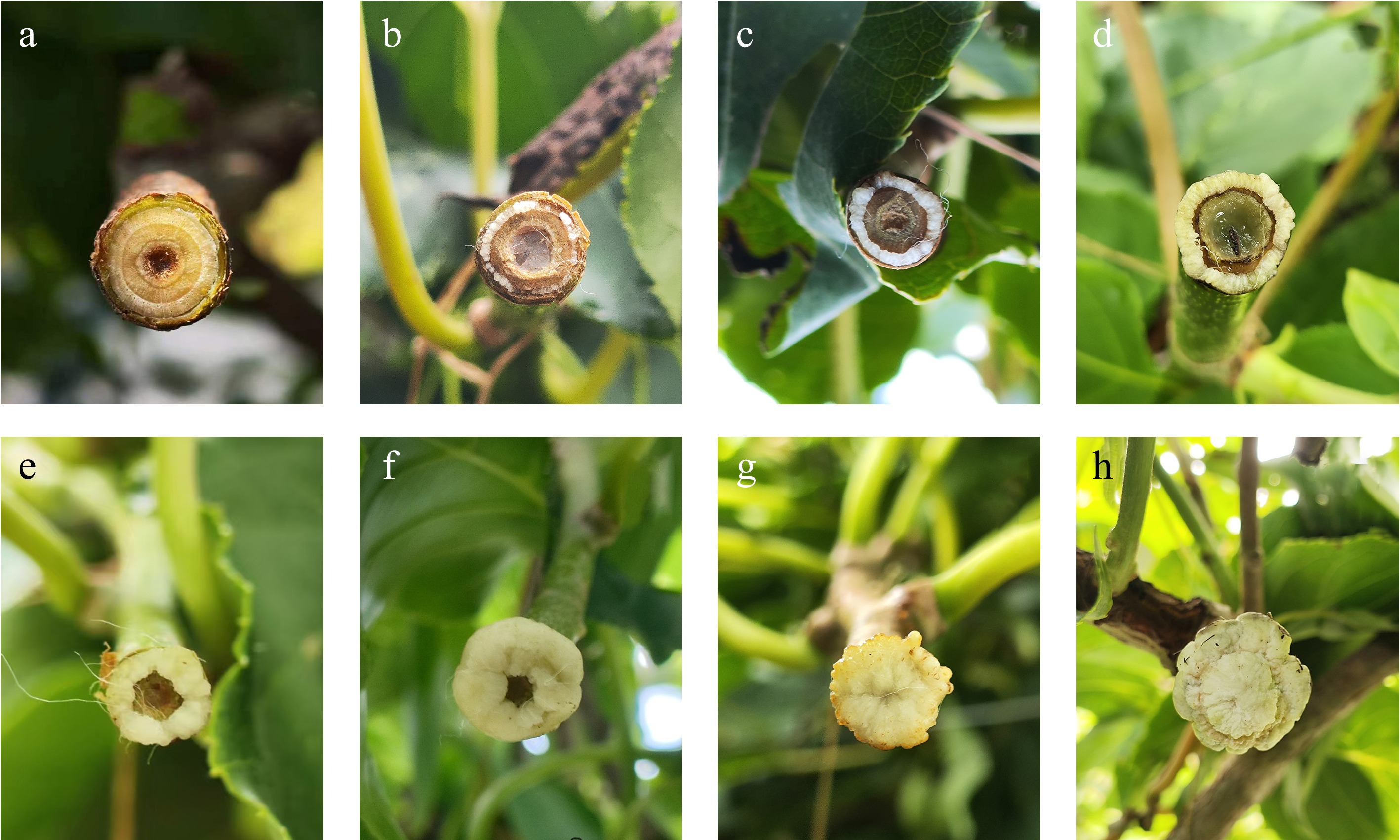
Figure 1.
Callus grading of branch sections of A. arguta. (a) Grade 0 (treatment for 1 d). (b) Grade 1 (treatment for 5 d). (c) Grade 2 (treatment for 10 d). (d) Grade 3 (treatment for 15 d). (e) Grade 4 (treatment for 20 d). (f) Grade 5 (treatment for 25 d). (g) Grade 6 (treatment for 40 d). (h) Grade 7 (treatment for 60 d).
-
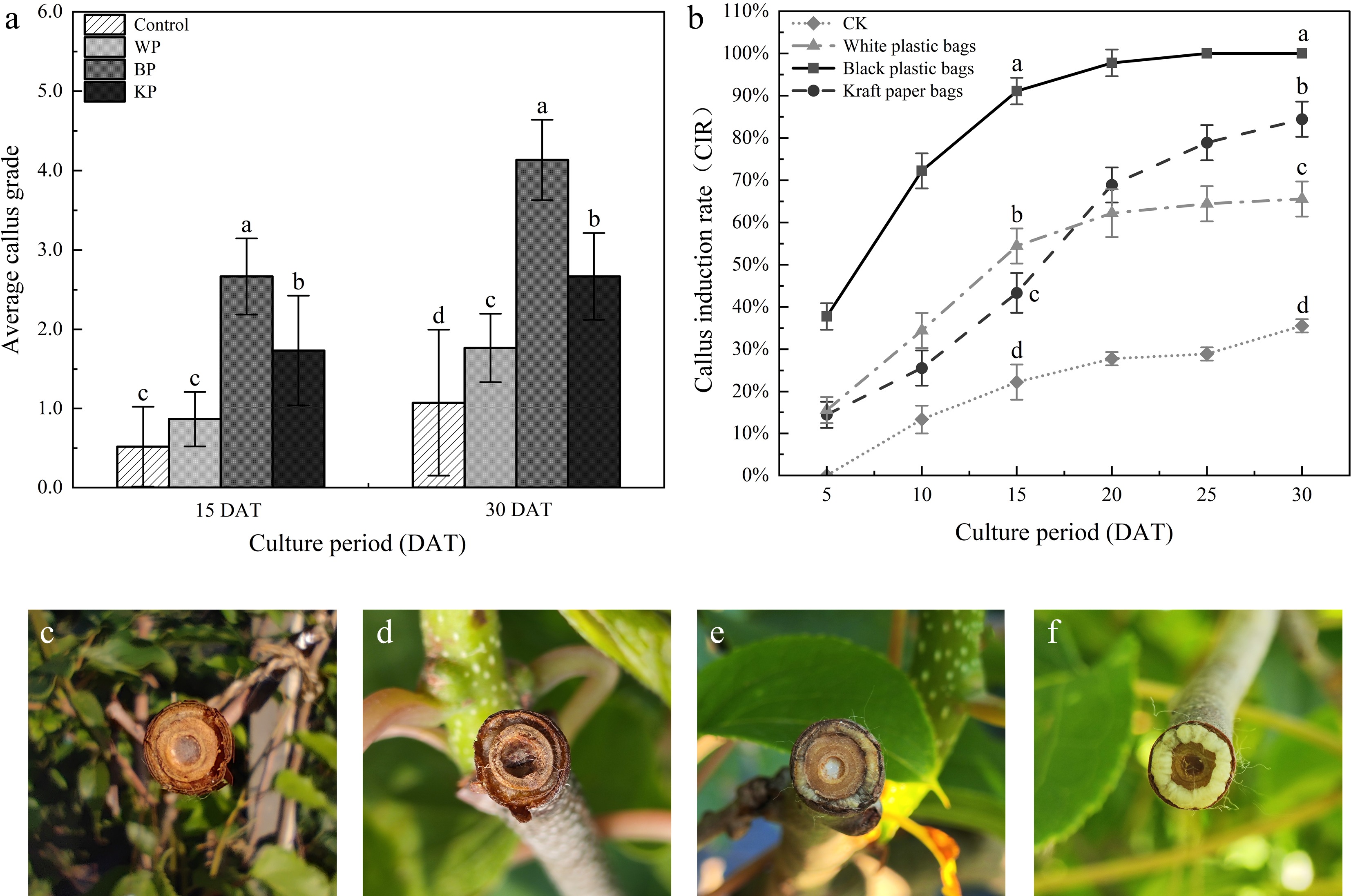
Figure 2.
Effect of different covering materials on the growth grade and morphology of callus. CK, without any covering. (a) Investigation on callus growth grade. (b) Investigation on callus induction rate. (c) Without any covering. (d) WP. (e) KP. (f) BP. Note: different letters indicate significant differences (p < 0.05).
-
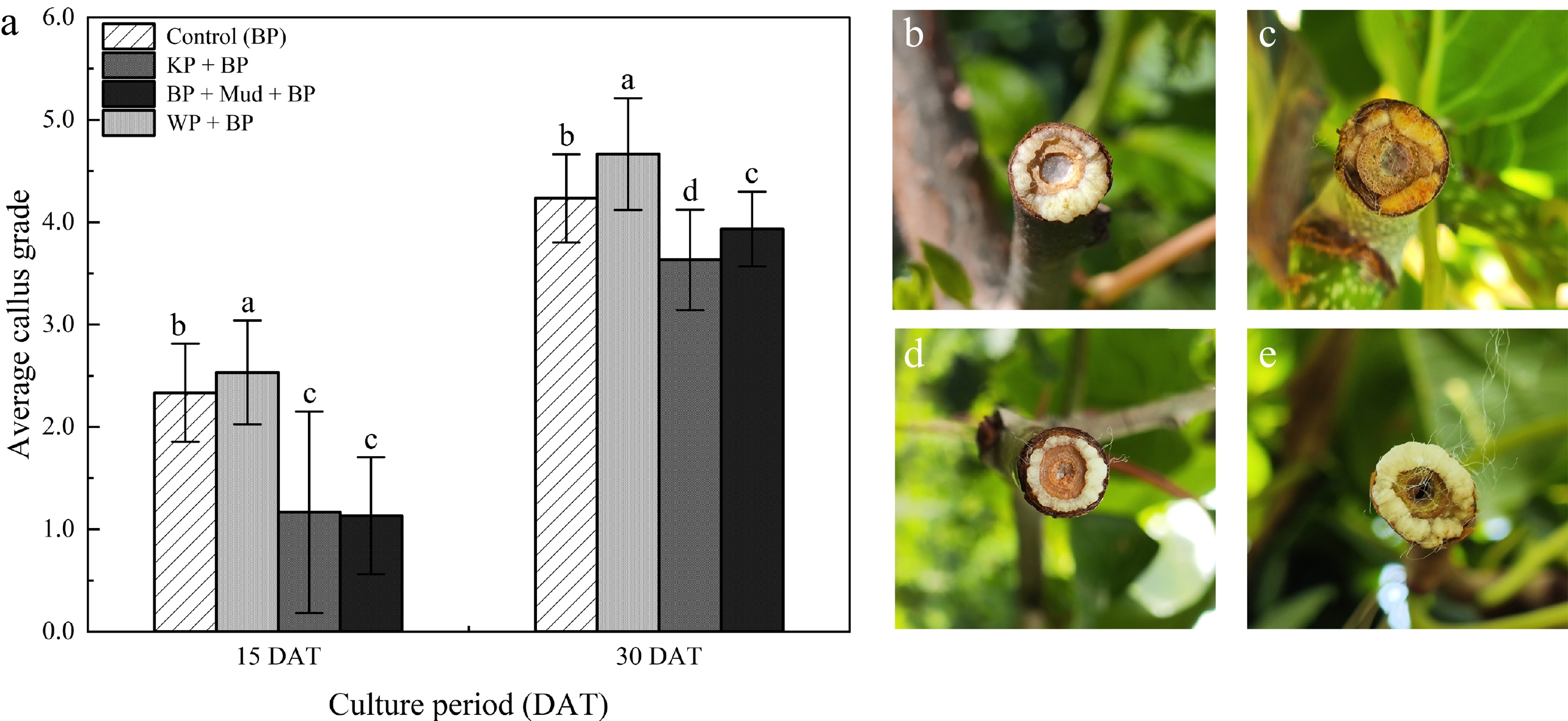
Figure 3.
Optimize the effects of different combination of covering materials on the growth rate and morphology of callus. Using the BP covering as the control. (a) Investigation on callus growth grade. (b) BP. (c) KP + BP. (d) BP + humid mud + BP. (e) WP + BP. Note: different letters indicate significant differences (p < 0.05).
-
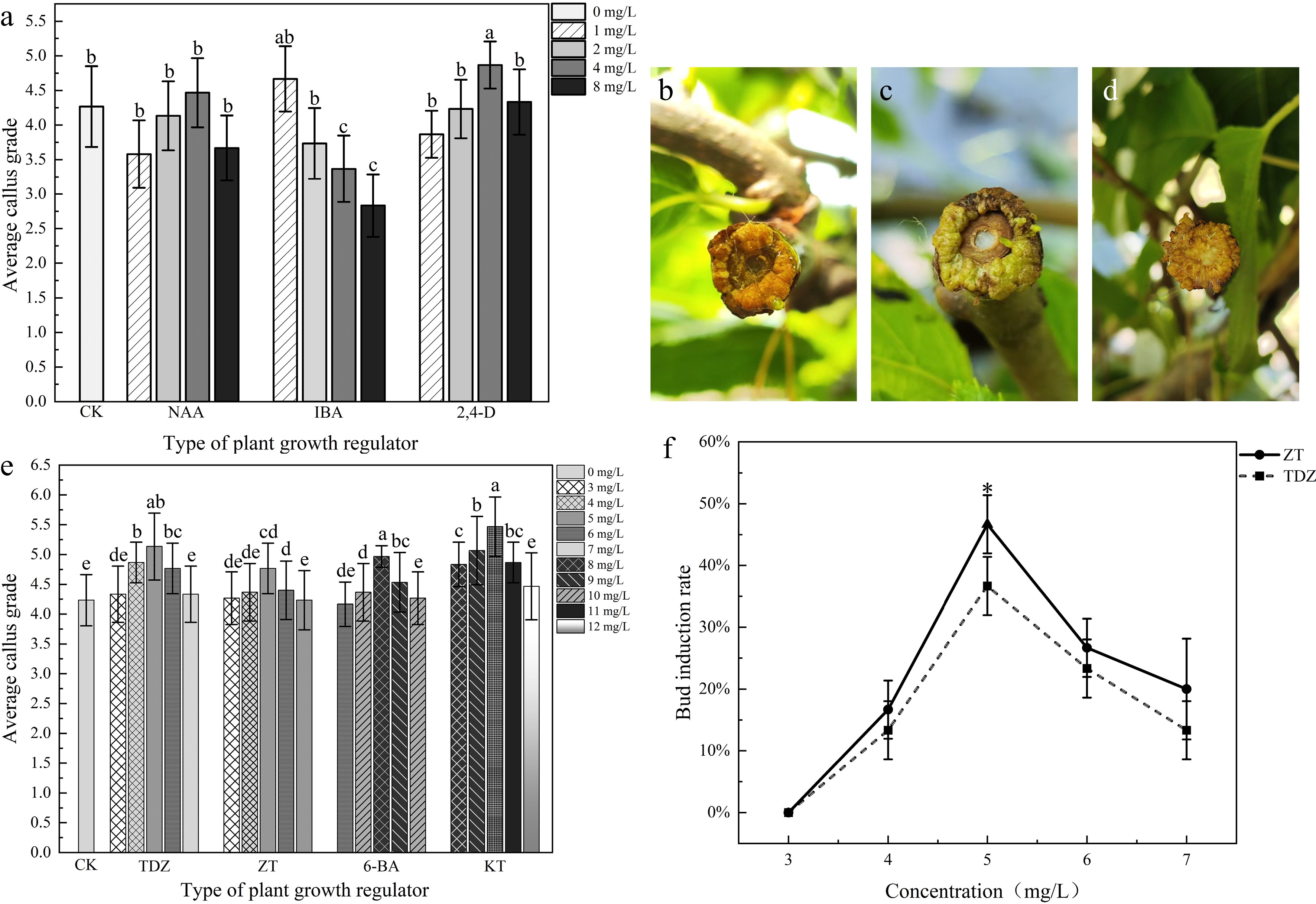
Figure 4.
The effects of different plant growth regulators on callus induction and bud regeneration. (a) Effects of auxin analogues on callus growth grade. (b) Adventitious bud regeneration after 52 d of treatment with 4.0 mg/L 2,4-D. (c) Adventitious bud regeneration after 58 d of treatment with 1.0 mg/L IBA. (d) Adventitious bud regeneration after 75 d of treatment with 1.0 mg/L IBA. (e) Effects of different cytokinin concentrations on callus growth grade. (f) Effects of ZT and TDZ concentrations on bud induction rate. Note: different letters or asterisks indicate significant differences between ZT and TDZ (p < 0.05).
-
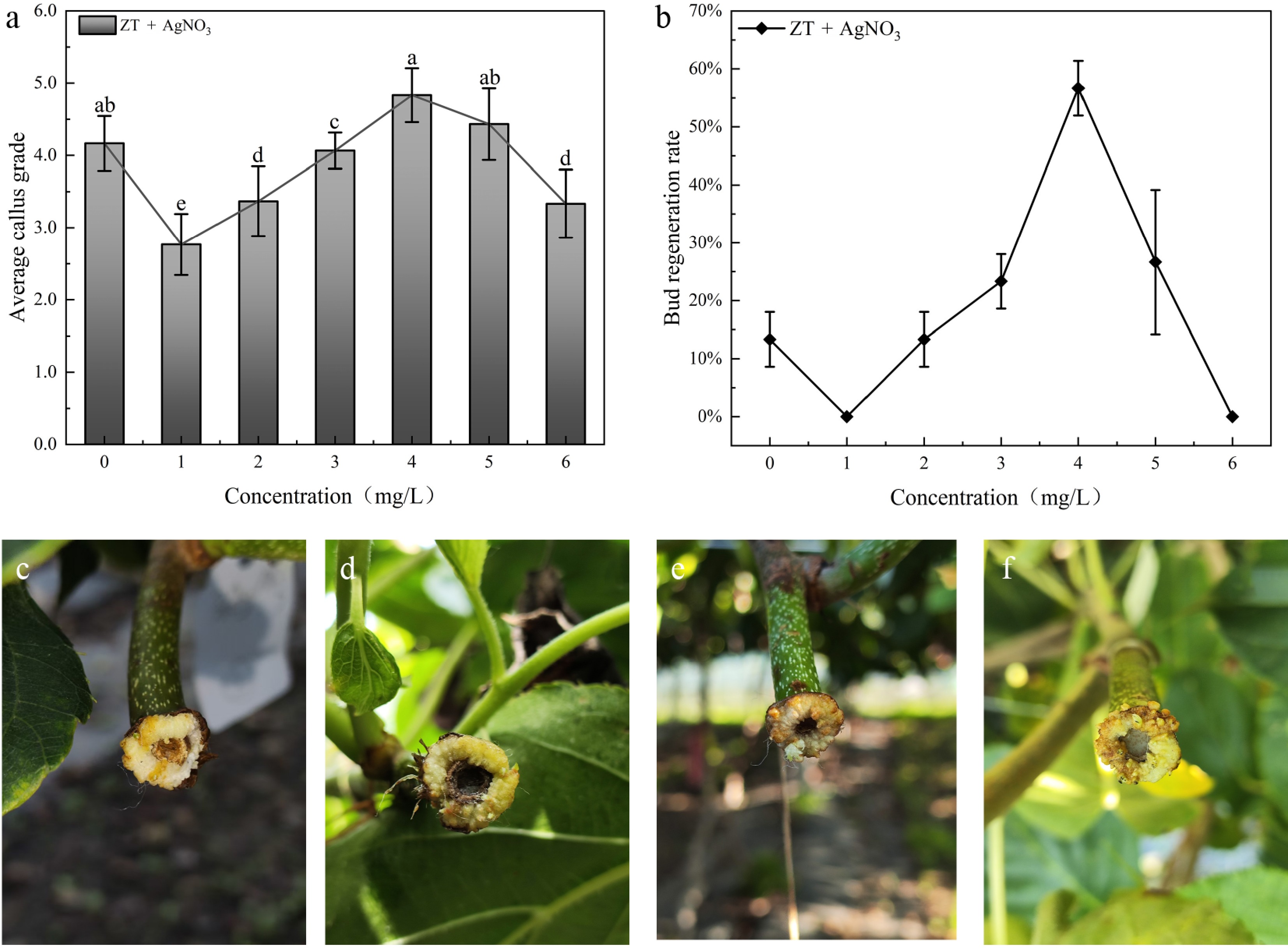
Figure 5.
The effect of ZT combined with different concentrations of AgNO3 (1.0–6.0 mg/L) on callus and bud regeneration. (a) Investigation on callus growth grade. CK: without AgNO3 addition. (b) Investigation on bud regeneration rate of callus. (c) 45 d, ZT 5.0 + 2.0 mg/L AgNO3. (d) 43 d, ZT 5.0 + 3.0 mg/L AgNO3. (e) 40 d, ZT 5.0 + 4.0 mg/L AgNO3. (f) 48 d, ZT 5.0 + 5.0 mg/L AgNO3. Note: different letters indicate significant differences (p < 0.05).
-
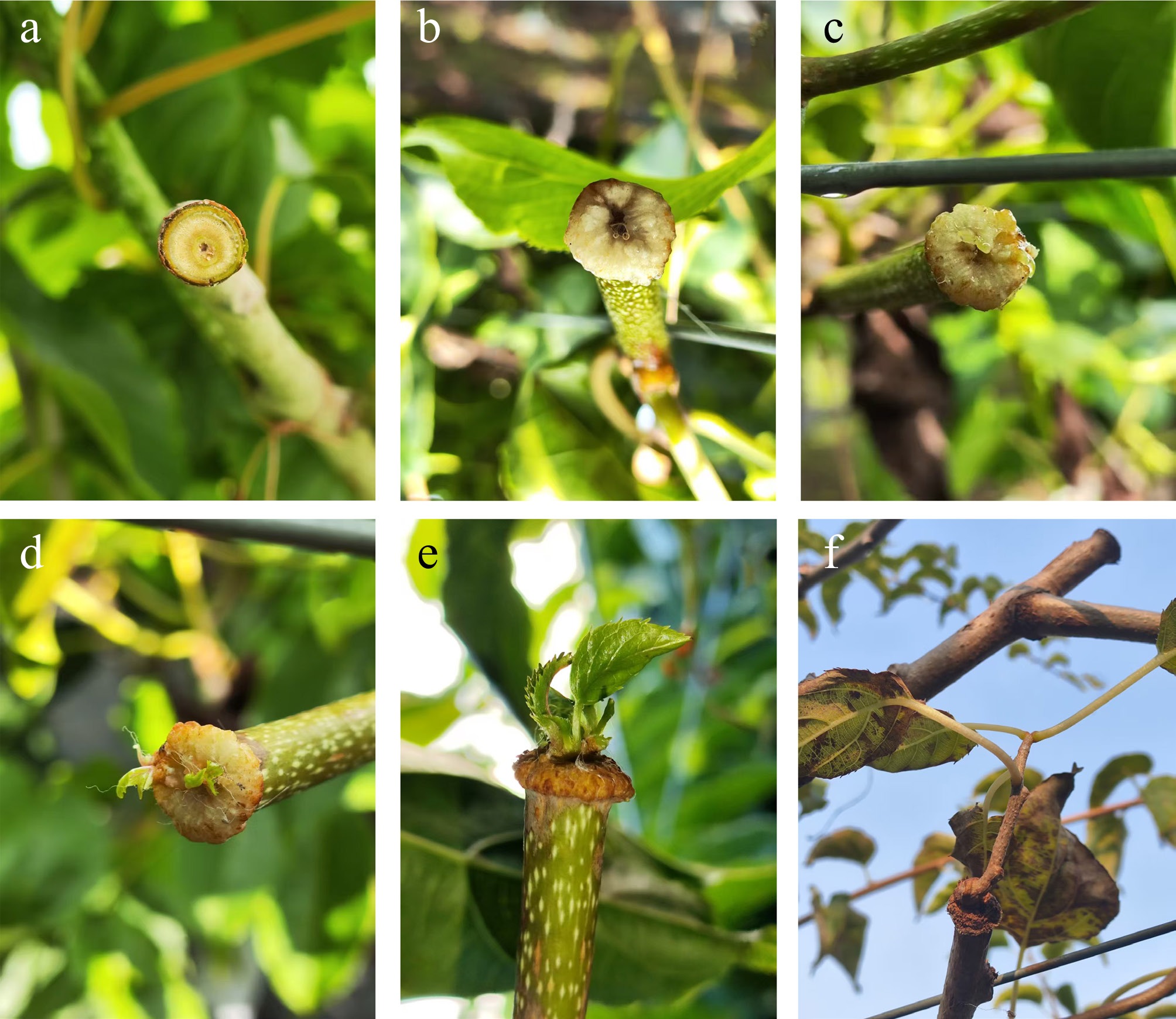
Figure 6.
Callus development and adventitious bud regeneration from branches of A. arguta under optimal treatment. (a) 0 d, freshly cut surface. (b) 20 d, visible callus proliferation. (c) 25 d, callus expansion. (d) 30 d, continued callus growth. (e) 40 d, well-formed adventitious buds. (f) 72 d, the plant has been completely lignified.
-
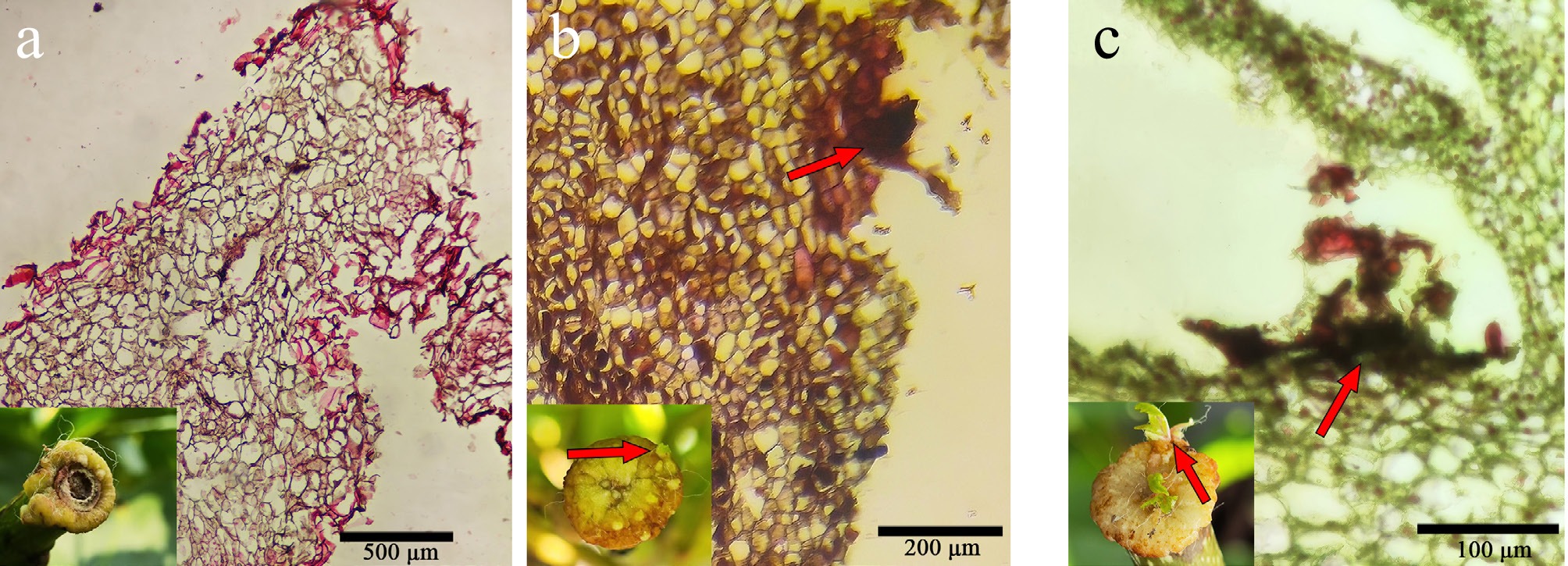
Figure 7.
Observation of callus tissue sections at different treatment times. (a) 10 d treatment, initiation of meristematic cell clusters. (b) 20 d treatment, embryogenic callus began to form on the surface of the callus (arrow). (c) 25 d treatment, buds regenerated on callus surface (arrow).
-
Grade Typical characters 0 The presence of calluses was not observed (Fig. 1a) 1 A cambium-derived callus became observed (Fig. 1b) 2 Callus has grown beyond the cut section and the callus circle has become thicker (Fig. 1c) 3 The callus circle becomes significantly thicker with its width accounting for between one-fifth and one-half of the radius of the cut surface (Fig. 1d) 4 The width of the callus circle is approximately equivalent to one-half of the radius of the cut surface (Fig. 1e) 5 The width of the callus circle accounts for more than one-half of the radius of the cut surface (Fig. 1f) 6 Callus fully covered the cut surface (Fig. 1g) 7 Callus proliferated and overflowed the cut surface (Fig. 1h) Table 1.
Grading standards for callus.
-
Concentration
(mg/L)Dark culture
durationAverage diameter
of branches (cm)Callus induction
rate (%)Average callus
gradeAdventitious bud
regenerationBud regeneration
rate (%)ZT5.0 + 4.0 AgNO3 0 d 0.64 a 93.3 b 0.73 ± 0.87 d − 0 5 d 0.67 a 100 a 1.97 ± 0.55 c − 0 10 d 0.73 a 100 a 4.67 ± 0.48 a 40 d 76.7 a 15 d 0.71 a 100 a 4.73 ± 0.44 a 49 d 53.3 b 20 d 0.62 a 100 a 4.13 ± 0.62 b 61 d 36.7 c 25 d 0.69 a 100 a 4.23 ± 0.62 b 67 d 13.3 d 30 d 0.78 a 100 a 4.37 ± 0.55 ab 70 d 6.7 e Table 2.
Effect of different dark culture time on callus formation and bud regeneration.
Figures
(7)
Tables
(2)