-
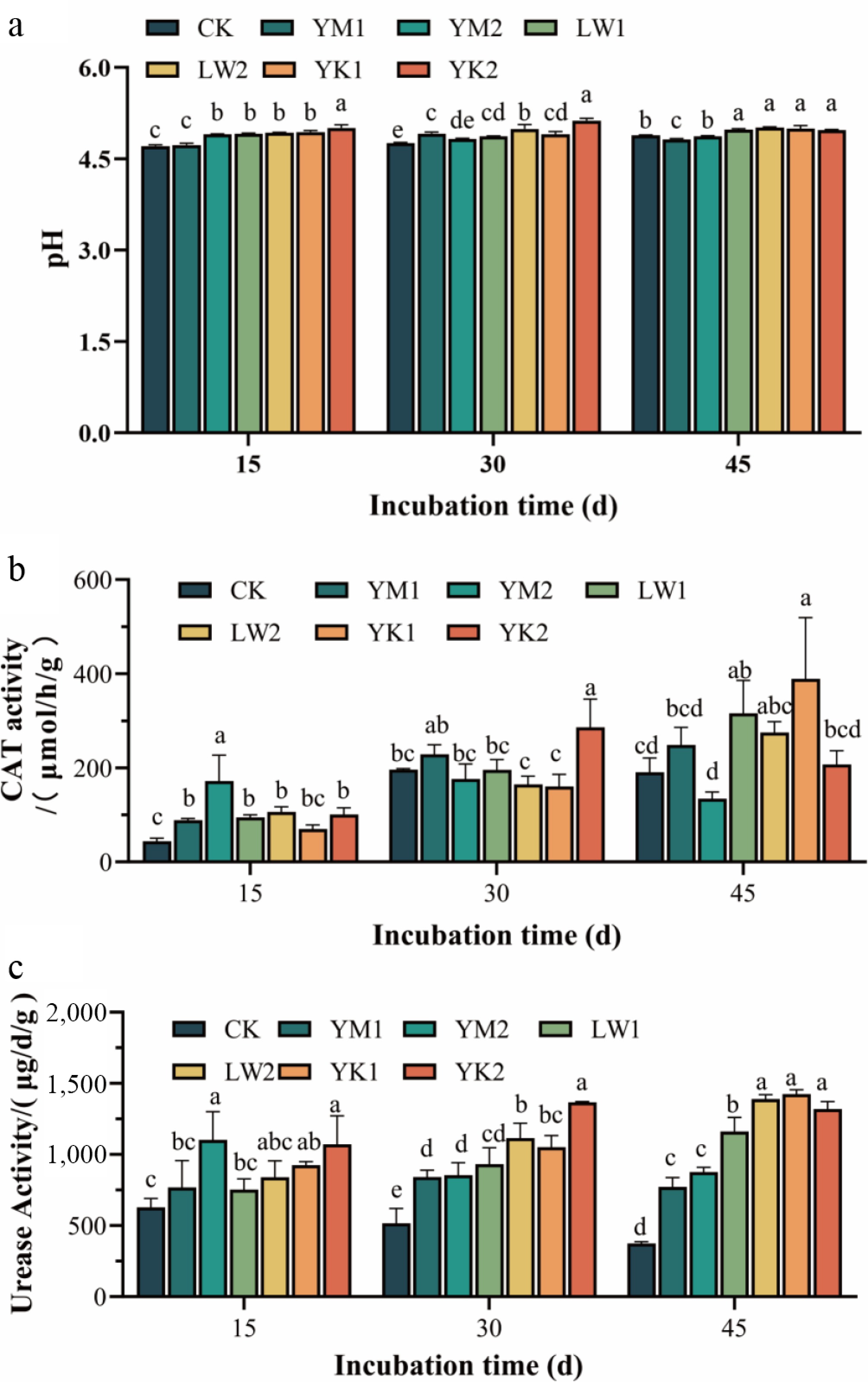
Figure 1.
Effect of application of different biochar treatments on soil pH and enzyme activity variations in tea plantations during 45 d of incubation. (a) pH. (b) CAT activity. (c) Urease activity. CK (no biochar), YM1 (0.5% corn stover biochar), YM2 (1.0% corn stover biochar), LW1 (0.5% reed biochar), LW2 (1.0% reed biochar), YK1 (0.5% coconut shell biochar), YK2 (1.0% coconut shell biochar). Different lowercase letters indicate significant differences between treatments after the same treatment time (p < 0.05).
-
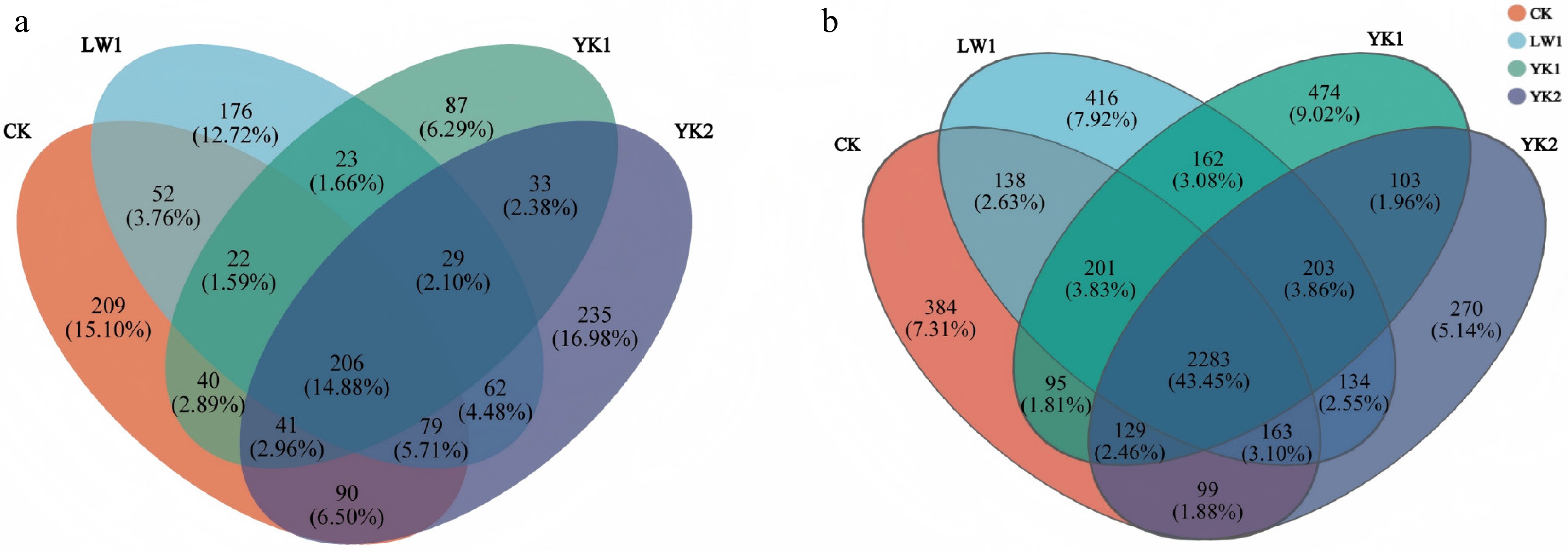
Figure 2.
Venn diagram illustrating Operational Taxonomic Unit (OTU) of (a) soil fungal, and (b) bacterial communities under different biochar application. CK (no biochar), LW1 (0.5% reed biochar), YK1 (0.5% coconut shell biochar), YK2 (1.0% coconut shell biochar).
-
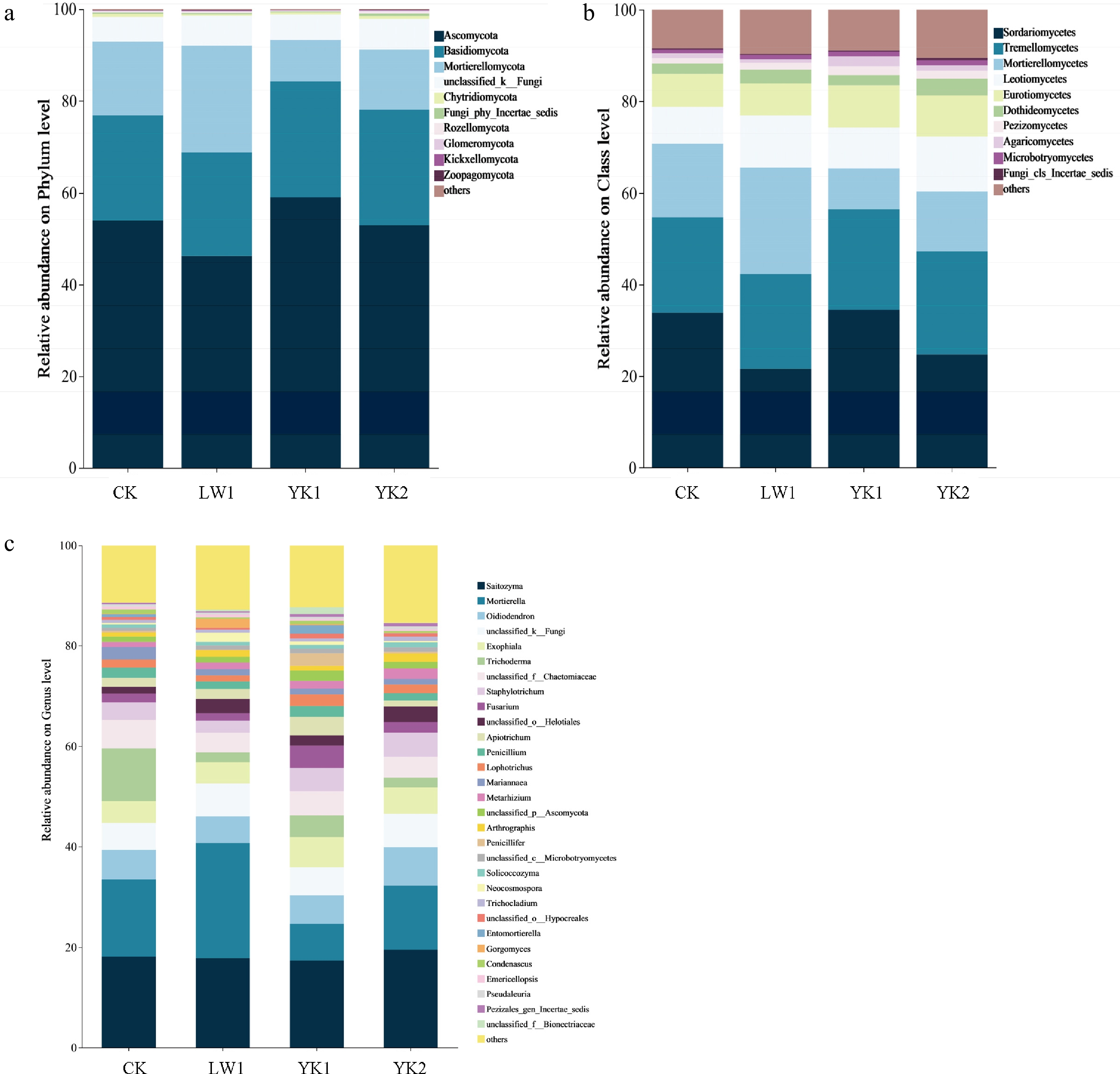
Figure 3.
Changes in (a) phylum, (b) class, and (c) genus level fungal community diversity in tea plantation soil under different biochar treatments. CK (no biochar), LW1 (0.5% reed biochar), YK1 (0.5% coconut shell biochar), YK2 (1.0% coconut shell biochar).
-
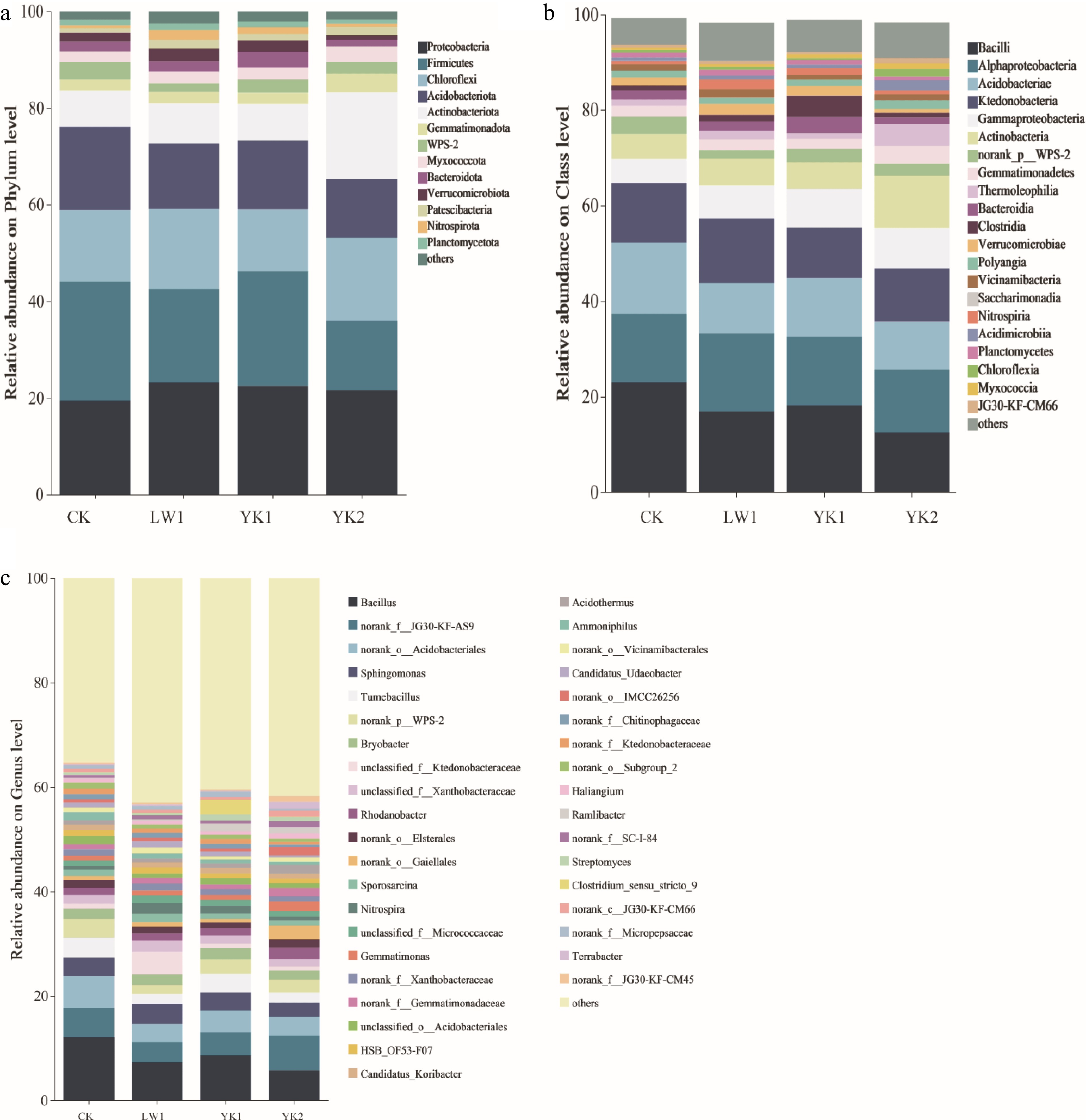
Figure 4.
Changes in (a) phylum, (b) class, and (c) genus level bacterial community diversity in tea plantation soil. CK (no biochar), LW1 (0.5% reed biochar), YK1 (0.5% coconut shell biochar), YK2 (1.0% coconut shell biochar).
-
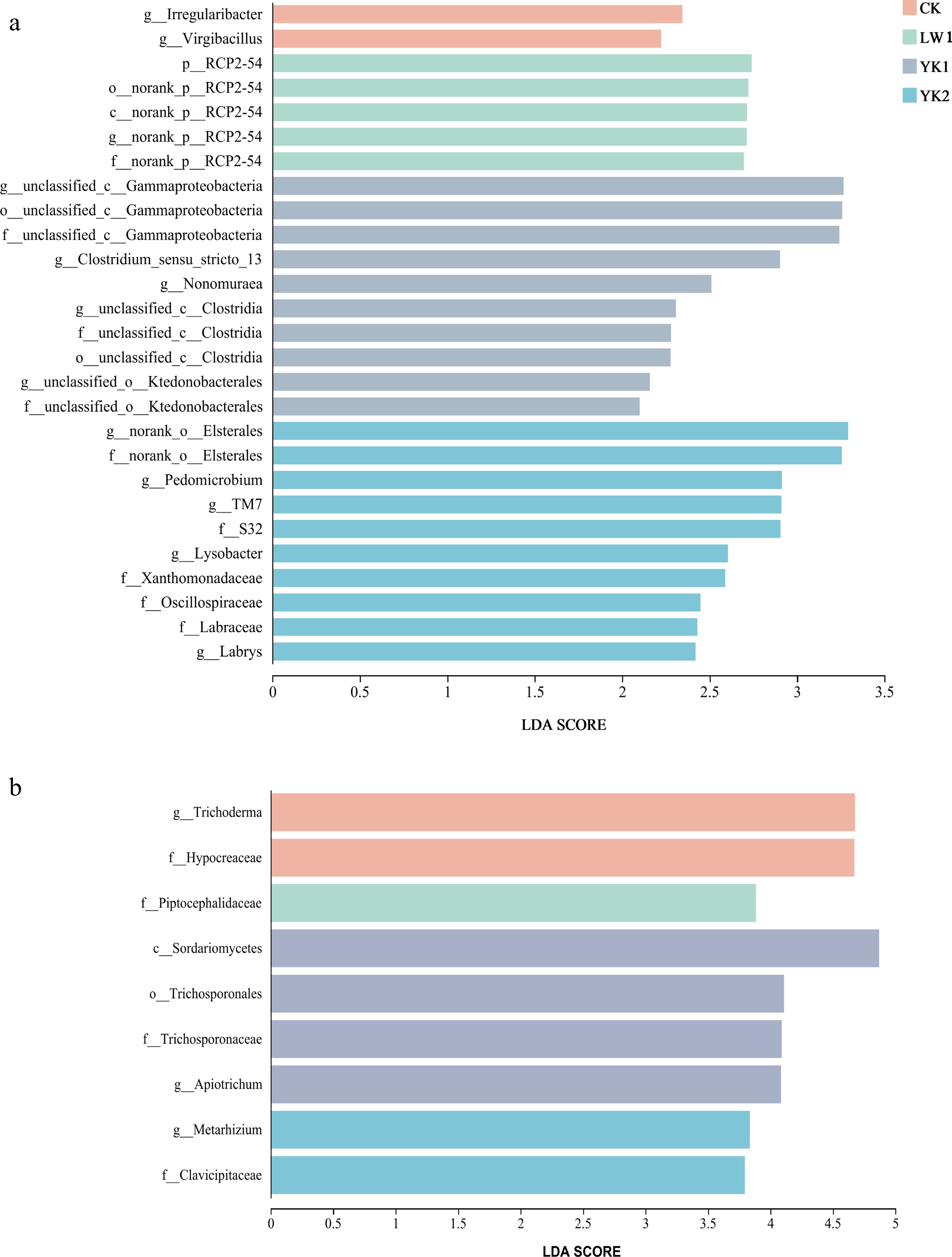
Figure 5.
Histogram of the Linear Discriminant Analysis (LDA) score computed for differentially abundant taxa (genus level) in (a) bacteria, and (b) fungi. CK (no biochar), LW1 (0.5% reed biochar), YK1 (0.5% coconut shell biochar), YK2 (1.0% coconut shell biochar).
-
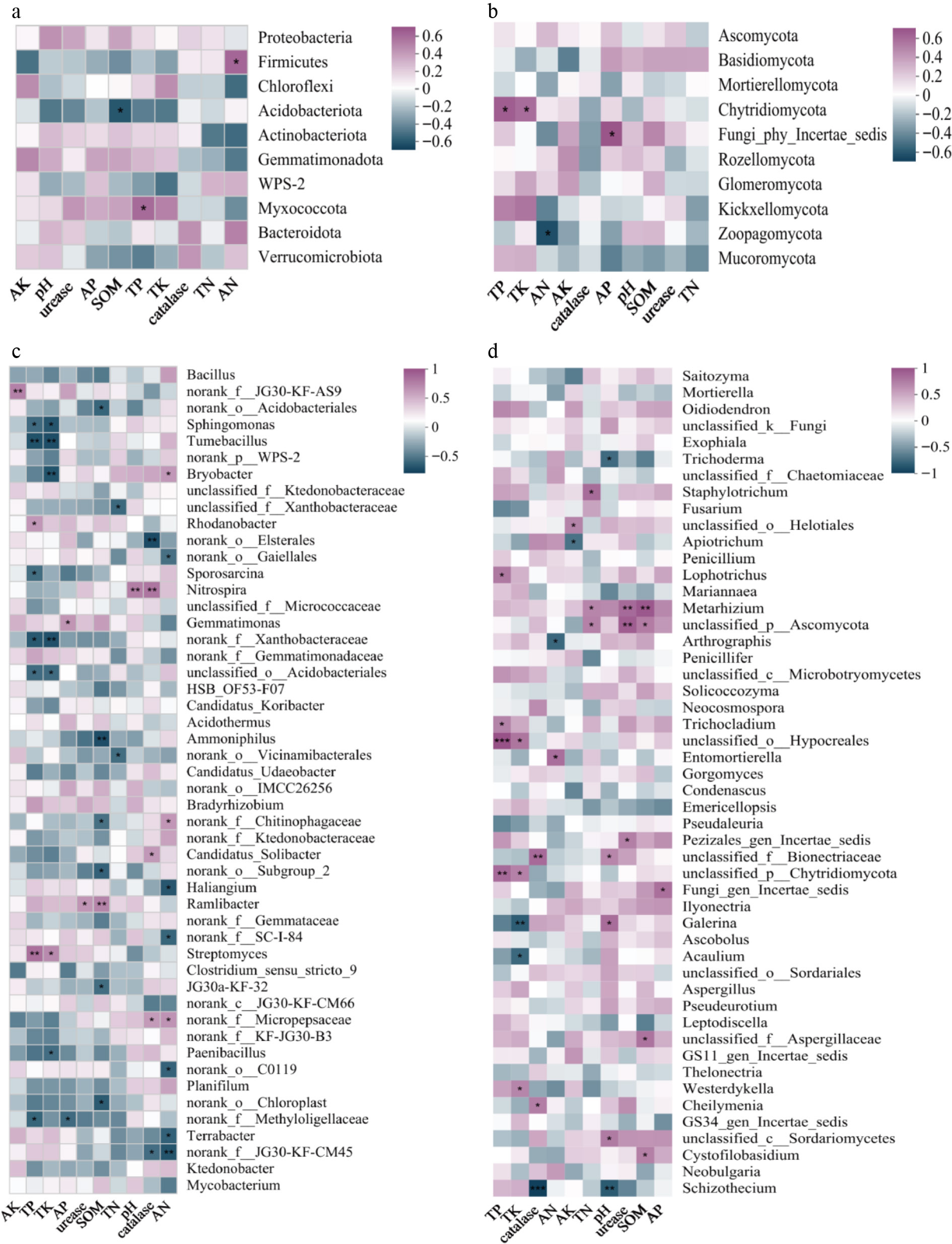
Figure 6.
Correlation analysis between bacterial/fungal communities and soil physicochemical properties in tea plantation soils. (a), (b) Correlations at the phylum level for bacterial and fungal communities. (c), (d) Correlations at the genus level for bacterial and fungal communities. *, **, and *** indicate significance at p < 0.05, p < 0.01, and p < 0.001, respectively.
-
TN/(g/kg) TP/(g/kg) TK/(g/kg) AP/(mg/kg) AK/(mg/kg) AN/(mg/kg) SOM/(g/kg) CK 1.53 ± 0.13a 0.79 ± 0.05a 10.56 ± 1.23a 61.12 ± 4.10b 333.28 ± 20.21ab 139.90 ± 18.53ab 32.68 ± 0.51d LW1 1.53 ± 0.15a 0.76 ± 0.00a 10.92 ± 0.35a 52.87 ± 3.14c 327.28 ± 10.13b 124.91 ± 16.16ab 35.28 ± 0.76c YM1 1.69 ± 0.01a 0.78 ± 0.02a 10.28 ± 0.84a 73.28 ± 3.10a 356.30 ± 0.44a 144.33 ± 9.82ab 36.72 ± 0.73c YK1 1.67 ± 0.02a 0.80 ± 0.05a 10.55 ± 1.00a 68.17 ± 6.26ab 327.22 ± 10.22b 151.79 ± 7.55a 39.47 ± 1.81b YK2 1.66 ± 0.03a 0.82 ± 0.08a 11.50 ± 1.52a 70.09 ± 1.54a 350.42 ± 20.04ab 121.59 ± 14.87b 47.26 ± 1.12a CK (no biochar), LW1 (0.5% reed biochar), YM1 (0.5% corn stover biochar), YK1 (0.5% coconut shell biochar), YK2 (1.0% coconut shell biochar). Different lowercase letters indicate significant differences between different biochar treatments (p < 0.05). Table 1.
Effect of different biochar types on soil nutrient content.
-
Microbial community Biochars ACE Chao Shannon Simpson Sobs Fungi CK 397.44 ± 16.70a 402.48 ± 15.66a 3.67 ± 0.13a 0.0709 ± 0.01a 387 ± 16.83a LW1 323.44 ± 74.39a 326.67 ± 75.79a 3.57 ± 0.27a 0.0917 ± 0.02a 312 ± 72.26a YK1 249.59 ± 19.34a 248.63 ± 19.12a 3.78 ± 0.03a 0.0564 ± 0.00a 243 ± 17.36a YK2 402.00 ± 91.46a 407.63 ± 93.11a 3.9 ± 0.07a 0.0643 ± 0.00a 390 ± 88.40a Bacteria CK 2,952.24 ± 61.13a 2,852.2 ± 49.90a 5.91 ± 0.03a 0.0126 ± 0.00a 2,391 ± 43.24a LW1 3,106.68 ± 77.37a 3,008.16 ± 67.79a 6.15 ± 0.13a 0.0102 ± 0.00a 2,560 ± 54.48a YK1 3,117.77 ± 30.74a 3,018.05 ± 28.17a 5.99 ± 0.16a 0.0111 ± 0.00a 2,476 ± 75.45a YK2 2,805.04 ± 195.27a 2,749.48 ± 170.77a 6.22 ± 0.05a 0.0064 ± 0.00b 2,304 ± 133.23a CK (no biochar), LW1 (0.5% reed biochar), YK1 (0.5% coconut shell biochar), YK2 (1.0% coconut shell biochar). Different lowercase letters indicate significant differences between different biochars (p < 0.05). Table 2.
Effect of different biochar types on alpha diversity of fungi and bacteria.
Figures
(6)
Tables
(2)