-
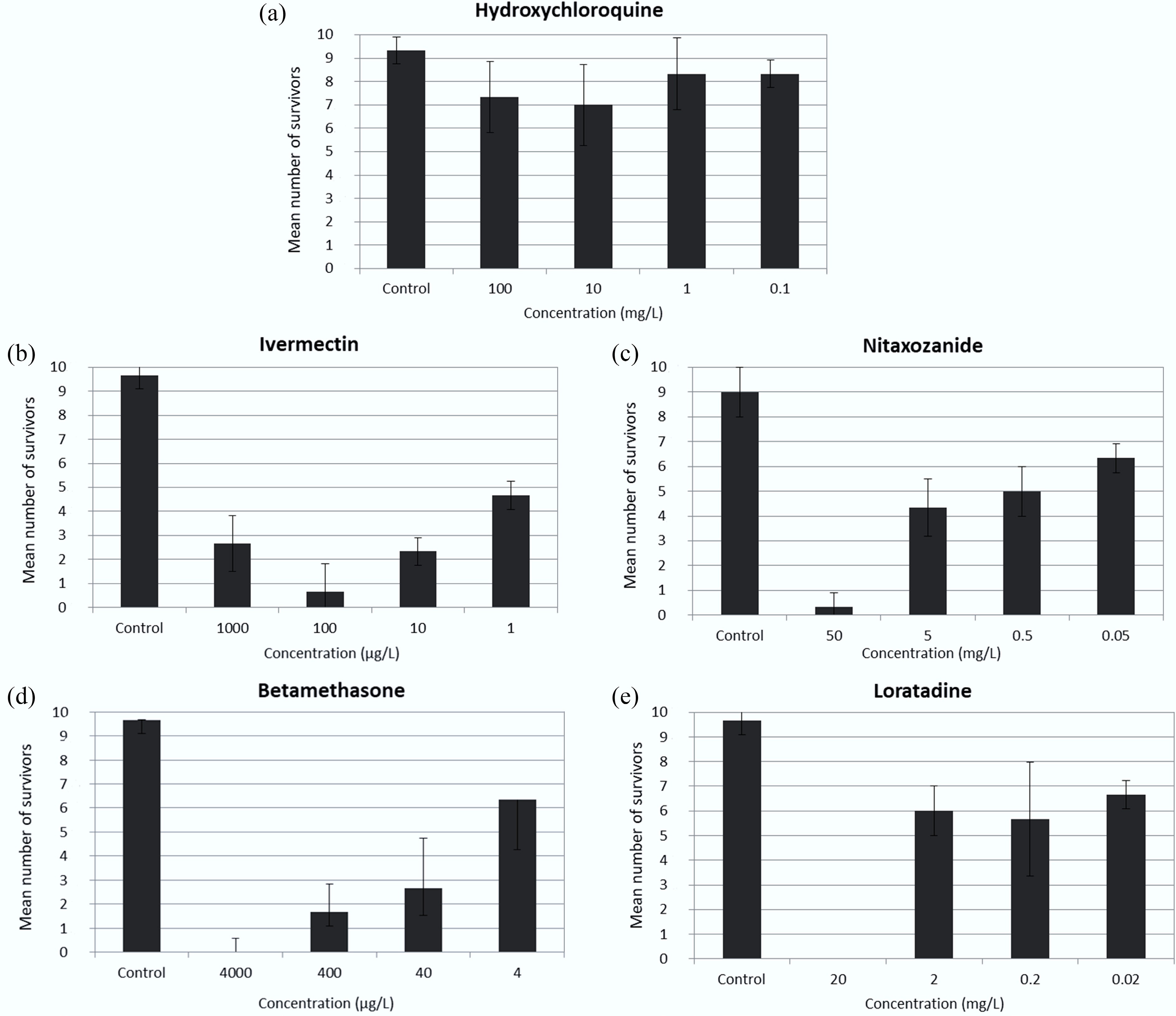
Figure 1.
Mean survival rates of nauplii of Artemia salina exposed to COVID-19 drugs: (a) Hydroxychloroquine, (b) ivermectin, (c) nitazoxanide, (d) betamethasone, and (e) loratadine) for 48 h. The control treatment consists of a 1.0% acetone solution. Error bars indicate standard deviations.
-
Hydroxychloroquine (mg/L) Nitazoxanide (mg/L) Ivermectin (μg/L) Loratadine (mg/L) Betamethasone (μg/L) Control 100 10 1 0.1 Control 50 5 0.5 0.05 Control 1,000 100 10 1 Control 20 2 0.2 0.02 Control 4,000 400 40 4 Salinity 35 35 35 35 35 35 35 35 35 35 35 35 35 35 35 35 35 35 35 35 35 35 35 35 35 pH 8.1 7.9 7.9 8 8 8.2 7.7 7.7 7.9 7.9 8.2 7.7 7.9 8 8 8.1 8 8 8.1 8 8.1 8 8.1 8 8.1 Temperature (°C) 25 25 25 25 25 25 25 25 25 25 25 25 25 25 25 25 25 25 25 25 25 25 25 25 25 D.O.
(% saturation)92 88 91 92 92 95 80 85 89 90 93 86 89 91 91 91 90 93 87 88 90 82 91 92 90 Table 1.
Physicochemical parameter of the tested solutions in the toxicity tests with pharmaceuticals used to treat COVID-19
-
Test compound LC50-48 h LOEC Hydroxychloroquine Not toxic Not toxic Ivermectin NC 1.0 μg/L Nitazoxanide 0.64 (0.21–1.93) mg/L 0.05 mg/L Betamethasone 33.64 (22.25–50.86) μg/L 4.0 μg/L Loratadine 0.53 mg/L 0.02 mg/L Table 2.
Lethal concentrations to 50% of organisms (LC50-48 h) and the lowest observed effect concentrations (LOECs) obtained for nauplii of Artemia salina exposed to COVID-19 pharmaceuticals
Figures
(1)
Tables
(2)