-
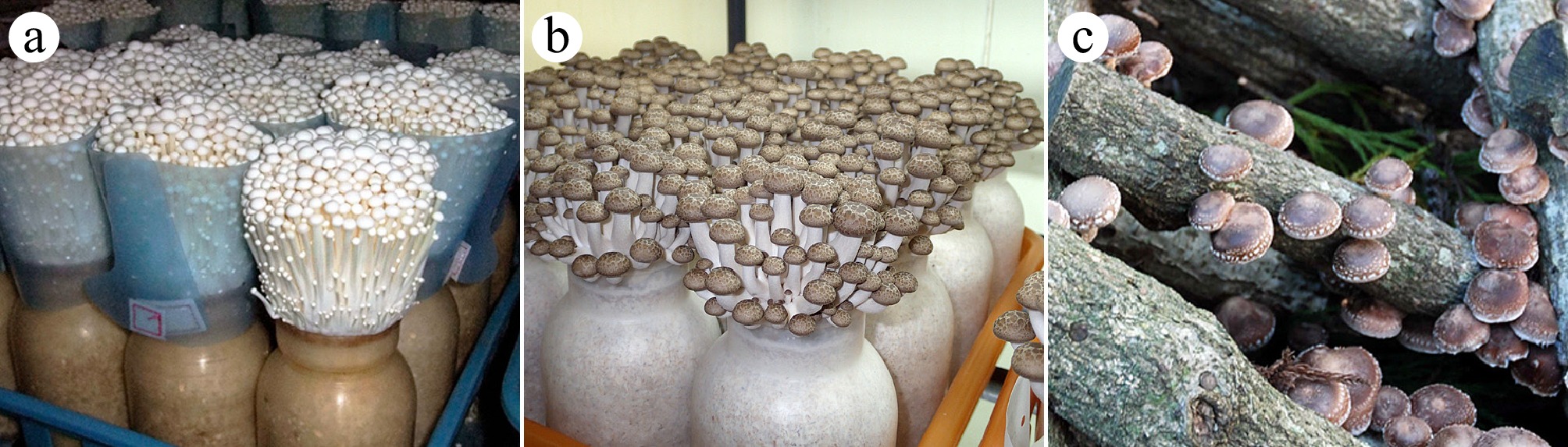
Figure 1.
Cultivated mushrooms of (a) Flammulina velutipes photographed by Hiroyuki Shimizu, (b) Hypsizygus marmoreus photographed by H. Shimizu, and (c) Lentinula edodes photographed by Hisayasu Kobayashi.
-
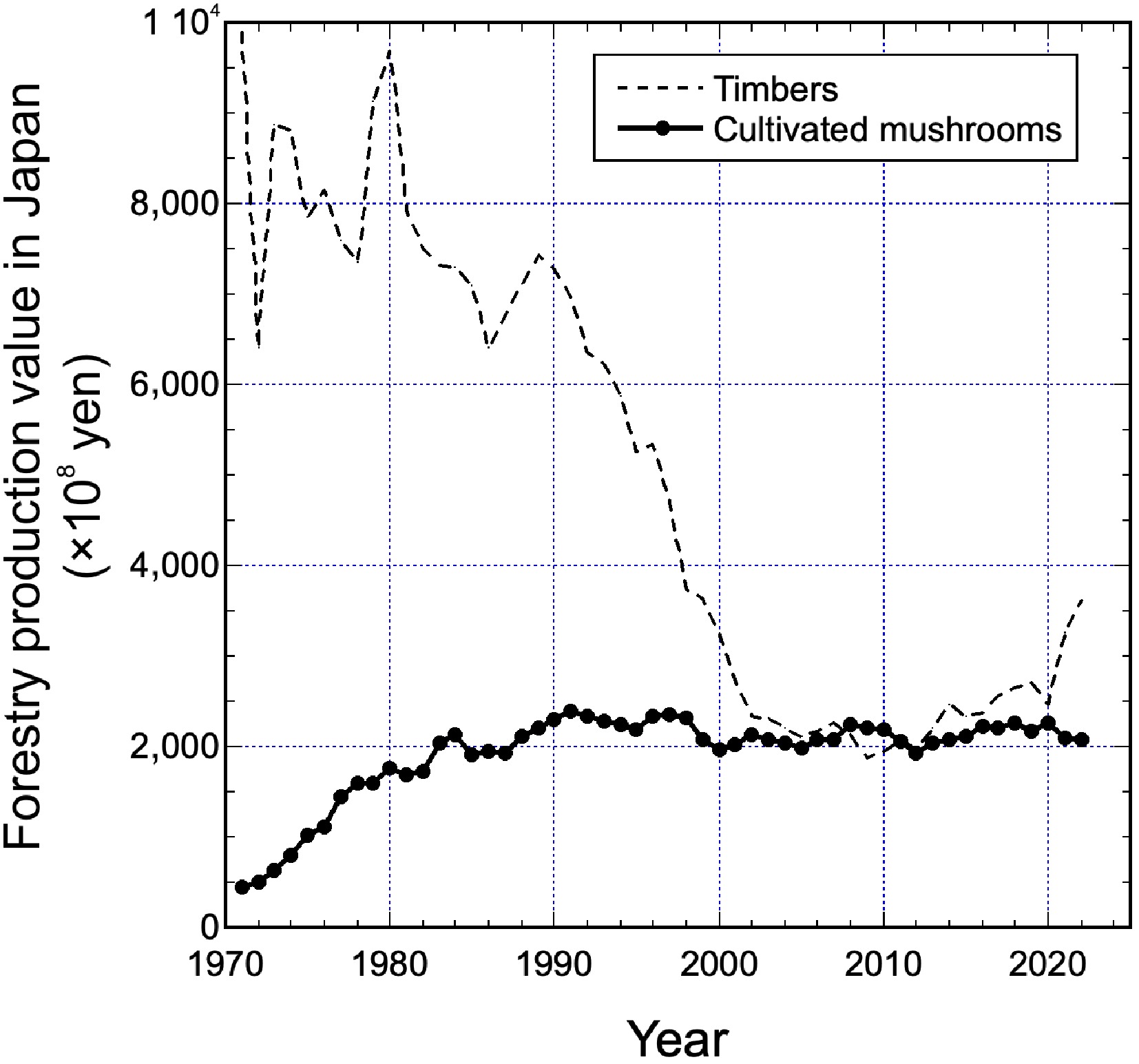
Figure 2.
The production of timbers and cultivated mushrooms in Japan in the past half-century. Data source: Statistics of the Ministry of Agriculture, Forestry and Fisheries, Japan (
www.maff.go.jp/j/tokei/index.html ). -
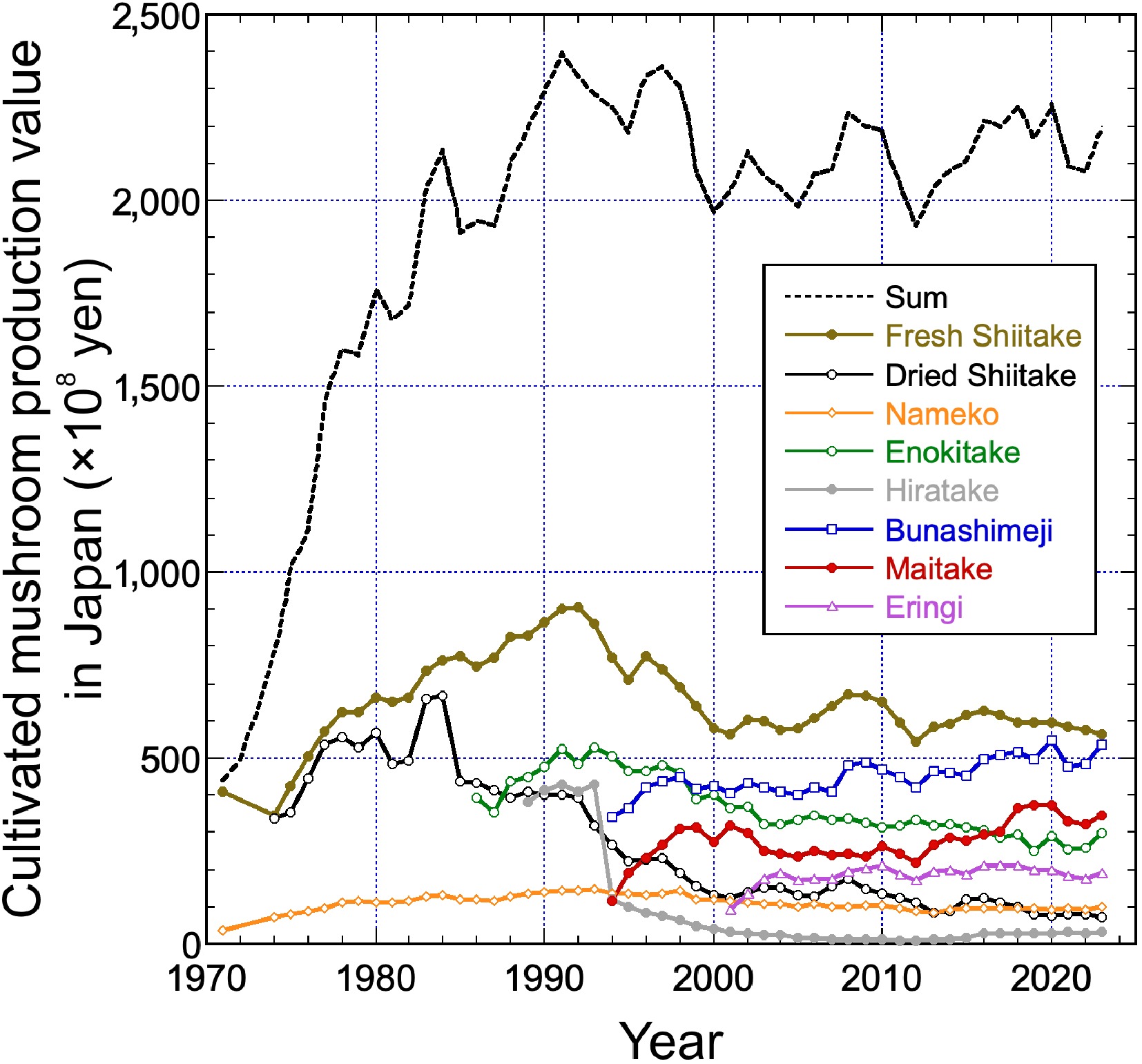
Figure 3.
Cultivated mushrooms production value in Japan in the past half a century. Data source: Statistics of the Ministry of Agriculture, Forestry and Fisheries, Japan (
www.maff.go.jp/j/tokei/index.html ). -
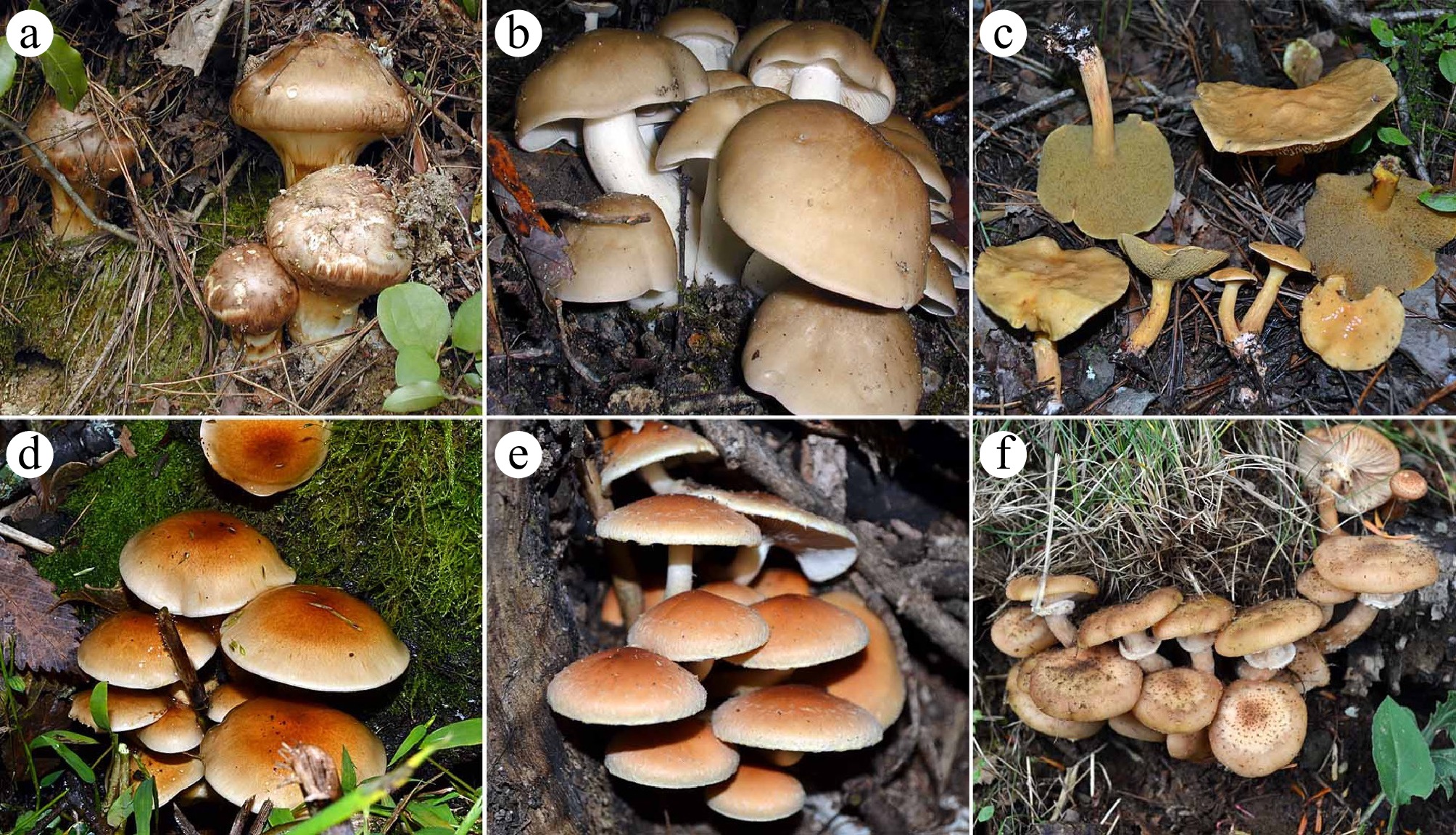
Figure 4.
Popular wild mushrooms in Japan since the old era. (a) Tricholoma matsutake (Oct 2007; Toyooka, Nagano). (b) Lyophyllum shimeji (Oct 2008; Nakagawa, Nagano). (c) Amitake (Sep 2018; Saku, Nagano). (d) Suillus bovinus (Oct 2011; Takayama, Gifu). (e) Hypholoma lateritium (Oct 2018; Okaya, Nagano). (f) Armillaria mellea (Sep 2012; Saku, Nagano).
-
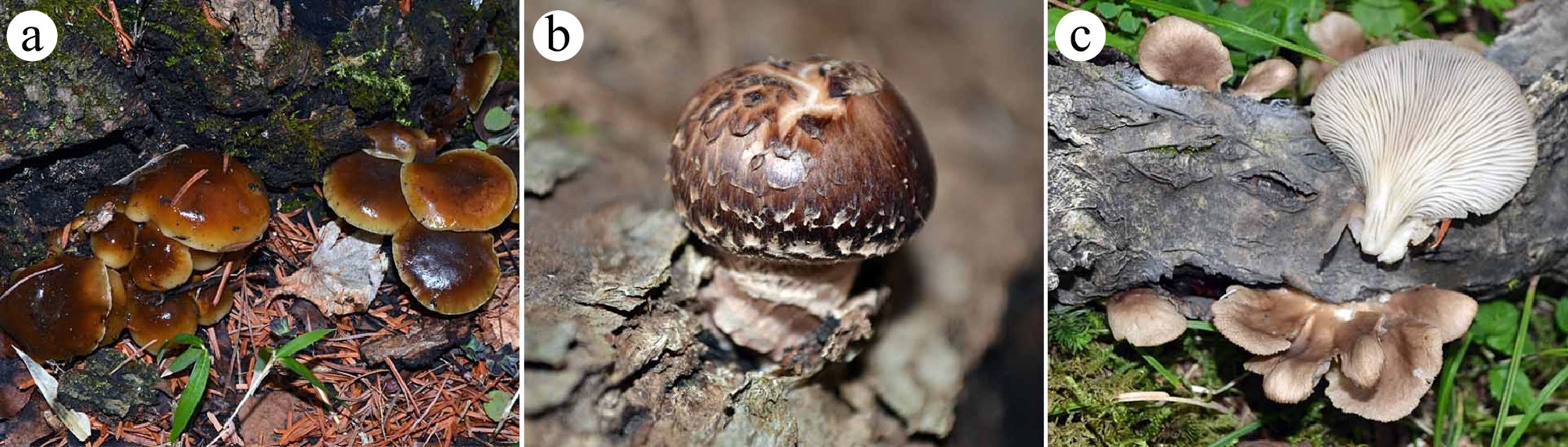
Figure 5.
Commercially important cultivated mushrooms in Japan. (a) Flammulina velutipes (Feb 2016; Okaya, Nagano; wild). (b) Lentinula edodes (Nov 2019; Koumi, Nagano; wild). (c) Pleurotus pulmonarius (July 2021; Saku, Nagano; wild). In Japan, P. pulmonarius and P. ostreatus are both common in the field and have been used in both wild and cultivated mushrooms.
-
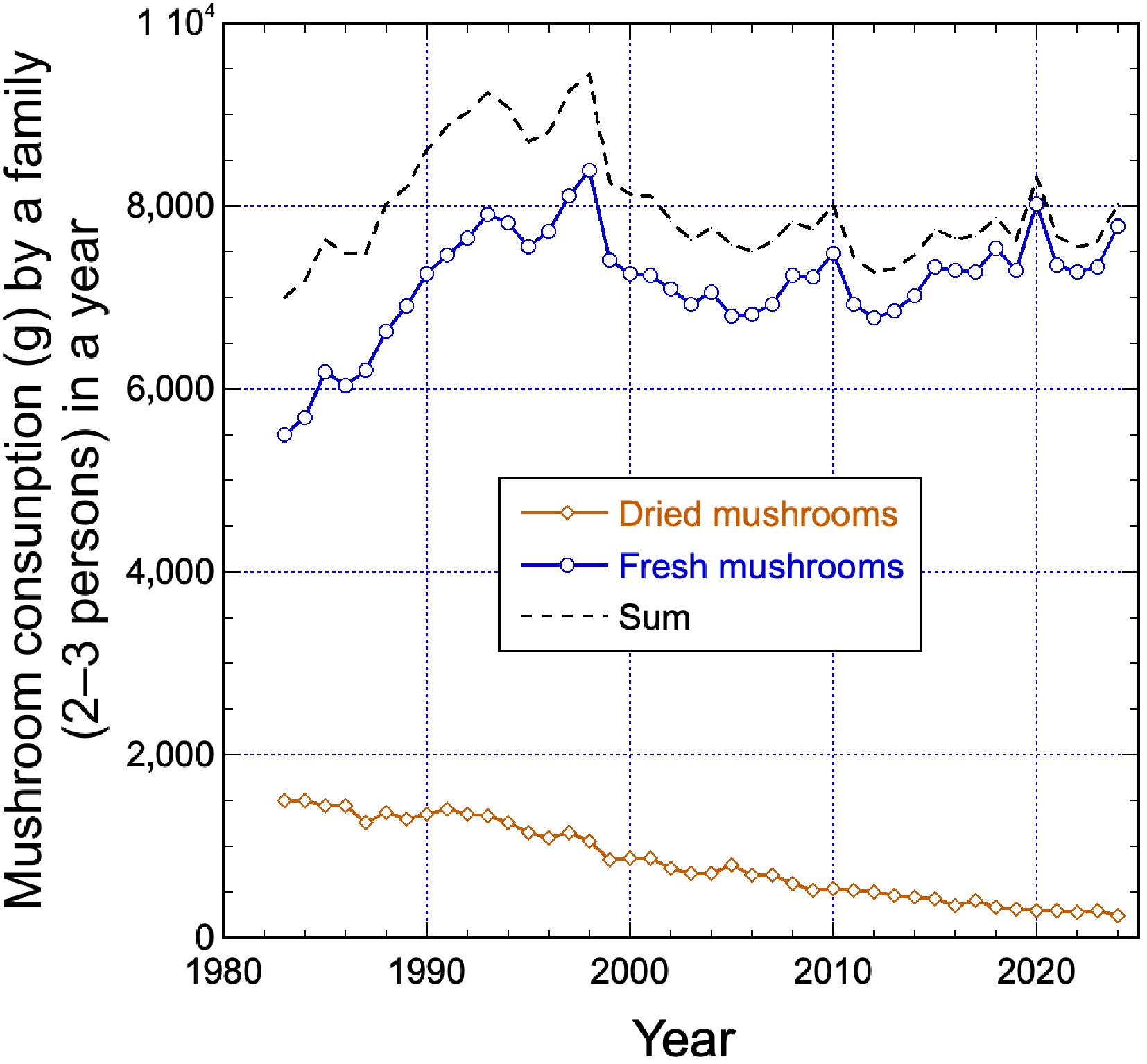
Figure 6.
Mushroom consumption by a family (two to three persons) in a year in Japan. Data source: Statistics of Japan (
www.e-stat.go.jp ). -
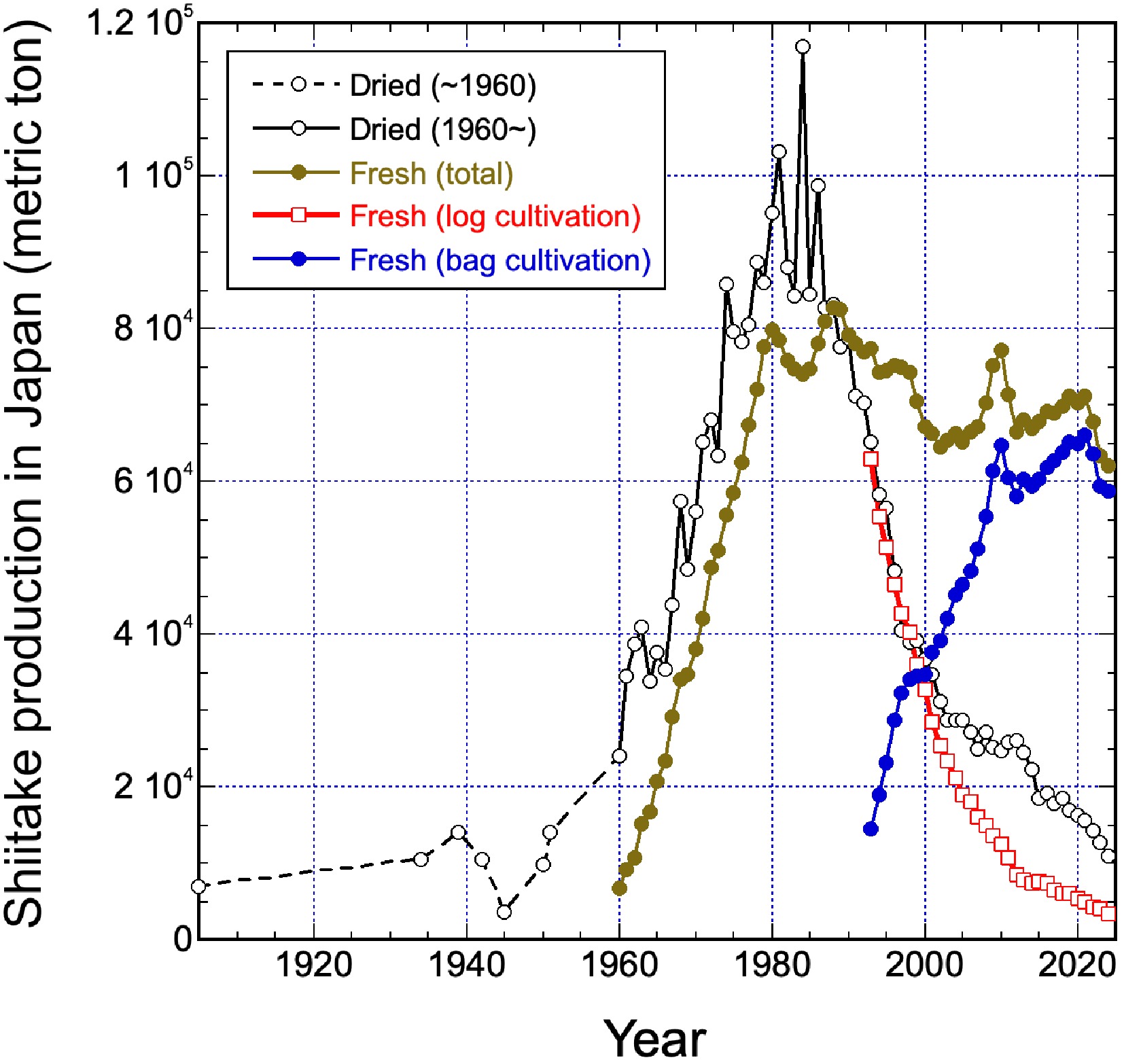
Figure 7.
The production of Lentinula edodes (shiitake) in Japan in the past 120 years. Data source: Statistics of the Ministry of Agriculture, Forestry and Fisheries, Japan (
www.maff.go.jp/j/tokei/index.html ). -
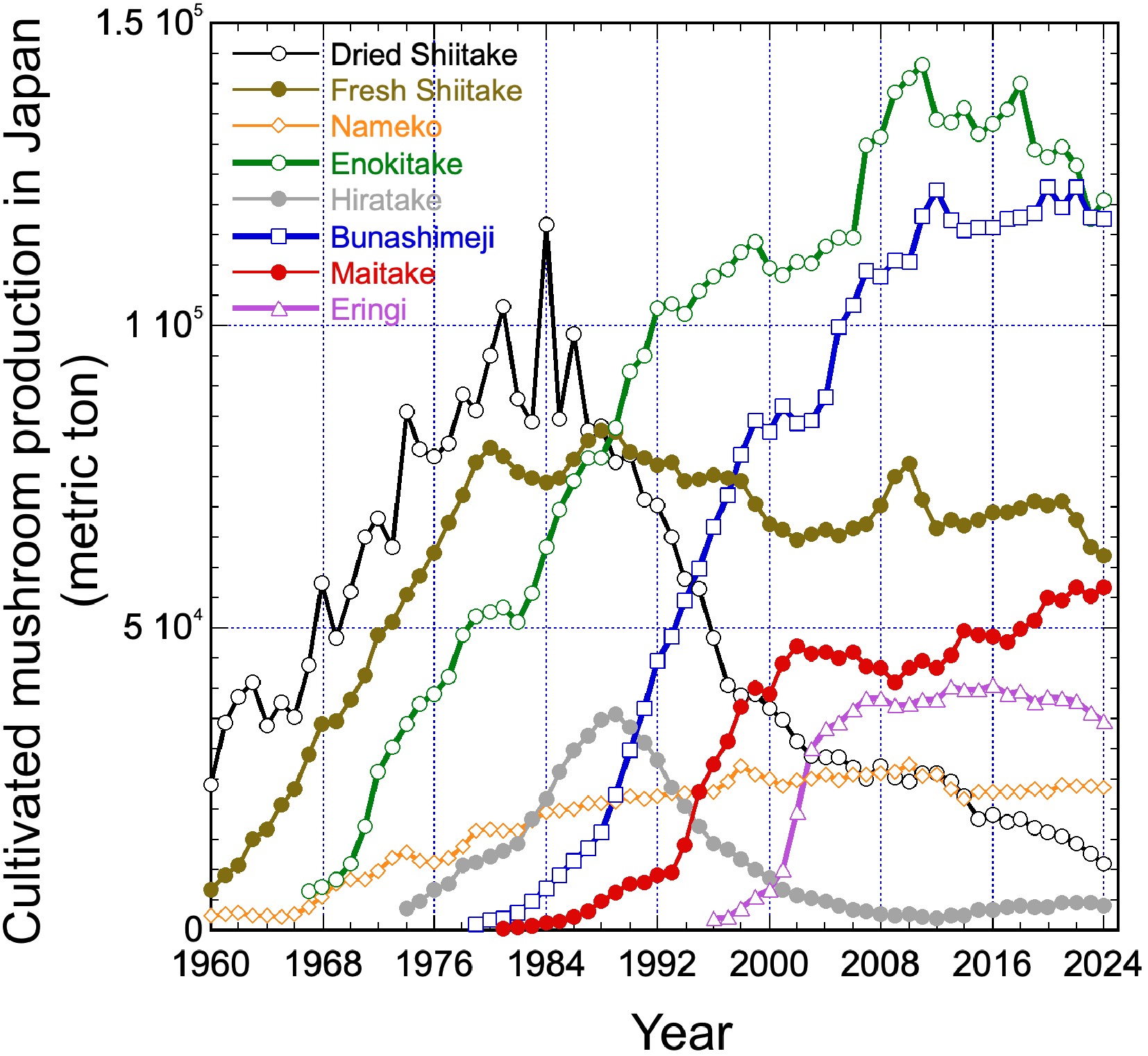
Figure 8.
The production of cultivated mushrooms in Japan in the past 65 years. Data source: Statistics of the Ministry of Agriculture, Forestry and Fisheries, Japan (
www.maff.go.jp/j/tokei/index.html ). -
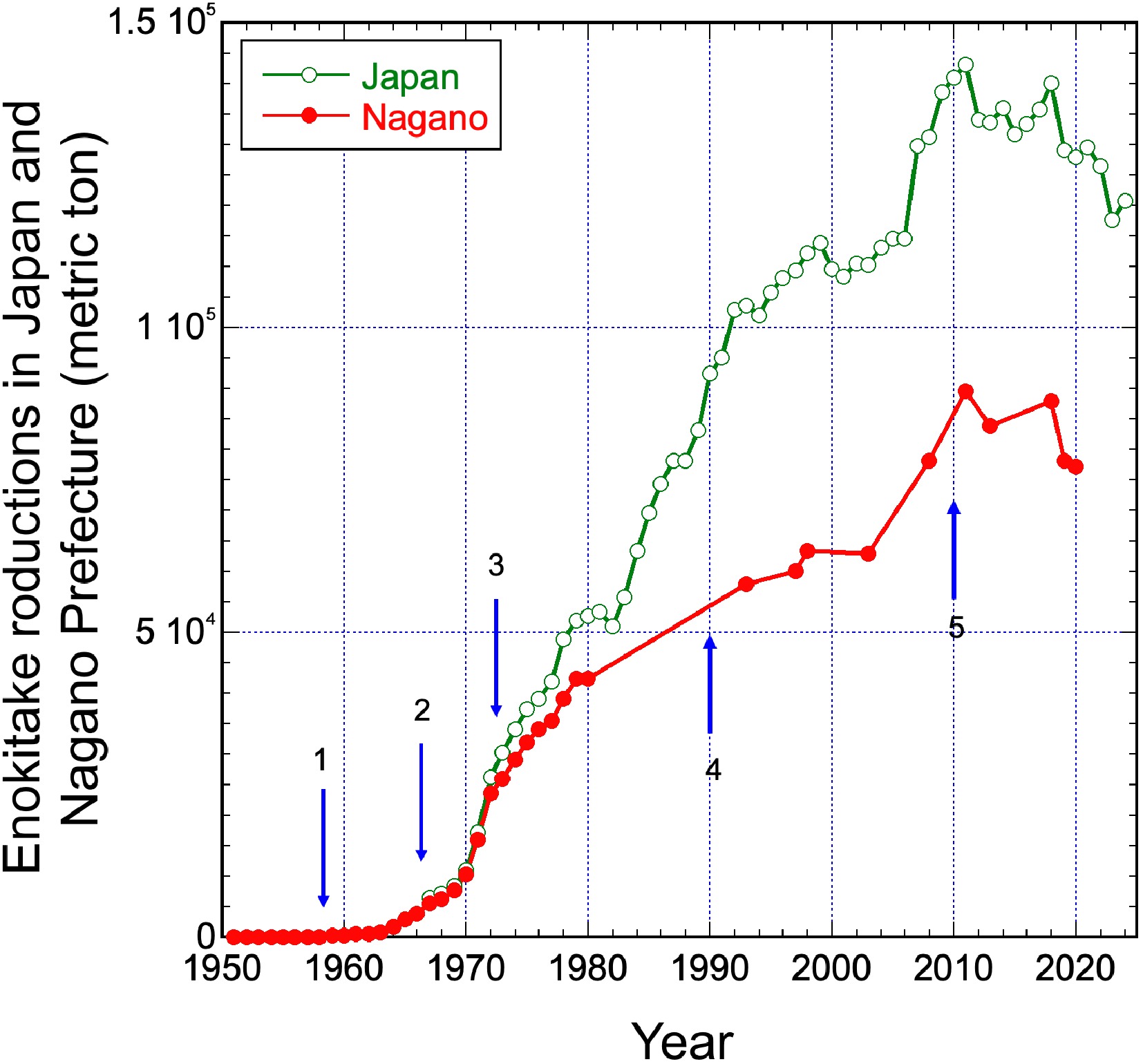
Figure 9.
The production of Flammulina velutipes (enokitake) in Japan and Nagano Prefecture in the past 75 years. 1: Nagano Prefecture provided subsidies for installing autoclaves to sterilize sawdust-based substrates. 2: Installation of air conditioners (coolers) at production sites and introduction of refrigerated trucks begun. 3: Transition from glass bottle cultivation to plastic bottles progressed. 4: Cultivation facilities became increasingly large-scale. 5: Large-scale, efficient mycelium inoculum production advances. Data source: Statistics of the Ministry of Agriculture, Forestry and Fisheries, Japan (
www.maff.go.jp/j/tokei/index.html ) and Uchiyama[28]. -
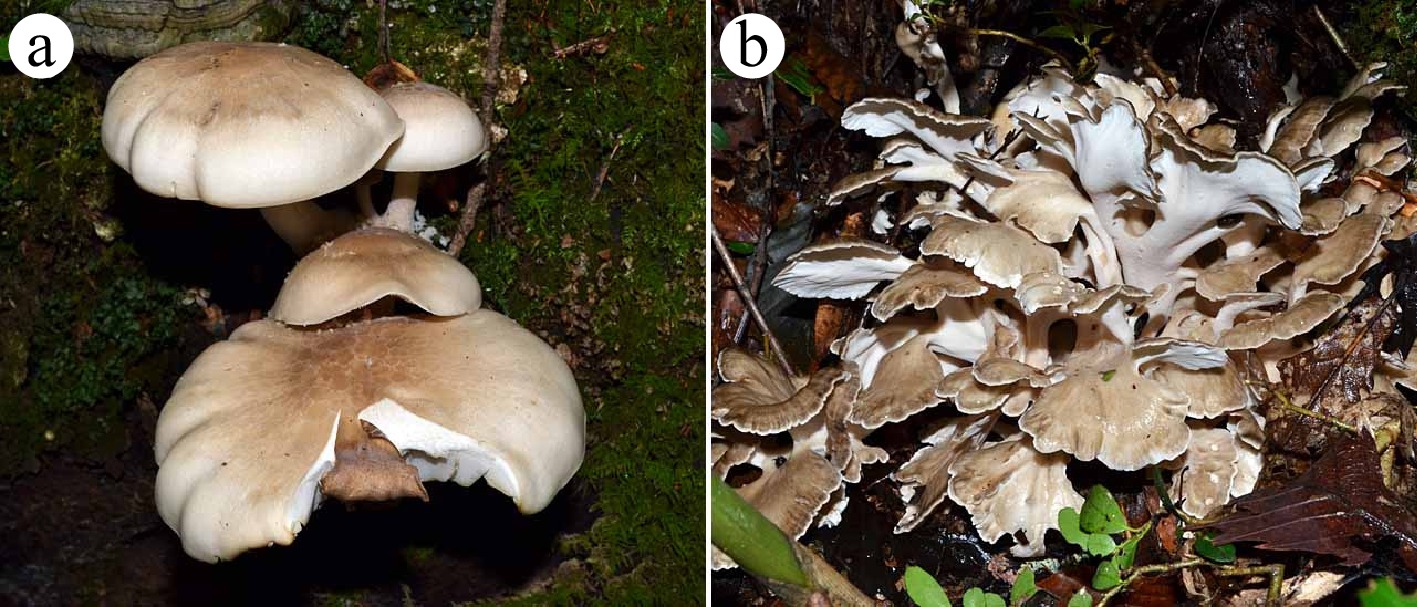
Figure 10.
Commercially important cultivated mushrooms in Japan. (a) Hypsizygus marmoreus (Sep 2015; Matsumoto, Nagano; wild). (b) Grifola frondosa (Oct 2016; Takayama, Gifu; wild).
-
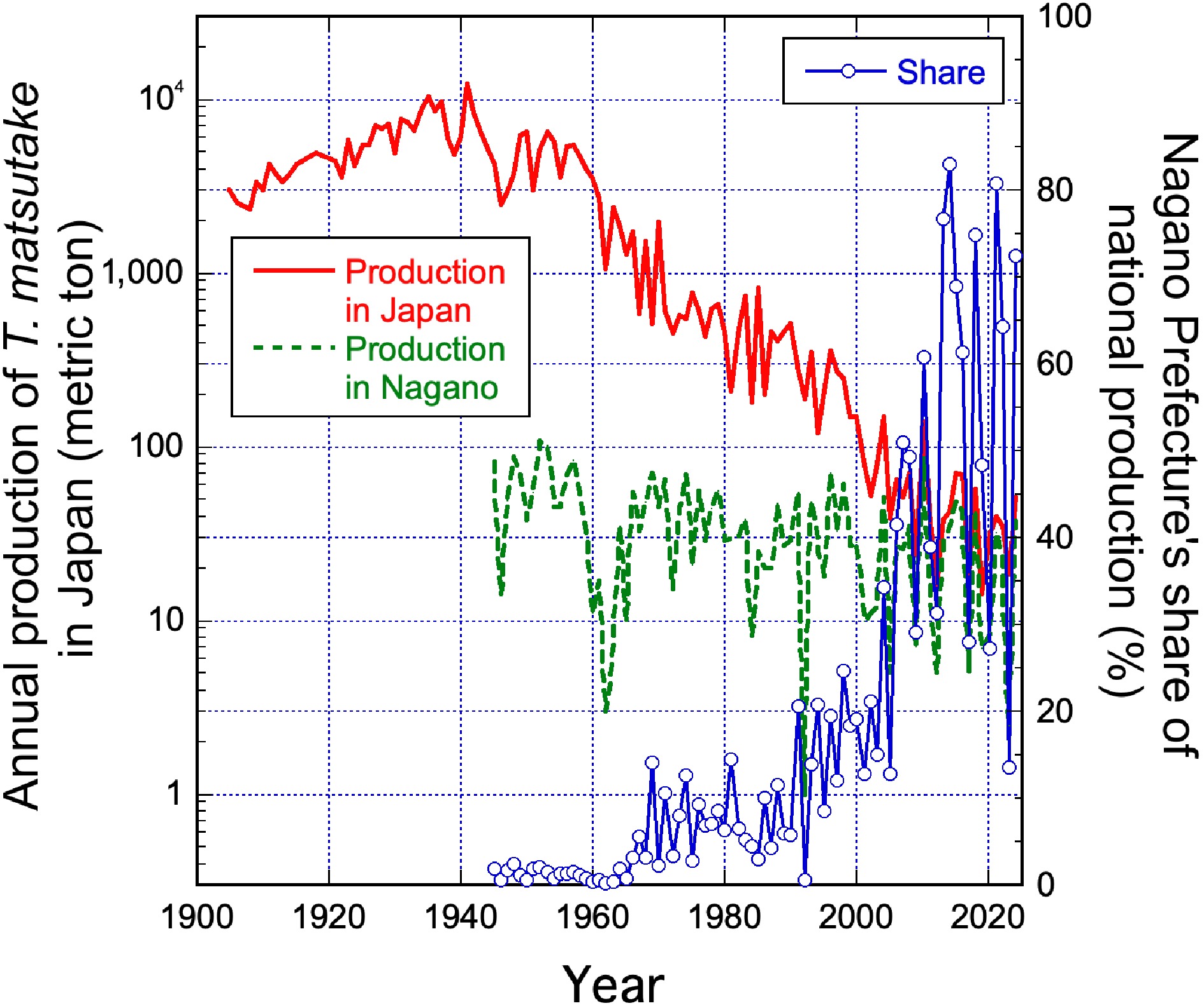
Figure 11.
Annual production of Tricholoma matsutake fruiting bodies in Japan and Nagano Prefecture in the past 120 years. Data source: Statistics of the Ministry of Agriculture, Forestry and Fisheries, Japan (
www.maff.go.jp/j/tokei/index.html ) and Editorial Committee of the Guide to Increasing Matsutake Production[43]. -
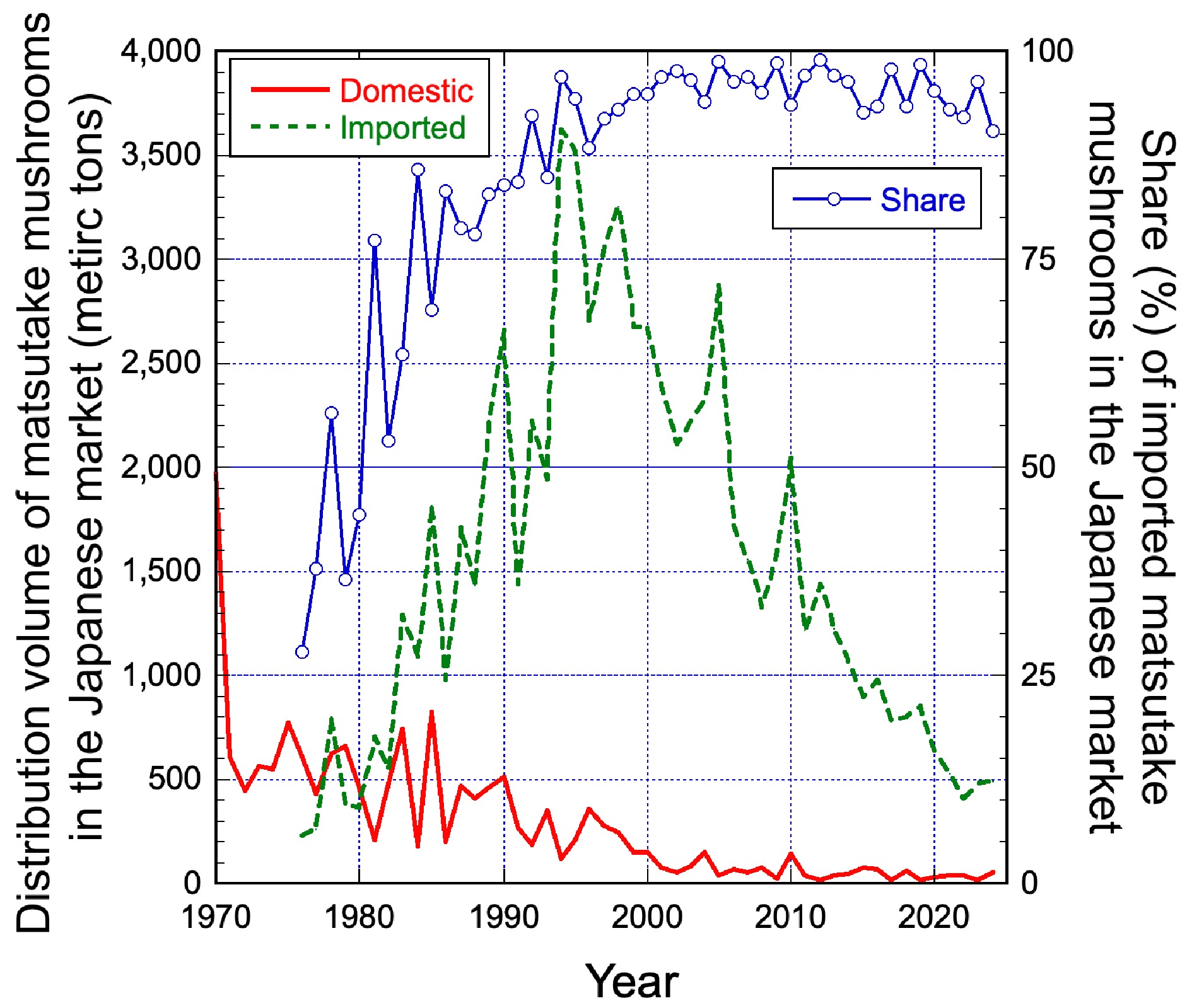
Figure 12.
Distribution volume of Tricholoma matsutake fruiting bodies in the Japanese market in the past half a century. Domestic matsutake only includes T. matsutake, whereas imported matsutakes include several closely related species. Data source: Statistics of the Ministry of Agriculture, Forestry and Fisheries, Japan (
www.maff.go.jp/j/tokei/index.html ). -
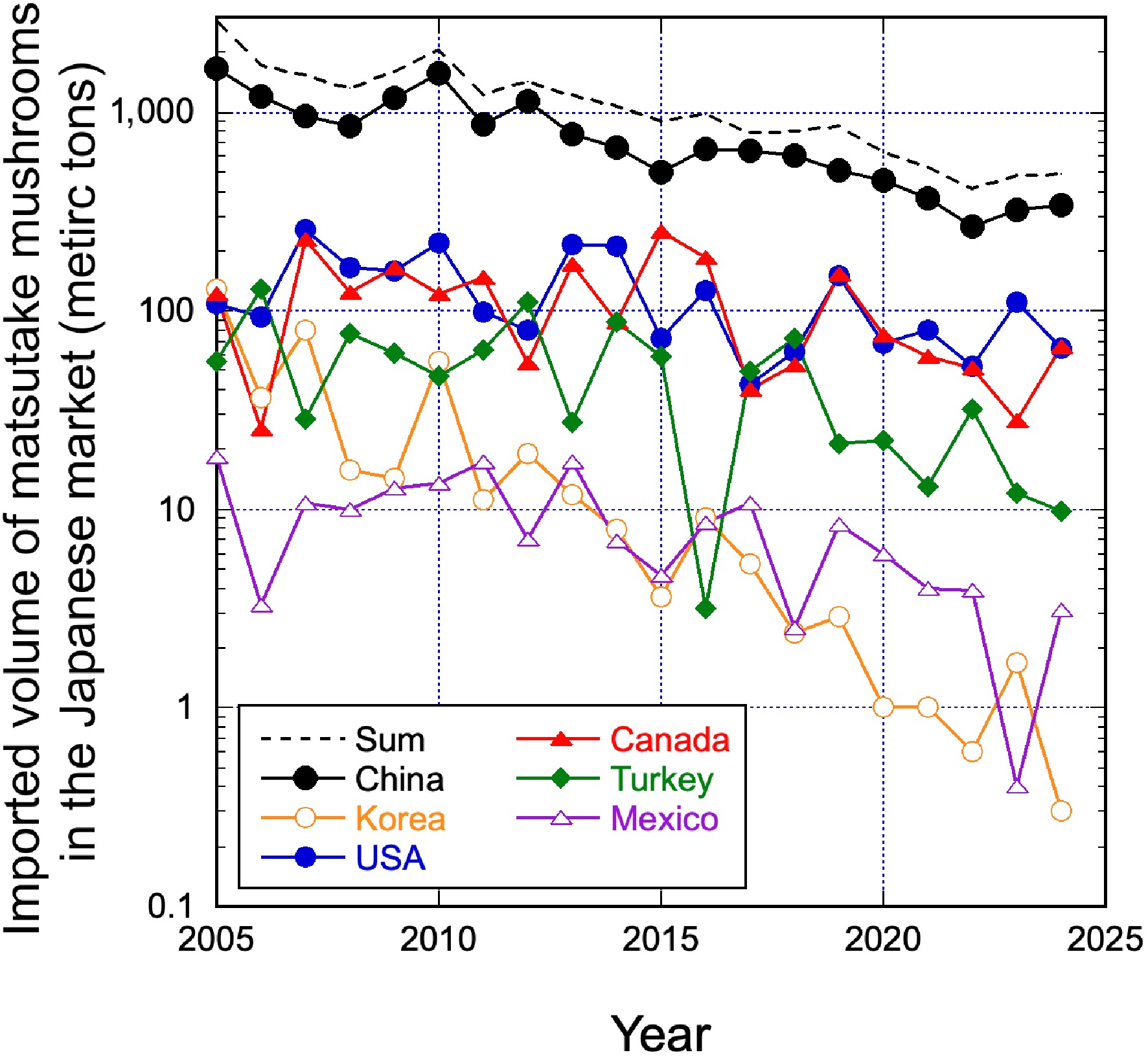
Figure 13.
Imported volume of Tricholoma matsutake and related species (matsutake mushrooms) in the Japanese market in the past 20 years. As well as Fig. 12, imported matsutakes include T. matsutake and several other closely related species. Data source: Statistics of the Ministry of Agriculture, Forestry and Fisheries, Japan (
www.maff.go.jp/j/tokei/index.html ). -
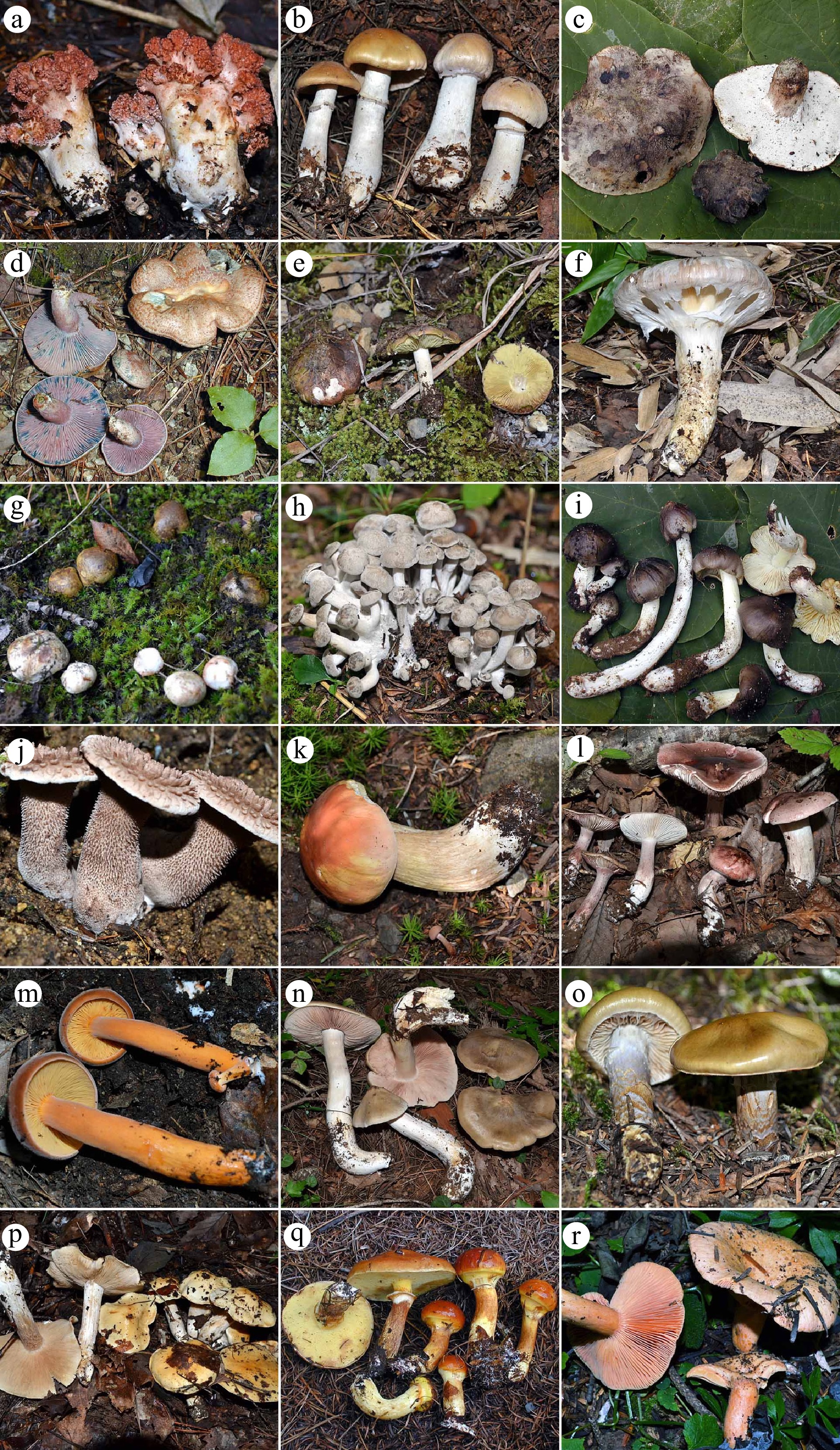
Figure 14.
Popular edible ectomycorrhizal mushrooms in Japan since the old era. (a) Ramaria botrytis (Sep 2013; Matsumoto, Nagano). (b) Cortinarius caperatus (Nov 2019; Okaya, Nagano). (c) Boletopsis leucomelaena (Oct 2000; Nakagawa, Nagano). (d) Lactarius hatsudake (Oct 2007; Ooshika, Nagano). (e) Tricholoma auratum (Nov 2022; Omi, Nagano). (f) Catathelasma ventricosum (Aug 2017; Matsumoto, Nagano). (g) Rhizopogon roseolus (Nov 2013, Takatori, Nara). (h) Lyophyllum fumosum (Oct 2018, Iiyama, Nagano). (i) Tricholoma portentosum (Oct 2000, Nakagawa, Nagano). (j) Sarcodon aspratu (Oct 2016, Ooshika, Nagano). (k) Boletus edulis (Aug 2022, Matsumoto, Nagano). (l) Hygrophorus russula (Sep 2014, Saku, Nagano). (m) Lactifluus volemus (July 2011, Okaya, Nagano). (n) Entoloma sarcopum (Sep 2014, Saku, Nagano). (o) Cortinarius pseudosalor (Sep 2021, Matsumoto, Nagano). (p) Cortinarius claricolor var. tenuipes (Sep 2015, Nakagawa, Nagano). (q) Suillus orientalis (Oct 2000, Ina, Nagano). (r) Lactarius laeticolor (Oct 2012, Matsumoto, Nagano). In Japan, T. auratum and T. flavovirens are often confused in the taxonomy, but both have been commonly used since the old era. In B. edulis, several related species such as B. reticulatus, B. violaceofuscus W.F. Chiu, and B. hiratsukae Nagas. are known in Japan and used as edible mushrooms in common. Suillus orientalis was recently described as a new species, divided from the S. grevillei complex.
-
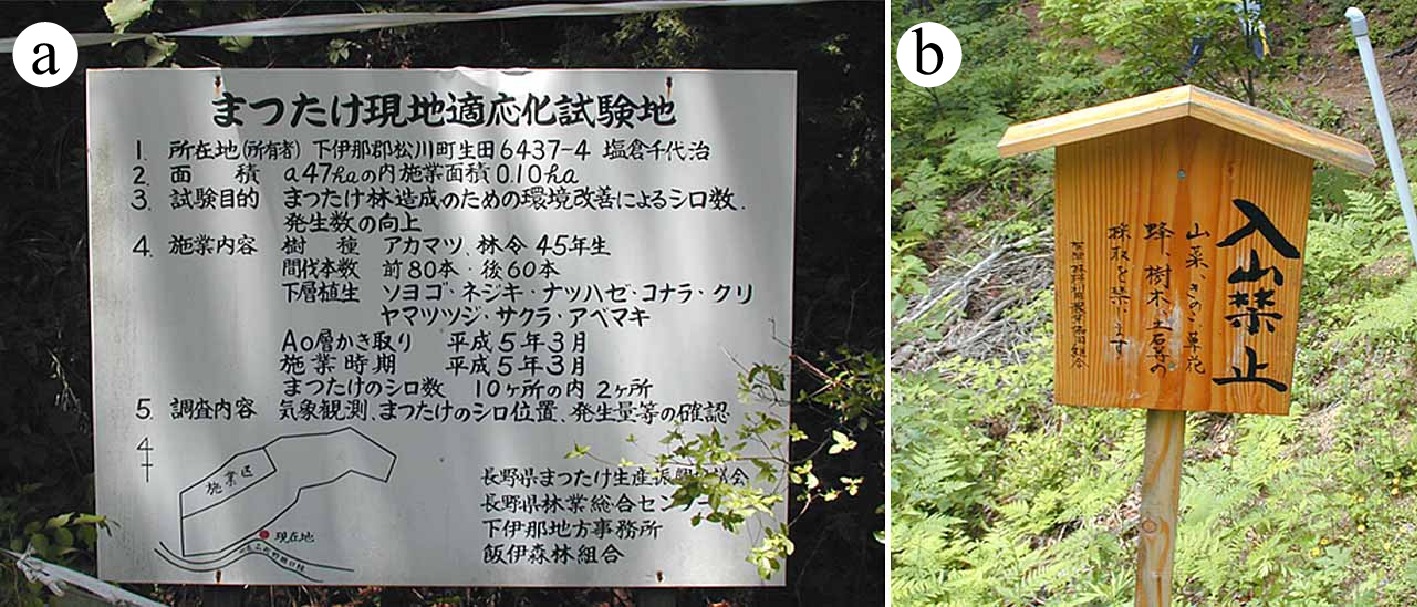
Figure 15.
Signs indicating management of the forest for Tricholoma matsutake harvest. (a) Sign indicating test areas through collaboration between private organizations and local governments. (b) No trespassing sign for private forest.
-
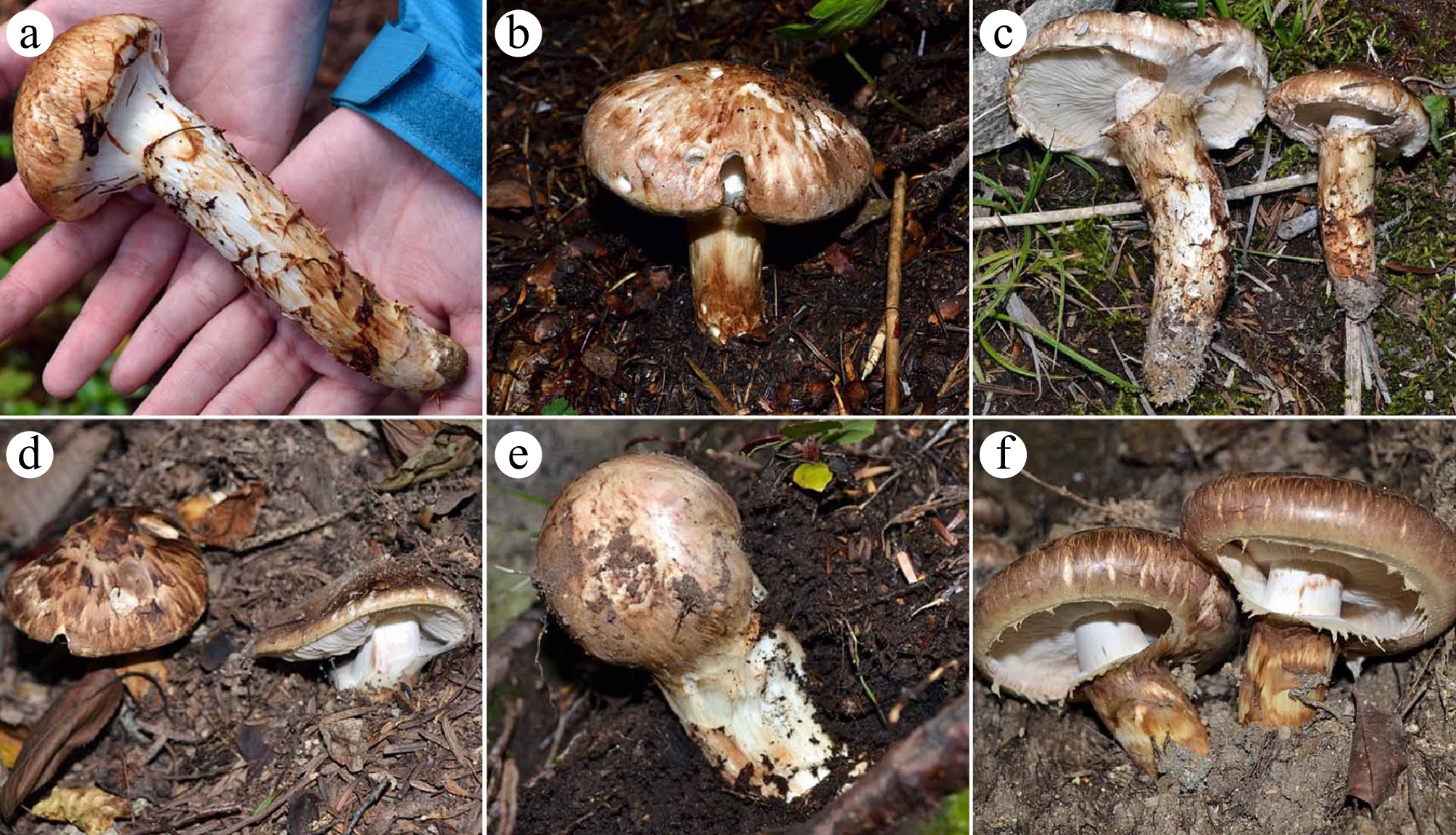
Figure 16.
Tricholoma matsutake occurrences in various forests other than Pinus densiflora. (a) Pinus pumila forest (Sep 2015, Ashoro, Hokkaido). (b) Abies sacharinensis forest (Sep 2015, Nishi-okoppe, Hokkaido). (c) A. veitchii forest (Aug 2017, Matsumoto, Nagano). (d) A. firma forest (Oct 2023, Nasu-shiobara, Tochigi). (e) Tsuga diversifolia forest (Sep 2021, Saku, Nagano). (f) T. sieboldii forest (Sep 2021, Ooshika, Nagano).
-
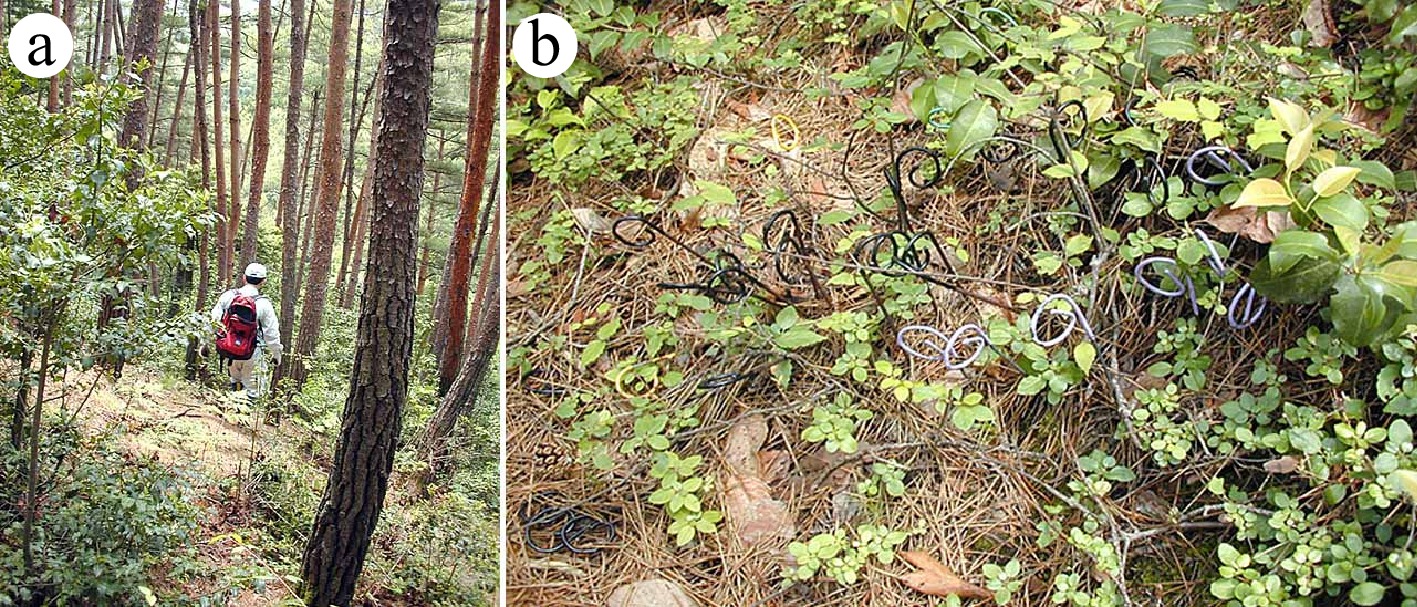
Figure 17.
Toyooka experimental site for Tricholoma matsutake research. (a) forest condition. (b) The pin was stuck in the spot where the T. matsutake fruiting body occurred. Different colors indicate different years of pins stuck. These two photographs were both taken in 2007.
-
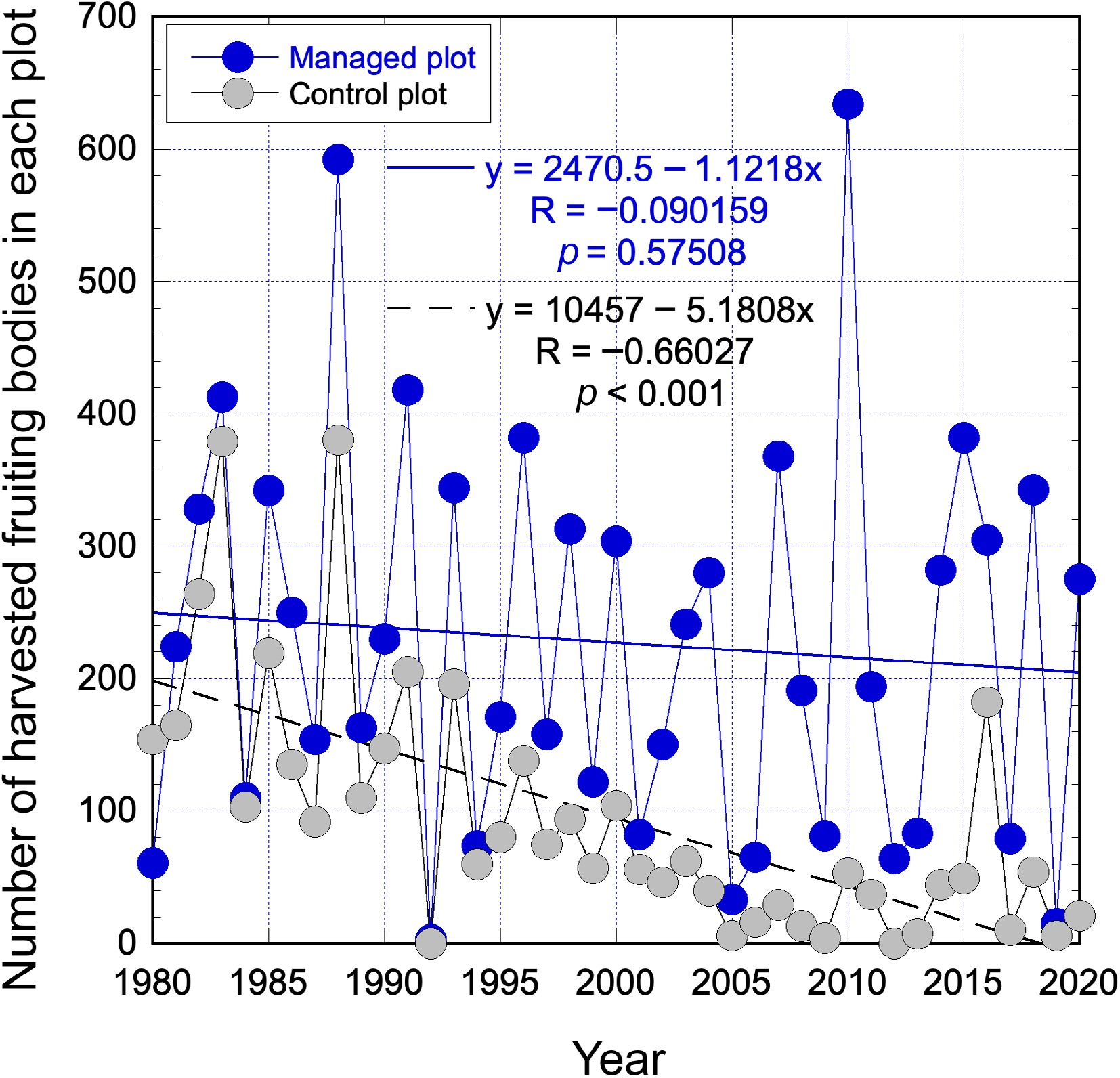
Figure 18.
Forty years of harvest records for Tricholoma matsutake fruiting bodies at the Toyooka experimental site in Nagano Prefecture (Fig. 17). While the harvest of fruiting bodies in the control plot decreased significantly throughout the experimental period, the harvest remained stable in the managed plot. This graph was redrawn based on the original data from Furukawa et al.[70]. In 2024, the number of harvested fruiting bodies in the managed plot was nearly equal to the number in 2010 (Hitoshi Furukawa, personal communication).
-
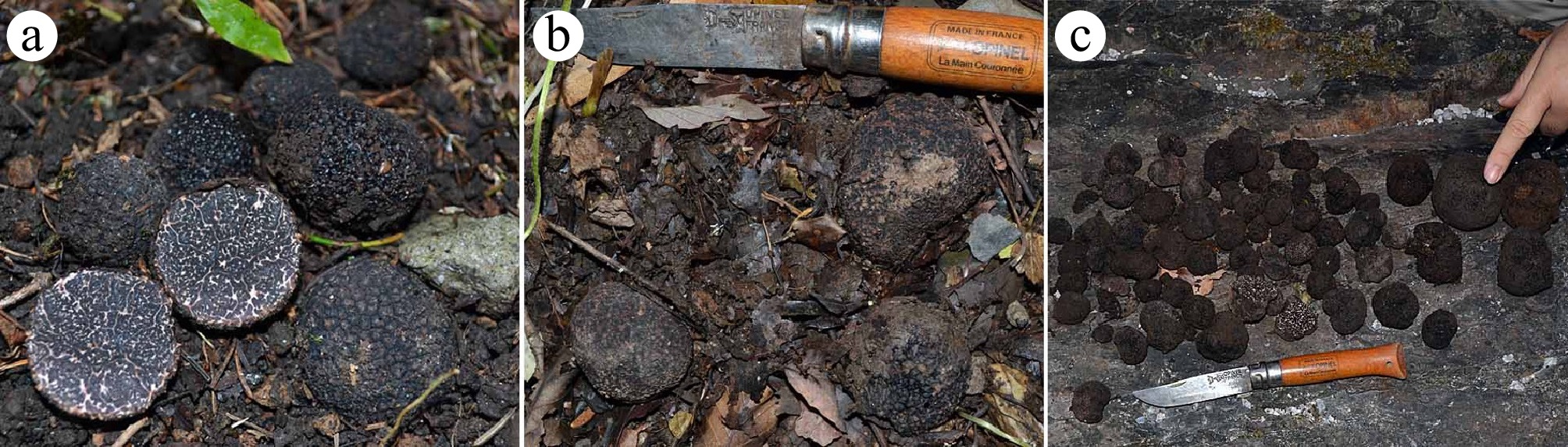
Figure 19.
Fruiting bodies of Tuber himalayense. (a) November 2019, Iizuna, Nagano. (b) October 2017, Tatsuno, Nagano. (c) December 2019, Tatsuno, Nagano.
-
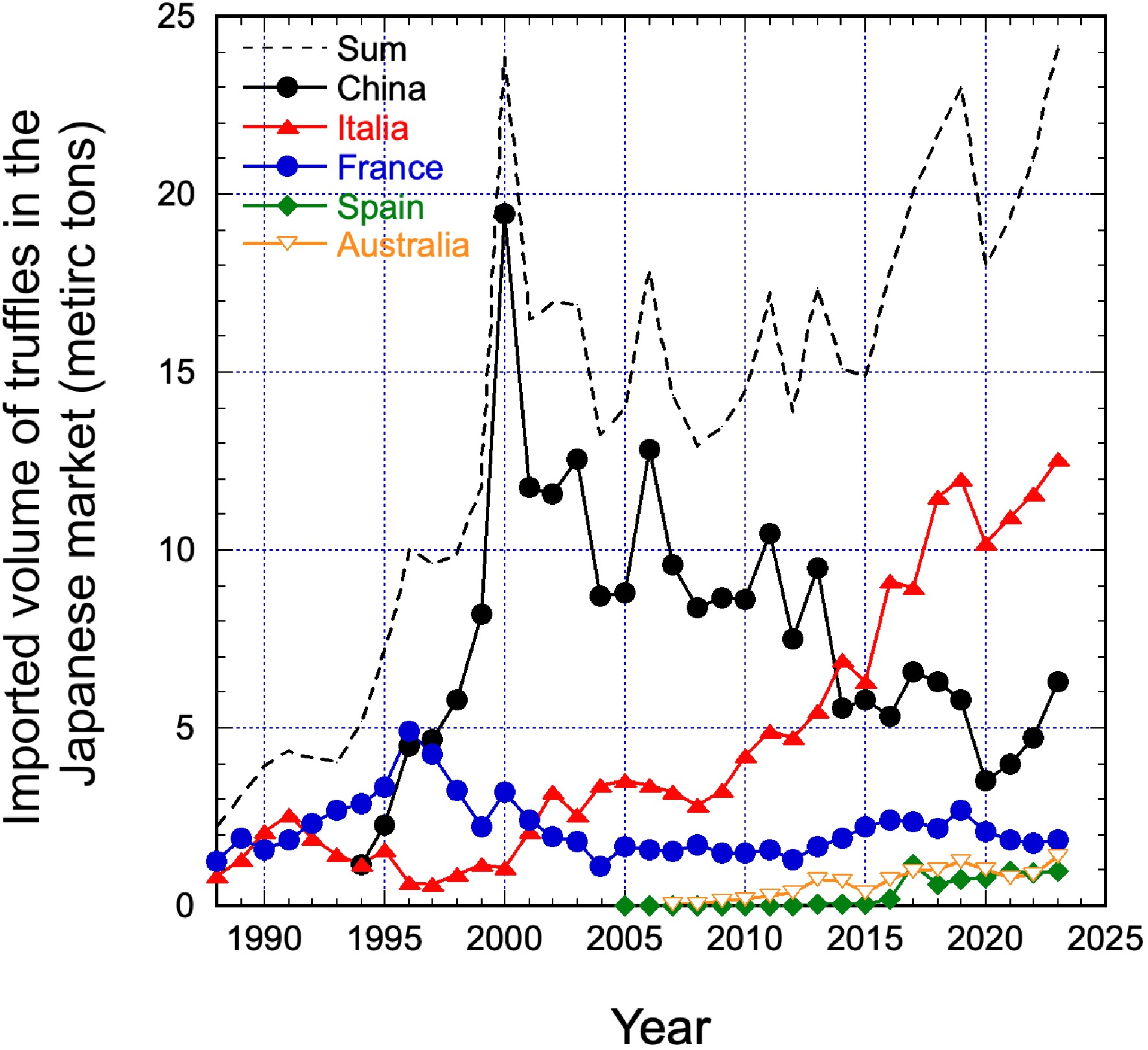
Figure 20.
Imported volume of truffles in the Japanese market in the past 40 years. Data source: Trade Statistics of Japan (
www.customs.go.jp/toukei/info/ ). -
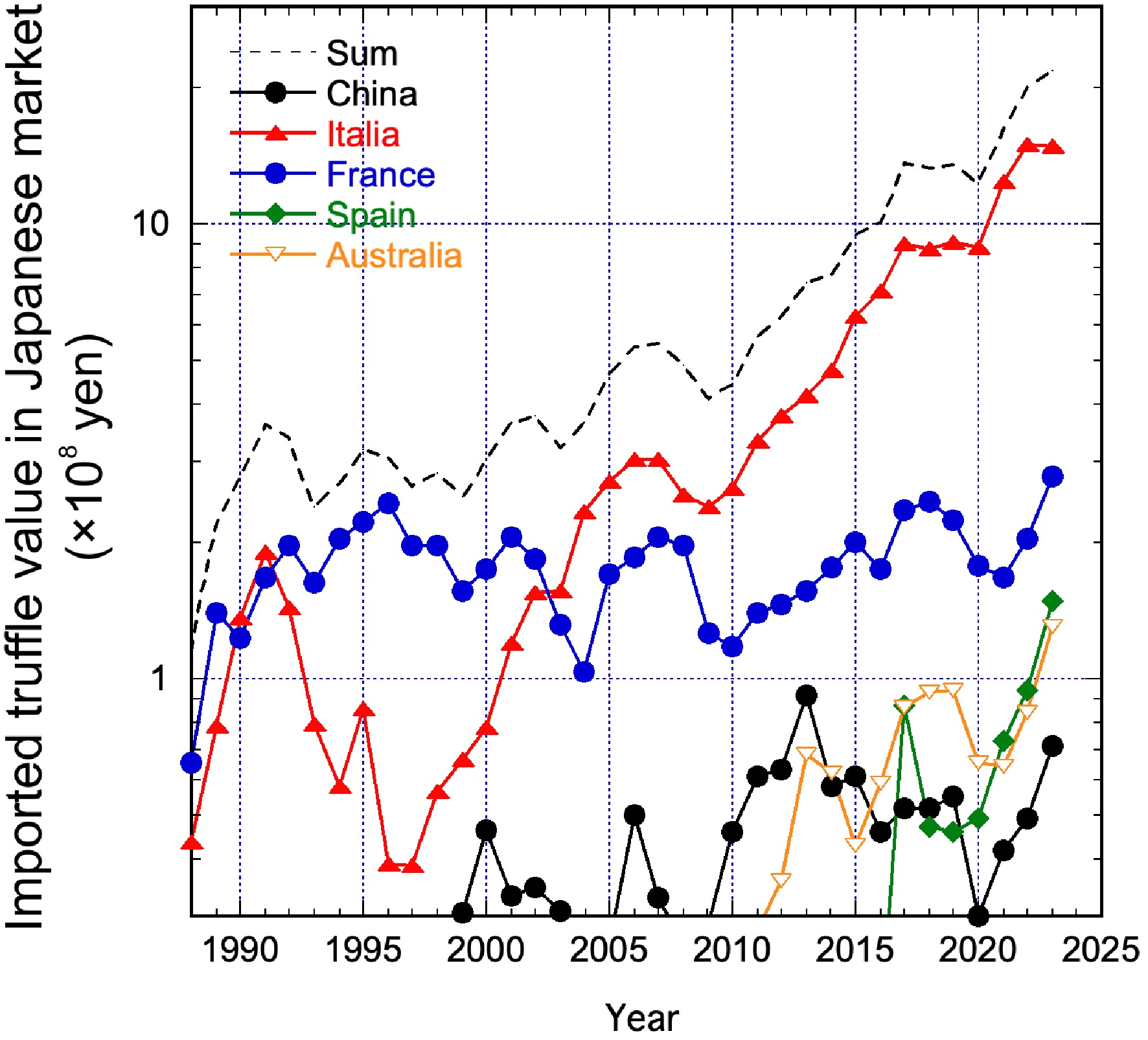
Figure 21.
Imported truffle value in the Japanese market in the past 40 years. Data source: Trade Statistics of Japan (
https://www.customs.go.jp/toukei/info/ ). -
Japanese common name Latin name* Year of registration Arage-kikurage Auricularia polytricha (Montagne) Sacc. 1983 Kikurage Auricularia auricula-judae (Bull.) Quél. 1983 Enokitake Flammulina velutipes (Curtis) Singer 1983 Shiitake Lentinula edodes (Berk.) Pegler 1983 Hiratake Pleurotus ostreatus (Jacquin) P. Kumm. 2004 Usuhiratake Pleurotus pulmonarius (Fr.) Quél. 2004 Eryngi Pleurotus eryngii (DC.) Quél. 2004 Oohiratake Pleurotus cystidiosus O.K. Mill. 2004 Kuro-awabitake Pleurotus abalonus Y.H. Han, K.M. Chen & S. Cheng 1983 Tamogitake Pleurotus citrinopileatus Singer 1991 Shiro-tamogitake Hypsizygus ulmarius (Bull.) Redhead 2004 Buna-shimeji Hypsizygus marmoreus (Peck.) Bigelow 2004 Hatake-shimeji Lyophyllum decastes (Fr.) Singer 2004 Hon-shimeji Lyophyllum shimeji (Kawam.) Hongo 2004 Niou-shimeji Macrocybe gigantea (Massee) Pegler & Lodge 2004 Murasaki-shimeji Lepista nuda (Bull.: Fr.) Cooke 2004 Komurasaki-shimeji Lepista sordida (Schumach. : Fr.) Singer 1991 Mukitake Sarcomyxa edulis (Y.C. Dai, Niemelä & G.F. Qin) T. Saito, Tonouchi & T. Harada 1983 Tsukuritake Agaricus bisporus (J.E. Lange) Imbach 2004 Hime-matsutake Agaricus subrufescens Peck 1991 Yanagi-matsutake Agrocybe cylindracea (Fr.) Gill. 1983 Nameko Pholiota microspora (Berk.) Sacc. 2004 Numeri-sugitake Pholiota aurivella (Batsch) P. Kumm. 1991 Kuritake Hypholoma lateritium (Schaeff.) P. Kumm. 2004 Tama-choreitake Polyporus tuberaster (Jacquin ex Persoon) Fries 1983 Maitake Grifola frondosa (Dicks.) Gray 2004 Tonbi-maitake Meripilus giganteus (Pers.) Karst. 2004 Hanabiratake Sparassis crispa (Wulfen) Fr., 2004 Buna-haritake Mycoleptodonoides aitchisonii (Berkeley) Maas Geesteranus 2004 Yamabushitake Hericium erinaceum (Bull.) Persoon 2004 Mannentake Ganoderma lucidum (Leyss. ex. Fr.) Karst 2004 Kinugasatake Phallus indusiatus Ventenat 2004 *Although several species have arguments in the Latin name, this list follows the government report. Table 1.
List of mushroom species eligible for variety registration under the Plant Variety Protection and Seed Act in Japan.
-
Species (Japanese common name) Production (metric tons) Production share (%) by the local provinces in the domestic market 1 2 3 Market share (%) Province Market share (%) Province Market share (%) Province Flammulina velutipes* (Enokitake) 126,000 59.1 Nagano 15.2 Niigata 4.4 Fukuoka Hypsizygus marmoreus (Buna-shimeji) 123,000 42.0 Nagano 17.5 Niigata 12.3 Fukuoka Lentinula edodes (Shiitake; fresh) 69,000 10.9 Tokushima 8.8 Iwate 7.1 Hokkaido Lentinula edodes (Shiitake; dried) 2,000 37.8 Ooita 17.7 Miyazaki 10.2 Kumamoto Grifola frondosa (Maitake) 57,000 64.0 Niigata 9.6 Shizuoka 6.7 Fukuoka Pleurotus eryngii (Eringi) 38,000 42.3 Nagano 31.5 Niigata 4.7 Fukuoka Pholiota microspora (Nameko) 24,000 22.9 Nagano 20.9 Niigata 18.1 Yamagata Sum of the above six species 460,000 33.5 Nagano 21.3 Niigata 6.2 Fukuoka * Although Flammulina filiformis is recently used for the taxonomy, the government report has used F. velutips. Data source: The database of the Ministry of Agriculture, Fisheries, and Forestry ( www.maff.go.jp/j/tokei/kouhyou/tokuyo_rinsan/index.html ).Table 2.
Annual production of primary cultivated mushrooms in Japan in 2022.
-
Japanese common name Latin name (Saprotrophic species) Naratake Armillaria mellea s. l. Ushiguso-hitoyotake Coprinopsis cinerea (Schaeff.) Redhead, Vilgalys & Moncalvo Chorei-maitake Polyporus umbellatus (Pers.) Fr. Chaname-tsumutake Pholiota lubrica (Pers.) Singer Saketsubatake Stropharia rugosoannulata Farl. ex Murrill Bukuryou Wolfiporia extensa (Peck) Ginns. (Ectomycorrhizal species) Kurokawa Boletopsis leucomelaena (Pers.) Fayod Yamadoritake Boletus edulis Bull. Yamadoritake-modoki Boletus reticulatus Schaeff. Momitake Catathelasma ventricosum (Peck) Sing. Shougenji Cortinarius caperatus (Pers.) Fr. Kuri-fuusentake Cortinarius claricolor var. tenuipes Hongo Abura-shimeji Cortinarius elatior Fr. Mureoo-fuusentake Cortinarius praestans (Cordier) Gillet Numeri-sasatake Cortinarius pseudosalor J.E. Lange Urabenihotei-shimeji Entoloma sarcopum Nagasawa & Hongo Sakura-shimeji Hygrophorus russula(Schaeff. ex Fr.) Kauffman Aka-hatsutake Lactarius akahatsu Nobuj. Tanaka Hatsutake Lactarius hatsudake Nobuj. Tanaka Aka-momitake Lactarius laeticolor (S. Imai) Imazeki ex Hongo Chichitake Lactifluus volemus (Fr.) Kuntze Shaka-shimeji Lyophyllum fumosum (Pers.) P.D. Orton Matsuba-haritake Phellodon fuligineoalbus (J.C. Schmidt) R.E. Baird, in Baird, Wallace, Baker & Scruggs Houkitake Ramaria botrytis (Persoon) Ricken Shouro Rhizopogon roseolus (Corda) Th. Fr. Amitake Suillus bovinus (L.) Roussel Hanaiguchi Suillus grevillei (Klotzsch) Singer Kogane-hanaiguchi Suillus orientalis Y. Miyam., Tamai & A. Yamada Shironumeri-iguchi Suillus viscidus (L.) Roussel Koutake Sarcodon aspratus (Berk.) S. Ito Shimokoshi Tricholoma auratum Gillet Ki-shimeji Tricholoma flavovirens (Pers.: Fr.) S. Lundell Shiro-shimeji Tricholoma japonicum Kawam. Matsutake Tricholoma matsutake (S. Ito & S. Imai) Singer Shimofuri-shimeji Tricholoma portentosum (Fr.) Quél. Ajiakuro-seiyoushouro Tuber himalayense B.C. Zhang & Minter Hon-seiyoushouro Tuber japonicum Hir. Sasaki, A. Kinosh. & Nara Table 3.
List of mushroom species commonly used as foods, medicines, or model organisms in Japan (excluding species list in Table 1).
Figures
(21)
Tables
(3)