-
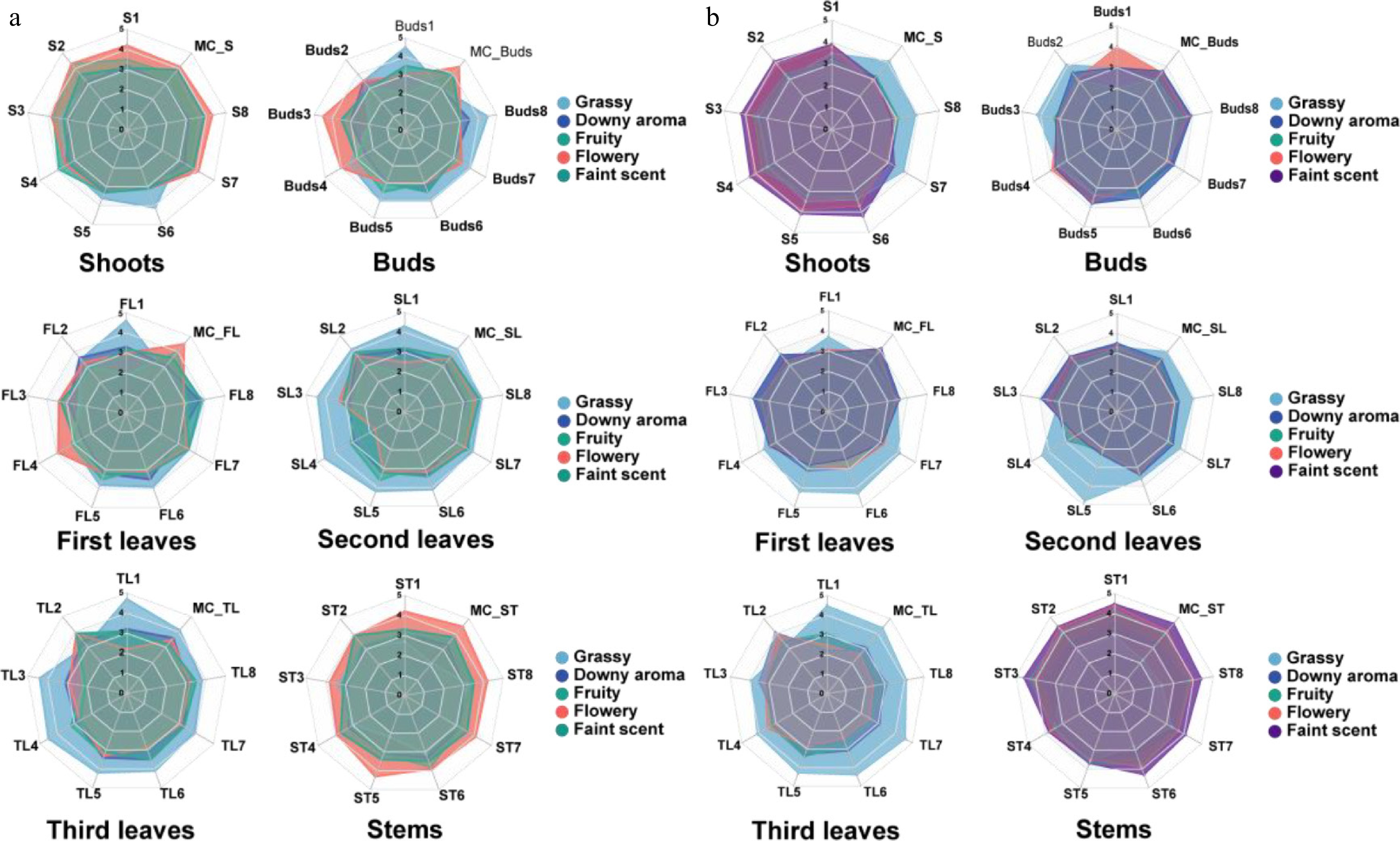
Figure 1.
The aroma sensory evaluation results for FD and ZL22 buds, first leaves, second leaves, third leaves, stems, and shoots. (a, b) The sensory evaluation results for the aromas of FD and ZL22, respectively. The fresh tea leaves are designated as 1, those withered for 8 h as 2, and so forth, with the leaves withered for 56 h designated as 8. FL1–8, the first leaf below the apical bud at different withering stages; SL, the second leaf below the apical bud at different withering stages; TL, the third leaf below the apical bud at different withering stages; ST, the stems at different withering stages; S, the intact tea shoots at different withering stages.
-
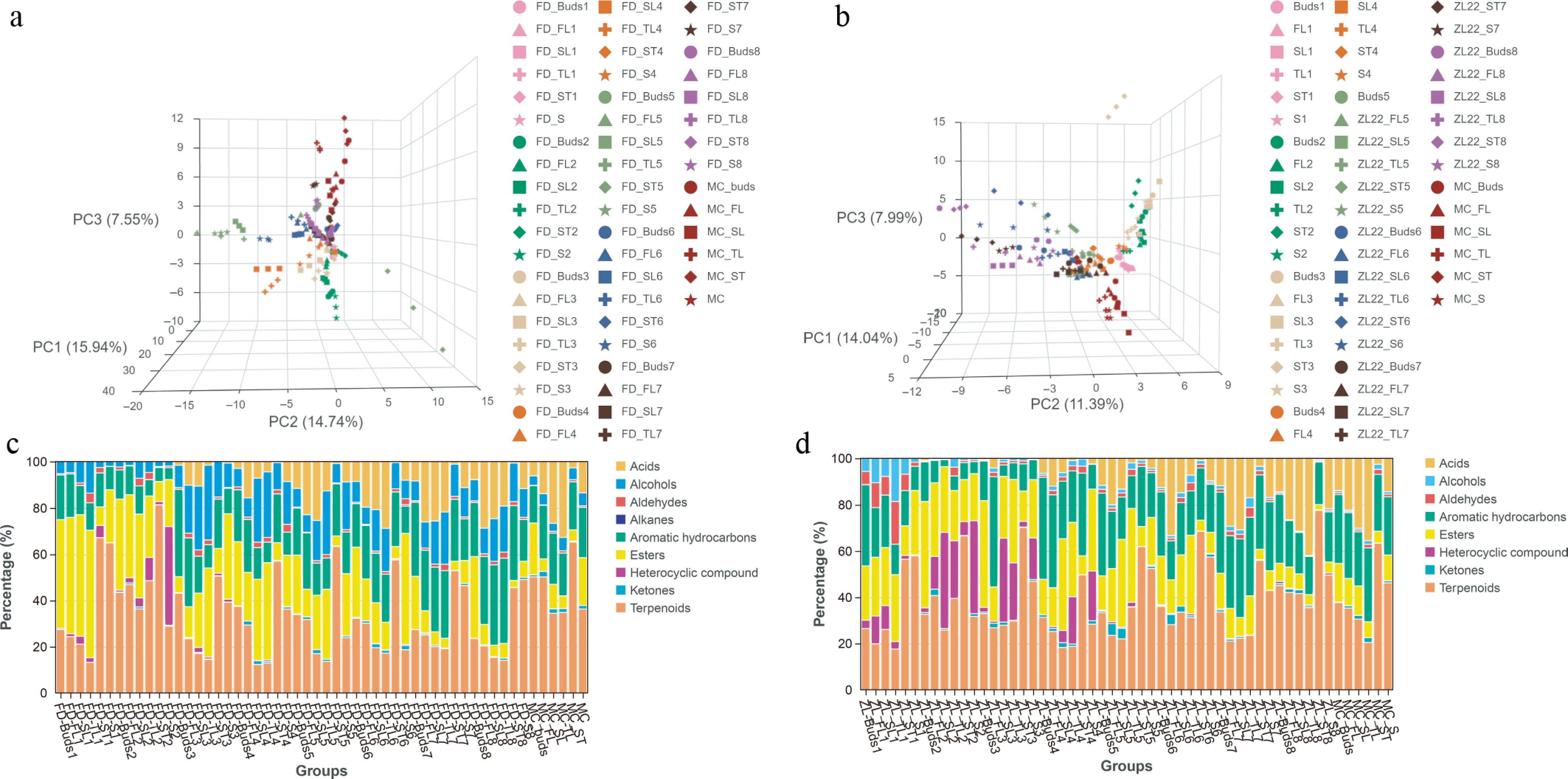
Figure 2.
Overall aroma profile analysis. (a, b) The 3D-PCA analysis of different tissues and shoots of FD and ZL22 during withering. (c, d) The percentage of nine types of compounds of different tissues and shootsof FD and ZL22 during the withering period. FL, first leaves; SL, second leaves; TL, three leaves; ST, stems; S, shoots; MC, tea products.
-
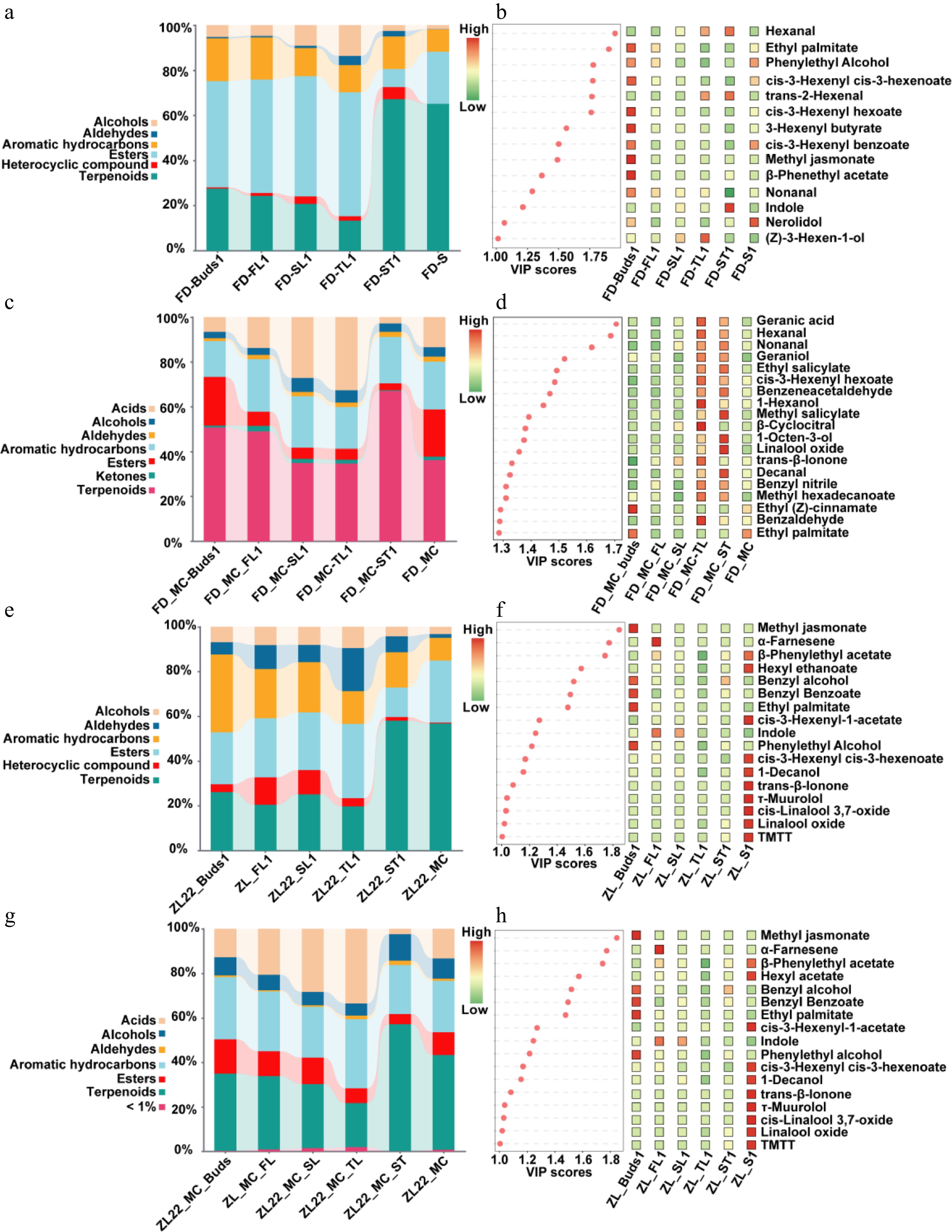
Figure 3.
The proportions of different aroma compounds and a relative content analysis of the fresh tea shoots and the tea products of FD and ZL22. (a, b) The proportions of different aroma compounds and a relative content analysis of the fresh tea shoots of FD. (c, d) The proportions of different aroma compounds and a relative content analysis of the tea products of FD. (e, f) The proportions of different aroma compounds and a relative content analysis of the fresh tea shoots of ZL22. (g, h) The proportions of different aroma compounds and a relative content analysis in the tea products of ZL22. Buds, apical buds; FL, the first leaves under the apical buds; SL, the second leaves under the apical buds; TL, the third leaves under the apical buds; MC, tea products. TMTT, (3E,7E)-4,8,12-trimethyltrideca-1,3,7,11-tetraene.
-
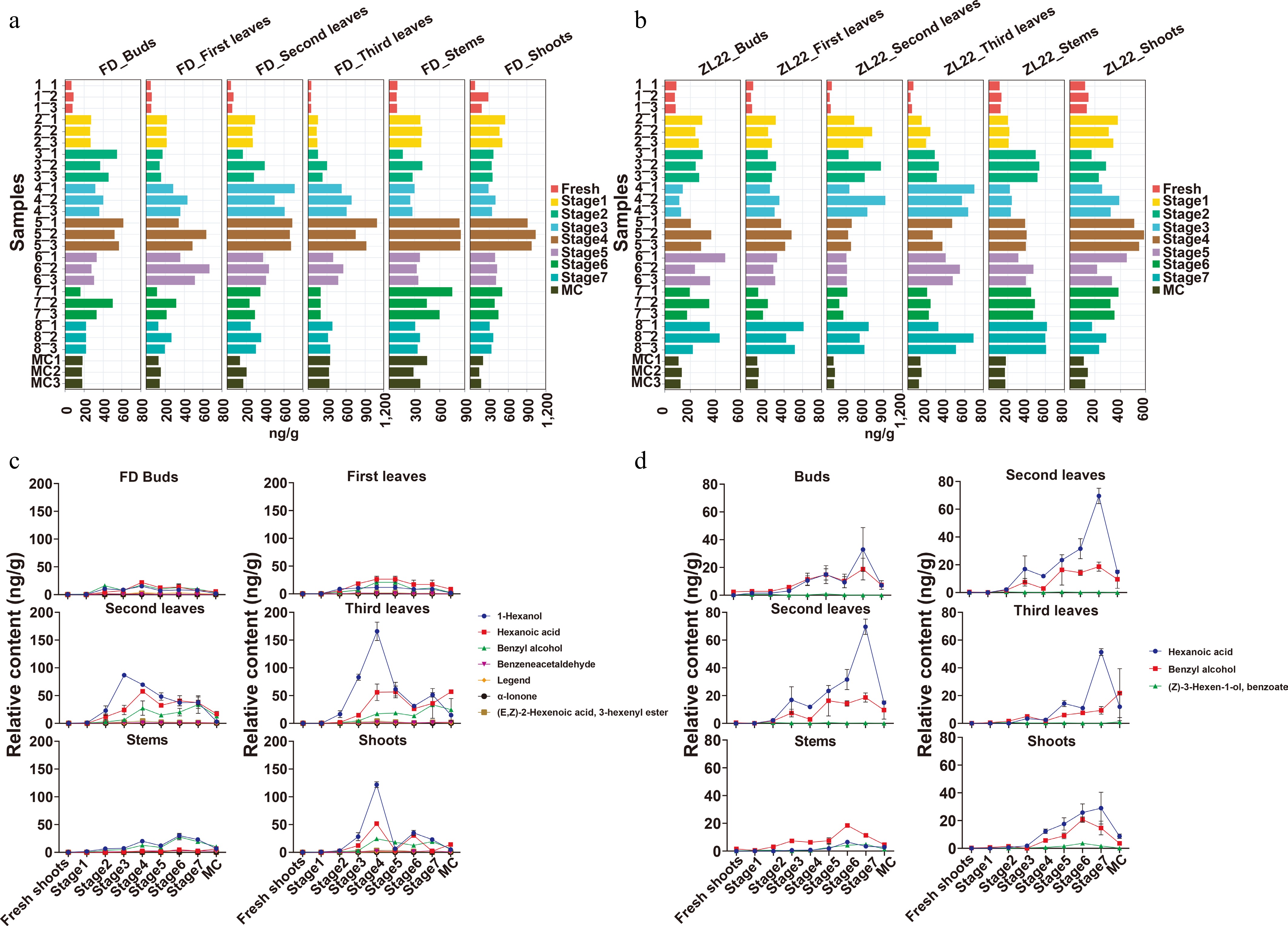
Figure 4.
The volatile compounds changed within different tissues of FD and ZL22 during the withering. (a, b) The relative variation in the content of total volatile compounds from different tissues of FD and ZL22 during the withering periods. (c, d) The DVCs in different tissues of FD and ZL22 during withering. MC, tea products.
-
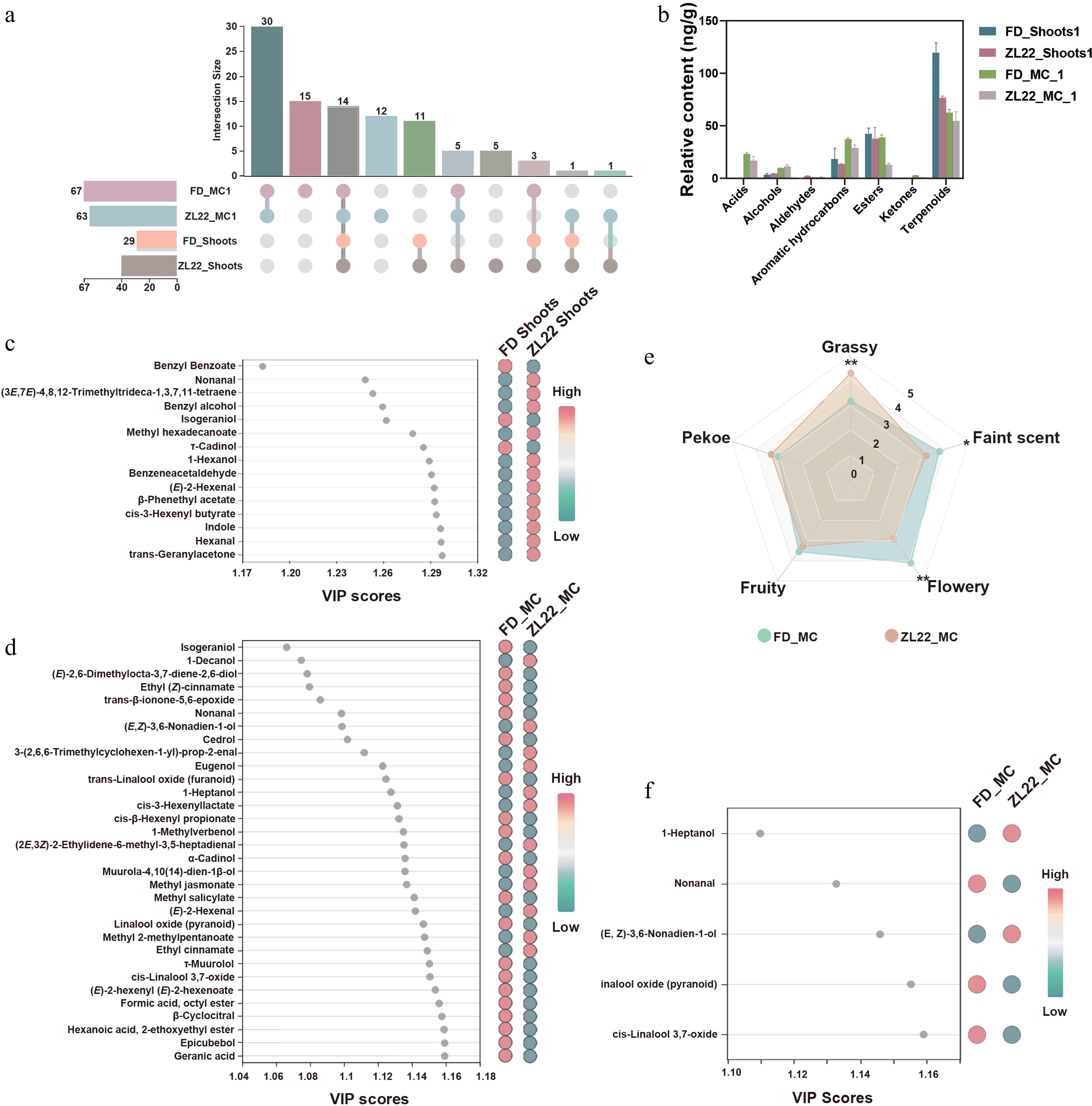
Figure 5.
Comparison of fragrance compounds for fresh tea shoots and tea products of ZL22 and FD. (a) The UpSet plots of the aroma compounds of fresh shoots and tea products of ZL22 and FD. (b) Relative contents of seven categories of aroma componenets in young shoots and tea products of FD and ZL22. (c, d) The different volatile compounds for fresh tea shoots and tea products of ZL22 and FD. (e) Sensory evaluation of ZL22 and FD tea products. (f) The OAVs of differentially volatile compounds for ZL22 and FD teas. MC, tea products.
-
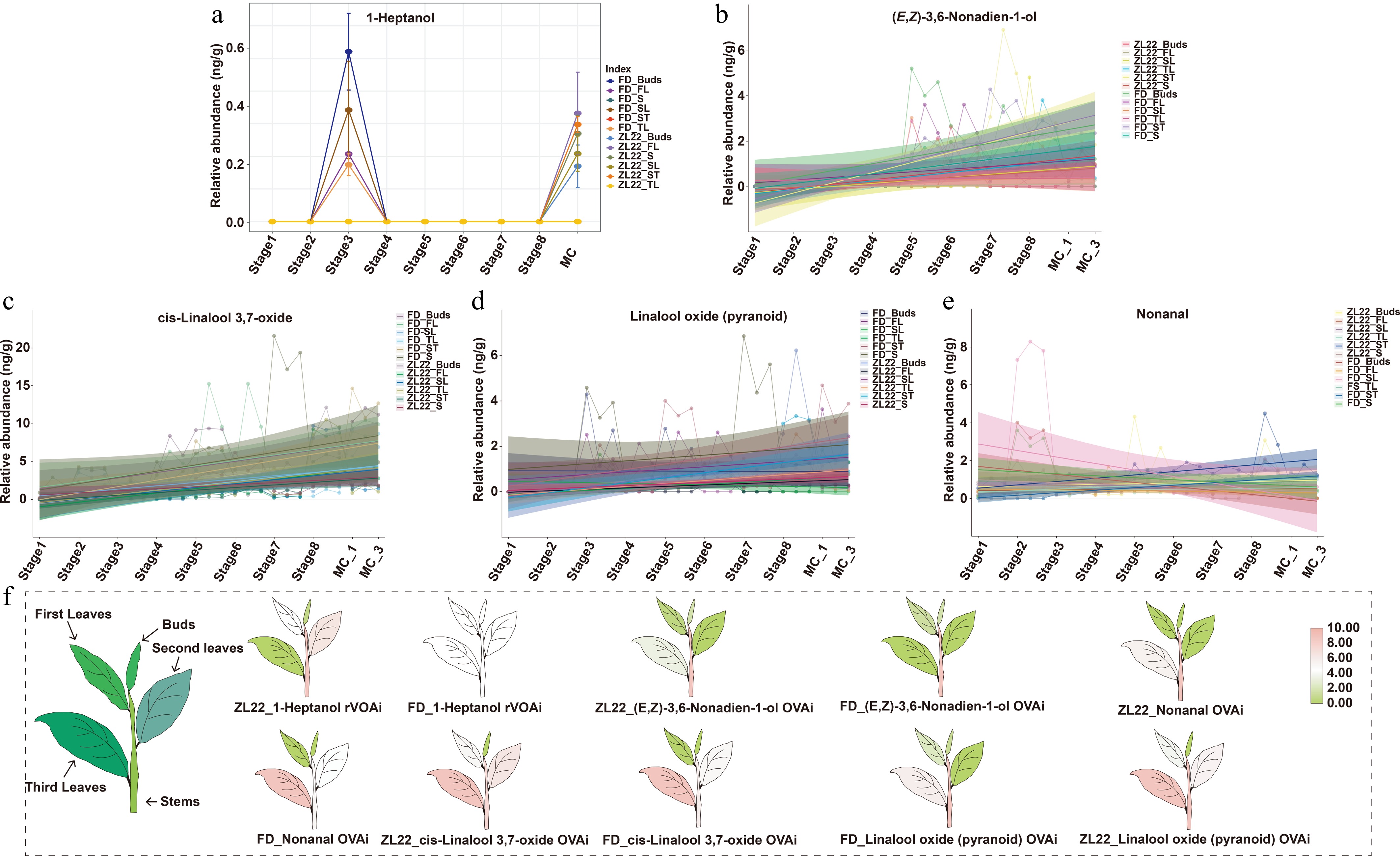
Figure 6.
The changes in grassy and flowery aroma compounds during the withering period and an OAV analysis of these compounds in the tea shoots. The dramatic changes in (a) 1-heptanol, (b) (E,Z)-3,6-nonadien-1-ol, (c) nonanal, (d) cis-linalool 3,7-oxide, and (e) linalool oxide (pyranoid) during the withering period. (f) The OAVs of 1-heptanol, (E,Z)-3,6-nonadien-1-ol, nonanal, cis-linalool 3,7-oxide, and linalool oxide (pyranoid) distributed in the tea shoots. FL, first leaves; SL, second leaves; TL, third leaves; ST, stems; MC, tea products.
Figures
(6)
Tables
(0)