-
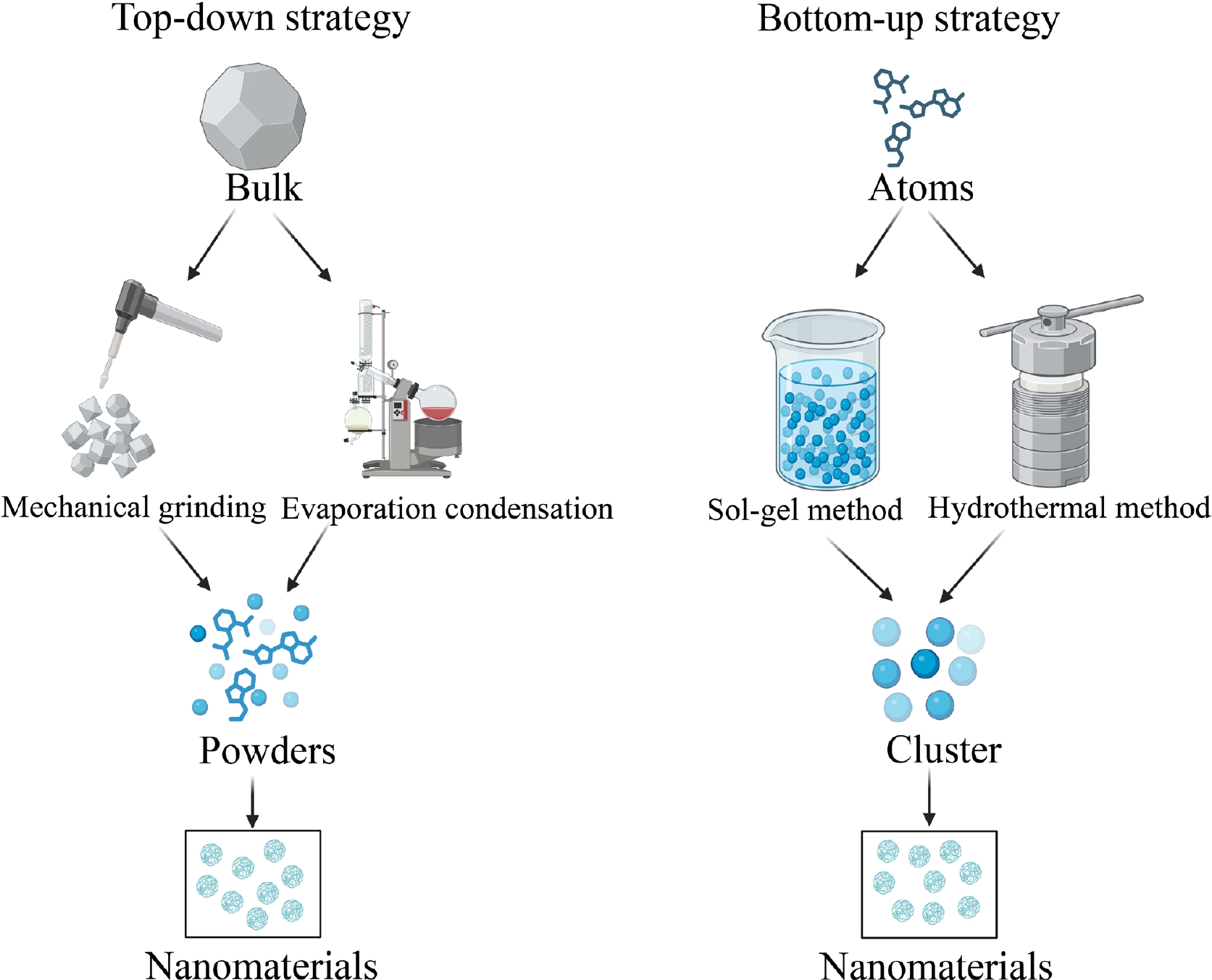
Figure 1.
Strategies for synthesizing nanomaterials. Two main strategies are adopted for synthesizing nanomaterials: (I) the top-down strategy, wherein macroscopic bulk materials are used as the initial materials and broken down into nanoscale powders through physical or chemical processes such as mechanical milling or evaporation-condensation; and (II) bottom-up strategy, wherein techniques like sol-gel synthesis or the hydrothermal method are used to guide the self-assembly and growth of microscopic units into atomic clusters, ultimately forming nanomaterials.
-
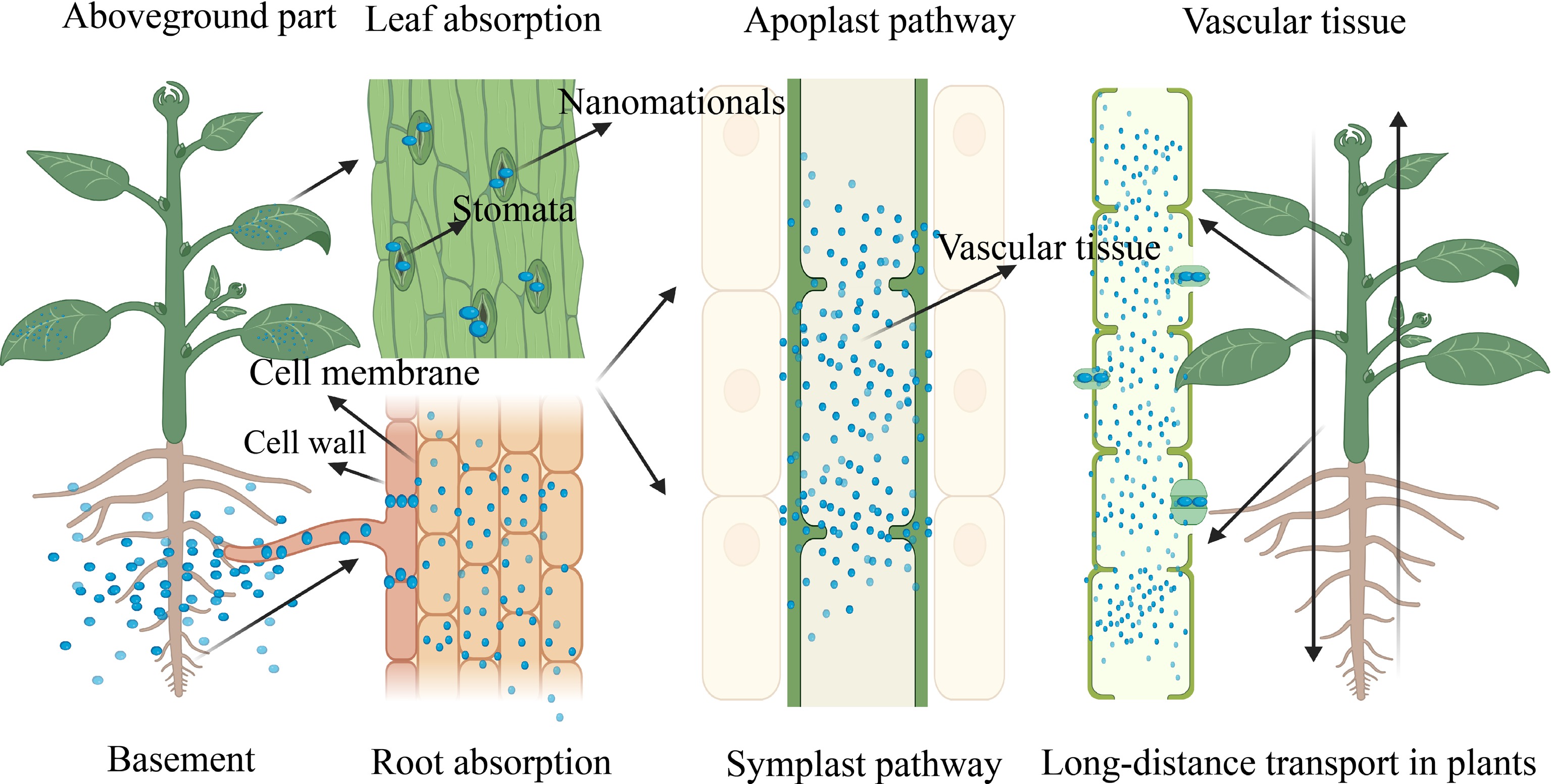
Figure 2.
Absorption routes of nanomaterials in plants. There are two primary routes for nanomaterial absorption in plants: (I) root absorption, wherein nanomaterials can penetrate the cell wall and membrane to enter root cells, and (II) foliar absorption, wherein nanomaterials enter through the leaf stomata or the epidermis into mesophyll cells. Once inside the roots or leaves, nanomaterials reach the vascular tissues via the apoplastic or symplastic pathway, and are then distributed upward to aerial tissues or downward to underground parts through long-distance transport in the vascular system, enabling plant-wide dispersion.
-
Class Nanomaterial Genetic element Utilization method Treatment target Plant species Refs Metal nanoparticles SWCNTs siRNA Injection Leaf Tobacco [54] Inorganic nanomaterials Gold nanoclusters siRNA Injection Leaf Tobacco [55] Mesoporous silica pDNA Spraying and injection Leaf and shoot Tomato [51] LDH dsRNA Soaking Mature pollen grain Tomato [53] Carbon nanomaterials Functional graphene oxide NPs siRNA Injection Leaf Tobacco [56] SWCNTs pDNA-GFP Soaking Root Tobacco [57] Table 1.
Applications of nanomaterials for genetic transformation in plants.
-
Class Nanomaterial Utilization method Treatment target Plant species Biological process Refs Carbon nanomaterials MWCNTs Spraying Leaf Tomato Antioxidant system [69] SWCNTs and MWCNTs Irrigation Root Tomato Early growth, flowering time, and phytohormones [70] SWCNTs Spraying Leaf Pea (Pisum sativum) Leaf micromorphology, chloroplast ultrastructure, and photosynthetic activity [71] Nanocrystalline
metal oxideNano-Fe3O4 Hydroponics Root Tobacco Physio-biochemical and ultrastructural traits [72] Nano-γ-Fe2O3 and Nano-Fe3O4 Irrigation Fruit Melon (Cucumis melo) Physiological process and fruit quality [73] Nano-TiO2 Hydroponics Root, leaf, stem, and fruit Tomato Light acclimation [74] Nano-CuO Irrigation Leaf Brassica rapa Growth and development [75] Nano-CuO Droplet Leaf Lettuce (Lactuca sativa) Growth and development [76] Nano-TiO2 Tissue culture Leaf Tobacco Ultraviolet-B stress tolerance [77] Nano-CeO2 Hydroponics Leaf and root Cucumber Salt tolerance [63] Nano-CeO2 Priming Seed Rapeseed Salt tolerance [78] SeNPs Irrigation Root Cucumber Lateral root growth [79] Inorganic nanomaterials MSNs Spraying Leaf Tomato Defense response [80] Metal nanoparticles AgNPs and FeNPs Irrigation Whole plant Soybean (Glycine max) Seedling development [81] TiO2 NPs and GNPs Water culture Root and stem Lettuce Phytotoxic effects [82] Table 2.
Applications of nanomaterials for regulating plant growth and development.
-
Nanomaterial Characteristics Size Treatment target Plant species Pest/disease Refs Clay nanosheets Light weight, stable shape 45 nm Leaf Cucumber Cytomegalovirus [35] Multilayer CNTs Small diameter, high aspect ratio 30−50 nm Leaf Tomato Fusarium oxysporum f. sp. lycopersici [69] Graphene Zero-dimensional semiconductor, high adsorption, stable structure 2 μm Leaf Tomato Fusarium oxysporum f. sp. lycopersici [69] Nano-Fe3O4 Morphological plasticity, high thermal stability 10−30 nm Leaf Tobacco Tobacco mosaic virus [92] Nano-CuO Antibacterial capacity, enhanced catalysis 30 nm Root Tomato Fusarium oxysporum f. sp. lycopersici [93] Nano-CeO2 High loading efficiency, carboxyl modification, antioxidation 8 ± 1 nm Root and leaf Tomato Fusarium oxysporum f. sp. lycopersici [88] Nano-SiO2 Anti-ultraviolet, water insolubility 20 nm Root Tomato Helicoverpa armigera [94] sLDH clay nanosheets Multifunctional, sustainable, and environmentally friendly 40 nm Leaf and stem Lettuce Botrytis cinerea [95] ECNs Safe, stable, and efficient 180 nm Leaf Tomato Phytophthora infestans [96] Table 3.
Applications of nanomaterials in plant pest/disease control.
Figures
(2)
Tables
(3)