-
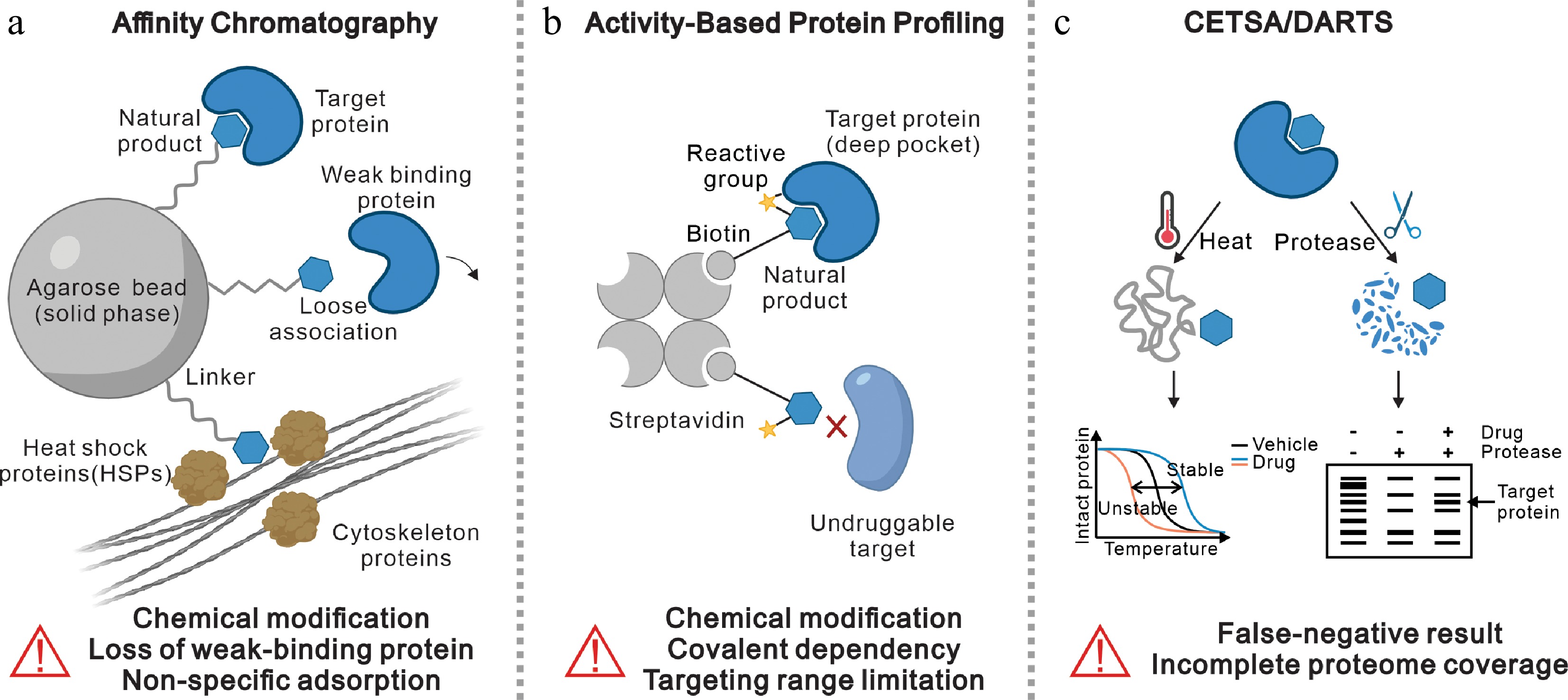
Figure 1.
Current target identification strategies and their limitations. (Contains elements from BioRender. Cheng, L. [2026]
https://BioRender.com/niqnoda ). (a) Affinity chromatography: NPs are immobilized on agarose beads via a linker to capture target proteins. Limitations include the requirement for chemical modification, loss of weak-binding proteins due to loose association, and non-specific adsorption of high-abundance proteins like HSPs and cytoskeleton proteins. (b) ABPP: uses probes containing a reactive group and a biotin tag to covalently bind and enrich target proteins via streptavidin. Limitations involve covalent dependency, chemical modification requirements, and limited targeting range (e.g., inability to capture undruggable targets). (c) CETSA/DARTS: label-free methods relying on ligand-induced changes in thermal stability (CETSA, left), or protease resistance (DARTS, right). Limitations include potential false-negative results and incomplete proteome coverage. -
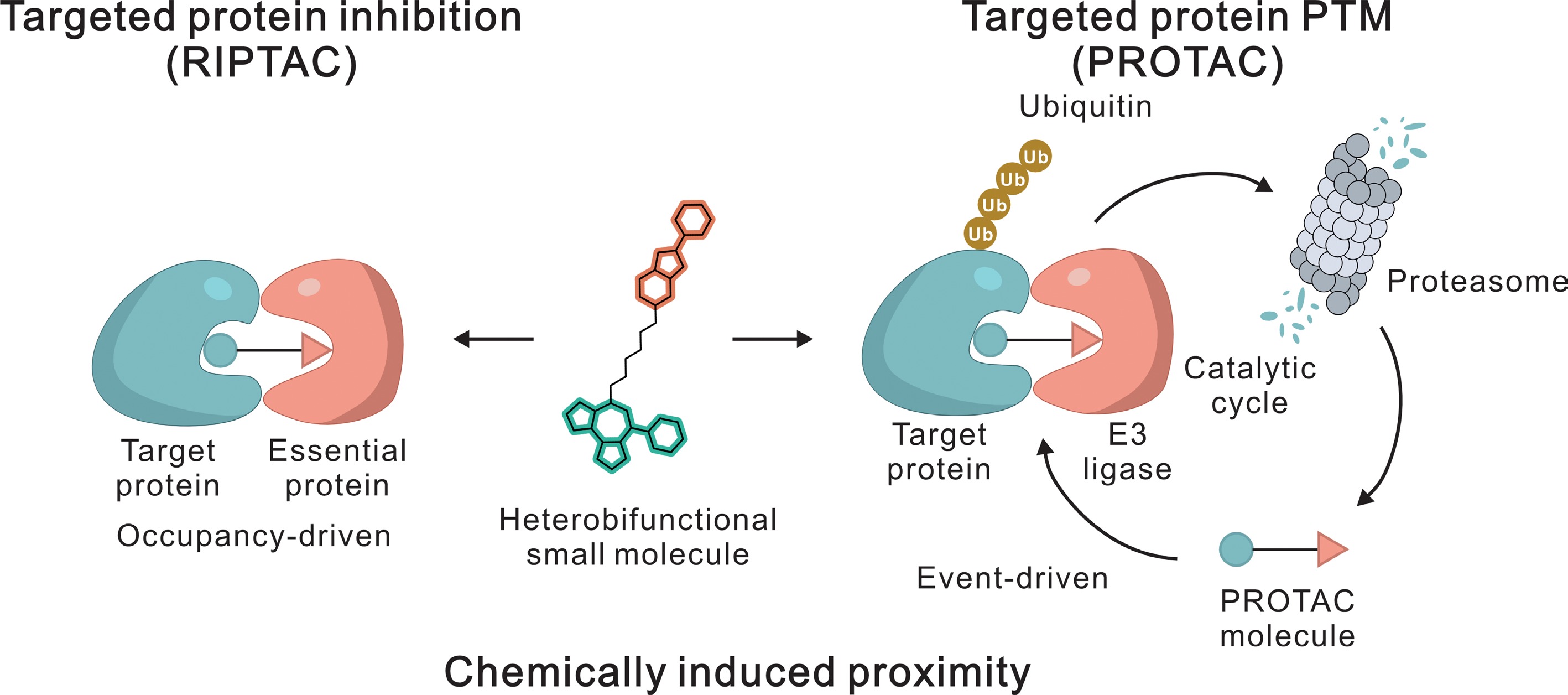
Figure 2.
Common modalities of chemically induced proximity. The schematic illustrates two distinct mechanisms mediated by heterobifunctional small molecules. Targeted protein inhibition (RIPTAC): This approach induces proximity between a target protein and an essential protein, resulting in functional inhibition. The mechanism acts via an occupancy-driven mode and requires stable binding to exert its effect. Targeted protein PTM (PROTAC): This approach recruits an E3 ligase to the target protein, facilitating the transfer of ubiquitin chains. The polyubiquitinated target is subsequently degraded by the proteasome. Subsequently, the PROTAC molecule was released and participated in the further reactions, thereby forming an event-driven and catalytic cyclic process.
-
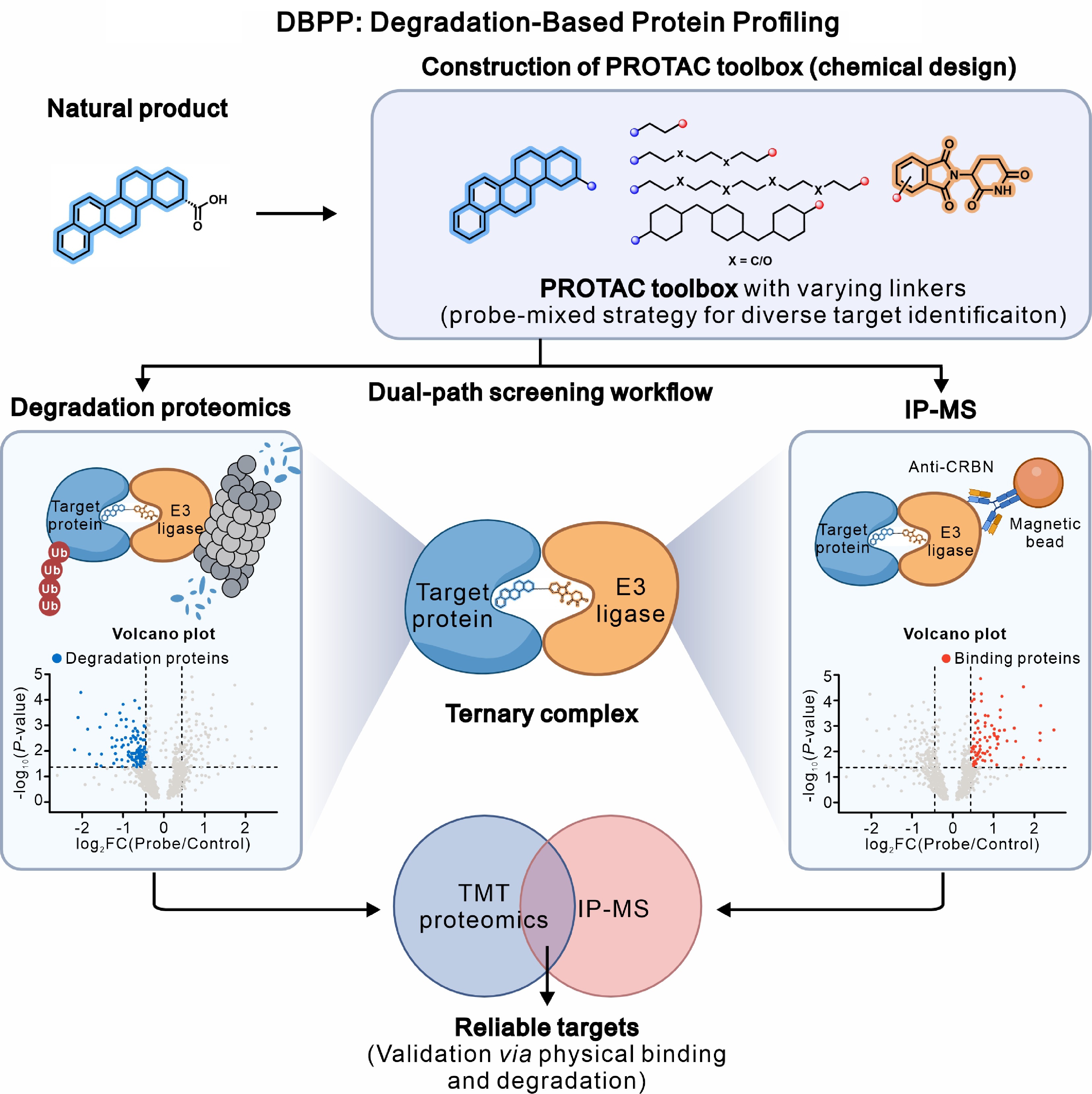
Figure 3.
Diagram of the DBPP strategy. The DBPP workflow integrates chemical design with a dual-path proteomics screening approach to systematically identify and validate NP targets. (Top) Construction of the PROTAC toolbox: A bioactive NP is chemically derivatized using a variety of linkers to connect with an E3 ligand. This generates a PROTAC library to accommodate the diverse spatial requirements necessary for ternary complex formation. (Bottom) Dual-path screening workflow: Upon treatment, the PROTACs induce the formation of target-PROTAC-E3 ligase ternary complexes, which are subsequently analyzed via two orthogonal parallel paths. (Left) Degradation proteomics: Quantitative TMT proteomics is employed to monitor global protein abundance. Significantly downregulated proteins are defined as potential degradation targets (blue dots in the volcano plot). (Right) IP-MS: Direct physical binding targets are captured by enriching the ternary complexes using E3 ligase-specific antibodies (e.g., Anti-CRBN magnetic beads) followed by mass spectrometry. Significantly enriched proteins are defined as potential binding targets (red dots in the volcano plot). (Center) Integration: The cross-validation of the functional 'degradation' dataset and the physical 'binding' dataset ultimately yields high-confidence, reliable targets for the NPs.
-
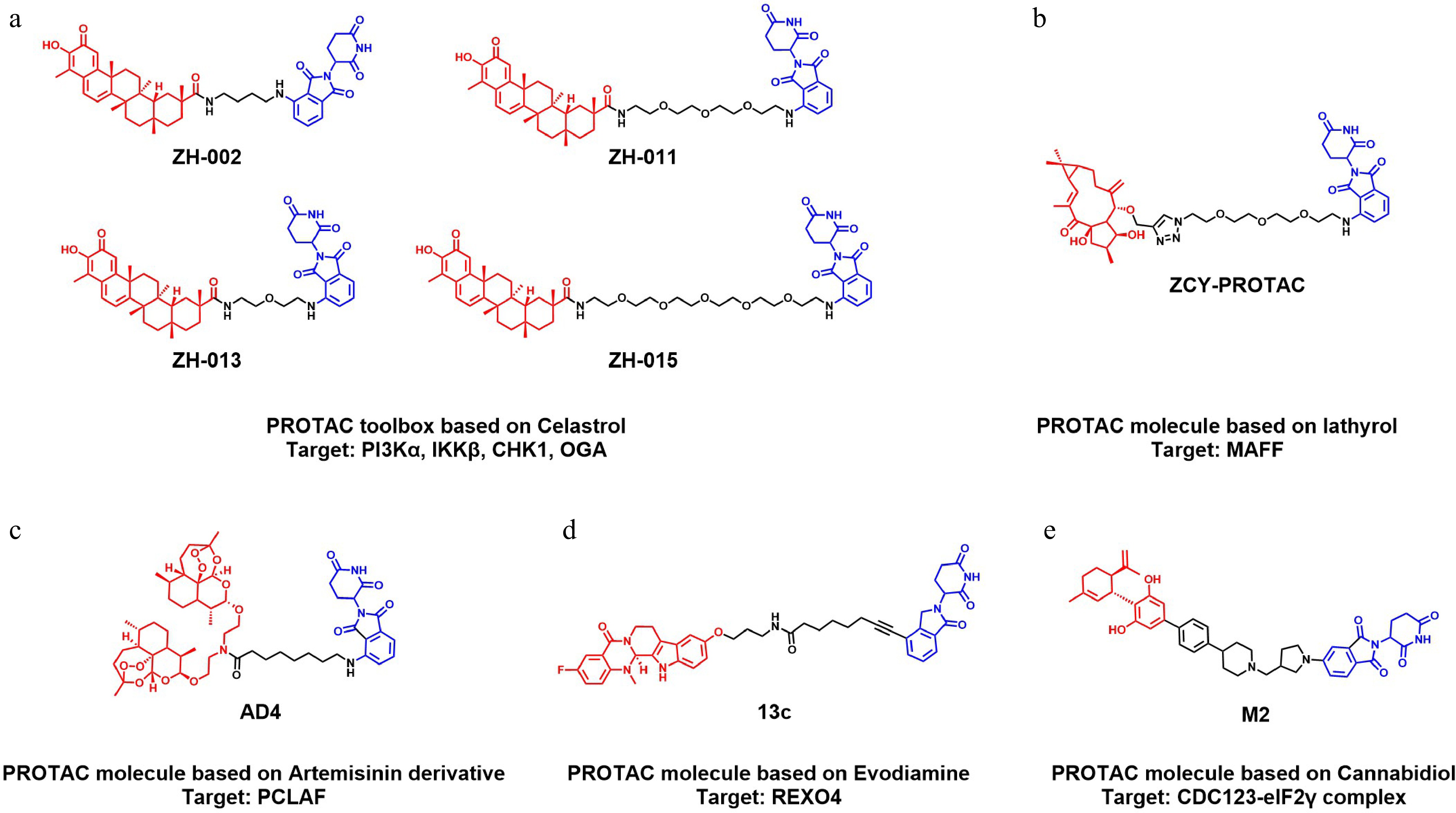
Figure 4.
Representative examples of NPs-derived PROTAC molecules. Chemical structures of various PROTAC molecules utilized in DBPP. The NP scaffolds are shown in red, the E3 ligands are shown in blue, and the linkers are shown in black. (a) A celastrol-based PROTAC toolbox (ZH-002, ZH-011, ZH-013, ZH-015) for multi-target identification (targets: PI3Kα, IKKβ, CHK1, OGA). (b) A PROTAC molecule derived from lathyrol (ZCY-PROTAC) (target: MAFF). (c) A PROTAC molecule derived from an artemisinin derivative (AD4) (target: PCLAF). (d) A PROTAC molecule derived from evodiamine (13c) (target: REXO4). (e) A PROTAC molecule derived from cannabidiol (M2) (target: CDC123-eIF2γ complex).
-
Label-free methods
(CETSA, TPP, DARTS)Activity-based protein
profiling (ABPP)Conventional single-probe
PROTAC profilingDegradation-based protein profiling (DBPP) Core mechanism Stability-based, label-free: ligand binding induces changes in protein thermal stability or protease susceptibility. Occupancy/activity-driven; probe captures target proteins through covalent or photoaffinity labeling. Event-driven discovery; a PROTAC induces ubiquitination and degradation, and downregulated proteins are screened by quantitative proteomics. Event-driven, dual-path discovery; combines degrader-induced depletion with ternary-complex/
binding-centered enrichment.Probe architecture No probe required; native compounds used directly. Warhead, linker, and reporter tag. Typically used as individual probes. Target ligand, linker, and E3 recruiter. Usually, one representative PROTAC molecule. A PROTAC toolbox with varied linker types/lengths; compatible with both single-toolbox and mixed-toolbox formats. Detection logic 'Indirect readout': targets inferred from ligand-induced stability shifts (thermal or proteolytic). 'Addition' readout: proteins are enriched by pull-down or probe capture. 'Subtraction' readout: proteins significantly decreased after degrader treatment are prioritized. Dual-path readout ('subtraction + addition'): candidate targets are prioritized by both degradation proteomics and IP-MS-based complex evidence. Target coverage Broad in principle (proteome-wide for TPP), but biased toward proteins with detectable stability changes. Best for ligandable/reactive proteins; biased toward proteins with suitable nucleophilic residues or photo-crosslinkable environments. Broad, but prone to false negatives due to strict spatial/conformational restrictions of a single ternary complex. Broadest among the three; can capture proteins that degrade and, through IP-MS, proteins that bind but do not degrade efficiently. Potential target number ~103 (thousands) ~102 (hundreds) 10–102 (tens to hundreds) Tens Main advantages 1. No derivatization required.
2. Preserves native binding properties.1. Direct target capture.
2. Strong mechanistic resolution for reactive ligands. 3. Mature chemoproteomic
framework.1. Converts binding into an amplified depletion signal. 2. Can reveal non-catalytic and weak-binding targets. 1. Toolbox strategy improves target coverage. 2. Dual-path validation reduces false positives/false negatives.
3. Suitable for multitarget NPs. 4. Compatible with the probe-mixed strategy to improve efficiency and reduce cost.Technical limitations 1. Requires measurable stability change (false negatives for weak/allosteric binding). 2. Limited sensitivity for low-abundance proteins.
3. Indirect readout may
include secondary effects.1. Probe synthesis is demanding. 2. Probe installation may perturb activity. 3. Coverage bias toward reactive or probe-compatible targets. 1. Strongly dependent on ternary complex geometry of one PROTAC molecule. 2. Indirect degradation effects may confound interpretation. 3. Coverage is further constrained by the subcellular accessibility and distribution of the recruited E3 ligase, making proteins in certain cellular compartments more difficult to identify. Requires construction and preliminary selection of a representative PROTAC toolbox, which may increase the entry barrier for groups without synthetic support. Table 1.
Comparison of current target identification strategies.
Figures
(4)
Tables
(1)