-
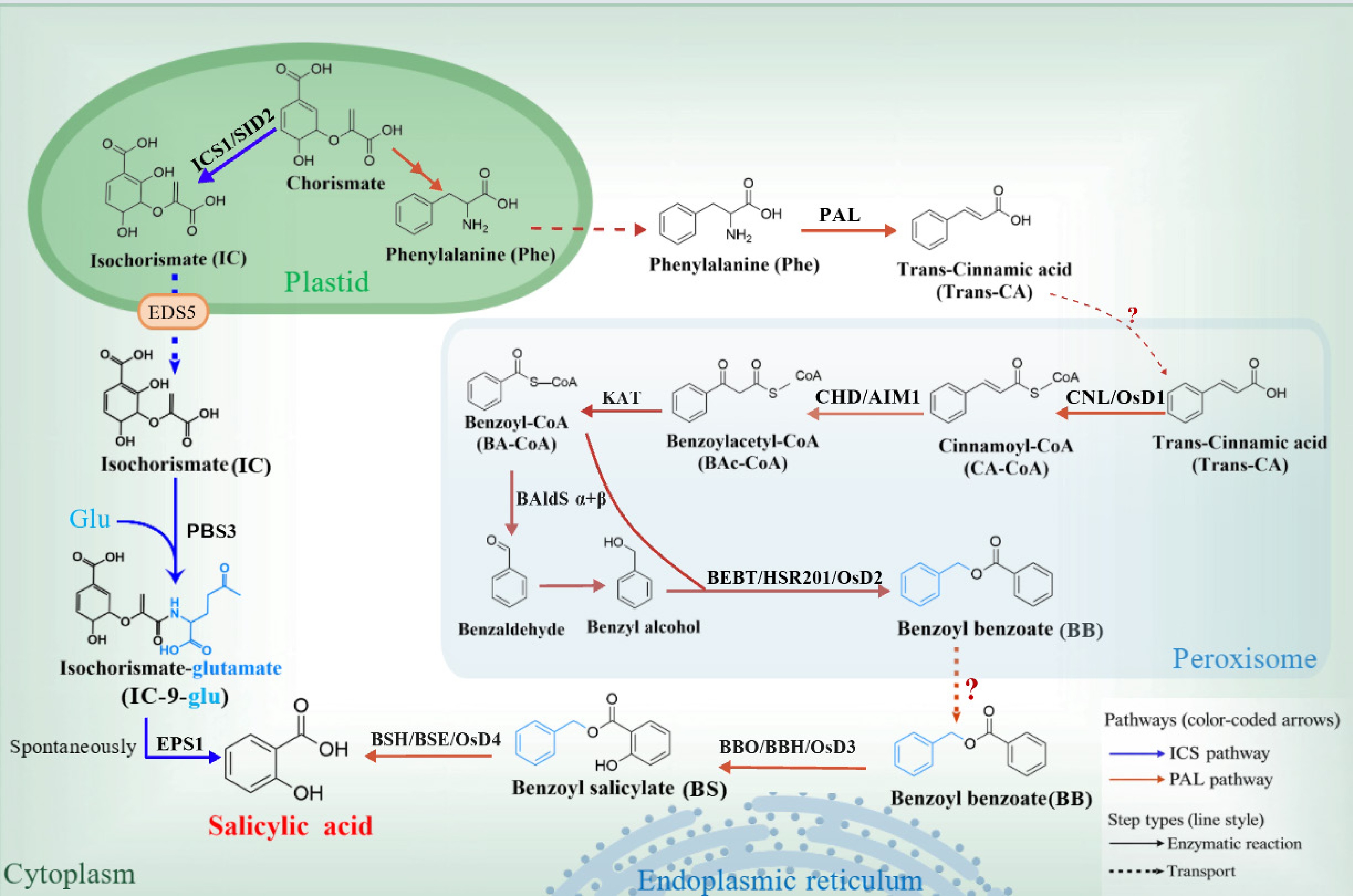
Figure 1.
Pathways for salicylic acid (SA) biosynthesis in plants. SA is produced via the plastid-derived isochorismate synthase (ICS) pathway and the phenylalanine ammonia-lyase (PAL) pathway. In plastids, chorismate is converted to isochorismate by ICS (ICS1/SID2) and exported to the cytosol for PBS3/EPS1-dependent SA formation. In the PAL route, phenylalanine is channeled through cinnamate- and benzoyl-CoA–derived intermediates, with key steps occurring in peroxisomes, followed by conversion of benzyl benzoate (BB) to benzyl salicylate (BS) at the endoplasmic reticulum (ER) by benzyl benzoate hydroxylase (BBH; OsD3 in rice, BBO in tobacco) and subsequent cytosolic hydrolysis of BS by benzyl salicylate hydrolase (BSE; OsD4 in rice, BSH in tobacco) to yield SA. Solid arrows denote enzymatic reactions and dashed arrows indicate metabolite transport; blue and orange arrows represent the ICS and PAL pathways, respectively. This schematic integrates evidence from Arabidopsis, rice, and tobacco.
-
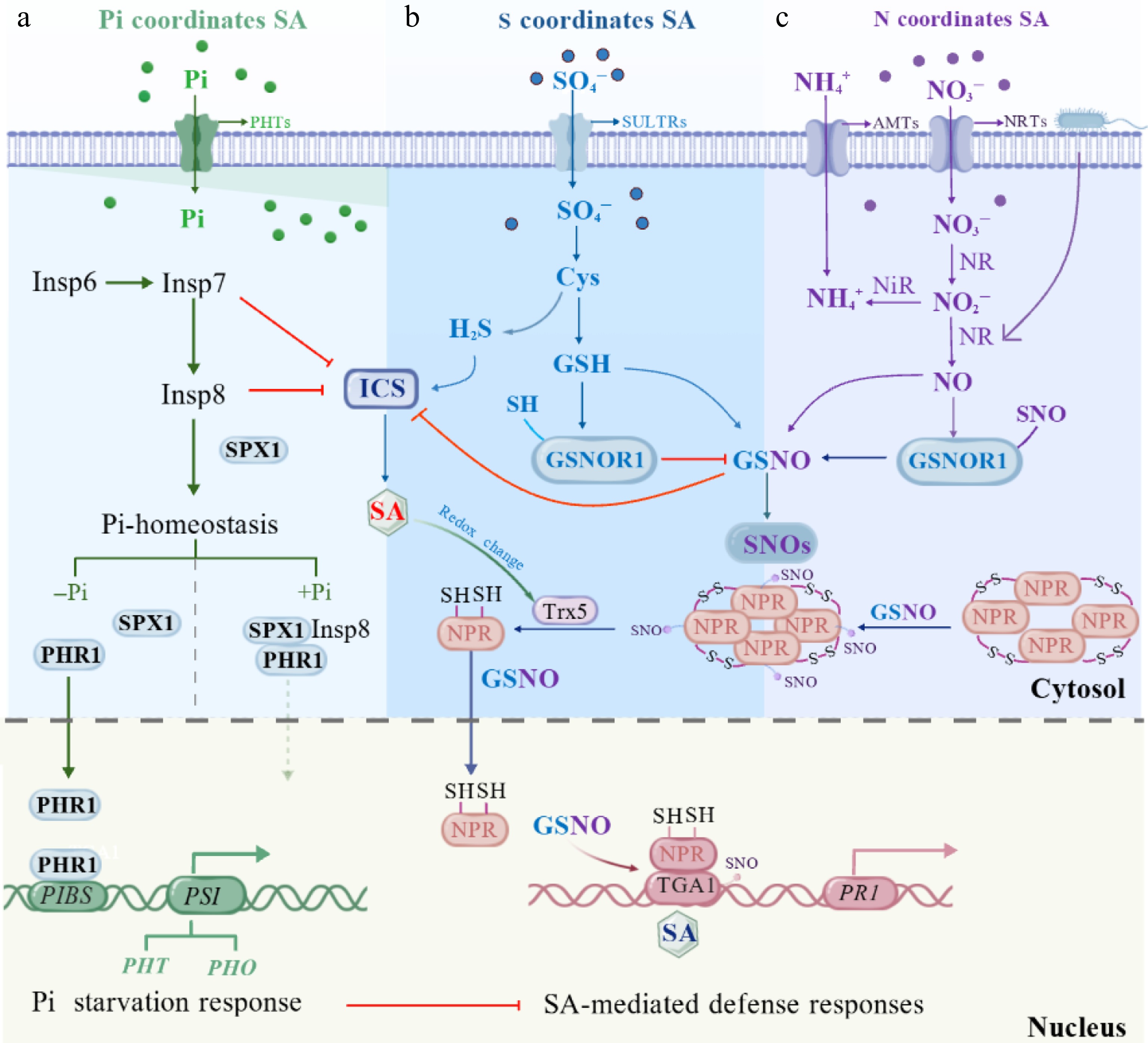
Figure 2.
Integrated model of crosstalk between phosphorus (P), sulfur (S), and nitrogen (N) and SA-mediated plant immunity. (a) Phosphorus availability regulates SA biosynthesis and defense responses through inositol polyphosphate (InsP) signaling and phosphate (Pi) homeostasis. (b) Sulfur assimilation influences SA signaling via cysteine (Cys)-derived redox regulation, controlling glutathione (GSH), hydrogen sulfide (H2S), and GSNOR1-dependent GSNO/SNO homeostasis, which modulates NPR1 activity. (c) Nitrogen-derived nitric oxide (NO) signaling intersects with SA-mediated immunity through GSNO-dependent protein S-nitrosylation, regulating NPR1–TGA–dependent activation of defense genes such as PR1.
-
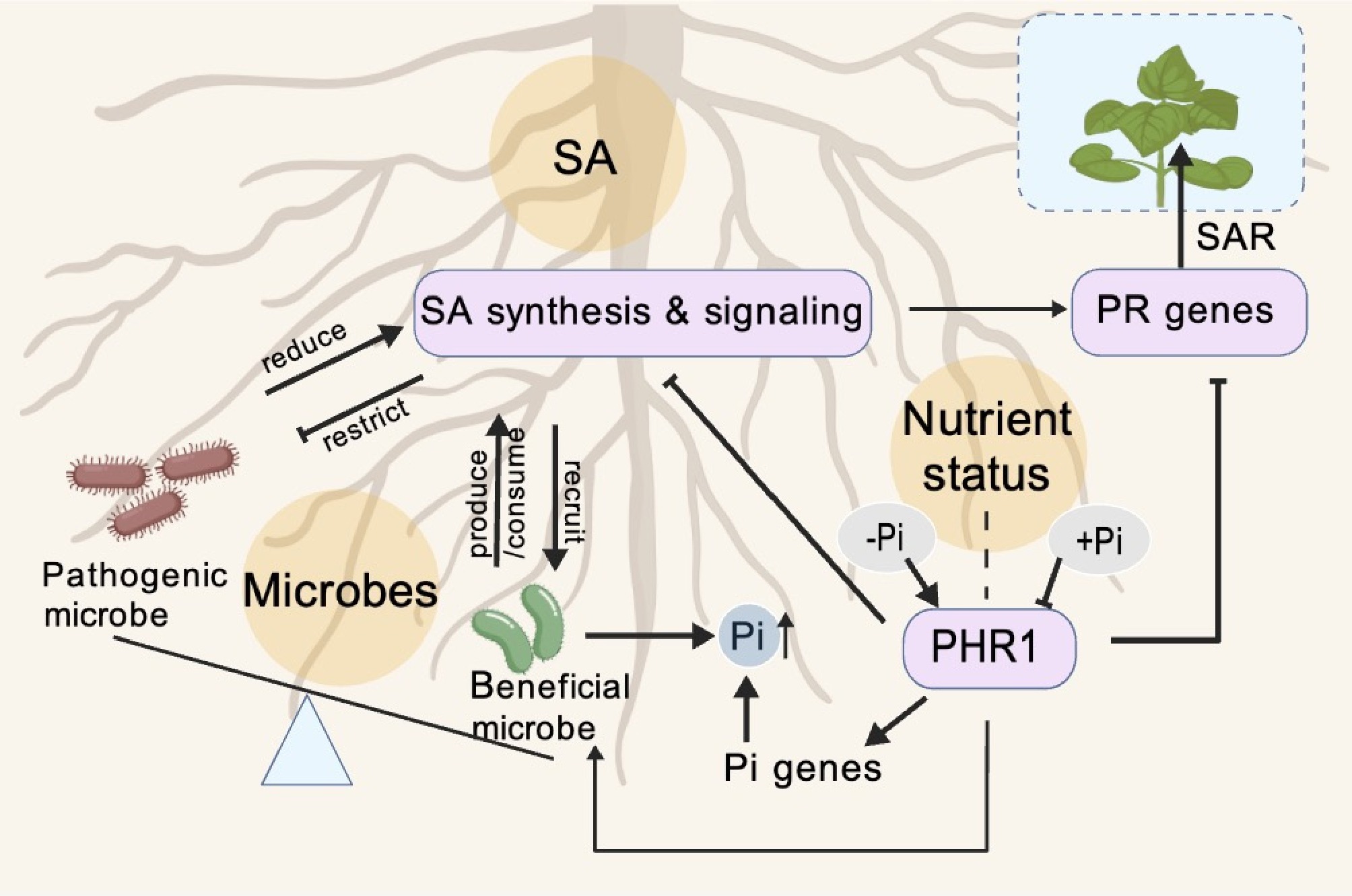
Figure 3.
Model of SA-mediated integration of plant immunity, root microbiome assembly, and phosphate status. SA produced in roots shapes the root-associated microbiome by favoring beneficial microbes and constraining pathogens, while beneficial microbes can in turn produce SA and enhance PR gene expression and SAR. Pi status regulates PHR1, which activates Pi-responsive genes and Pi uptake and influences the recruitment of beneficial, Pi-scavenging microbes, while modulating SA-dependent immune outputs, thereby linking nutrient status, microbiome composition, and plant defense.
-
Nutrient status Key component/mechanism Modulation of SA signaling Defense response/phenotype Species Ref. Pi deficiency PHR1–SPX/PSR signaling;
P1BS elementsSA-responsive genes ↓ PTI ↓; phr1 mutant→Resistance to bacterial and fungal pathogens ↑ A. thaliana [24,41] Pi deficiency PAL3/PAL pathway; OsPT2/6 SA biosynthesis/
accumulation ↑SA→Cell wall phosphorus remobilization ↑ Rice [37] Pi sufficiency miR399–PHO2 module;
SPX–PHR networkRelief of PHR1-mediated repression on SA genes;
Defence gene induction ↓Resistance ↑ (A. thaliana); Susceptibility to Magnaporthe oryzae ↑ (rice) A. thaliana/rice [46,47] Pi transporter activity PHT4;1, CCA1; PHT4;6 Modulates SA synthesis PHT4;1-1 gain→Susceptibility ↑; PHT4;6 loss→Resistance ↑ A. thaliana [44,45] N deficiency PAL1 induction SA accumulation ↑ Resistance to Pst DC3000↑;
Trade-off with growthTomato [8,49] Nitrate (NO3−) NR-dependent NO generation SA accumulation via NO ↑ Resistance to bacterial
pathogens ↑Tomato/tobacco [49,53] Ammonium (NH4+) Reduced NR-dependent NO generation SA accumulation (low NO) ↓ Susceptibility to bacterial pathogens ↑ Tomato/A. thaliana [49,51] NO signaling NO–ROS crosstalk SA biosynthesis and signaling ↑ SAR ↑; Immune responses ↑ A. thaliana [75] S deficiency SA-mediated PR1 expression (NPR1-dependent) SA signaling ↑; SA-dependent genes (PR1) ↑ Resistance to Pst DC3000 ↑; Susceptibility to B. cinerea ↑ A. thaliana [62] S excess SA-mediated PR1 expression; SA–JA crosstalk SA biosynthesis ↓; PR1 ↓ Susceptibility to Pst DC3000 ↑; Resistance to B. cinerea ↑ A. thaliana [62] H2S signaling Cysteine desulfhydrases (LCD/DES1) SA biosynthesis and PR genes ↑ Pathogen resistance ↑; Antioxidant defense ↑ A. thaliana [64,67] Cys and GSH signaling Cys; GSH; GSNO–GSNOR1 system; S-nitrosation Regulates SA signaling & ICS1-dependent SA biosynthesis SA-mediated defense ↑; Resistance to Pst DC3000 ↑ A. thaliana [65,70] ↑ Indicates relative increases or activation, ↓ indicates decrease or suppression. PTI, PAMP-triggered immunity; SAR, systemic acquired resistance; NO, nitric oxide; ROS, reactive oxygen species; JA, jasmonic acid; GSH, glutathione; GSNO, S-nitrosoglutathione; GSNOR1, GSNO reductase 1. Table 1.
Nutrient status-dependent modulation of SA signaling and plant immune responses.
Figures
(3)
Tables
(1)