-
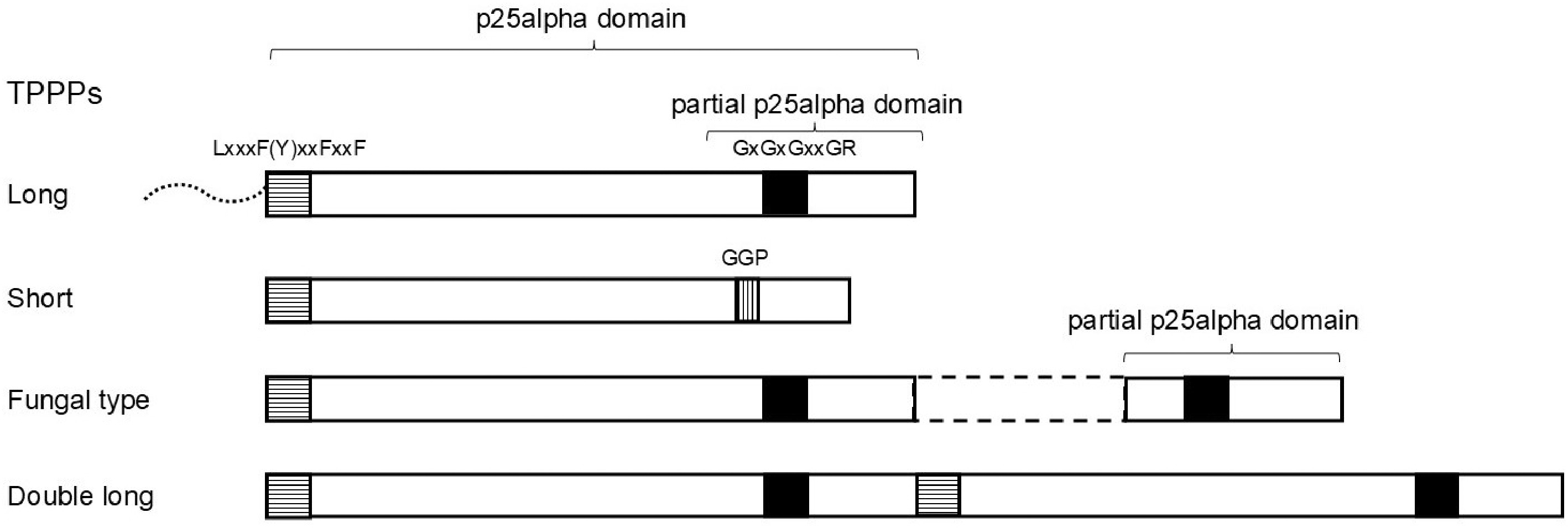
Figure 1.
Schematic structures of various TPPPs. Squares indicate conservative sequences. Dotted line indicates an unstructured N-terminus present in some long TPPPs. Dashed lines indicate a sequence of fungal type TPPP that does not belong to the p25 alpha domains.
-
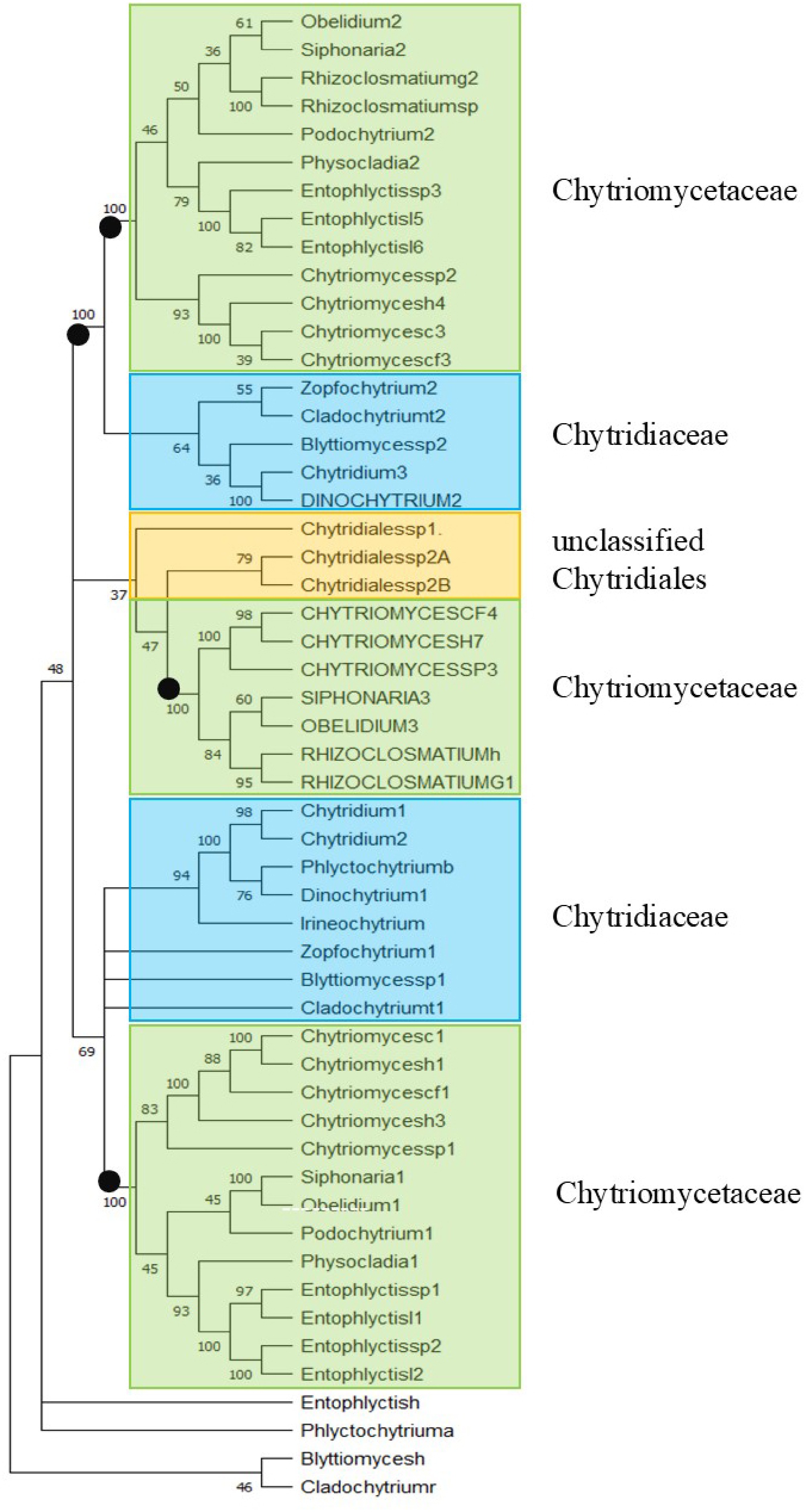
Figure 2.
Phylogenetic tree of TPPPs of Chytridiales by ML analysis. The accession numbers of proteins are listed in Supplementary Table S1. Capital letters indicate long TPPPs. Bootstrap values (500 replicates) above 33% are shown at branch nodes. Branches corresponding to partitions reproduced in less than 33% bootstrap replicates are collapsed. Black circles indicate maximal (100%) bootstrap values at main branches. Boxes represent families. Color code: Chytriomycetaceae (green), Chytridiaceae (blue), unclassified Chytridiales (orange).
-
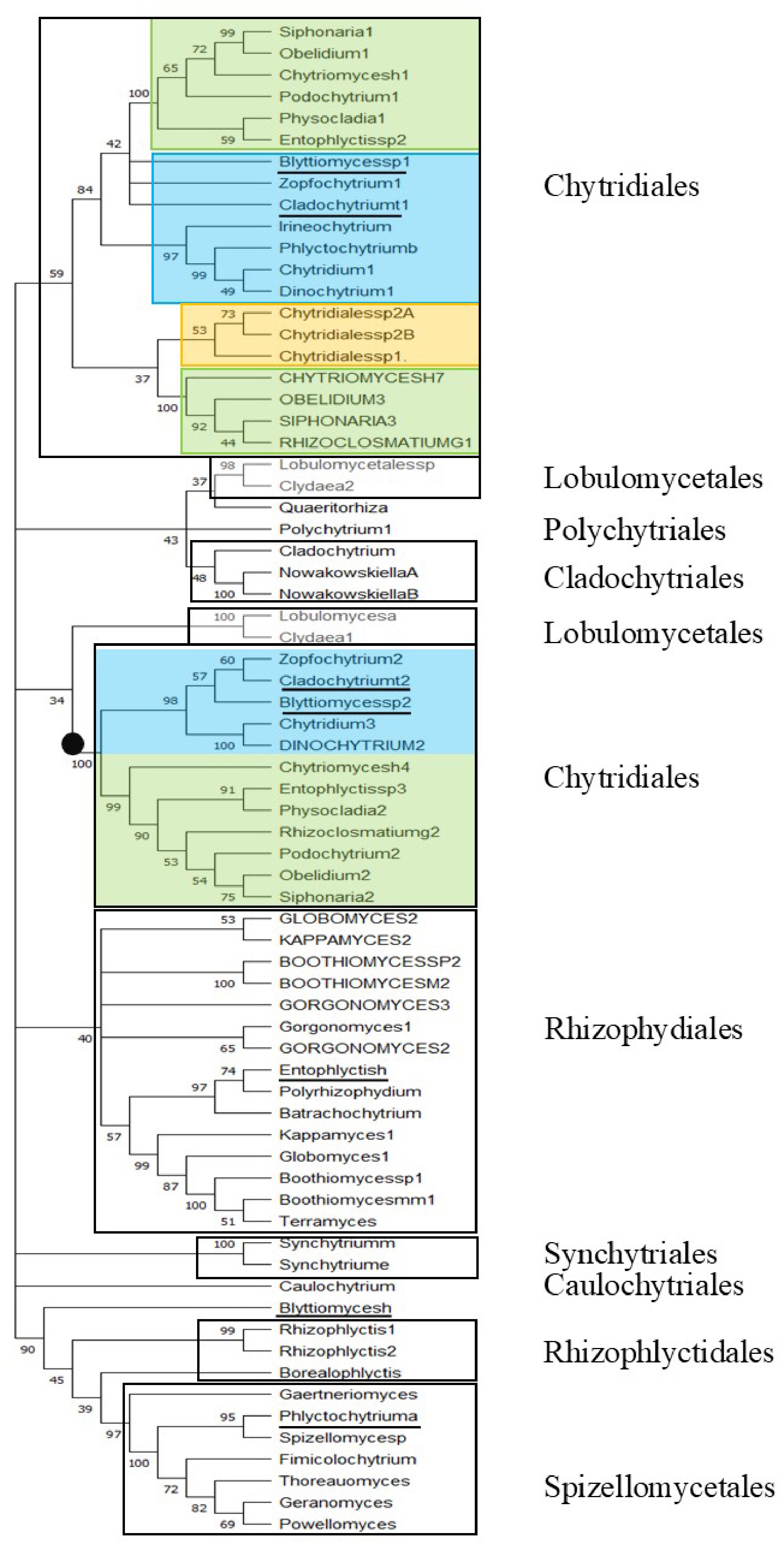
Figure 3.
Phylogenetic tree of TPPPs of Chytridiomycota by ML analysis. The Accession Numbers of proteins are listed in Supplementary Table S1. Capital letters indicate long TPPPs. Underlining indicates species whose taxonomic classification have been disputed. Bootstrap values (500 replicates) above 33% are shown at branch nodes. Branches corresponding to partitions reproduced in less than 33% bootstrap replicates are collapsed. The black circle indicates the maximum (100%) bootstrap value of a main branch. Boxes represent orders. Color code as in Fig. 2.
-
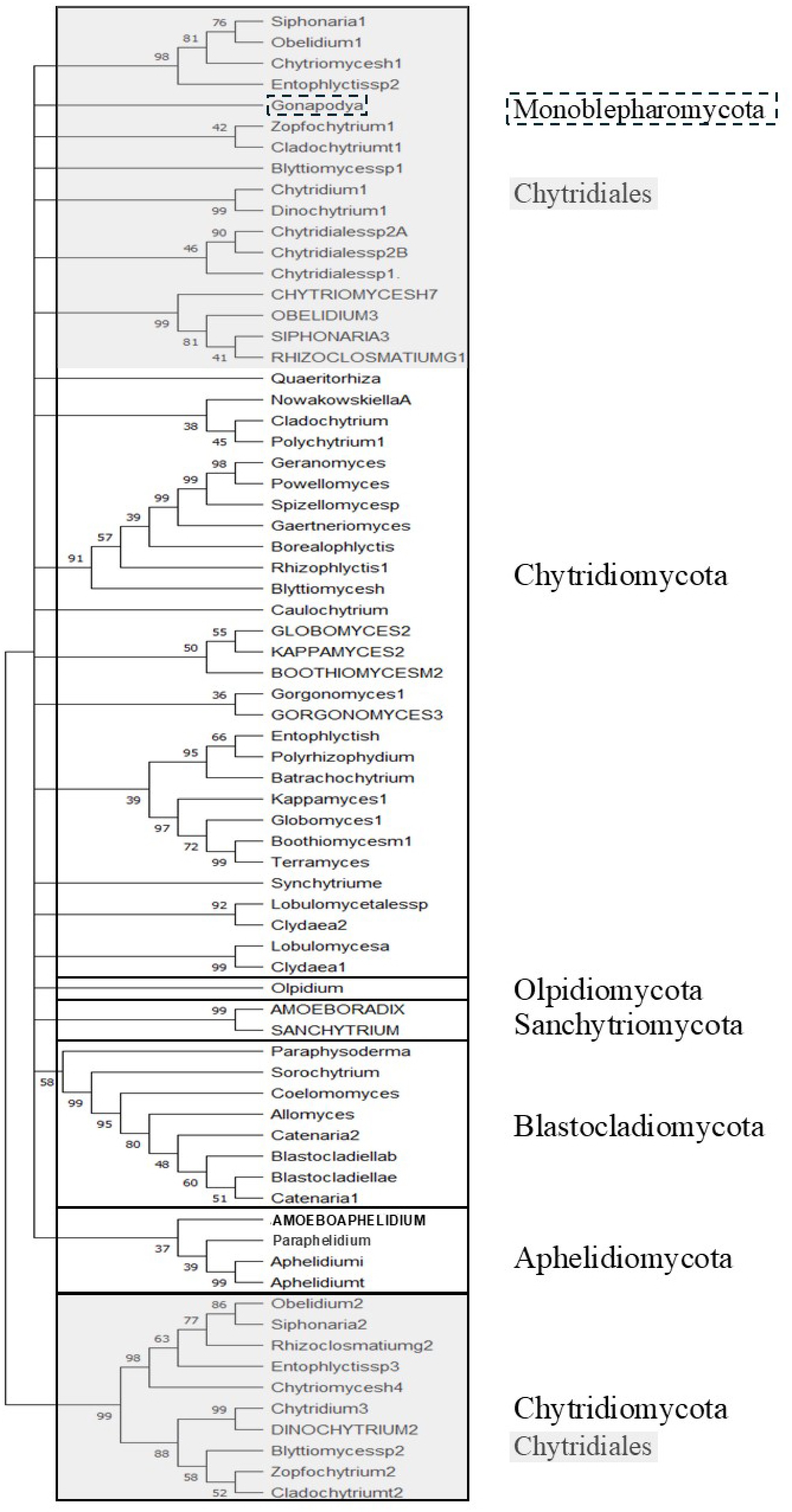
Figure 4.
Phylogenetic tree of TPPPs of fungi by ML analysis. The Accession Numbers of proteins are listed in Supplementary Table S1. Capital letters indicate long TPPPs. Bootstrap values (500 replicates) above 33% are shown at branch nodes. Branches corresponding to partitions reproduced in less than 33% bootstrap replicates are collapsed. Boxes represent phyla. Grey background indicates the Chytridiales order.
-
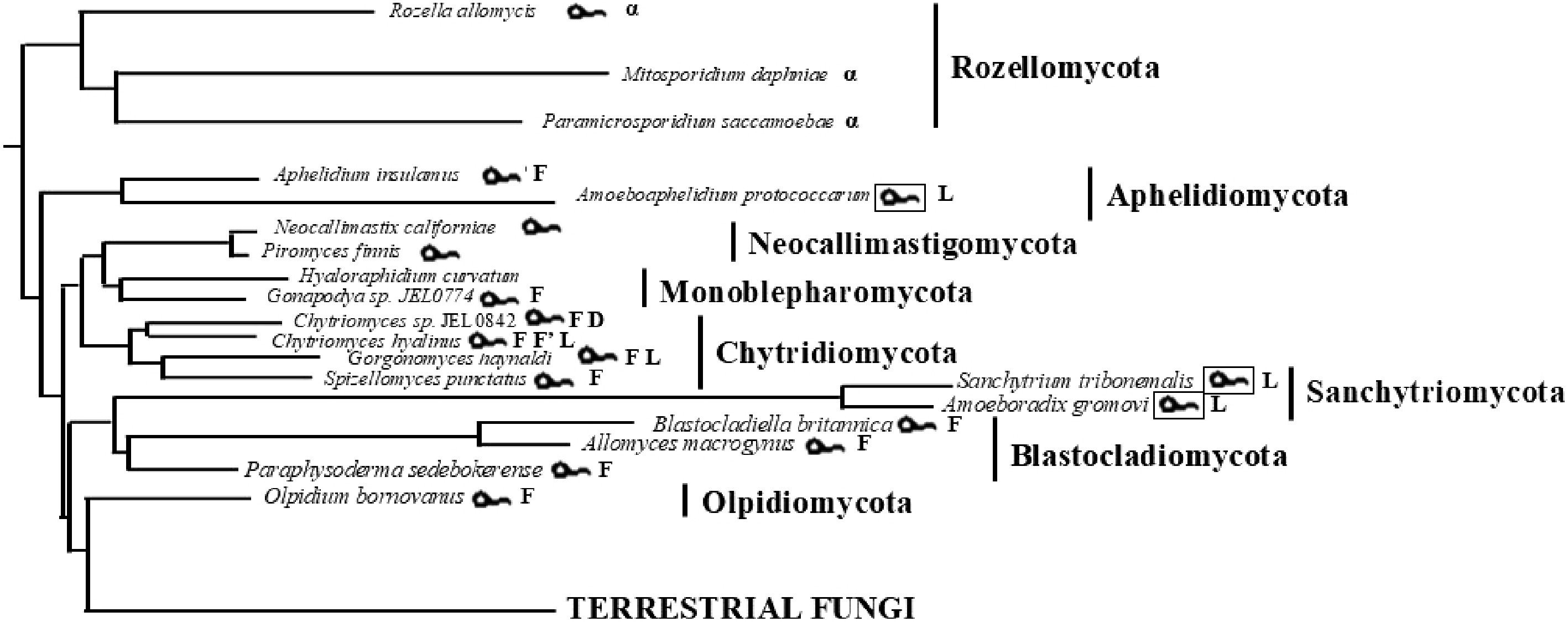
Figure 5.
Occurrence of flagellum and TPPP-like proteins in the Kingdom of fungi. The tree is based on the species phylogeny published in previous studies[24,40]. The presence of flagellum, fungal-type TPPPs, long, TPPP, double-long and TPPP-like p25alpha-containing domain proteins is labeled by the following symbols:

-
Phylogenetic
unitTPPP Long Fungal Fungal2 Double-long Blastocladiomycota Phylum − 10 − − Chytridiomycota Phylum 14 53 17 1 Chytridiomycetes Class 14 53 17 1 Caulochytridales Order − 1 − − Chytridiales Order 7 19 17 1 Chytriomycetaceae Family 7 11 12 − Chytridiaceae Family − 7 5 − Cladochytriales Order − 3 − − Lobulomycetales Order − 3 − − Polychytriales Order − 1 − − Rhizophlyctidales Order − 2 − − Rhizophydiales Order 7 11 − − Synchytriales Order − 2 − − Spizellomycetales Order − 10 − − Monoblepharidomycota Phylum − 1 − − Olpidiomycota Phylum − 1 − − Sanchytriomycota Phylum 2 − − − Aphelidiomycota Phylum 1 3 − − Kingdom of fungi 17 68 17 1 Table 1.
Occurrence of TPPPs in various fungi. How many species are there in the given phylogenetic unit in which it occurs?
Figures
(5)
Tables
(1)