-
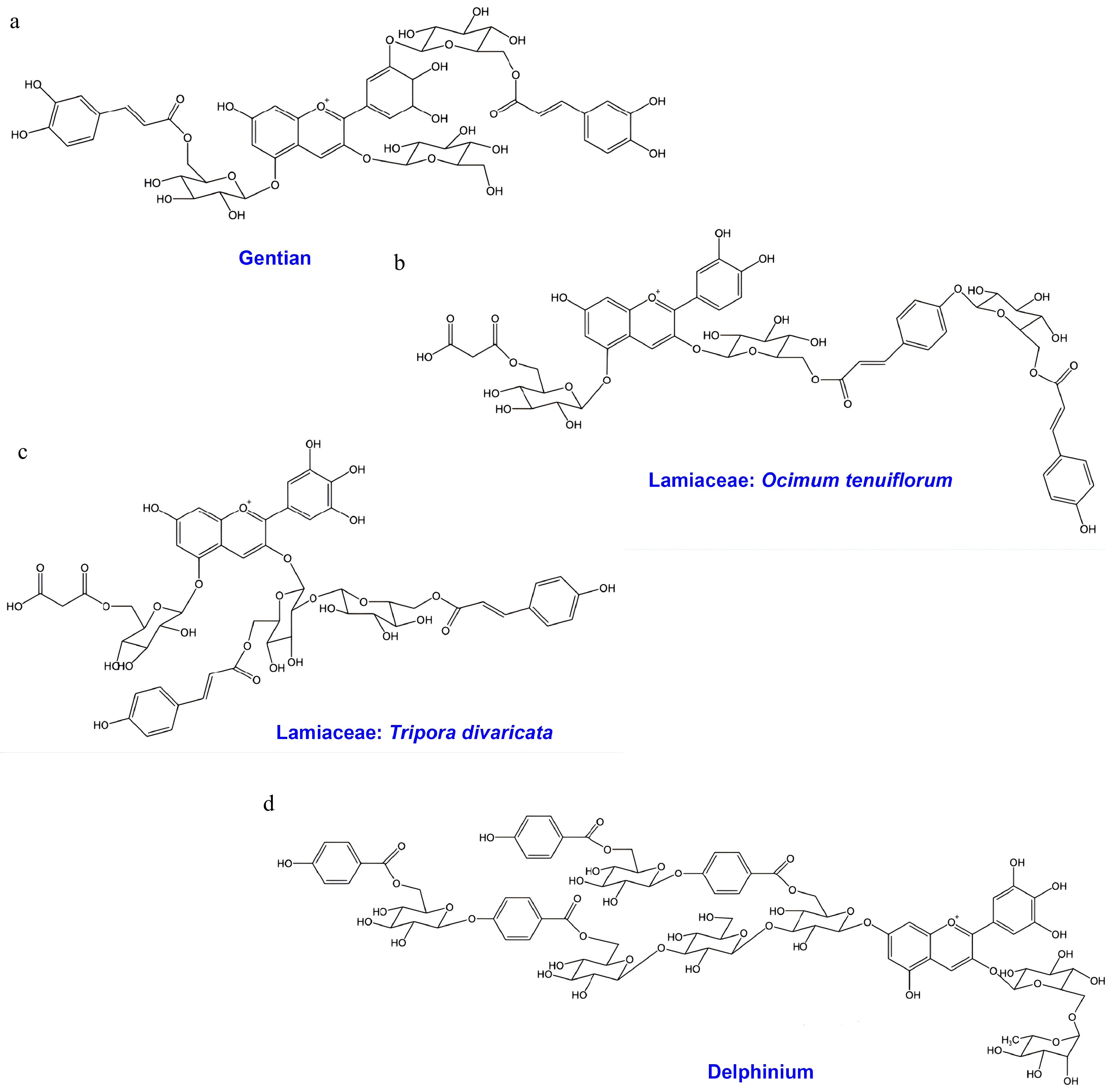
Figure 1.
Chemical structure of polyacylated anthocyanins from Gentian, Lamiaceae, and Delphinium species. (a) Gentiodelphin from Gentiana sp.; (b) polyacylated anthocyanin from Ocimum tenuiflorum; (c) polyacylated anthocyanin from Tripora divaricata; (d) cyanodelphin from Delphinium sp.
-
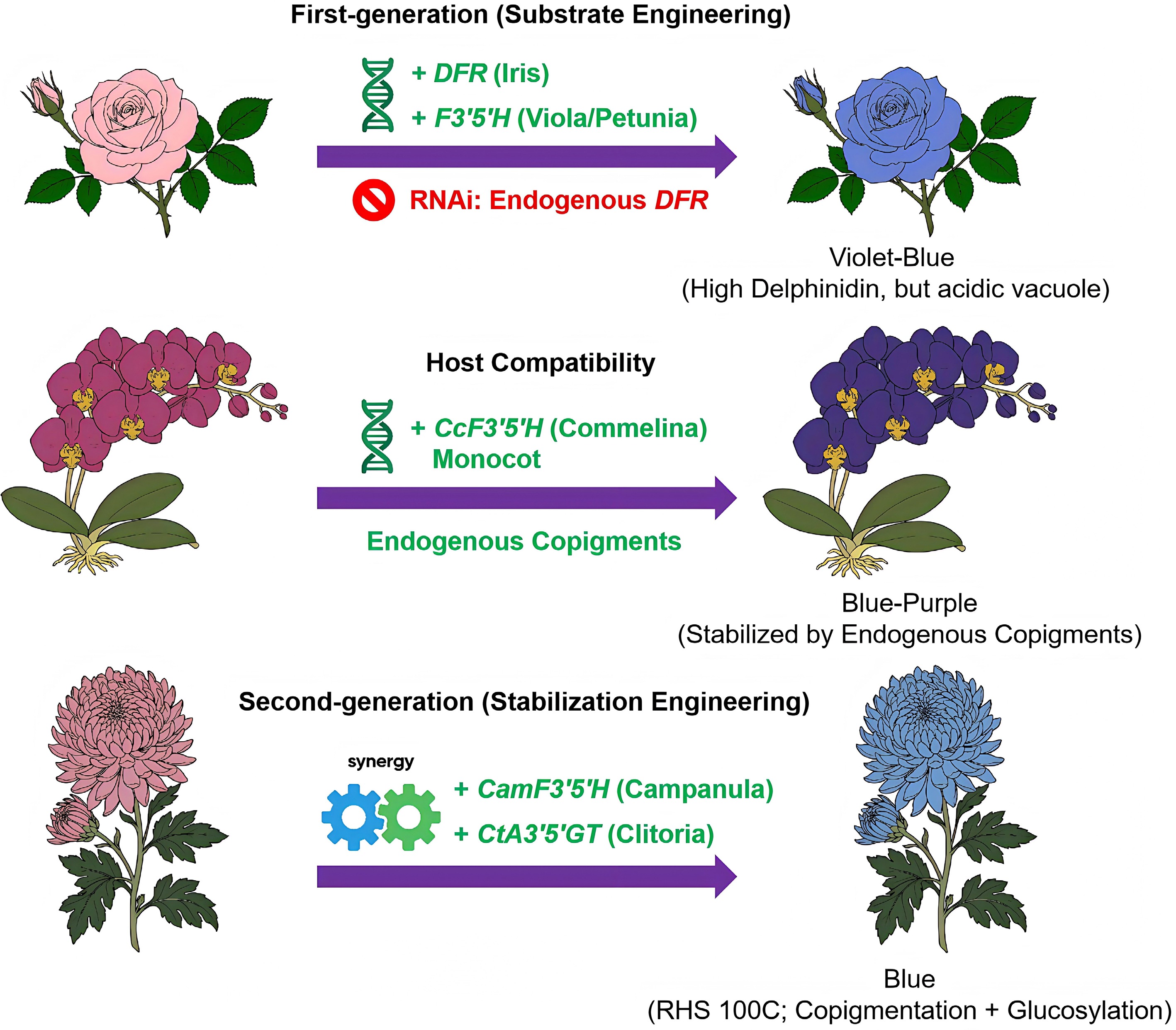
Figure 2.
Evolution of genetic engineering strategies for blue flowers. (Top) First-generation substrate engineering in rose. The introduction of heterologous F3'5'H (from Viola/Petunia) and DFR (from Iris) drives delphinidin accumulation. This strategy includes RNAi-mediated silencing of endogenous DFR. However, acidic vacuoles produce a violet-blue hue rather than a true blue. (Middle) Host compatibility in Phalaenopsis. Expression of a monocot-derived F3′5′H (from Commelina) yields blue-purple flowers. Endogenous copigments specific to orchids stabilize this color. (Bottom) Second-generation stabilization in Chrysanthemum. Co-expressing F3′5′H (from Campanula) and CtA3′5′GT (from Clitoria) produced a bluer phenotype, reported as RHS 100C in selected lines, through the combined effects of copigmentation and glucosylation. The flower illustrations are schematic and summarize the reported phenotypic trends and engineering strategies rather than reproducing the exact color intensity of the original studies.
-
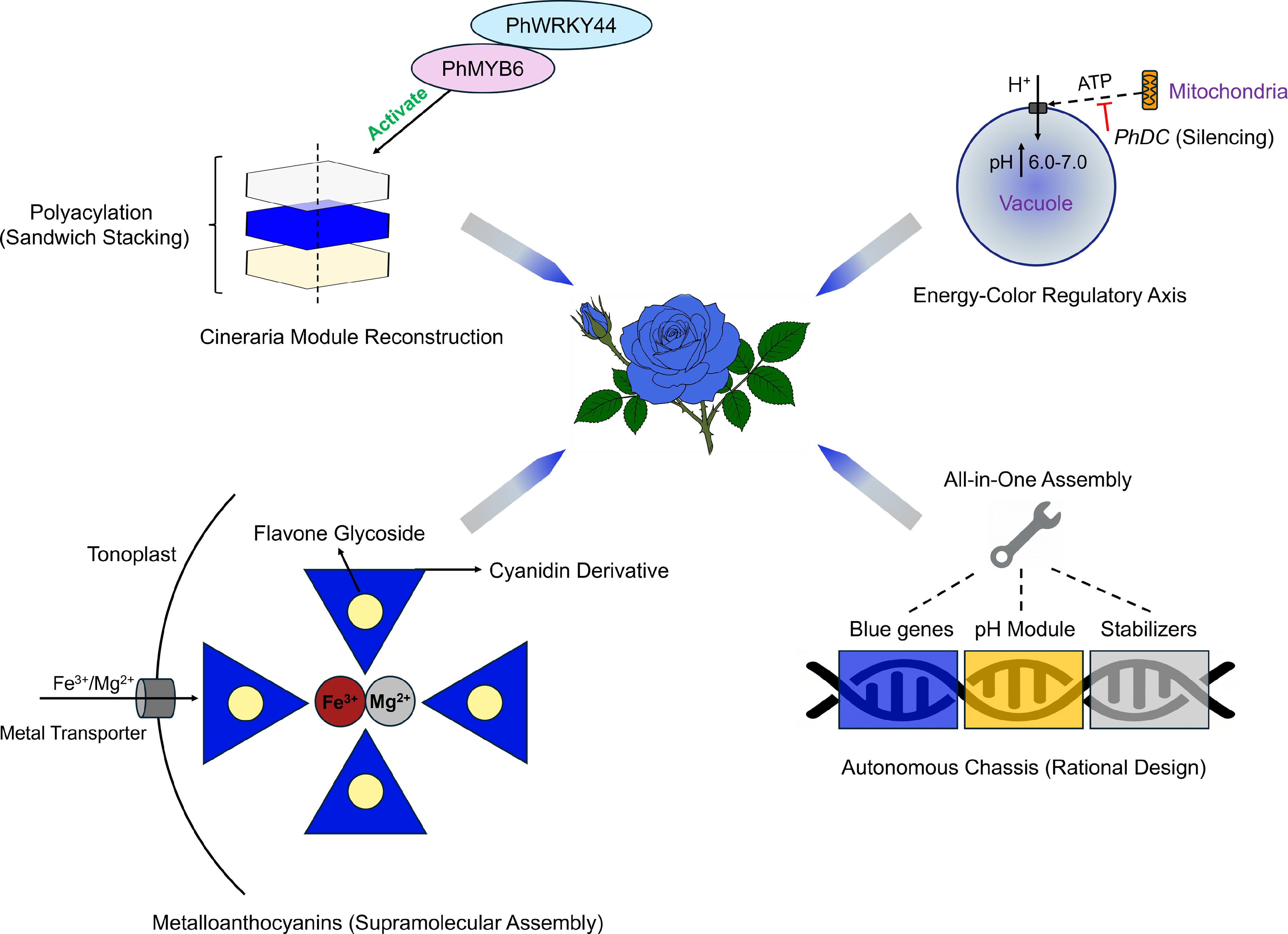
Figure 3.
Third-generation paradigm: future strategies for autonomous true blue flowers. This diagram outlines the four integrated synthetic biology modules to create an ideal true blue rose independent of the host background. (Top left) Polyacylation via the Cineraria module. The transcription factor complex PhMYB6–PhWRKY44 activates the pathway for polyacylated anthocyanins. These molecules form a stable "sandwich" stack that protects the chromophore[7]. (Top right) Engineering pH via the energy-color axis. A novel mitochondrial tuning strategy silences PhDC to limit ATP supply to the vacuolar proton pumps. This strategy raises vacuolar pH to a neutral range (6.0−7.0) and favors blue coloration[44]. (Bottom left) Metalloanthocyanin assembly. Engineered metal transporters (e.g., VIT1/MGT) move Fe3+ and Mg2+ into the vacuole. These ions drive the self-assembly of cyanidin derivatives and flavone glycosides into stable blue complexes. (Bottom right) Autonomous chassis design. This "all-in-one" approach integrates modules for blue gene expression, pH regulation, and structure stabilization. It creates a versatile chassis for universal application.
-
Host cultivar Introduced genes Key anthocyanins produced Resulting RHS
colorCore mechanism Ref. 'LPi' ScF3'5'H (PCFH)
(Senecio cruentus) CmF3'H RNAiCyanidin Brighter red Failure: ScF3'5'H exhibited only F3'H activity; functional incompatibility [38] '94-765', 'Taihei' CamF3'5'H (Campanula medium) A5, A6 Purple (77C), violet (83B) Success (violet): Achieved high-level accumulation (up to 95%) of the delphinidin substrate in chrysanthemum for the first time [39] 'Taihei', 'Sei Arabella' CamF3'5'H (Campanula medium)
CtA3'5'GT (Clitoria ternatea)
CmF3'H RNAiA8 (ternatin C5)
A7 (preternatin C5)Blue (100C), violet-blue (94B) Success (blue, RHS 100C): B-ring glycosylation of A8; strong intermolecular copigmentation with the endogenous flavone (C1) [40] 'Nannong Fencui' OhF3'5'H (Osteospermum hybrid)
CtA3'5'GT (Clitoria ternatea)A7, A8, A9 Purple-violet (N82D), violet (84C) Success (violet): Confirmed that the gene source for the Noda strategy is replaceable [41] 'Nannong Fencui' CmF3'Hm (T485S mutation)
CtA3'5'GT (Clitoria ternatea)A3, A4 Light purple (77D), very pale purple (N76C) Failure (risk identified): The CmF3'Hm mutation was nonfunctional; Cta3'5'GT exhibited substrate promiscuity, acting on cyanidin [41] A3, cyanidin-3-O-(6"-malonyl) glucoside 3'-O-glucoside; A4, cyanidin-3-O-(3",6"-dimalonyl) glucoside 3'-O-glucoside; A5, delphinidin 3-O-(6"-O-malonyl) glucoside; A6, delphinidin 3-O-(3",6"-di-O-malonyl) glucoside; A7, delphinidin 3,3',5'-tri-O-glucoside; A8, delphinidin 3-O-(6"-O-malonyl) glucoside 3',5'-di-O-glucoside; A9, delphinidin 3-O-(3",6"-dimalonyl) glucoside 3',5'-di-O-glucoside. Table 1.
Comparative analysis of genetic engineering strategies for blue/violet coloration in Chrysanthemum.
Figures
(3)
Tables
(1)