-
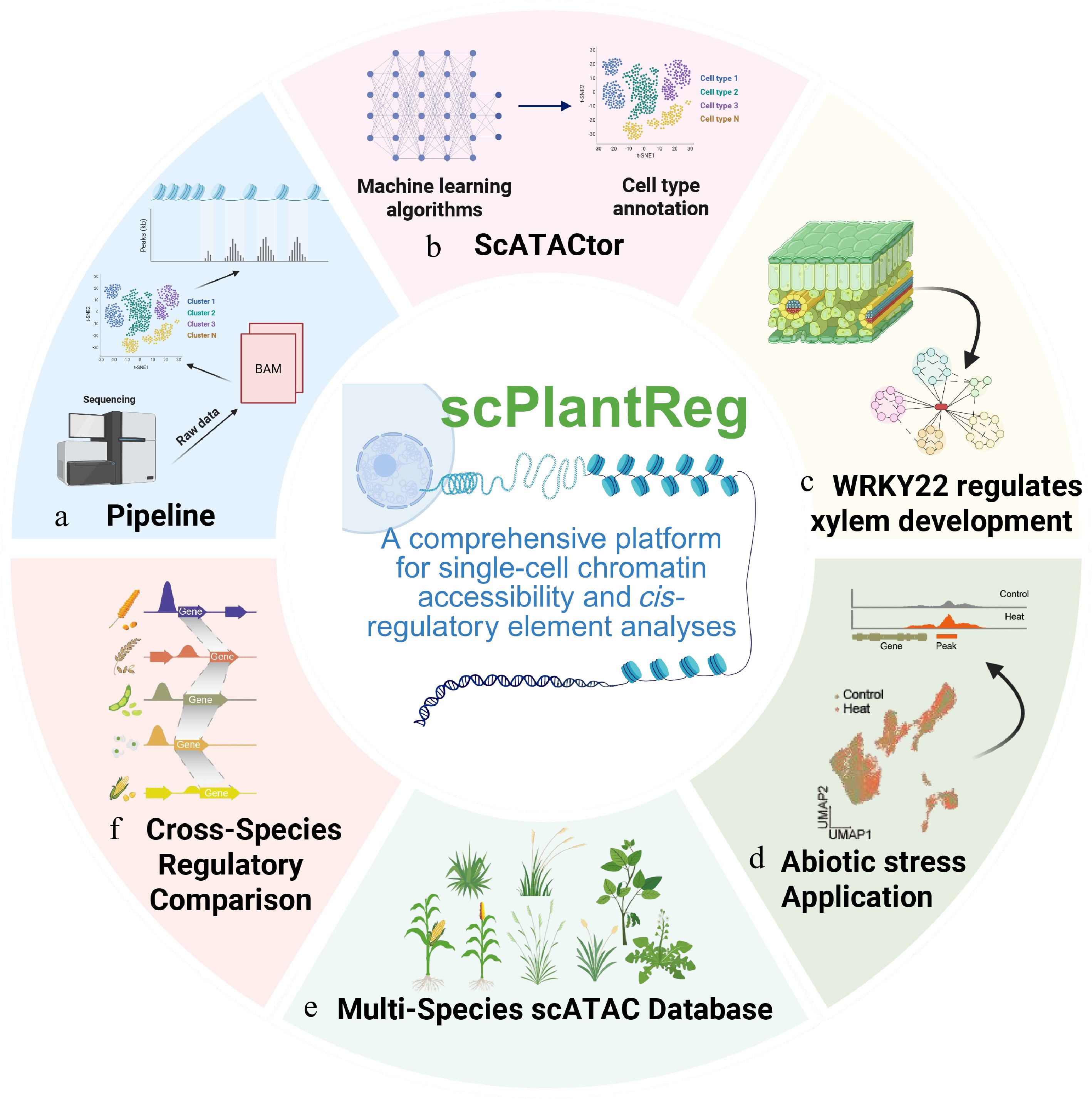
Figure 1.
Six key features of applications within the scPlantReg platform. (a) scPlantReg provides an end-to-end framework for plant-related single-cell chromatin accessibility analysis, integrating data processing, quality control, clustering, cell-type annotation, motif enrichment, regulatory prediction, and cross-species comparison through the Socrates2 module. The platform is optimized for scATAC-seq data from plants and improves reproducibility and stability, particularly in nonmodel species such as pearl millet. (b) ScATACtor, a machine learning-based tool for accurate cell-type annotation using genome-wide accessibility patterns, with support for cross-modality integration. (c) Application in pearl millet enabled the construction of a single-cell chromatin accessibility landscape, the identification of cell-type-specific regulatory regions, and functional validation of transcription factors such as WRKY22 in xylem development. (d) The framework also supports the analysis of stress responses, revealing cell-type-specific chromatin dynamics under heat stress. (e) scPlantReg hosts a standardized multispecies scATAC-seq database, integrating datasets from major grasses, thus enabling comparative analysis. (f) Cross-species analyses highlight conserved regulatory programs at the level of chromatin accessibility and transcription factor motifs, even in the absence of strong sequence conservation. Overall, the platform links single-cell epigenomic data to functional regulatory insights and supports gene discovery and molecular breeding in forage grasses. Created with BioRender (
https://BioRender.com/a16u6sj ).
Figures
(1)
Tables
(0)