-
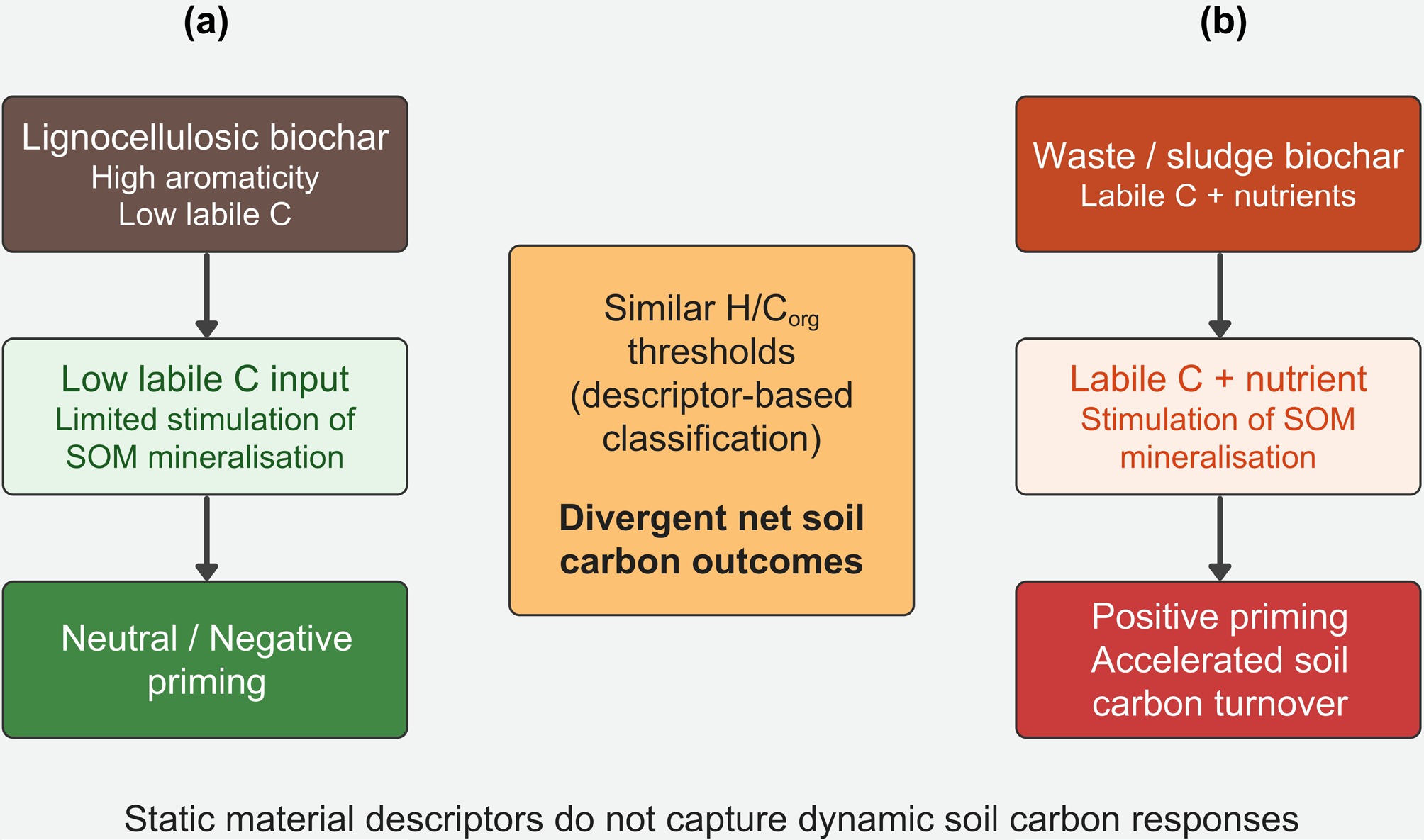
Figure 1.
Conceptual representation of feedstock-driven divergence in soil carbon dynamics despite similar descriptor thresholds. Biochars derived from lignocellulosic feedstocks (e.g., wood; [a]), characterized by high aromaticity and low labile carbon content, tend to limit stimulation of soil organic matter (SOM) mineralization and are commonly associated with neutral or negative priming, favoring soil carbon preservation. In contrast, biochars derived from (b) nutrient-rich waste or sludge provide labile carbon and nutrients that can stimulate SOM mineralization and are often associated with positive priming, leading to accelerated soil carbon turnover. Despite meeting similar physicochemical descriptor thresholds (e.g., H/Corg), these materials may result in divergent net soil carbon outcomes, highlighting the importance of complementing descriptor-based evaluation with performance-oriented interpretation.
-
Indicator What it captures Example method When it matters most H/Corg (molar ratio) Intrinsic aromaticity/structural stability Elemental analysis Carbon retention-focused applications Labile carbon fraction Potential for microbial stimulation/short-term reactivity Water-extractable C Early-stage soil responses, priming Microbial/respiration response Priming effects on SOM mineralization Incubation/CO2 flux Assessing carbon turnover impacts Soil context parameters Modulation of biochar behavior Texture, SOM content Site-specific performance interpretation The indicators reflect key dimensions of biochar–soil interactions discussed in this perspective and are intended as a minimal, illustrative guide rather than a prescriptive framework. Table 1.
Indicative set of function-oriented indicators for interpreting biochar performance in soil systems.
Figures
(1)
Tables
(1)