-
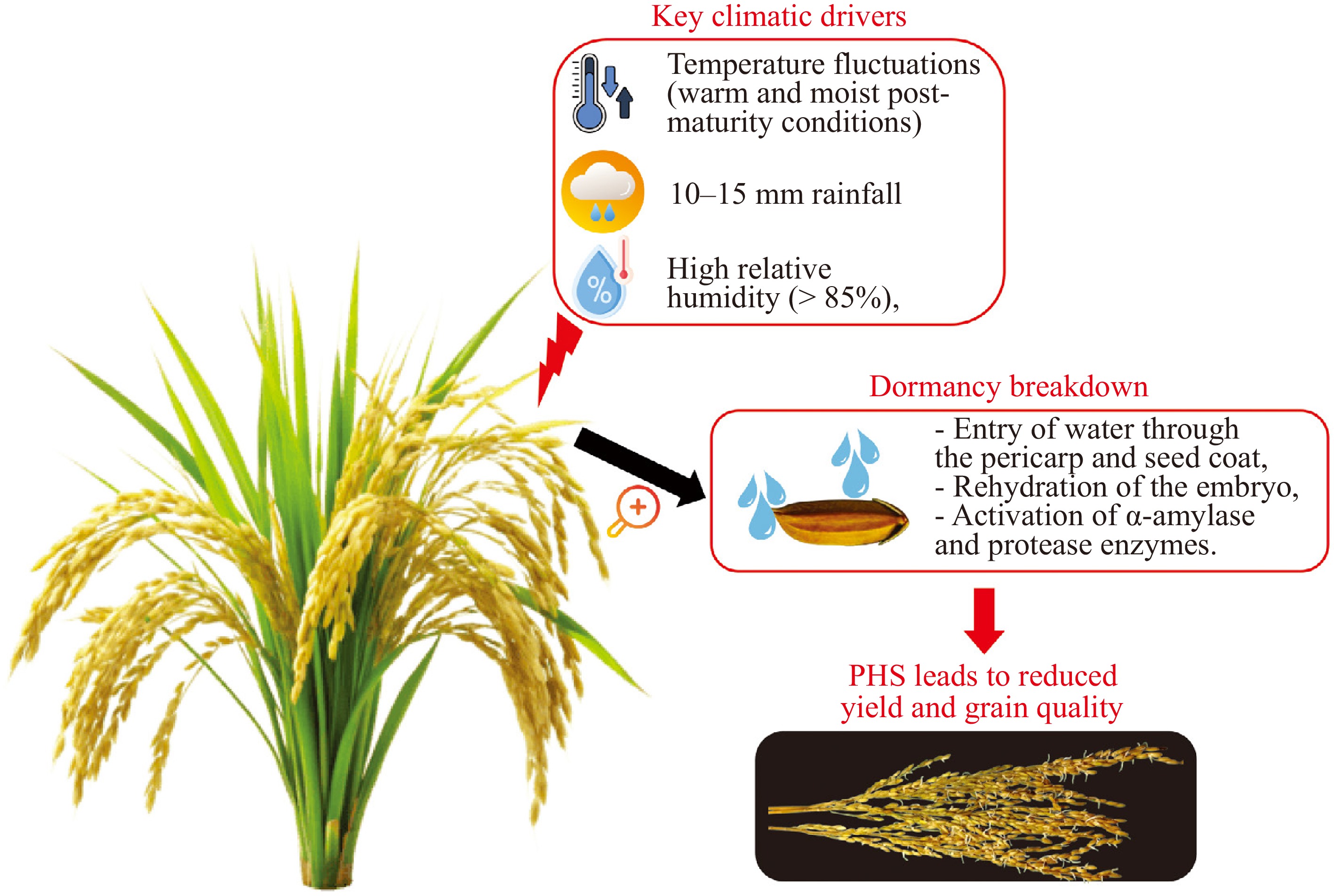
Figure 1.
Conceptual overview of pre-harvest sprouting in rice. Environmental triggers such as rainfall, humidity, and temperature affect moisture uptake by panicles and spikelets. Water infiltration through glumes and hulls reactivates metabolic enzymes and causes dormancy breakdown and premature germination. The physiological consequence of pre-harvest sprouting results in lower grain yield, reduced processing quality, and decreased storage stability.
-
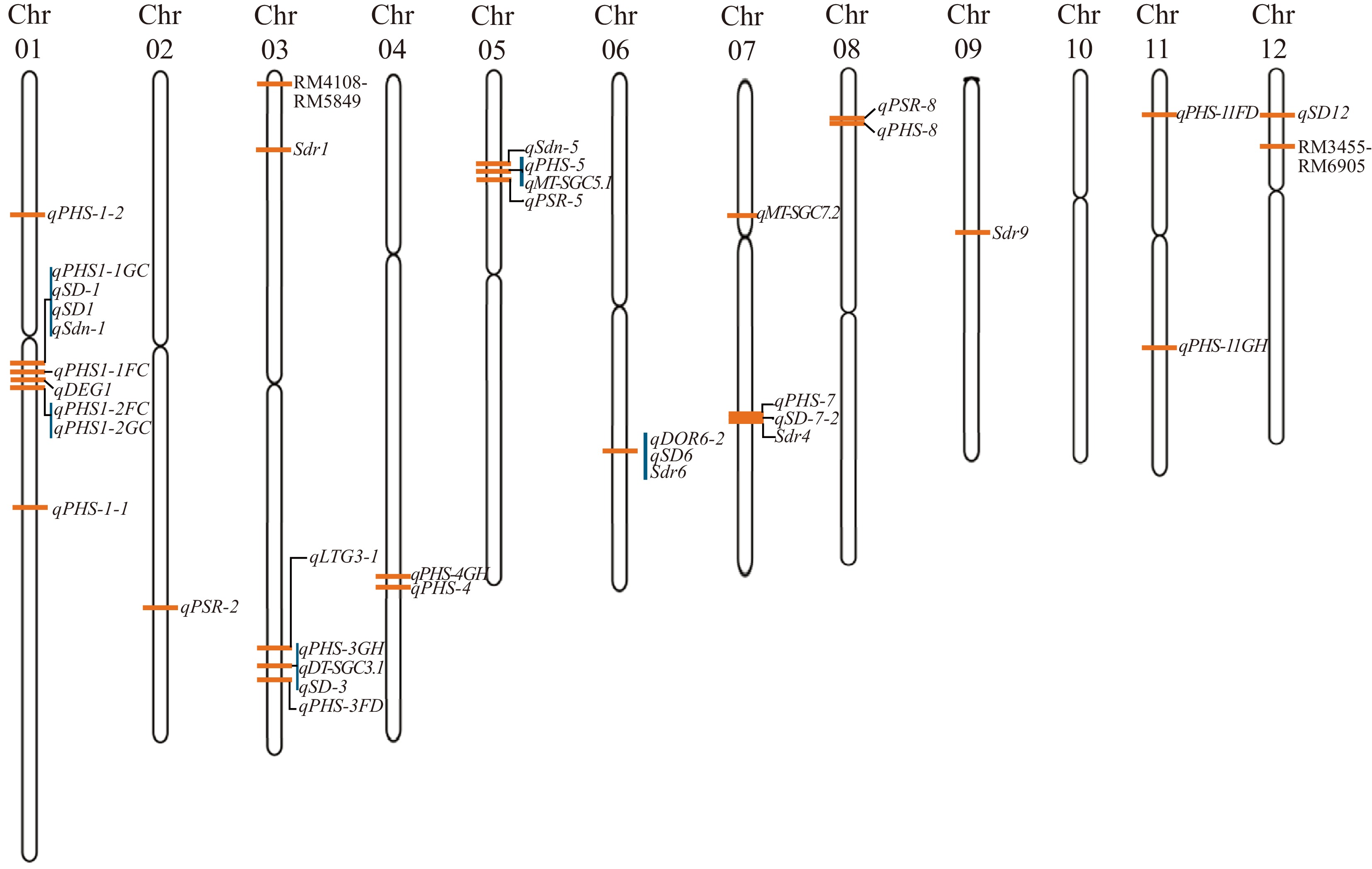
Figure 2.
Physical distribution of reported pre-harvest sprouting-associated quantitative trait loci on the rice genome. Rice chromosomes (Chr01–Chr12) are shown as vertical bars. Orange horizontal bars indicate the approximate physical positions of pre-harvest sprouting-related QTLs.
-
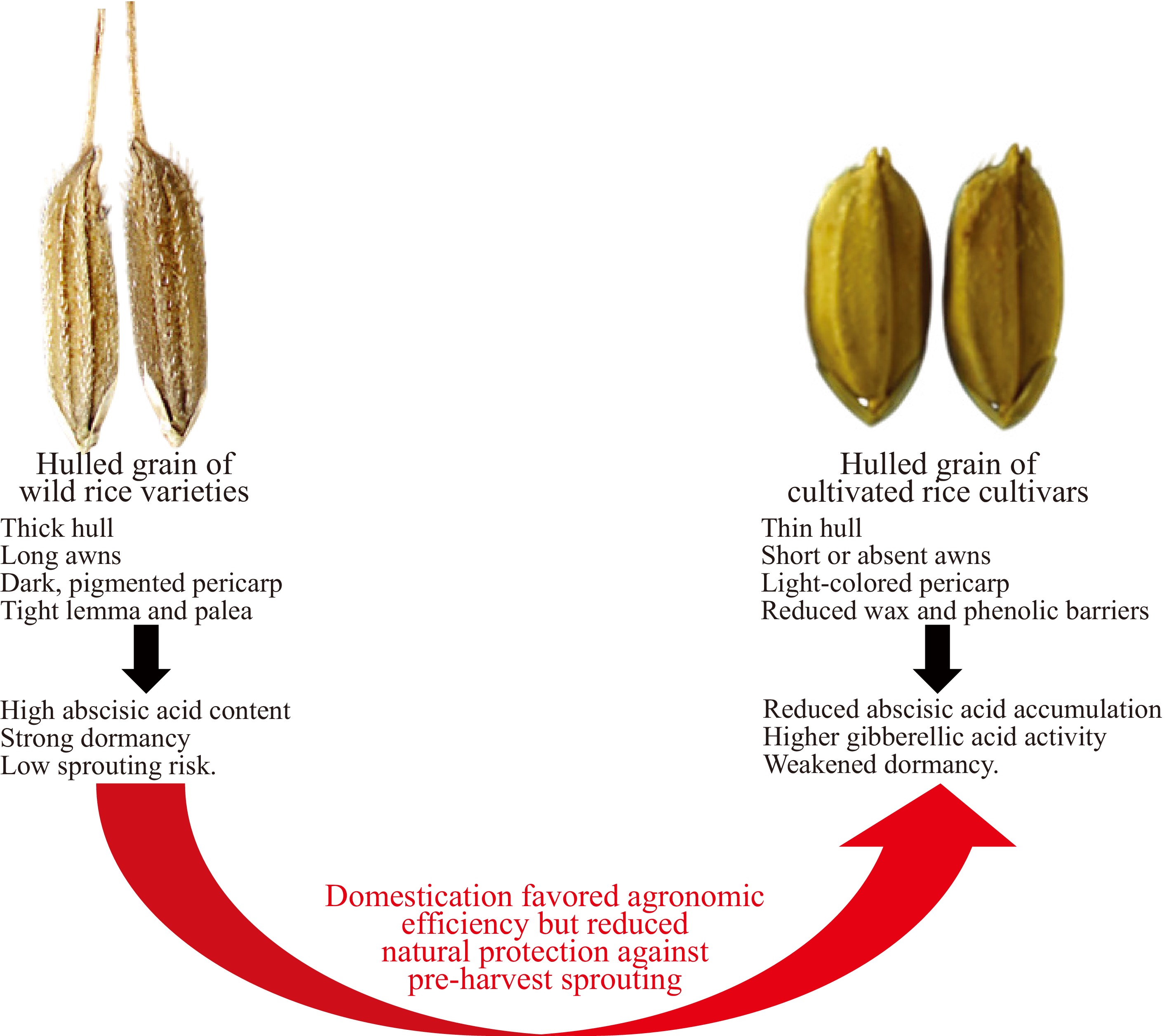
Figure 3.
Evolutionary and domestication-related changes affecting pre-harvest sprouting in rice. Wild rice species possess firm hulls, pigmented pericarps, and high abscisic acid levels that maintain strong seed dormancy and resist moisture penetration. Domestication selected for traits that favor rapid germination and easy threshing, including thinner hulls and reduced dormancy, which increased pre-harvest sprouting susceptibility in cultivated rice varieties. These evolutionary trade-offs highlight the need to reintroduce dormancy alleles and structural defenses into modern breeding programs.
-
# Environmental factor Rice Wheat Barley Maize 1 Rainfall and humidity ≥ 10–15 mm rainfall over several days with relative humidity
> 85% during late maturity strongly increases vivipary.Moderate rainfall with relative humidity > 80% near harvest promotes sprouting, especially in white-grained cultivars. Short rainfall events with high humidity rapidly induce sprouting due to shallow dormancy. Sustained rainfall that maintains kernel moisture for several days increases vivipary when husks are loose. 2 Temperature × moisture Warm temperatures > 25 °C combined with high moisture accelerate dormancy loss. Cool temperatures (10–20 °C) with prolonged moisture extend grain hydration and favor sprouting. Moderate temperatures (15–25 °C) with moisture rapidly activate germination. Warm and humid conditions slow kernel drying and favor vivipary. 3 Rainfall timing Rainfall after physiological maturity or during early after-ripening presents the highest risk. Rainfall during late grain filling and immediately before harvest increases PHS incidence. Rainfall close to harvest readily induces sprouting. Rainfall after black layer formation increases vivipary under exposed kernels. 4 Wetting-drying cycles Multiple wet-dry cycles destabilize dormancy and increase sensitivity to later rainfall. Alternating wet and dry conditions weaken dormancy within spikes. Repeated moisture fluctuations accelerate dormancy breakdown. Wet-dry cycles increase kernel moisture when husk protection is incomplete. 5 Duration of grain wetness Continuous spikelet wetness > 48 h strongly correlates with vivipary. Prolonged spike wetness enhances water uptake through glumes. Short wetness periods are sufficient to initiate germination. Extended kernel wetness occurs when husks retain moisture. 6 Morphology and architecture Hull tightness, hull thickness, and panicle openness regulate water entry. Spike compactness, glume closure, and pericarp permeability control hydration. Spike architecture and hull adherence influence moisture retention. Husk tightness, husk length, and ear orientation determine kernel exposure. Table 1.
Species-specific environmental parameters influencing pre-harvest sprouting in cereal crops.
-
QTL Chr Mapping population Parents Ref. ♀ ♂ qPHS-1-1 1 RIL IR64 (Indica) Asominori (Japonica) [100] qPHS-1-2 1 RIL IR64 (Indica) Asominori (Japonica) [100] qPHS1-1FC 1 RIL Jinsang (Japonica) Gopum (Japonica) [101] qPHS1-2FC 1 RIL Jinsang (Japonica) Gopum (Japonica) [101] qPHS1-1GC 1 RIL Jinsang (Japonica) Gopum (Japonica) [101] qPHS1-2GC 1 RIL Jinsang (Japonica) Gopum (Japonica) [101] qSD-1 1 − 14 Japonica rice varieties 7 Indica rice varieties [102] qSD1 1 − 14 Japonica rice varieties 7 Indica rice varieties [102] qDEG1 1 − 14 Japonica rice varieties 7 Indica rice varieties [102] qSdn-1 1 − 14 Japonica rice varieties 7 Indica rice varieties [102] qPSR-2 2 F2 K81 G46B [103] qPHS-3GH 3 RIL Odae (Japonica) Unbong40 (Japonica) [104] qPHS-3FD 3 RIL Odae (Japonica) Unbong40 (Japonica) [104] Sdr1 3 − 14 Japonica rice varieties 7 Indica rice varieties [102] qDT-SGC3.1 3 − 14 Japonica rice varieties 7 Indica rice varieties [102] qSD-3 3 − 14 Japonica rice varieties 7 Indica rice varieties [102] RM4108 - RM5849 3 BIL Nipponbare (Japonica) Koshihikari (Japonica) [105] qLTG3-1 3 − 14 Japonica rice varieties 7 Indica rice varieties [102] qPHS-4GH 4 RIL Odae (Japonica) Unbong40 (Japonica) [104] qPHS-4 4 RIL IR64 (Indica) Asominori (Japonica) [100] qPHS-5 5 RIL IR64 (Indica) Asominori (Japonica) [100] qPSR-5 5 F2 K81 G46B [103] qSdn-5 5 − 14 Japonica rice varieties 7 Indica rice varieties [102] qMT-SGC5.1 5 − 14 Japonica rice varieties 7 Indica rice varieties [102] qDOR6-2 6 − 14 Japonica rice varieties 7 Indica rice varieties [102] qSD6 6 − 14 Japonica rice varieties 7 Indica rice varieties [102] Sdr6 6 − 14 Japonica rice varieties 7 Indica rice varieties [102] qPHS-7 7 RIL IR64 (Indica) Asominori (Japonica) [100] Sdr4 4 − 14 Japonica rice varieties 7 Indica rice varieties [102] qMT-SGC7.2 7 RIL Milyang 23 Tong 88-7 [102] qSD-7-2 7 − 14 Japonica rice varieties 7 Indica rice varieties [102] qPHS-8 8 RIL IR64 (Indica) Asominori (Japonica) [100] qPSR-8 8 F2 K81 G46B [103] Sdr9 9 − 14 Japonica rice varieties 7 Indica rice varieties [102] qPHS-11FD 11 RIL Odae (Japonica) Unbong40 (Japonica) [104] qPHS-11GH 11 RIL Odae (Japonica) Unbong40 (Japonica) [104] qSD12 12 − 14 Japonica rice varieties 7 Indica rice varieties [102] RM3455 - RM6905 12 BIL Nipponbare (Japonica) Koshihikari (Japonica) [105] Table 2.
Quantitative trait loci associated with pre-harvest sprouting in rice.
Figures
(3)
Tables
(2)