-
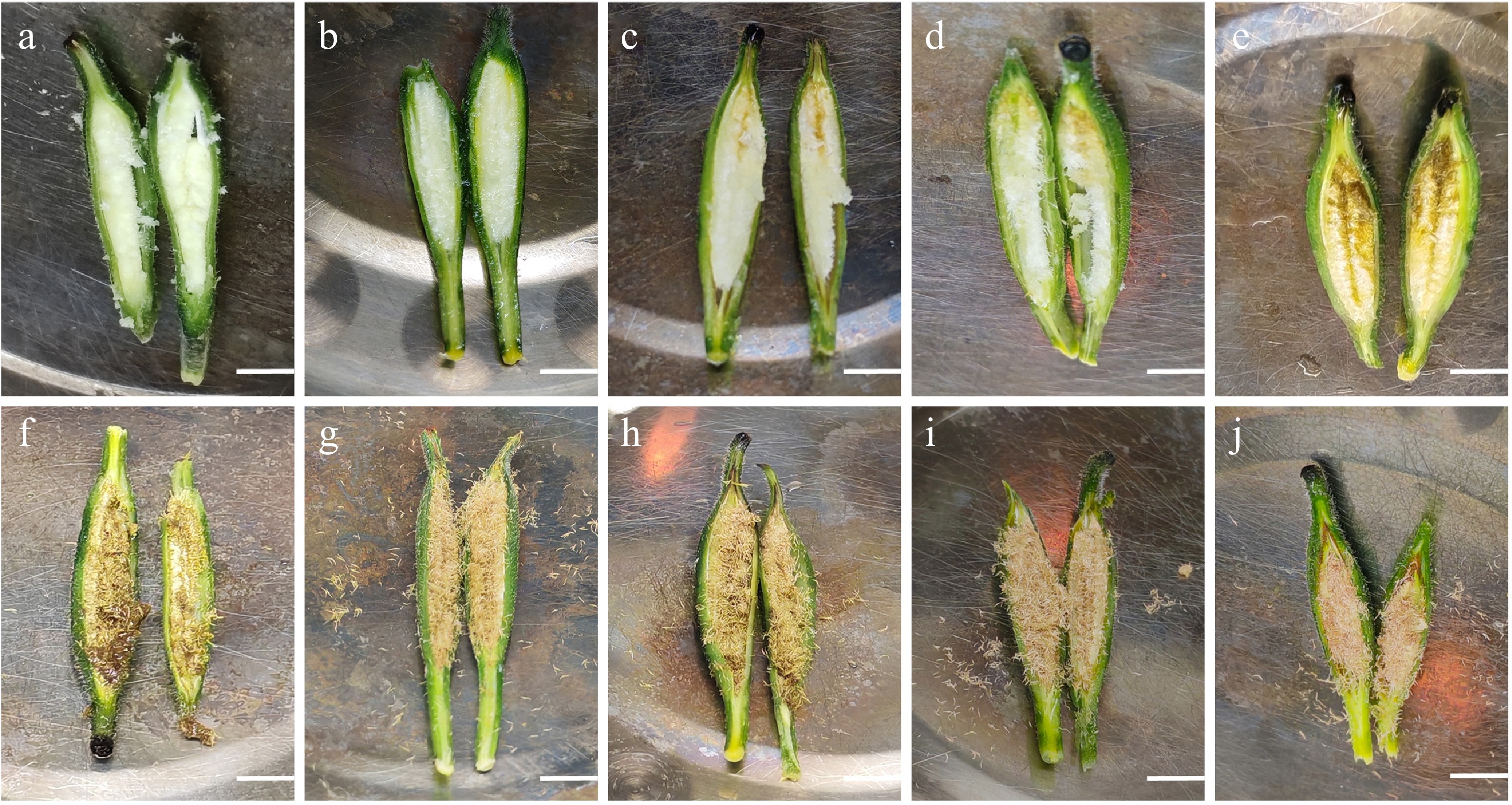
Figure 1.
Longitudinal sections of P. purpuratum capsules at different developmental stages (scale bars = 1 cm). (a) 140 DAP, (b) 170 DAP, (c) 200 DAP, (d) 210 DAP, (e) 220 DAP, (f) 230 DAP, (g) 240 DAP, (h) 250 DAP, (i) 260 DAP, and (j) 270 DAP.
-
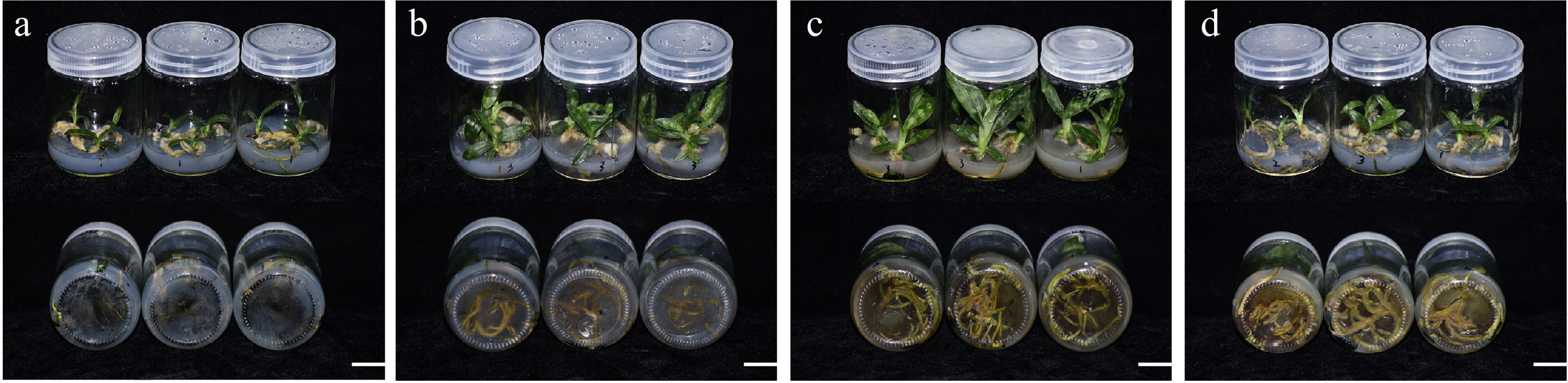
Figure 2.
Effects of different organic additives on robust seedling growth of P. purpuratum (scale bars = 2 cm). (a) CK, (b) potato, (c) banana, (d) coconut water.
-
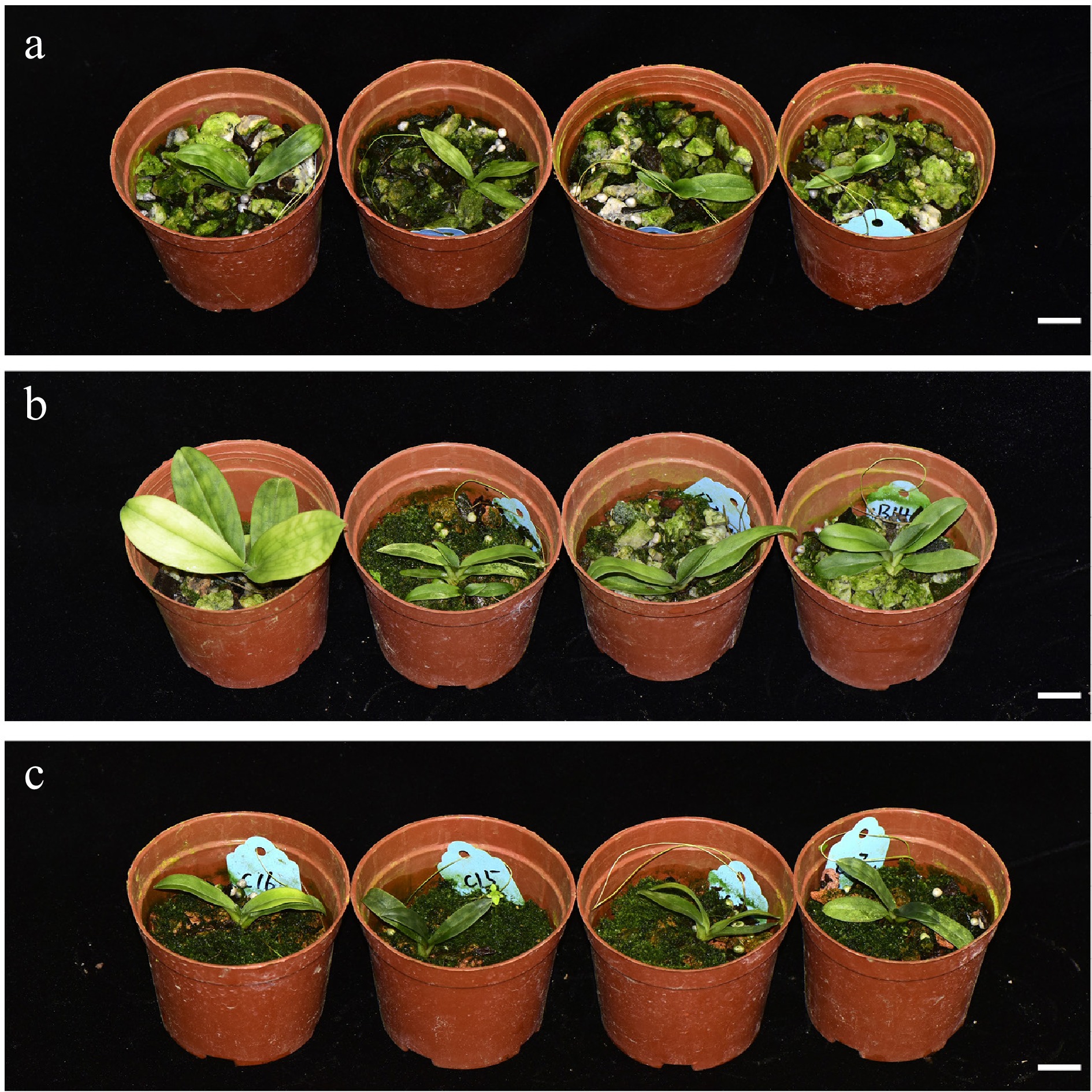
Figure 3.
Effects of different cultivation substrates on transplantation of P. purpuratum (scale bars = 2 cm), (a) bark: limestone (1:1), (b) in-situ substrate: limestone (1:1), (c) bark: volcanic rock (1:1).
-
Cultivation substrate Characteristics Bark The fermented pine bark, with a particle size of 3−6 mm. In-situ substrate The substrate collected from natural P. purpuratum populations in Zhongshan city, Guangdong Province, China,
primarily consists of humus and decomposed plant litter.Limestone With a particle size of 3−6 mm. Volcanic rock Particle size 3−6 mm, featuring a rough surface with honeycomb-like porosity. Table 1.
Characteristics of cultivation substrates.
-
DAP Germination
rate (%)Mortality
rate (%)Germination initiation
time (d)140 0d − − 170 65.77 ± 3.31ab 68.39 ± 4.01a 52 200 42.64 ± 3.68c 47.71 ± 8.72b 51 210 40.90 ± 3.37c 33.93 ± 2.46c 52 220 48.27 ± 14.03bc 42.00 ± 1.45bc 53 230 80.58 ± 9.17a 0d 52 240 45.28 ± 5.61c 0d 52 250 42.25 ± 5.82c 0d 51 260 0d − − The data are mean ± standard deviation, and different letters after the same column of numbers indicate significant differences between different treatments (p < 0.05). '−' indicates no statistically available data. Table 2.
Effects of capsule maturity on germination rate in P. purpuratum.
-
Treatment Crown width increment
(cm)Root proliferation number Total root
elongation
(cm)CK 1.99 ± 0.21c 3.29 ± 0.27b 16.52 ± 1.76b Potato 3.91 ± 0.21b 3.61 ± 0.41ab 20.76 ± 1.73b Banana 4.53 ± 0.21a 4.78 ± 0.51a 31.85 ± 3.22a Coconut water 3.62 ± 0.18b 3.65 ± 0.33ab 27.52 ± 1.72a The data are mean ± standard deviation, and different letters after the same column of numbers indicate significant differences between different treatments (p < 0.05). Table 3.
Effects of different organic additives on the robust seedling growth of P. purpuratum.
-
Physiological
parametersCK Potato Banana Coconut water Chlorophyll a content (mg/g.FW) 0.09 ± 0.02ab 0.13 ± 0.02a 0.10 ± 0.01ab 0.08 ± 0.01b Chlorophyll b content (mg/g.FW) 0.20 ± 0.05ab 0.26 ± 0.04a 0.19 ± 0.02ab 0.15 ± 0.02b Total chlorophyll content (mg/g.FW) 0.29 ± 0.07ab 0.39 ± 0.06a 0.29 ± 0.03ab 0.23 ± 0.03b Root activity
[mg TTF/(g.h)]0.03 ± 0.01a 0.03 ± 0a 0.04 ± 0a 0.03 ± 0a Total soluble sugar content
(mg/g)64.37 ± 5.23b 89.44 ± 3.47a 26.30 ± 2.61b 59.21 ± 5.39c The data are mean ± standard deviation, and different letters after the same line of numbers indicate significant differences between different treatments (p < 0.05). Table 4.
Effects of different organic additives on physiological characteristics of P. purpuratum.
-
Growth parameters Treatment (µM·M−2·S−1) t p 66.13 4.67 Crown width increment
(cm)3.91 ± 0.21 3.15 ± 0.19 2.652 0.012* Root proliferation count 3.61 ± 0.41 3.12 ± 0.51 0.759 0.453 Total root growth increment 20.76 ± 1.73 27.02 ± 1.082 −2.492 0.018* The data are mean ± standard deviation, and * indicates significant differences between the two treatments (* p < 0.05). Table 5.
Effects of different light intensities on robust seedling growth of P. purpuratum.
-
Physiological parameters Treatment (µM·M−2·S−1) t p 66.13 (n = 18) 4.67 (n = 17) Chlorophyll a content
(mg/g.FW)0.13 ± 0.08 0.14 ± 0.05 −0.217 0.829 Chlorophyll b content
(mg/g.FW)0.26 ± 0.16 0.27 ± 0.11 −0.211 0.834 Total chlorophyll content
(mg/g.FW)0.39 ± 0.24 0.41 ± 0.16 −0.213 0.832 Root activity
[mg TTF/(g.h)]0.03 ± 0.02 0.02 ± 0.01 0.331 0.743 Total soluble sugar content
(mg/g)89.44 ± 14.73 82.94 ± 21.06 1.063 0.295 The data are mean ± standard deviation, and * indicates significant differences between the two treatments (* p < 0.05). Table 6.
Effects of different light intensities on physiological indices of P. purpuratum.
-
Substrate Survival rate
(%)Crown width
(cm)Soluble sugar
content (mg/g)Chlorophyll a content
(mg/g.FW)Chlorophyll b content
(mg/g.FW)Total chlorophyll
content (mg/g.FW)Bark: limestone 36.11 ± 2.41c 2.72 ± 0.69a 69.90 ± 11.33a 0.10 ± 0.02a 0.21 ± 0.03a 0.31 ± 0.05a In-situ substrate: limestone 75.93 ± 1.60a 2.86 ± 0.42a 68.57 ± 8.63a 0.19 ± 0.04a 0.39 ± 0.07a 0.58 ± 0.11a Bark: volcanic rock 63.89 ± 2.41b 3.04 ± 0.40a 45.57 ± 6.20a 0.10 ± 0.02a 0.20 ± 0.04a 0.30 ± 0.06a The data are mean ± standard deviation, and different letters after the same line of numbers indicate significant differences between different treatments (p < 0.05). Table 7.
Effects of different cultivation substrates on the growth of P. purpuratum.
Figures
(3)
Tables
(7)