-
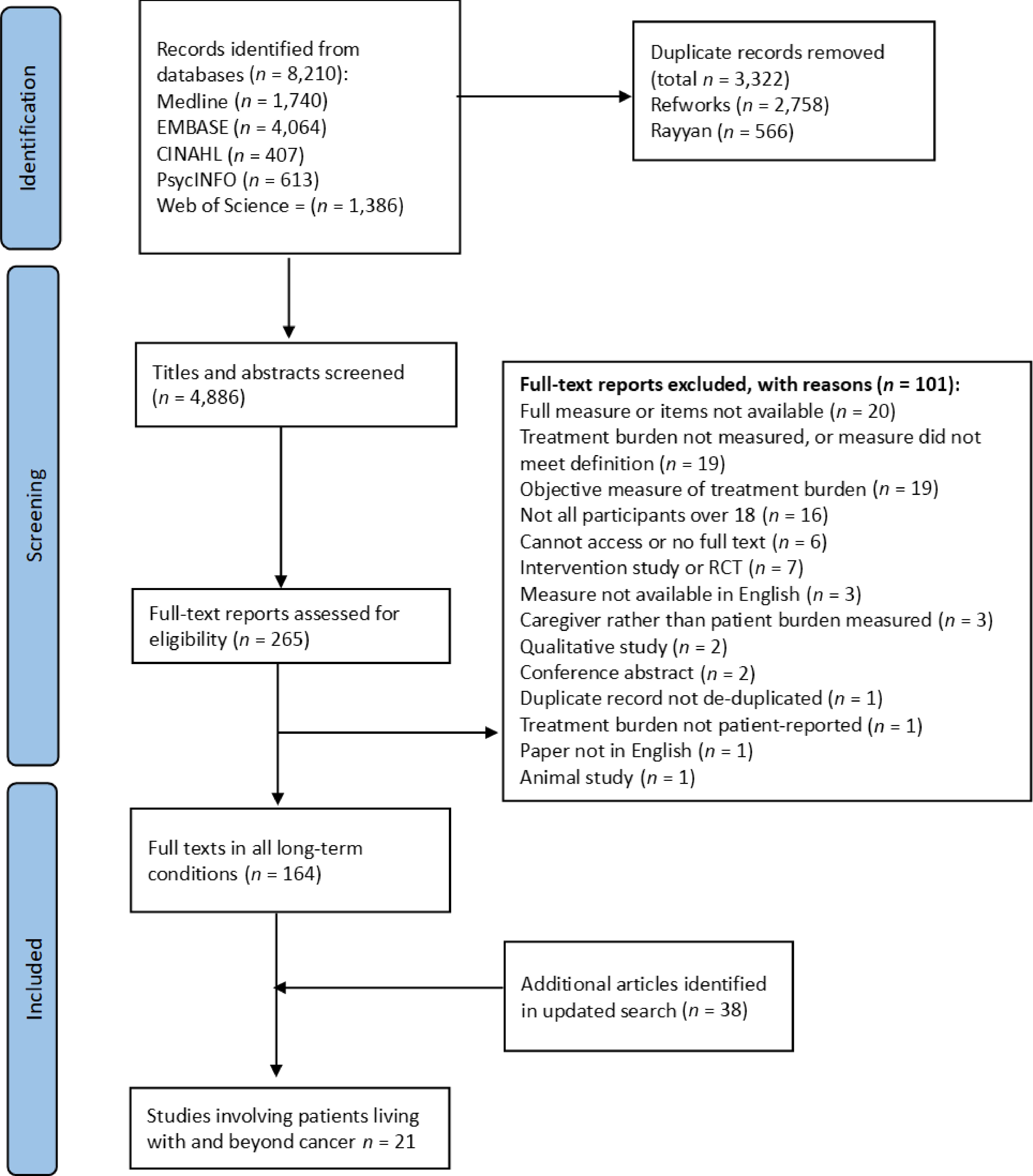
Figure 1.
PRISMA flow diagram of the study inclusion process.
-
Inclusion criteria Exclusion criteria Studies in people living with and beyond cancer Qualitative research, literature reviews, unpublished work, grey literature or work not published in peer-reviewed journal, conference abstracts, randomised controlled trials (RCTs) or studies where treatment burden is measured as a primary or secondary outcome of an intervention. Published from 2000 to current in English Studies in which a measure of treatment burden is described but the items included in the measure are not reported or available. Any geographical location Studies that measure the burden on caregivers, healthcare professionals, health services and systems, or economic burden, where patient treatment burden is not reported separately. Studies that describe the use, development, or validation (including assessing the psychometric/measurement properties) of a patient-reported subjective measure of treatment burden (i.e., not simple counts of pills, medications, costs, or clinician-assessed treatment burden). Full measures, subscales, and single items which met the definition of treatment burden – 'the workload of healthcare and the impact on functioning and wellbeing'[29] – were included, as well as measures that assess only one dimension of treatment burden if this definition is met. Studies where a measure of treatment burden is not used, developed, or validated. Participants are individuals over 18 years of age. Studies that only examine illness burden, symptom burden, or other health/medical burdens where treatment burden is not reported separately. Quantitative research or mixed-methods studies that have a distinct quantitative component Table 1.
Inclusion and exclusion criteria.
-
Categorisation Description Example Direct PROMs PROMs/studies that explicitly mention and comprehensively measure treatment burden The Patient Experience with Treatment and Self-Management (PETS) questionnaire which explicitly mentions treatment burden and assesses all six domains Inferred PROMs PROMs/studies that mention 'treatment burden' but only measure one or two domains/dimensions The European Organisation for Research and Treatment of Cancer quality of life questionnaire elderly cancer patients module (EORTC-QLQ-ELD14), which includes a two-item illness/treatment burden subscale Indirect PROMs PROMs/studies that do not mention 'treatment burden'
(or a domain of treatment burden) explicitly but measure one or two dimensionsThe Treatment Satisfaction with Medication Questionnaire (TSQM) which includes a three-item 'convenience' subscale Table 2.
Categorisation of PROMs according to Sav et al.[10].
-
First author Patient-reported outcome
measure (PROM)Domains of treatment burden Financial Medication Administrative Lifestyle Healthcare Time/travel Other Other domains Aghdam[35] EORTC-QLQ-ELD14 ✓ Anderson[36] PETS (subscales) ✓ ✓ ✓ ✓ Emotional impact Bath[47] PETS ✓ ✓ ✓ ✓ ✓ ✓ ✓ Emotional impact Beeler[37] Two bespoke financial burden items and COST ✓ Eton[46] PETS (subscales) ✓ ✓ Emotional impact Garg[48] TBQ ✓ ✓ ✓ ✓ ✓ ✓ Greenup[42] Bespoke ✓ Haider[40] MEPS-Household Component ✓ ✓ Husebø[34] PETS ✓ ✓ ✓ ✓ ✓ ✓ ✓ Learning about treatment
Emotional impact
Side-effectsHusebø[33] PETS ✓ ✓ ✓ ✓ ✓ ✓ ✓ Learning about treatment
Emotional impact
Side-effectsKarimzadeh[52] EORTC-QLQC30 ✓ ✓ Kircher[49] COST ✓ Kent[39] Bespoke ✓ Myers[50] Bespoke ✓ ✓ Philp[45] EORTC-QLQC30 and EORTC-OV28 ✓ ✓ Rifkin[44] Convenience subscale of TSQM-9 ✓ Saoud[43] EORTC-QLQC30 ✓ ✓ Smedsland[51] EORTC-QLQC30 ✓ ✓ Stone[38] Bespoke ✓ Xiao[53] TBQ and COST ✓ ✓ ✓ ✓ ✓ ✓ Yucel[41] SEQ-G-CSF ✓ ✓ ✓ ✓ ✓ Total papers 21 16 8 7 15 6 6 5 Learning about treatment
Emotional impact
Side-effectsEORTC-QLQ-ELD14, European Organisation for Research and Treatment of Cancer quality of life questionnaire elderly cancer patients module; PETS, Patient Experience with Treatment and Self-Management; COST, COmprehensive Score for financial Toxicity; TBQ, the Treatment Burden Questionnaire; TSQM-9, the Treatment Satisfaction Questionnaire for Medication-9; SEQ-G-CSF, the Satisfaction and Experience Questionnaire for Granulocyte Colony-Stimulating Factor; MEPS-Household Component, Medical Expenditure Panel Survey - Household Component; EORTC-QLQC30, European Organisation for Research and Treatment of Cancer Quality of Life Questionnaire Core; EORTC-OV28, European Organisation for Research and Treatment of Cancer Quality of Life Questionnaire Ovarian Cancer Module. Table 3.
The domains of treatment burden assessed in each study and PROM according to Sav et al.'s[10] framework of treatment burden.
Figures
(1)
Tables
(3)