-
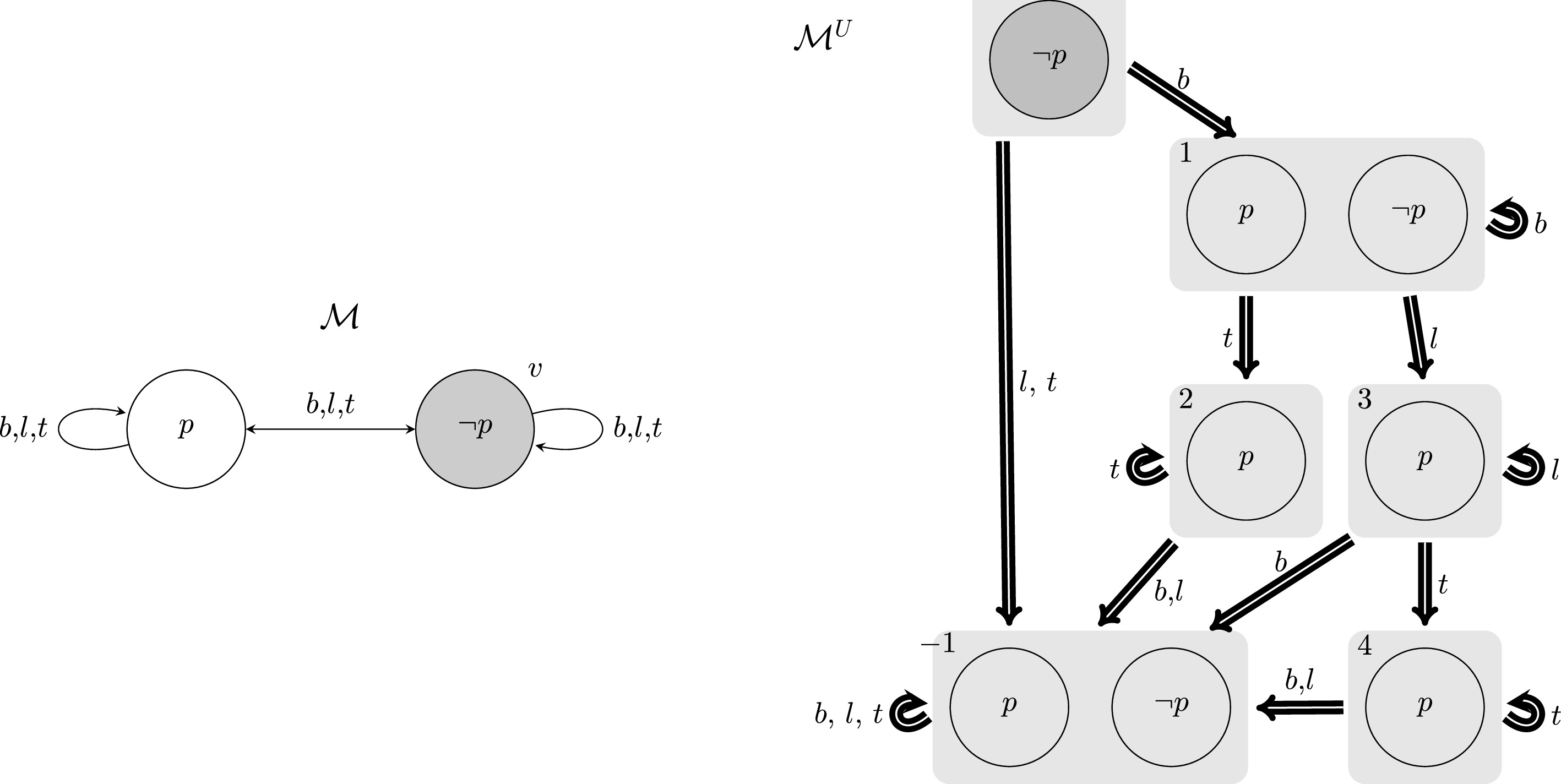
Figure 1.
Left: Initial pointed Kripke model
$ {\cal{M}} $ $ {\cal{M}}^U $ $ v $ $ \varphi $ $ \varphi $ $ n $ $ n $ $ n $ $ m $ $ n $ $ m $ -

Figure 2.
Left: Initial (pointed) Kripke model
$ {\cal{M}} $ $ a $ $ b $ $ p $ $ \lnot p $ $ {\cal{U}} $ $ p $ $ a $ $ a $ $ p $ $ b $ $ \varphi $ $ \beta $ $ \text{pre}(\beta) = \varphi $ -
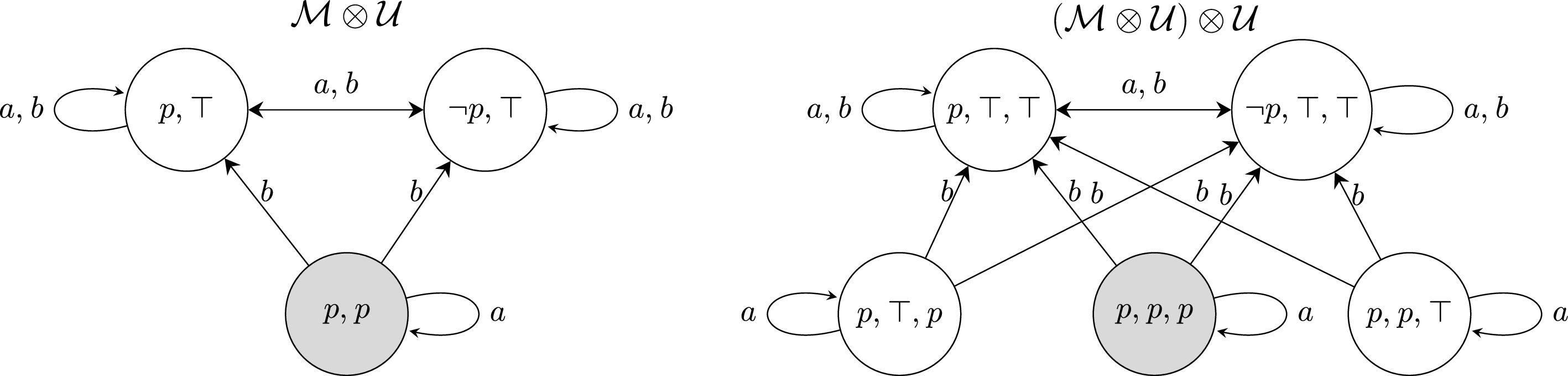
Figure 3.
Left: First product update
$ {\cal{M}} \otimes {\cal{U}} $ $ {\cal{M}} $ $ {\cal{U}} $ $ ({\cal{M}} \otimes {\cal{U}}) \otimes {\cal{U}} $ $ {\cal{U}} $ $ p $ $ p $ $ \lnot p $ -
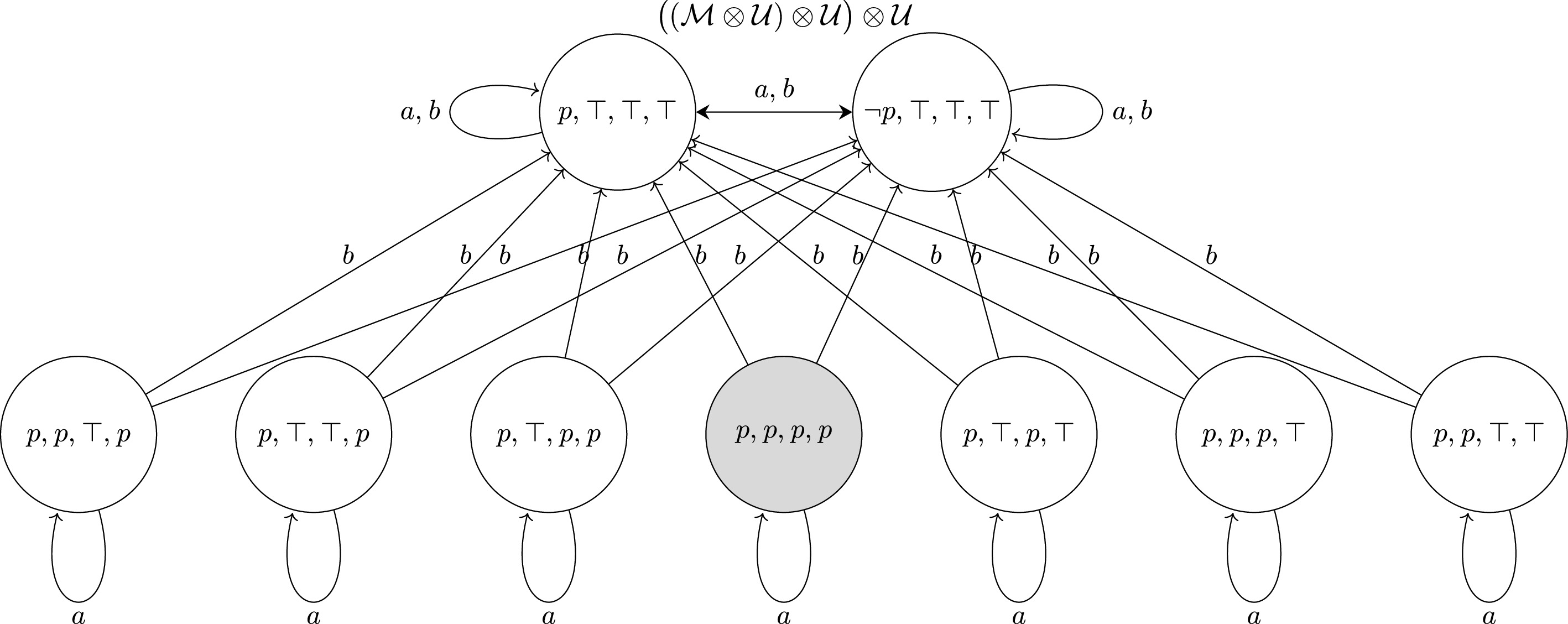
Figure 4.
Third product update
$ \bigl(({\cal{M}} \otimes {\cal{U}})\otimes {\cal{U}}\bigr)\otimes {\cal{U}} $ $ {\cal{U}} $ -
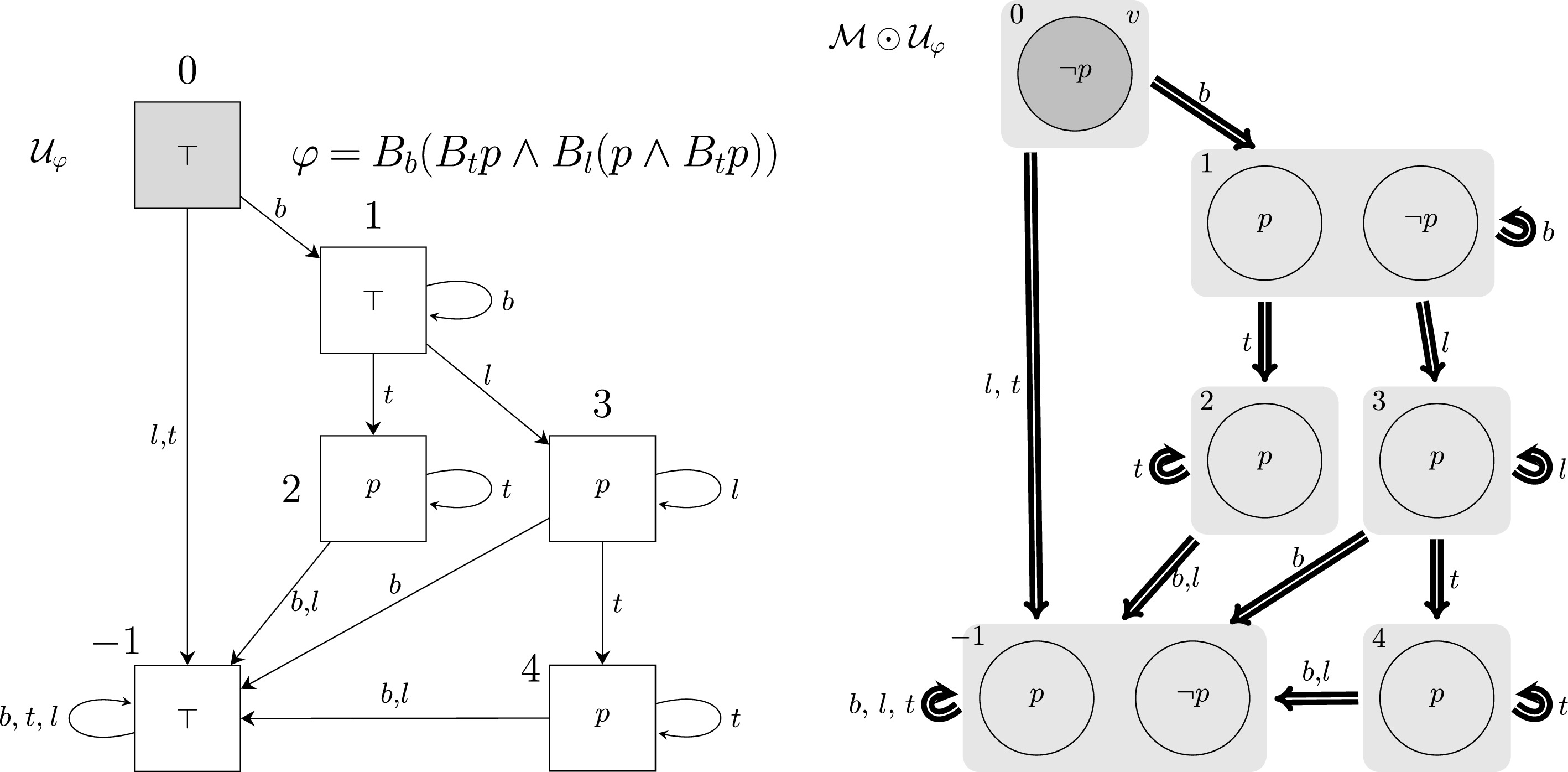
Figure 5.
Successful update synthesis
$ {\cal{M}}\odot {\cal{U}}_\varphi, (v,0) \vDash \varphi $ $ ({\cal{U}}_ \varphi,0) $ $ ({\cal{M}},v) $ -
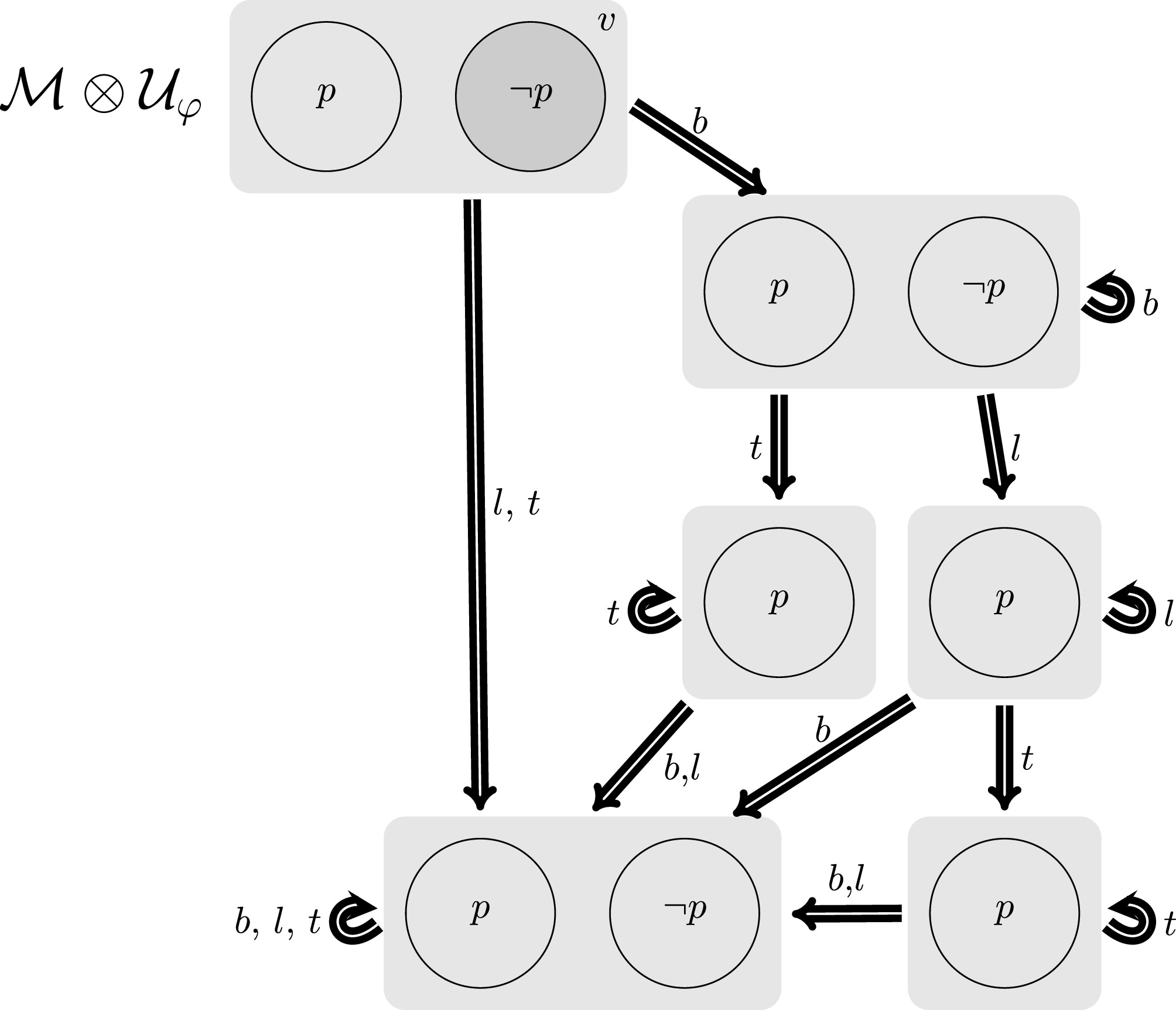
Figure 6.
Balder-Loki-Thor updated model using product updates
$ {\cal{M}} \otimes {\cal{U}}_\varphi $ -
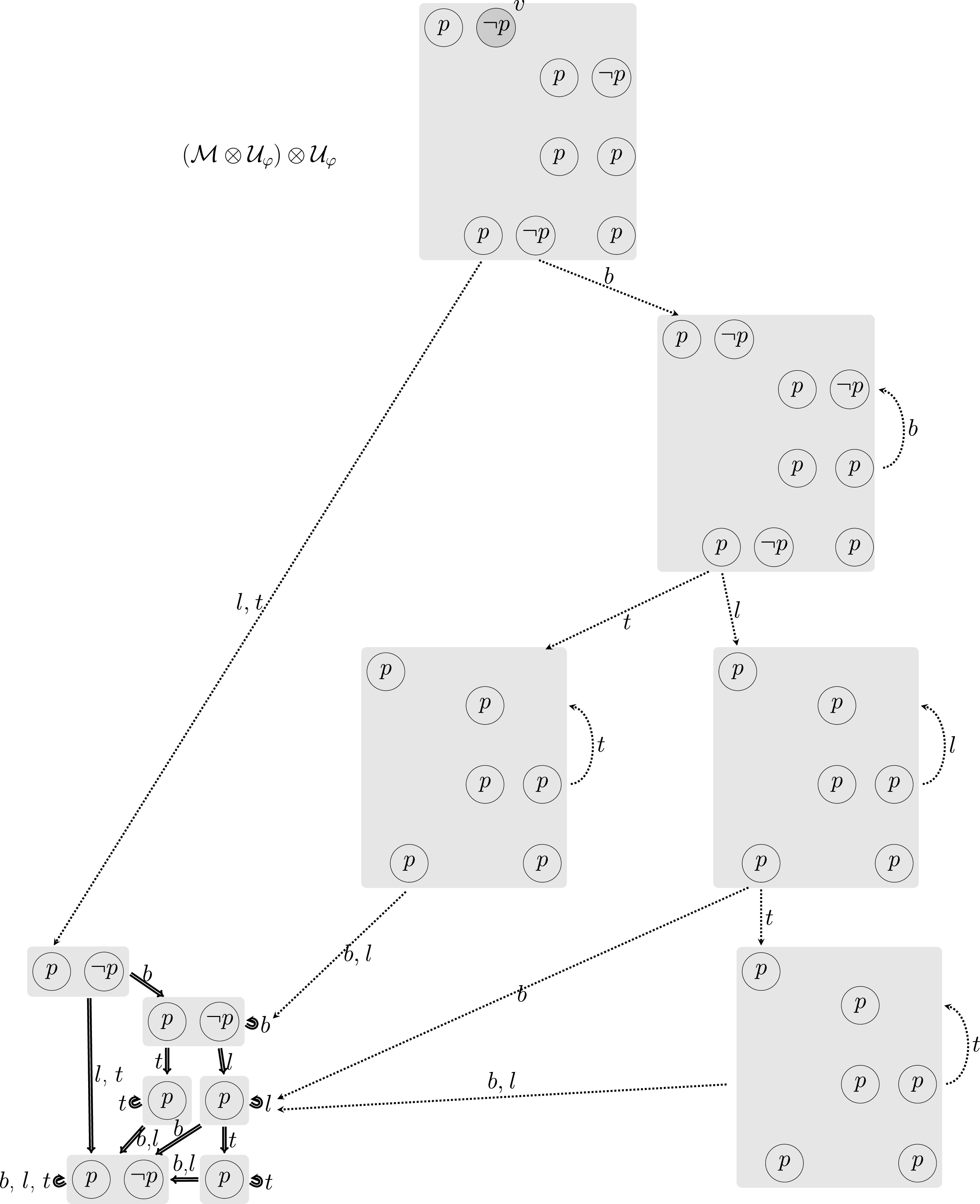
Figure 7.
Sketch of the result of the iterated product update operation
$ ({\cal{M}} \otimes {\cal{U}}_\varphi) \otimes {\cal{U}}_\varphi $ -
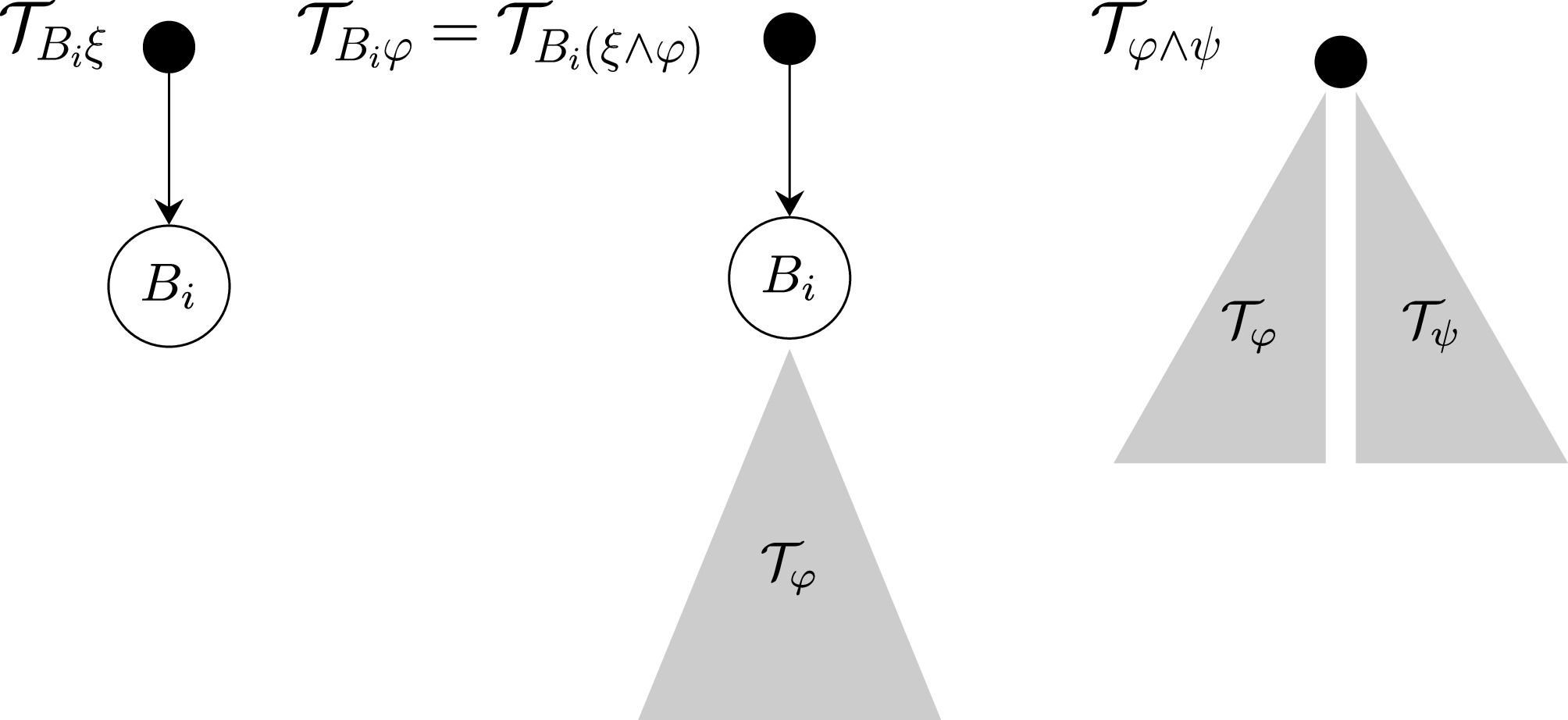
Figure 8.
Modal syntactic trees.
-
// initially add the model’s point 1: $ E^\varphi := \{0\} $ 2: for all $ i \in {\cal{A}} $ 3: $ Q^\varphi_{i} := \varnothing $ 4: $ pre(0) := \top $ 5: $ {\text{CreateActionModel (}} \varphi $ $ \langle E^\varphi, R^\varphi, pre^\varphi \rangle $ $ {\text{0)}} $ 6: $ {\text{AddSink}} (\langle E^\varphi, Q^\varphi, pre^\varphi \rangle)$ 7: return $ (\langle E^\varphi, Q^\varphi, pre^\varphi\rangle, 0) $ Table 1.
$ {\text{SynthesizeActionModel}} (\varphi) $ -
// $\langle E^\varphi, Q^\varphi, pre^\varphi\rangle$ 1: if $ \varphi = B_i \xi $ $ \xi $ 2: $ u':=\text{ComputeAccState}(\langle E^{\varphi},Q^{\varphi},pre^{\varphi}\rangle, u,i) $ 3: $ pre^\varphi(u') := \xi $ 4: else if $ \varphi = B_i \varphi' $ 5: $ u' := { \text{ComputeAccState}}(\langle E^\varphi, Q^\varphi, pre^\varphi\rangle, u, i) $ 6: $ { \text{CreateActionModel}}(\varphi', \langle E^\varphi, Q^\varphi, pre^\varphi\rangle, u') $ 7: else if $ \varphi = B_i (\xi \wedge \varphi') $ 8: $ u':=\text{ComputeAccState}(\langle E^{\varphi},Q^{\varphi},pre^{\varphi}\rangle, u,i) $ 9: $ \text{CreateActionModel}(\varphi', \langle E^\varphi, Q^\varphi, pre^\varphi\rangle, u') $ 10: $ pre^\varphi(u') := \xi $ 11: else if $ \varphi = \varphi_1 \wedge \varphi_2 $ 12: $ { \text{CreateActionModel}}(\varphi_1, \langle E^\varphi, Q^\varphi, pre^\varphi\rangle, u) $ 13: $ { \text{CreateActionModel}}(\varphi_2, \langle E^\varphi, Q^\varphi, pre^\varphi\rangle, u) $ Table 2.
$ {\text{CreateActionModel}} (\varphi, \langle E^\varphi, Q^\varphi, pre^\varphi\rangle, u) $ -
// $\langle E^\varphi, Q^\varphi, pre^\varphi\rangle$ 1: create new state $ u' $ $ u' \ne 0 $ $ u' \ne -1 $ $ \text{pre}^\varphi(u') = \top $ 2: $ E^\varphi := E^\varphi \cup \{u'\} $ 3: $ Q^\varphi_i := Q^\varphi_i \cup \{(u, u'), (u', u')\} $ 4: return $ u' $ Table 3.
$ \text{ComputeAccState}(\left\langle E^{\varphi},Q^{\varphi},pre^{\varphi}\right\rangle, u,i) $ -
1: create state $ -1 $ $ pre^\varphi(-1) = \top $ 2: $ E^\varphi := E^\varphi \cup \{-1\} $ 3: for all $ i \in {\cal{A}} $ 4: $ Q^\varphi_i := Q^\varphi_i \cup \{(-1, -1)\} $ 5: for all $ s \in E^\varphi $ 6: for all $ i \in {\cal{A}} $ 7: if $ (\forall s' \in E^\varphi)\ (s, s') \not\in Q^\varphi_i $ 8: $ Q^\varphi_i := Q^\varphi_i \cup \{(s, -1)\} $ Table 4.
$ {\text{AddSink}} $ $ \langle E^\varphi, Q^\varphi, pre^\varphi \rangle $
Figures
(8)
Tables
(4)