-
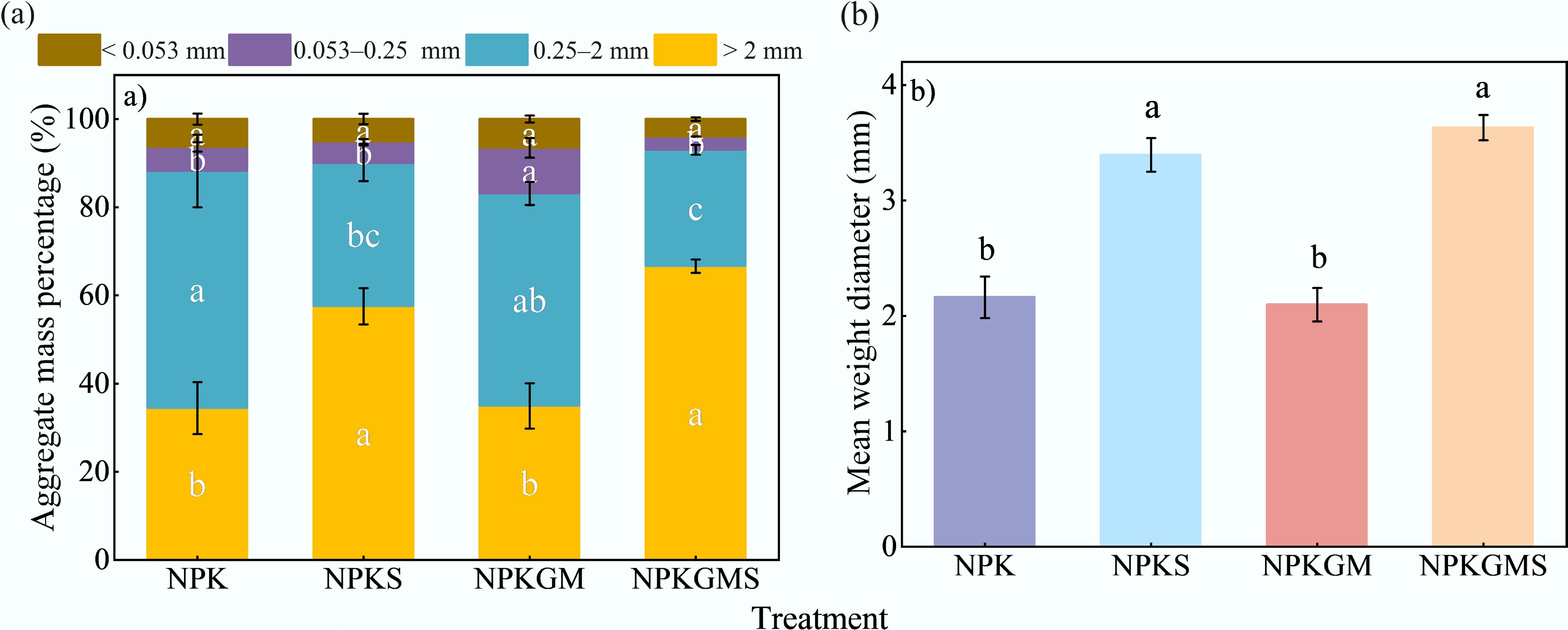
Figure 1.
(a) Mass percentage and (b) mean weight diameter of soil aggregates under different treatments. Different lowercase letters indicate significant differences among treatments at p < 0.05. Error bars represent the standard deviation (n = 3). NPK: NPK fertilization, winter fallow without straw return; NPKS: NPK fertilization, winter fallow with straw return; NPKGM: NPK fertilization, winter green manure (Chinese milk vetch) without straw return; and NPKGMS: NPK fertilization, winter green manure with straw return.
-
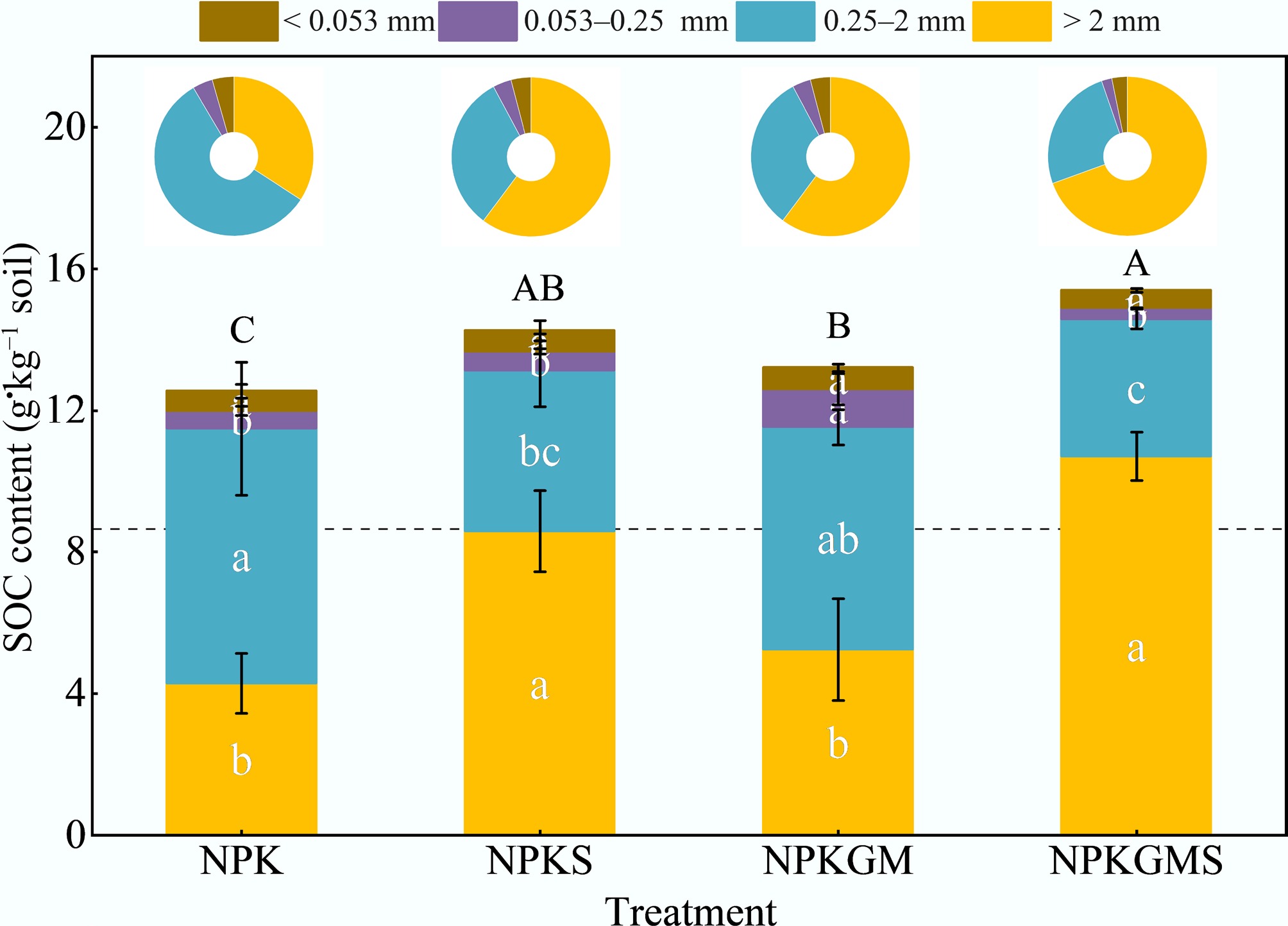
Figure 2.
Soil organic carbon content under different treatments. Stacked bars represent the organic carbon content in each aggregate fraction, with the total bar height representing the total soil organic carbon content. The inset pie charts show the proportional distribution of organic carbon across aggregate fractions. The dashed line indicates the organic carbon content before the experiment. Different lowercase letters within aggregate fractions and uppercase letters for total SOC indicate significant differences among treatments at p < 0.05. Error bars represent the standard deviation (n = 3). NPK: NPK fertilization, winter fallow without straw return; NPKS: NPK fertilization, winter fallow with straw return; NPKGM: NPK fertilization, winter green manure (Chinese milk vetch) without straw return; and NPKGMS: NPK fertilization, winter green manure with straw return.
-
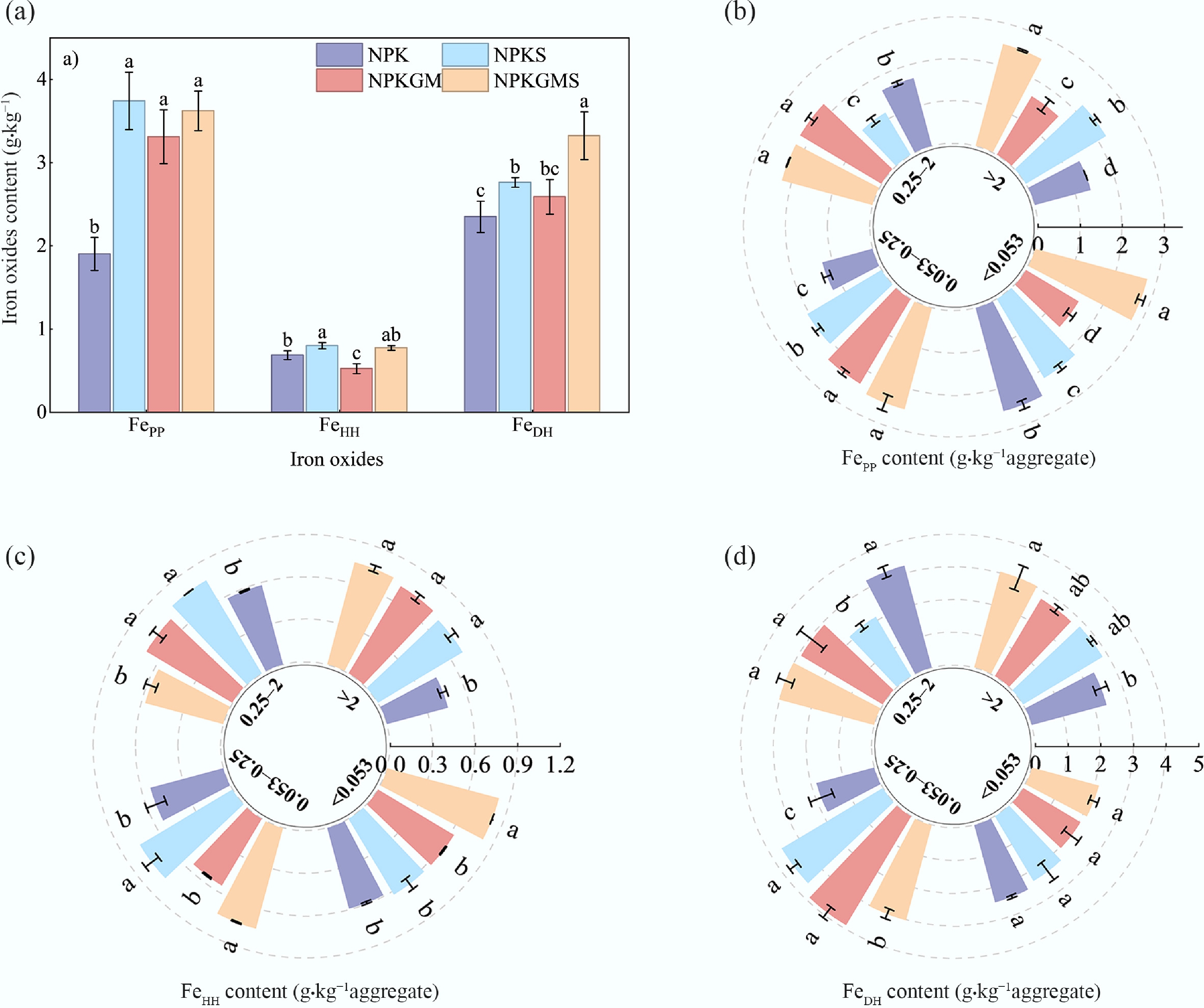
Figure 3.
The contents of iron oxides in (a) bulk soil and (b)–(d) soil aggregates under different treatments. Different lowercase letters indicate significant differences among treatments at p < 0.05. Error bars represent the standard deviation (n = 3). NPK: NPK fertilization, winter fallow without straw return; NPKS: NPK fertilization, winter fallow with straw return; NPKGM: NPK fertilization, winter green manure (Chinese milk vetch) without straw return; and NPKGMS: NPK fertilization, winter green manure with straw return. FePP: complexed iron oxides; FeHH: amorphous iron oxides; FeDH: crystalline iron oxides.
-
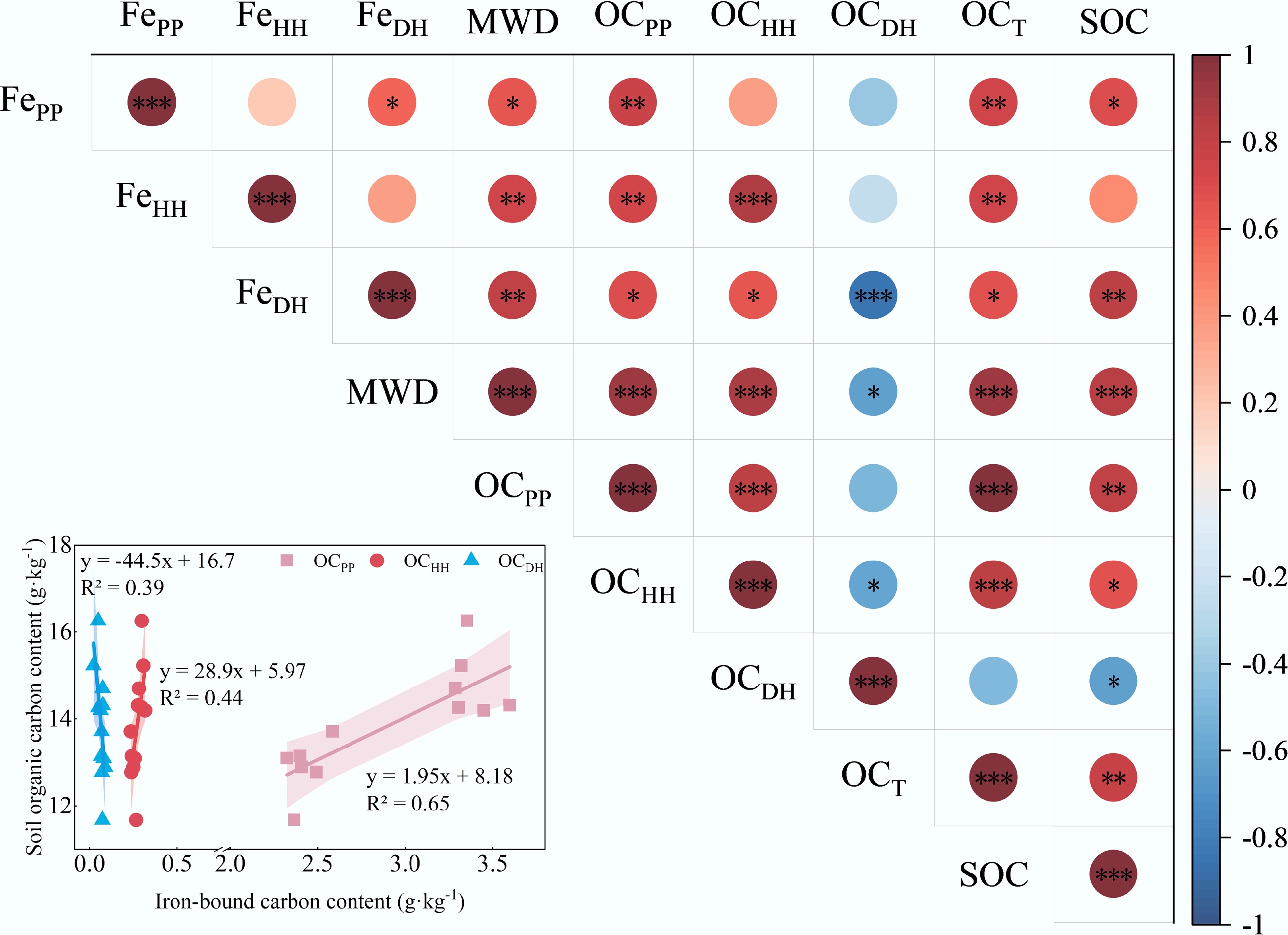
Figure 4.
Correlation analysis between different indicators and SOC, and linear correlation between iron-bound carbon content and SOC content. *** indicates p < 0.001, ** indicates p < 0.01, and * indicates p < 0.05 (n = 12).
-
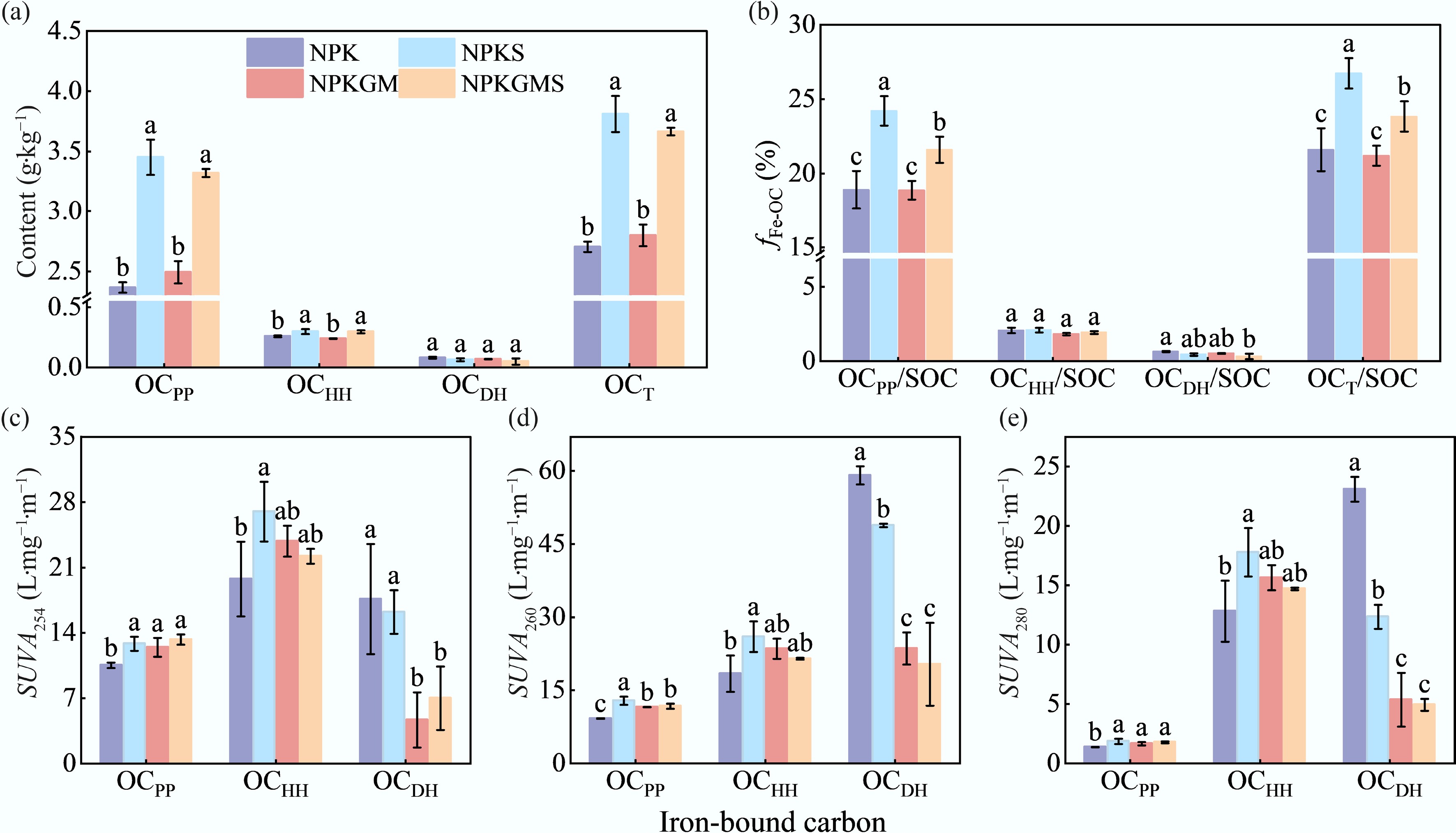
Figure 5.
(a) The iron-bound organic carbon content, (b) its ratios to total SOC, and the specific UV absorbance values of (c) SUVA254, (d) SUVA260, and (e) SUVA280 under different treatments. Different lowercase letters indicate significant differences among treatments at p < 0.05. Error bars represent the standard deviation (n = 3). NPK: NPK fertilization, winter fallow without straw return; NPKS: NPK fertilization, winter fallow with straw return; NPKGM: NPK fertilization, winter green manure (Chinese milk vetch) without straw return; and NPKGMS: NPK fertilization, winter green manure with straw return. OCPP: complexed iron-bound organic carbon; OCHH: amorphous iron-bound organic carbon; OCDH: crystalline iron-bound organic carbon; OCT: total iron-bound organic carbon; OCPP/SOC: complexed iron-bound organic carbon ratio; OCHH/SOC: amorphous iron-bound organic carbon ratio; OCDH/SOC: crystalline iron-bound organic carbon ratio; and OCT/SOC: total iron-bound organic carbon ratio. SUVA254: aromaticity; SUVA260: hydrophobicity; and SUVA280: high-molecular-weight compounds.
-
Iron oxide content (g·kg−1) Particle size
(mm)Aggregate mass
contentMWD FePP > 2 0.91** 0.95** 0.25–2 ns ns 0.053–0.25 ns ns < 0.053 ns ns FeHH > 2 ns ns 0.25–2 ns ns 0.053–0.25 ns 0.94** < 0.053 0.60* 0.71* FeDH > 2 ns ns 0.25–2 ns ns 0.053–0.25 ns ns < 0.053 ns ns Note: numbers indicate the Pearson correlation coefficient, ** indicates p < 0.01, * indicates p < 0.05, and ns indicates no statistical significance at the p < 0.05 level (n = 3). Table 1.
Correlation of iron oxides in soil aggregates and mass content and stability of aggregates
Figures
(5)
Tables
(1)