-
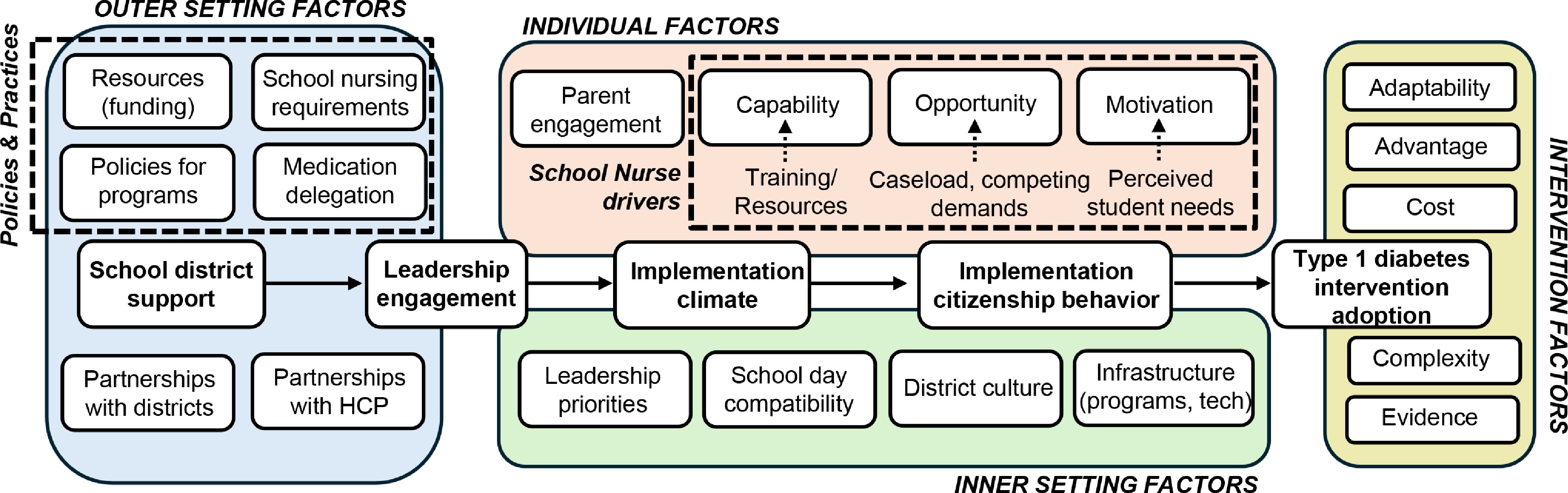
Figure 1.
Conceptual model of CFIR determinants of the implementation, which may influence the adoption of Type 1 diabetes interventions in schools. Determinants are categorized by CFIR domains: Outer setting (external to the school district), inner setting (school district), individuals involved, and the intervention's characteristics. These determinants are hypothesized to influence district support, leadership engagement, the climate for implementation, identification of implementation leads, and ultimately adoption. This conceptual model can guide pre- and post-implementation assessments for school-based diabetes interventions. Abbreviations: HCP, healthcare providers.
-
CFIR domain Definition for this study Sample interview questions Intervention SPACE or similar collaborative intervention How well do you think the collaborative care model (SPACE) would meet the needs of your students with type 1 diabetes? Individuals Participants involved in the intervention (e.g., school nurses, parents) Who are the decision-makers in establishing changes or new programs for your school's approach to diabetes management? Inner setting School district where SPACE would be implemented What factors help promote your school district's ability to embrace improvements in diabetes management? Outer setting Entities external to the district (e.g., neighboring school districts, local health systems, school nursing organizations, policies/regulations) How do local, state, or national policies or regulations play a role in adopting new interventions? Implementation processes Not assessed Not assessed Table 1.
CFIR domains applied to this study with sample interview questions.
-
Characteristic PA (n = 20), n (%) WV (n = 12), n (%) Highest degree Bachelor's degree 6 (30) 8 (67) Master's or Doctorate 14 (70) 4 (33) Years as a school nurse < 10 years 7 (35) 7 (58) ≥ 10 years 13 (65) 5 (42) Geographic setting Rural/town 5 (25) 9 (75) Suburban 13 (65) 2 (17) City/urban 2 (10) 1 (8) Number of schools covered 1 7 (35) 6 (50) 2 7 (35) 4 (33) > 2 6 (30) 2 (17) Grades covereda Elementary (K–5) 13 (62) 8 (38) Middle (6–8) 10 (62) 6 (38) High (9–12) 13 (81) 3 (19) Student caseload < 750 5 (25) 6 (50) 750–1,000 6 (30) 3 (25) 1,001–1,500 9 (45) 3 (25) Student caseload (students with diabetes in the past 5 years) < 5 5 (25) 3 (25) 5–10 8 (40) 7 (58) 11–15 4 (20) 0 (0) > 15 3 (15) 2 (17) a Nurses could select more than one grade distribution. Table 2.
Characteristics of interview participants and represented school districts.
-
CFIR Domain Theme (CFIR constructs/codes) Representative quotation(s) Intervention Theme 1: SPACE may be timesaving by proactively addressing concerns (innovation's relative advantage; innovation's cost) "We have these students in school for 12 years. If we can establish a really good program and a really good relationship, and really good expectations on what's going to happen with their care in school, a consistent message stays all the way through, then it alleviates a ton of stress, a ton of worry, a ton of concern, all from both the educators, the staff, the teachers, from our parents at home, and, ultimately, us." (PA Nurse 18, < 5 years, suburban region) "I think we need more communication between the nurses and the providers and parents. We all need to be on the same page. I like updates. If a student goes to a doctor for a visit, I would like to have an update on what they discussed. How are they doing? It's like, you don't hear any of that feedback. I feel, as a nurse trying to take care of these students, I need to know that feedback." (WV Nurse 8, < 5 years, rural region) Intervention Theme 2: Remaining hurdles: The intervention's complexity and evidence base (innovation's evidence base; innovation's complexity; innovation's adaptability) "Well, the cost of it, obviously, how much time it's going to take, how it's going to benefit my students, and how much time is it going to take up to implement and then keep running." (PA Nurse 8, 5–10 years, suburban region) Subtheme: Students who may benefit "If we introduce that care model, I really feel [it] would benefit the ones where we're struggling… the kids that are coming in the 300, 400s. I would say it would probably be more of our at-risk students that we would focus because we're already spending—the nurses are already spending a lot of time with these students." (WV Nurse 1, 5–10 years, rural region) Subtheme: Promoting adaptability "We just have to structure it around our time, when we're not busy with medications or diabetes care, that sort of thing, other treatments. It would be based on the building and the student, as to what the rest of the schedule looks like for the day." (PA Nurse 5, 11–20 years, suburban region) Outer setting Theme 3: Relationships between school districts can be influential (external pressure; partnerships and connections; critical incidents) "I definitely think that if another school district's doing something and it's working for them, and we see that—I think that that would be for sure something that our district would be on board with, with giving a try." (PA Nurse 1, 11–20 years, suburban region) Subtheme: These relationships may be less prominent in larger school districts. "I would say not so much what other counties or school districts near us. Probably we would want to know more like how other larger places [city] have done it because sometimes it's a little easier to look that way. We have a little bit of different structure in our county. Just because we have multiple people and we do have a supervisor. Some counties only have one or two nurses. They don't have a nursing supervisor. It's very different for them." (WV Nurse 11, 5–10 years, rural region) Outer setting Theme 4: Concerns about privacy limit interactions with the health care system. (policies and laws; partnerships and connections) "I think we could do a better job of outreach to their diabetes educators, though there's no smooth way to do that." (PA Nurse 16, >20 years, suburban region) Subtheme: Communication may be smoother with consistent points of contact. "We just call [the clinic nurse]. Pretty much she just tells us what we need to do to make sure we're all on the same page. She could even pull up the information from the student side. She works really well." (WV Nurse 10, 11–20 years, rural region) Inner setting Theme 5: Interventions must align with leadership priorities (mission alignment; compatibility; relational connections) "I just think if it was just presented in the right fashion and [I] explain the details of…how this was going to look and how it would benefit the students, then I think they would be very supportive and be there to help in any way necessary." (PA Nurse 9, >20 years, suburban region) "Usually, our coordinator of health services, whatever she wants, she gets. They place safety first for all of our kids at the level of superintendent and down. Usually they know that healthy children are the best kind of learners because they're feeling good enough to come to school, to pay attention in class, and that maintaining that level of health is important to their education." (WV Nurse 12, 11–20 years, urban) "It would be—this is in line with what IDEA [Individuals with Disabilities in Education Act] is trying to demand of us, that we are a team, and we're going to help this kid be safe and educated. At that point, you're just like, 'Listen, this is a special needs kid.' We actually have to just do the thing that it takes to do it right. End of story." (PA Nurse 12, 5–10 years, urban region) Inner setting Theme 6: The school district culture is generally supportive of diabetes interventions (culture; incentive systems) "Their diabetes isn't going away. How can we help them get through school? If there's any changes or any studies or anything like that. That can improve the health and education of our students. They're very willing to say, 'Okay, show me what ya got. What's out there? What's the new and greatest thing to help these students?'". (WV Nurse 1, 5–10 years, rural region) Subtheme: School staff may need more education about diabetes care. "I think when a student shows up on a teacher's caseload or another—cafeteria or recess, a non-nursing staff member's caseload that it is like you're starting from the very bottom of teaching them, unless, for some reason, they've had a recent interaction with a student with diabetes. At large, staff is not prepared at all, but nursing, in my opinion, has been." (PA Nurse 7, 5–10 years, suburban region) Inner setting Theme 7: Existing programs/infrastructure enhance feasibility (compatibility; structural characteristics; resources) "With Zoom anymore, we can build that in and have the student here and Zoom with the parents. I think it's pretty workable. It's almost like any more you can make anything work." (PA Nurse 17, > 20 years, rural region) "It's called Student Assistance Team and it's usually for kids who maybe don't have an IEP or a 504, but they're having some kind of issue, whether it's with attendance, whether it's with behavior, whether it's with a health problem that hasn't gotten to the point where it needs a 504 or maybe we're thinking that it could need a 504. We go that route and visit first, and try to establish something and then if we feel like it needs to go beyond that, then we go beyond it." (WV Nurse 3, > 20 years, rural region) Individuals Theme 8: School nurses are highly motivated yet face competing demands (capability; opportunity; motivation; implementation leads) "Even just the chronic health care, I really love the work that we do here with our kids with diabetes because I feel like we make a big difference in their lives and the lives of their families, and I love that we get to see them all the time and contribute to how their life will be in the future. That's why I wanted to be here. That's why I wanted to do what I do." (PA Nurse 2, 5–10 years, rural region) "There's often a lot—there are other things going on in schools besides diabetes management. That might be a struggle in some situations." (WV Nurse 6, 11–20 years, rural region) Individuals Theme 9: Parent engagement is variable within districts (implementation recipients; opinion leaders) "Some parents, they seem to be involved, but yet they're distant, I guess is—they come the first day of school, and then there's never any other good rapport, communication, even if email or try to call back and forth. I've watched this change over the years." (PA Nurse 17, > 20 years, rural region) "The parents that I have worked with, they want to be involved with the school health nurse. They want to make sure that the school health nurse is knowledgeable of all the orders. They want us to have access. We've never had a problem of saying, 'Do you mind if we have to call? We would, of course, let you know, but if we need to call and ask a question or fi—or need some record or something of a visit.' We've never had an issue. The parents are glad that we are paying attention to their children because sometimes a [student with diabetes] can walk around, and you wouldn't even know that anything was going on." (WV Nurse 2, <5 years, rural region) Table 3.
Themes organized by CFIR domain with representative quotations.
Figures
(1)
Tables
(3)