-
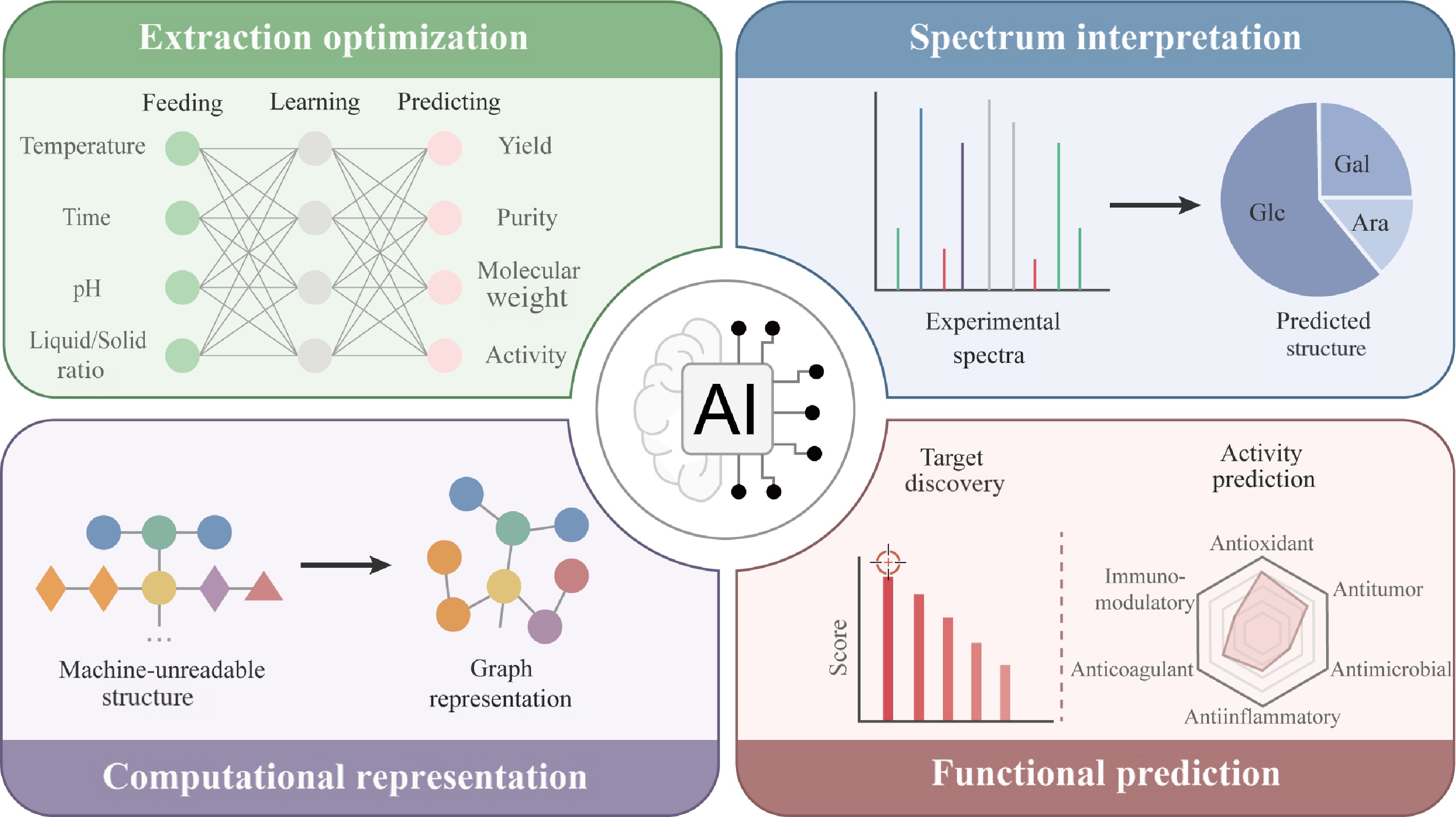
Figure 1.
AI powered stages in polysaccharide drug development. The diagram summarizes the integration of AI methodologies across the pipeline of polysaccharide-based drug discovery and development, highlighting how data-driven approaches accelerate each stage from raw material processing to bioactivity prediction.
-
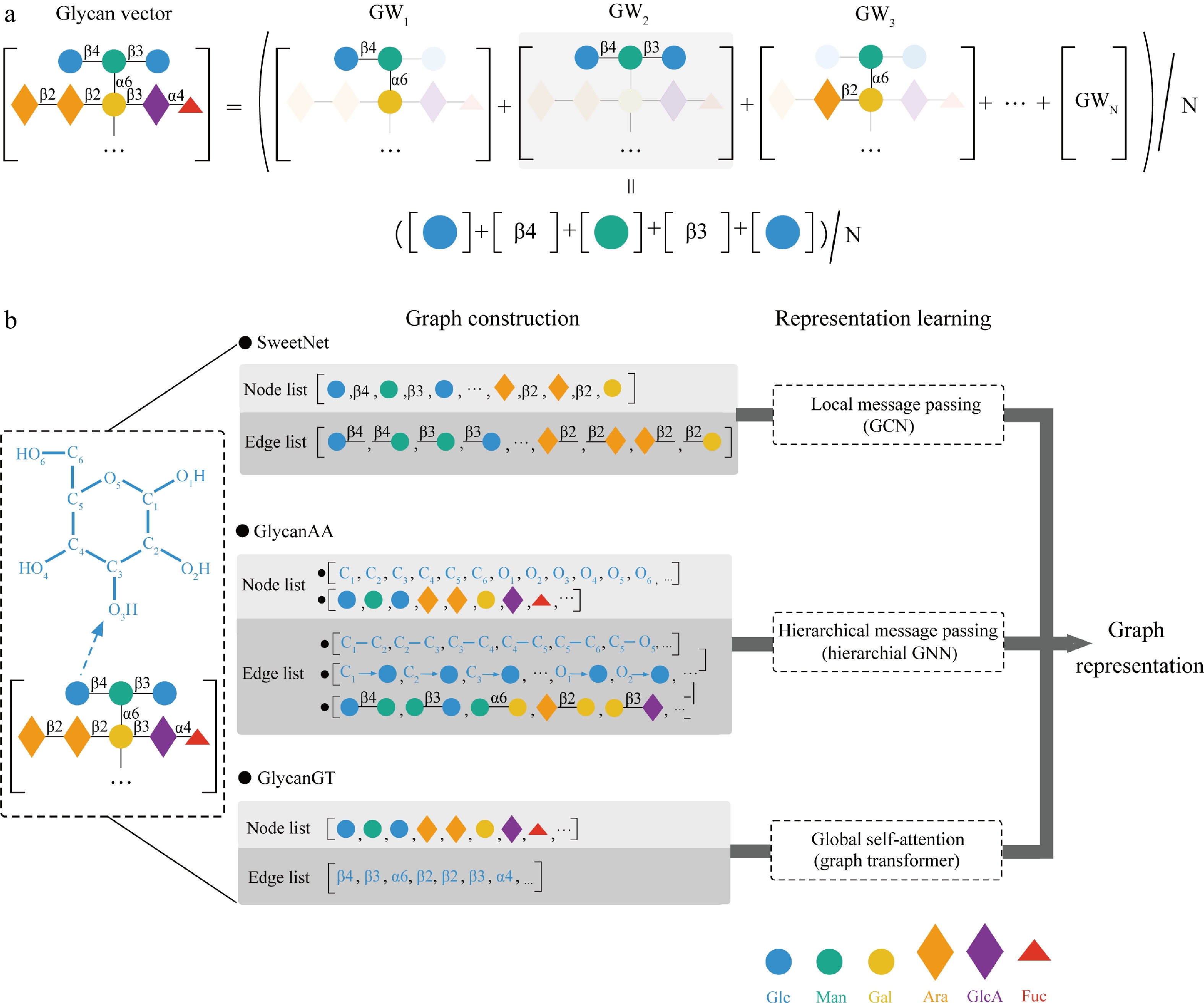
Figure 2.
Schematic illustration of glycan representation learning. (a) SweetTalk: a recurrent neural network (RNN)-based language model. GW: glycoword (three monosaccharides and two bonds). Glycans are featurized by extracting GWs, whose embeddings are obtained by averaging their constituent glycoletter embeddings. The corresponding embeddings for whole glycans are then constructed by averaging GW embeddings for downstream tasks. (b) SweetNet, GlycanAA, and GlycanGT: three graph-based glycan encoders with distinct node/edge definitions and information propagation strategies. SweetNet uses monosaccharides and linkages as nodes with connections between them as edges and performs local message passing via graph convolutional layers. GlycanAA constructs a heterogeneous graph with atom and monosaccharide nodes, connected by atom-atom, atom-monosaccharide, and monosaccharide-monosaccharide edges, enabling hierarchical message passing from the atomic to the monosaccharide level. GlycanGT treats monosaccharides and glycosidic bonds as tokens and captures global context through full self-attention.
-
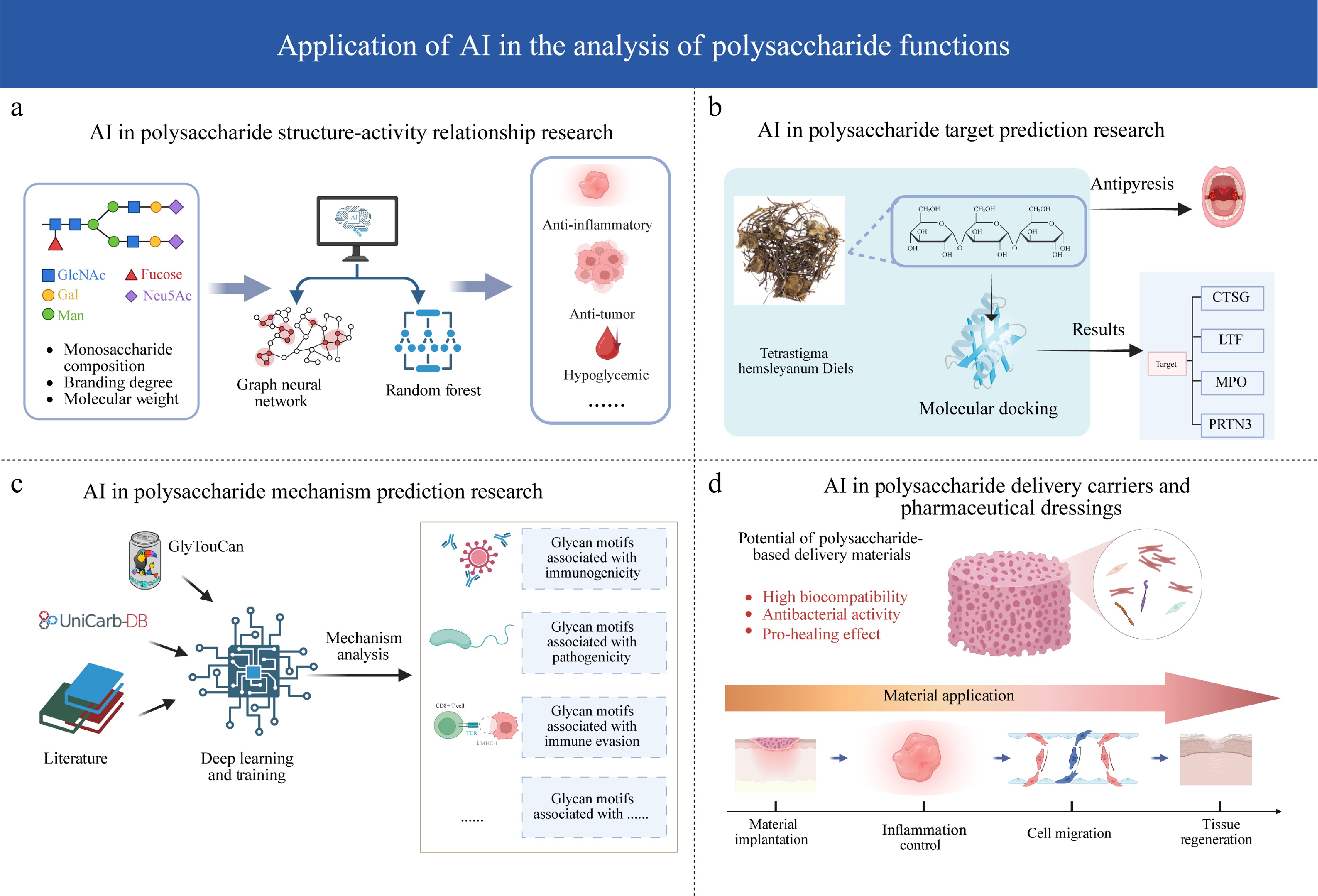
Figure 3.
Application of AI in the analysis of polysaccharide functions. (a) AI in polysaccharide structure–activity relationship research: structural features (composition, branching, molecular weight) are processed by machine learning models (graph neural networks, random forests) to predict biological activities (anti-inflammatory, anti-tumor, hypoglycemic). (b) AI in polysaccharide target prediction research: integration of chemical structures with molecular docking to identify protein targets (e.g., CTSG, LTF, MPO, PRTN3) linked to specific therapeutic results like antipyresis. (c) AI in polysaccharide mechanism prediction research: data from literature and databases (GlyTouCan, UniCarb-DB) are utilized via deep learning to predict functional mechanisms, identifying glycan motifs associated with immunogenicity, pathogenicity, and immune evasion. (d) AI in polysaccharide delivery carriers and pharmaceutical dressings: evaluation of polysaccharide-based biomaterials with key properties (biocompatibility, antibacterial, pro-healing) across consecutive stages of material application, from implantation to tissue regeneration.
-
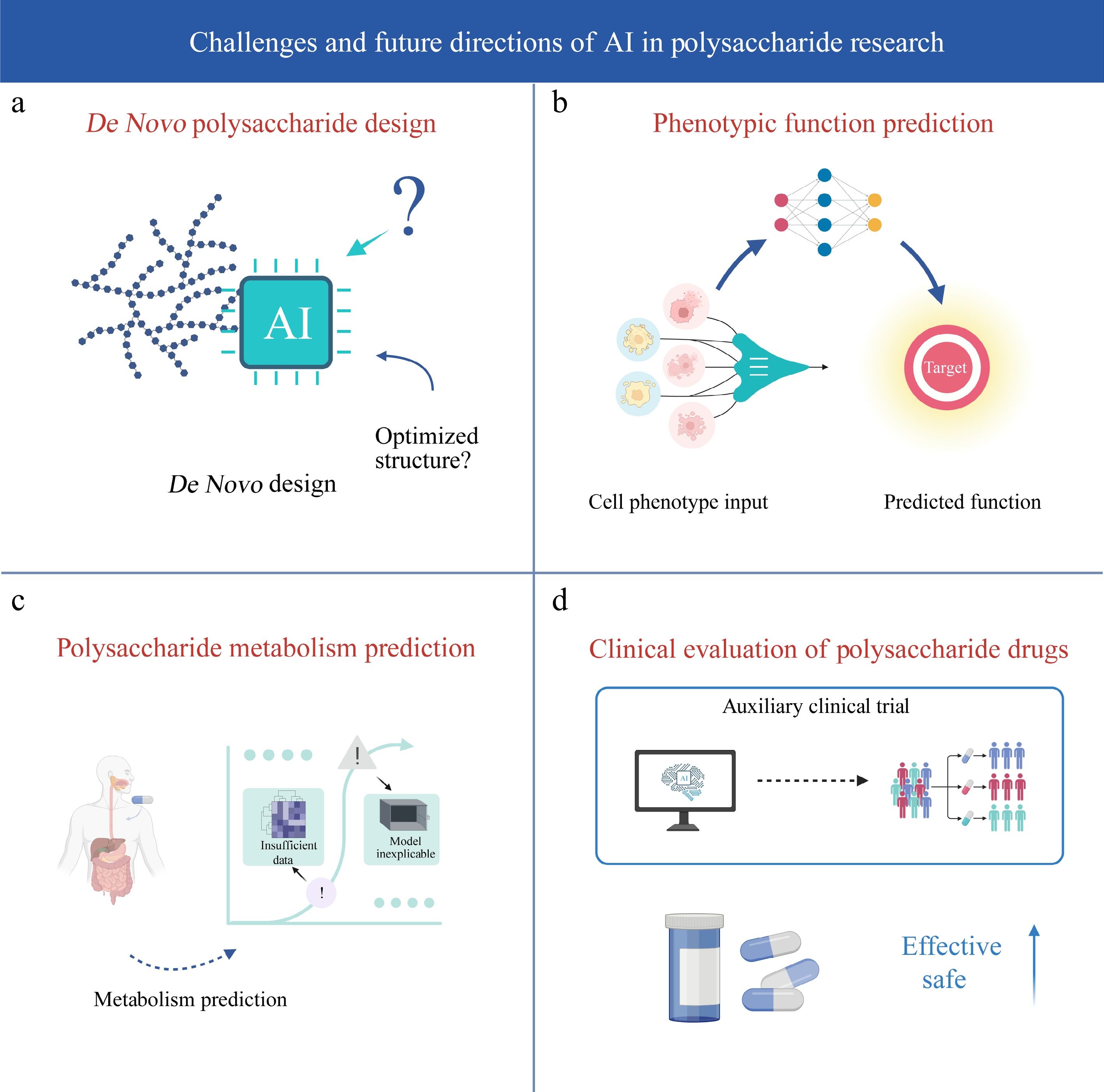
Figure 4.
Challenges and future directions of AI in polysaccharide research. (a) De novo polysaccharide design: Illustration of using AI to generate completely novel polysaccharide molecular structures, highlighting the challenge and goal of achieving an 'Optimized structure'. (b) Phenotypic function prediction: schematic of the workflow mapping Cell phenotype input' through an AI model to hit a specific 'Target', resulting in a 'Predicted function' for biological activity. (c) Polysaccharide metabolism prediction: representation of human metabolic tracking, highlighting current bottlenecks such as 'Insufficient data' and a 'Model inexplicable', (lack of interpretability) within the predictive pipeline. (d) Clinical evaluation of polysaccharide drugs: demonstration of AI acting as an 'Auxiliary clinical trial' tool to simulate patient group cohorts, aimed at ensuring 'Effective' and 'Safe' outcomes for polysaccharide-based therapeutics.
-
Category Generic name Source Indications Year Country Adjuvant therapy Lentinan Lentinus edodes mycelium/fruiting body Gastric cancer 1985 Japan Polysaccharide K Trametes versicolor (CM-101 strain) mycelium Gastric and colorectal cancer 1998 Japan Sizofiran Schizophyllum commune mycelium Cervical cancer 1986 Japan Poria cocos polysaccharide Poria cocos sclerotium/mycelium/fruiting body Cancers and Hepatitis B 2005 China Astragalus polysaccharide Astragalus membranaceus root Leukopenia/cancer-related fatigue 2001 China Polysaccharopeptide Trametes versicolor (COV-1 strain) mycelium Gastric and lung cancer 1970s China; Japan Fucoidan Brown seaweed (Phaeophyceae) thallus Cancers and immunodeficiency 2003 China Ganoderma lucidum polysaccharide Ganoderma lucidum fruiting body/mycelium/spore Cancers/immunodeficiency 2000 China Polyporus umbellatus polysaccharide Polyporus umbellatus sclerotium/mycelium/fruiting body Lung cancer/Hepatitis B ~1990 China Panax ginseng polysaccharide Panax ginseng root Leukopenia and immunodeficiency 2006 China Phellinus linteus polysaccharide Phellinus linteus fruiting body/mycelium Gastrointestinal cancer 1993 South Korea Tremella fuciformis polysaccharide Tremella fuciformis fruiting body/mycelium/spore Chemotherapy-induced leukopenia 2002 China Plasma volume expander Dextran 40/70 Leuconostoc mesenteroides (NRRL B-512F strain) fermentation broth Hypovolemia 1953;1962 USA Hydroxyethyl starch Modified waxy maize starch/potato starch Hypovolemia 2000 Germany Chondroitin sulfate Bovine, porcine, chicken, and shark cartilage Osteoarthritis 1983 Switzerland Symptomatic management Heparin sodium Porcine intestinal mucosa/bovine lung Anticoagulant 1939 USA Sodium alginate Brown seaweed (Phaeophyceae) thallus/bacterial fermentation broth Gastroesophageal reflux disease 1961 Japan Sodium hyaluronate Streptococcus equi fermentation broth/Avian (rooster combs) Osteoarthritis and dry eye 1987 Japan Table 1.
Approved natural product-derived polysaccharide drugs.
Figures
(4)
Tables
(1)