-
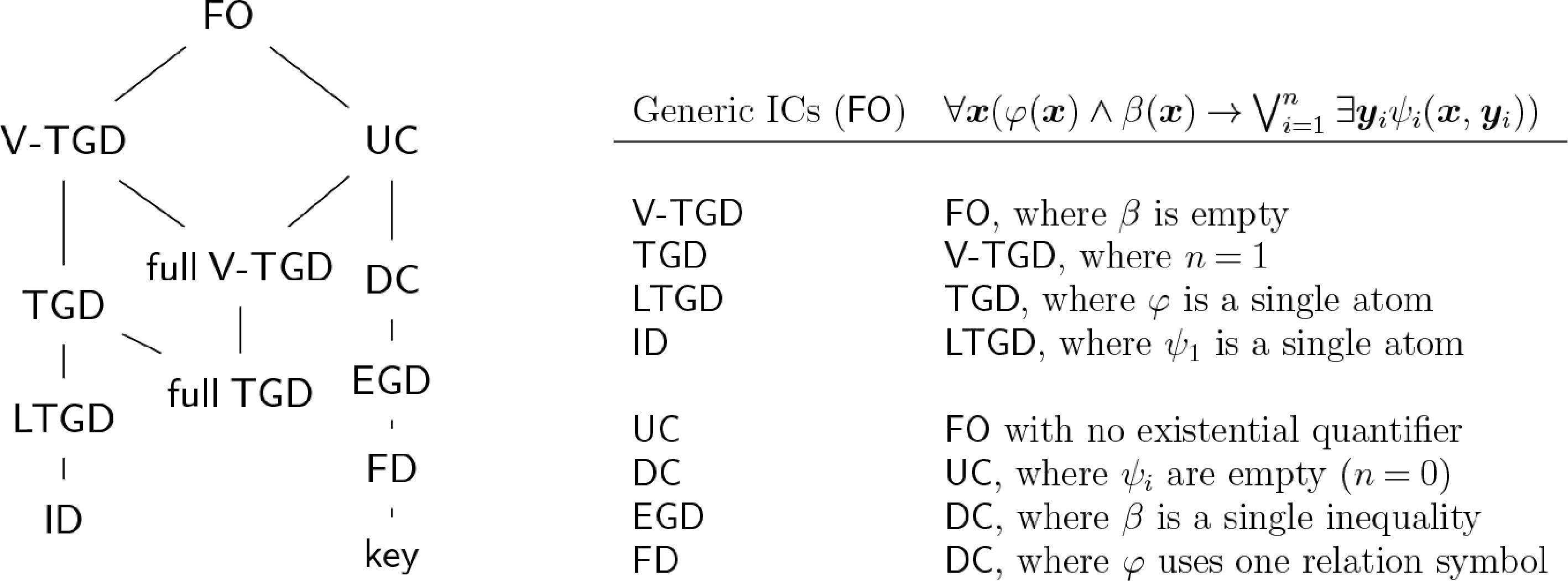
Figure 1.
Hierarchy of ICs and syntactic form for the most commonly studied constraints[39].
-
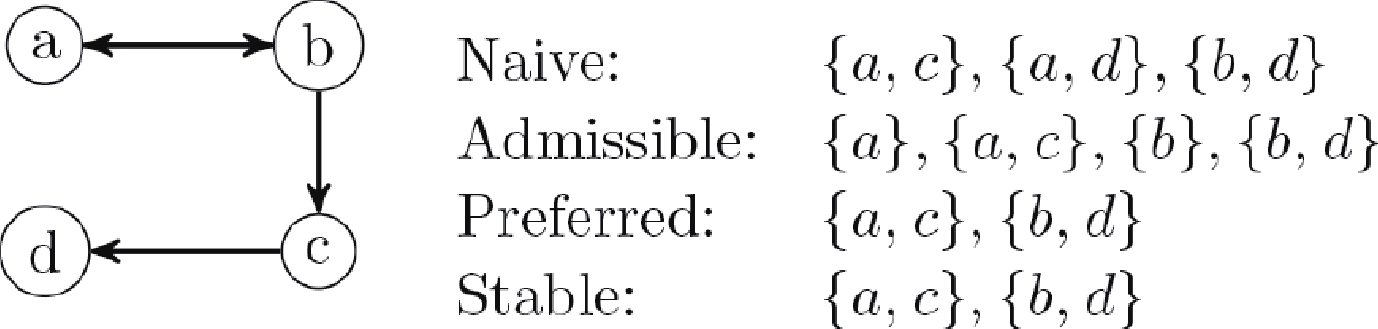
Figure 2.
Framework
$ {\cal{F}} $ -
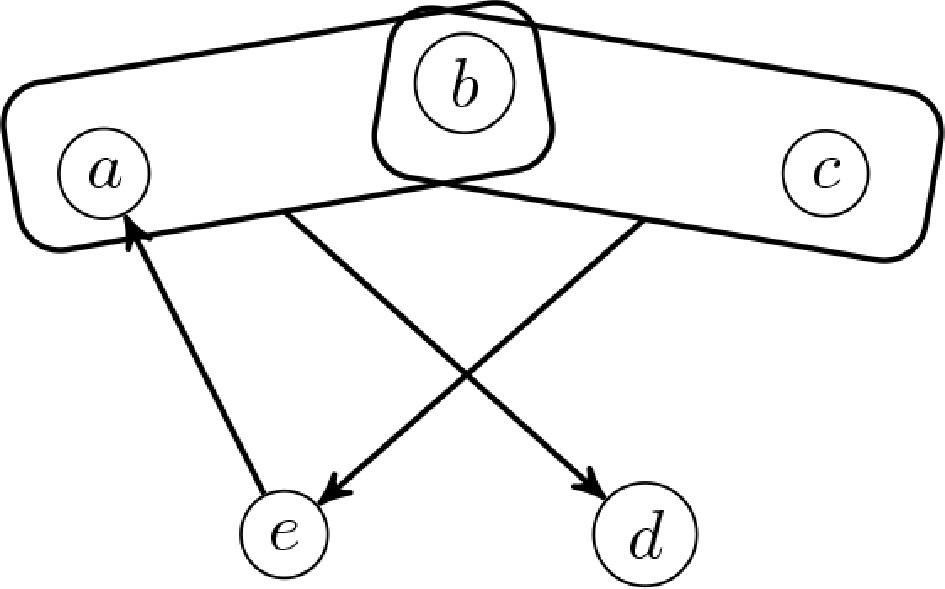
Figure 3.
The SETAF
$ {\cal{S}} $ -
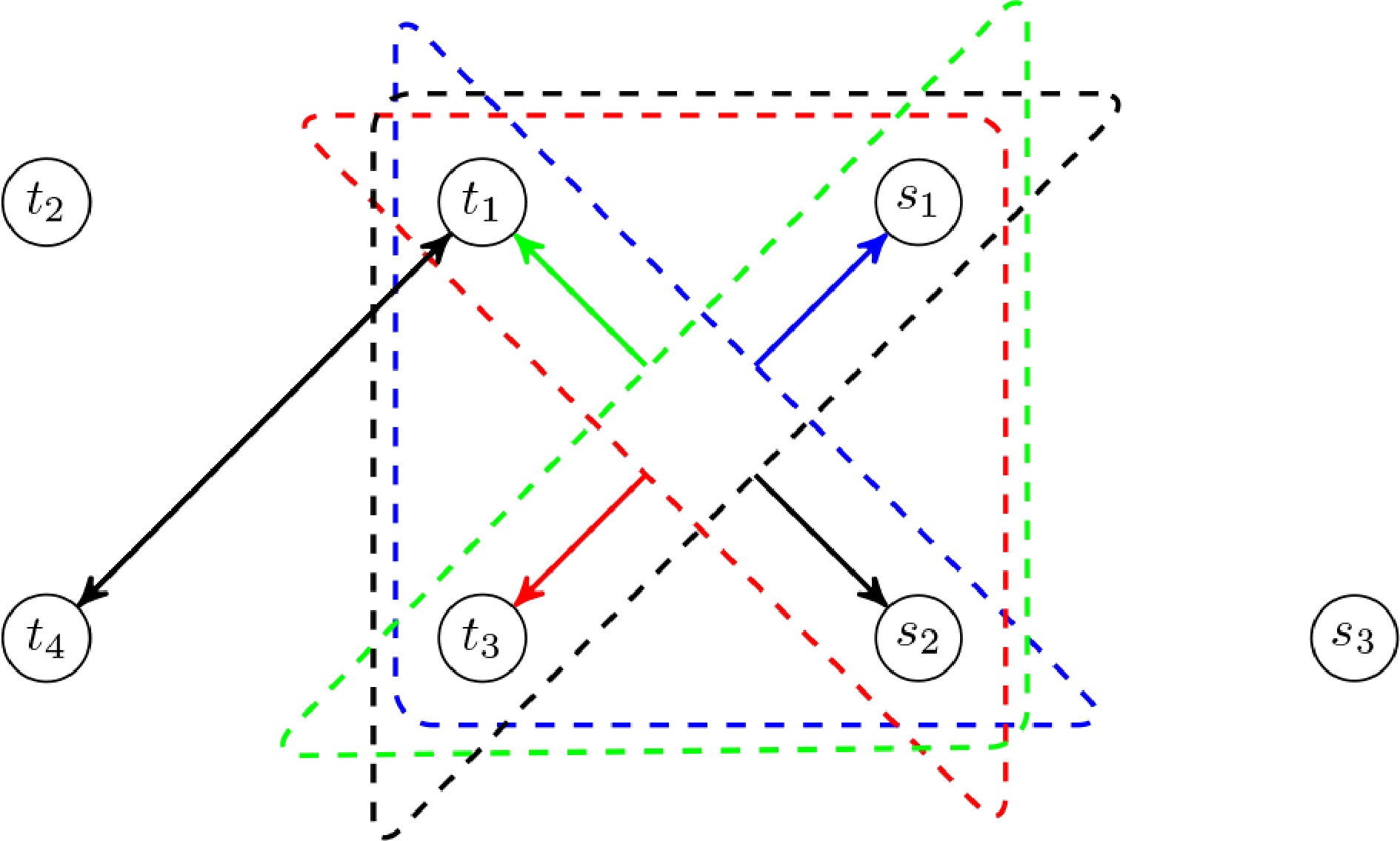
Figure 4.
SETAF
$ {\cal{S}}_{\langle \{C, O\}, D \rangle} $ $ (\{t_1,s_1,s_2\},t_3) $ -
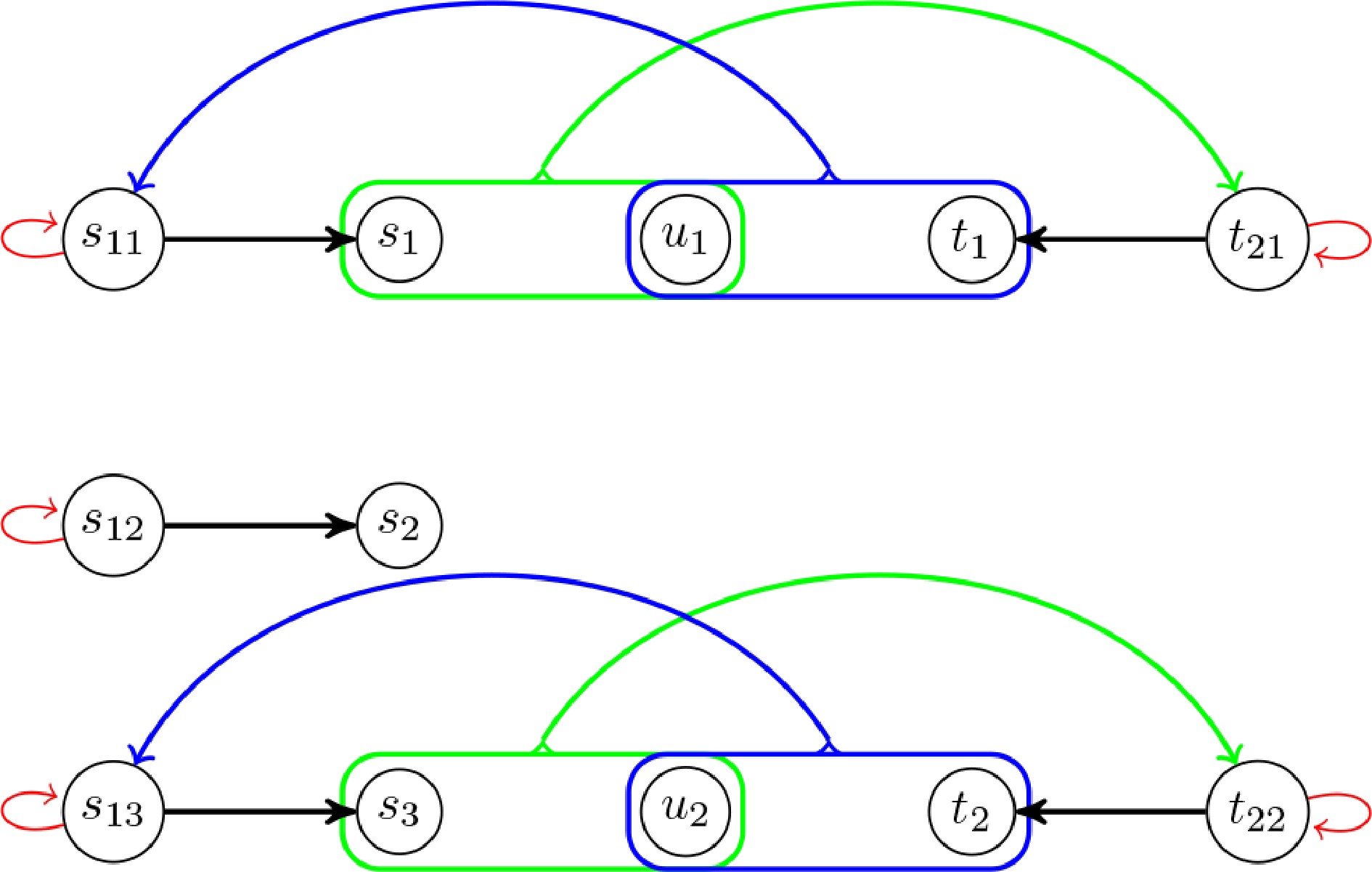
Figure 5.
SETAF
$ {\cal{S}}_{\langle \{E, D, P\}, L \rangle} $ $ \{{\rm{lav}}_1,{\rm{lav}}_2\} $ $ \{1,2\} $ $ \text{source}(1) $ $ s_i $ $ s_{1i} $ $ \text{source}(2) $ $ t_j $ $ t_{2j} $ -
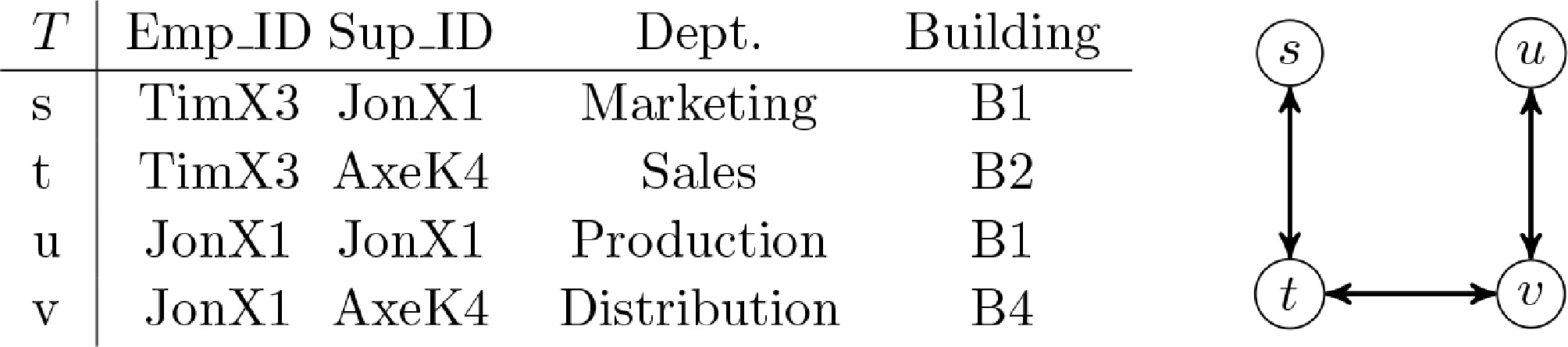
Figure 6.
Argumentation framework for modeling the FDs in Example 4.2.
-
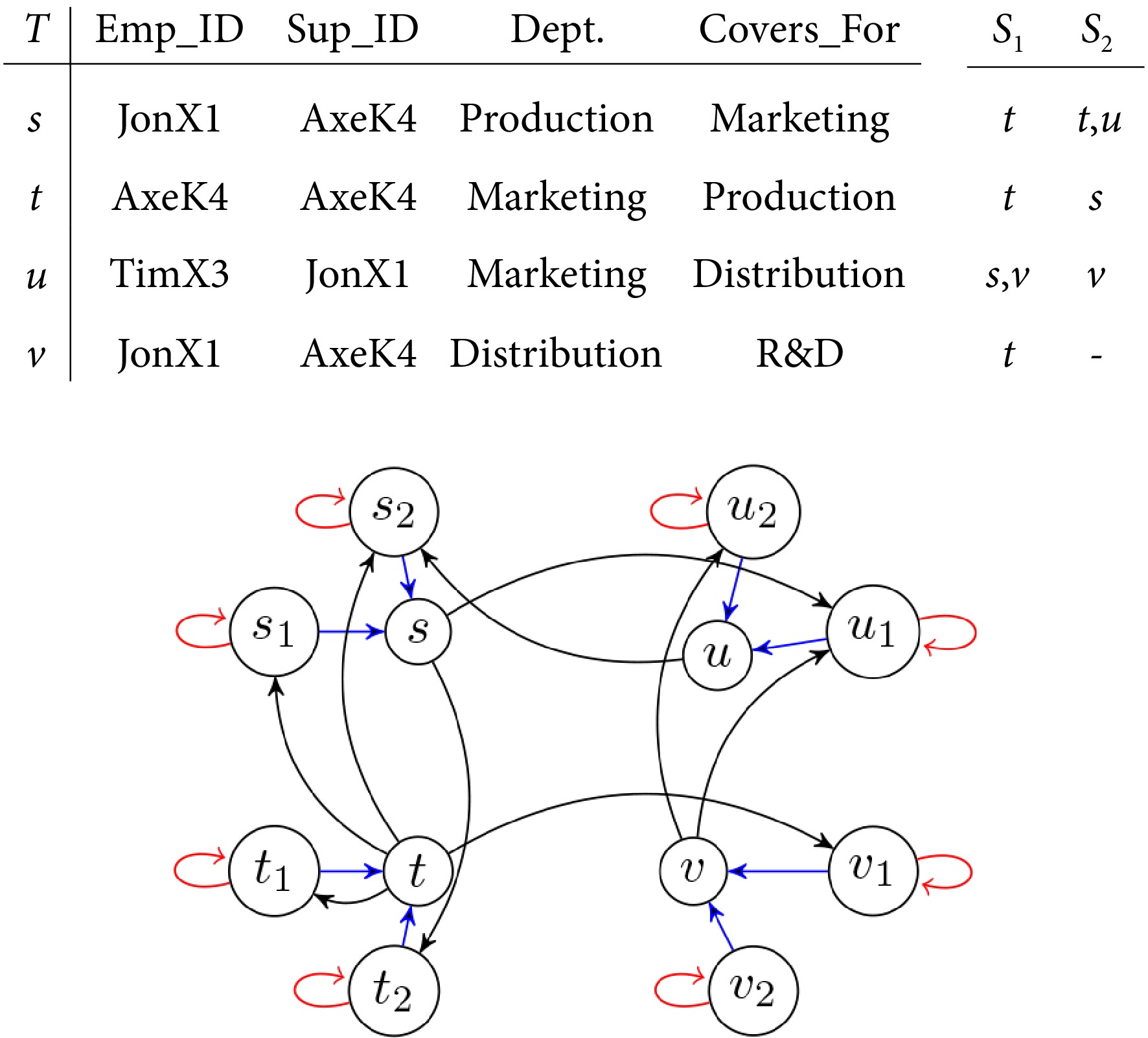
Figure 7.
The AF
$ {\cal{F}}_{\cal{I}} $ $ {\cal{I}} $ $ w\in T $ $ i\in I $ $ {\boldsymbol{S}}_i(w) $ -
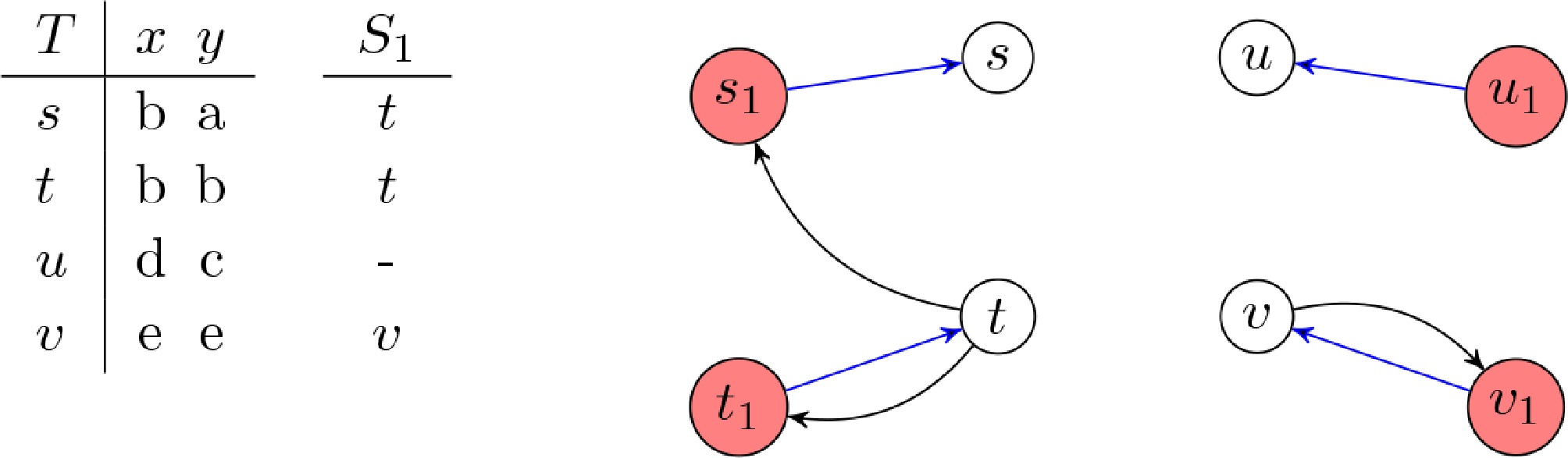
Figure 8.
Argumentation framework without self-attacks for modelling IDs in Example 4.9. The auxiliary arguments are highlighted in red for convenience.
-
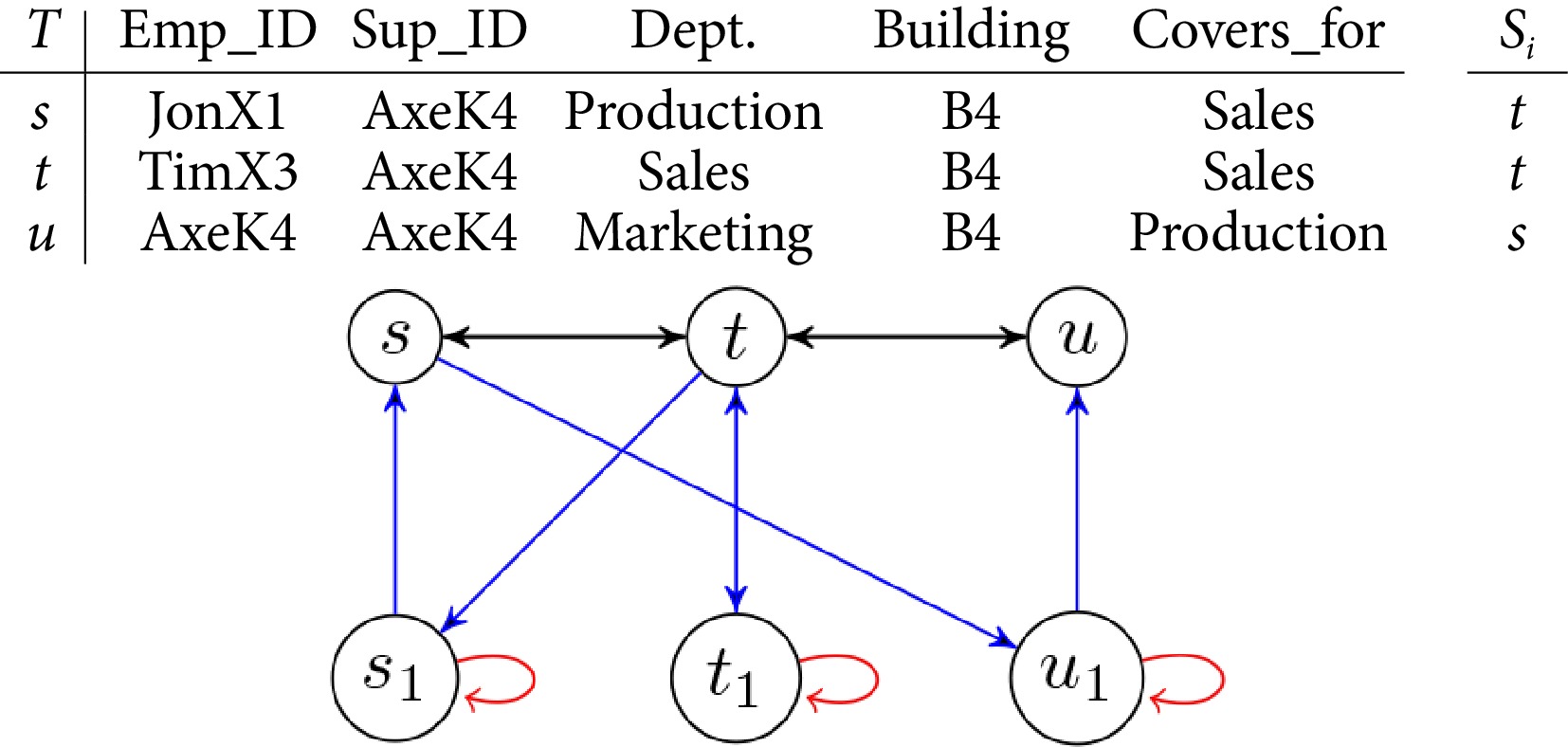
Figure 9.
Argumentation framework for modelling dependencies in Example 4.10. Black arcs depict conflicts due to functional, and blue ones due to inclusion dependency.
-
Equivalence between DBs with expressive ICs and SETAFs, along with data complexity results. ICs SETAF-equivalent semantics for repairs Complexity results $ {\rm{REP}}_{{\rm{B}}} $ $ \exists {\text{-}}{\rm{REP}}_{{\rm{B}}} $ $ \forall {\text{-}}{\rm{REP}}_{{\rm{B}}} $ DCs $ \sigma \in \{\text{naive},\text{pref},\text{stab}\}^\star $ (trivial) (trivial) $ \in{\bf{P}} $ LTGDs $ \text{pref} $ $ \in{\bf{P}} $ $ \in{\bf{P}} $ $ \in{\bf{P}} $ DCs+LTGDs $ \text{pref} $ $ {\bf{NP}} $ $ {\bf{NP}} $ $ {\boldsymbol{\Pi}}_2^{{\bf{P}}} $ Equivalence between DBs with less expressive ICs and AFs, along with combined complexity results. ICs AF-equivalent semantics for repairs Complexity Results $ {\rm{REP}} $ $ \exists {\text{-}}{\rm{REP}} $ $ \forall {\text{-}}{\rm{REP}} $ FDs $ \sigma \in \{\text{naive},\text{pref},\text{stab}\}^\star $ (trivial) (trivial) $ \in{\bf{P}} $ IDs $ \text{pref} $ $ \in{\bf{P}} $ $ \in{\bf{P}} $ $ \in{\bf{P}} $ FDs+IDs $ \text{pref} $ $ {\bf{NP}} $ $ {\bf{NP}} $ $ {\boldsymbol{\Pi}}_2^{{\bf{P}}} $ The table at the top indicates results for expressive ICs involving a fixed set $ B $ Table 1.
Overview of our main contributions.
-
E Emp_ID Dept_ID Location D Dept_ID Dept_NAME Location e1 E1 D1 Paderborn d1 D1 Sales Paderborn e2 E2 D2 Sheffield d2 D2 Marketing Sheffield e3 E3 D2 Hanover d3 D3 HR Hanover The first column indicates identifier for each fact/tuple. Table 2.
A database with two tables over the schema {E,D}.
-
Problem: REP Input: a constrained database $ {\cal{D}}=\langle {\cal{T}}, B\rangle $ Question: is there a repair $ \mathcal R\in \text{repairs}({\cal{D}}) $ $ \mathcal R\neq \emptyset $ -
Problem: $ \exists {\text{-}}{\rm{REP}} $ Input: a constrained database $ {\cal{D}}=\langle {\cal{T}}, B\rangle $ $ s\in {\cal{T}} $ Question: does $ s $ $ {\cal{D}} $ -
Problem: $ \forall {\text{-}}{\rm{REP}} $ Input: a constrained database $ {\cal{D}}=\langle {\cal{T}}, B\rangle $ $ s\in {\cal{T}} $ Question: does $ s $ $ {\cal{D}} $ -
Problem: $ {\rm{Ext}}\sigma $ Input: an argumentation framework $ {\cal{F}} $ Question: is it true that $ \sigma({\cal{F}})\neq\emptyset $ -
Problem: $ {\rm{Cred}}_\sigma $ Input: an AF $ {\cal{F}} = (A, R) $ $ a \in A $ Question: is it true that $ a \in E $ $ E \in \sigma({\cal{F}}) $ -
Problem: $ {\rm{Skep}}_\sigma $ Input: an AF $ {\cal{F}} = (A, R) $ $ a \in A $ Question: is it true that $ a \in E $ $ E \in \sigma({\cal{F}}) $ -
Problem: $ {\rm{Ext}}\sigma^{SET} $ Input: a SETAF $ {\cal{F}} $ Question: is it true that $ \sigma({\cal{F}}) \neq \emptyset $ -
$ F $ $ t_0 $ $ u_0 $ $ t_1 $ $ u_1 $ $ \begin{array}{c|cc}C & t_2 & u_2 \\\hline s_c & \text { sat } & c_1 \\s_1 & c_1 & c_2 \\s_2 & c_2 & c_3 \\s_3 & c_3 & \text { sat }\end{array} $ $ s_d $ sat sat sat sat $ x_1 $ $ x $ 1 $ c_1 $ sat $ {\bar{x}_2} $ $ x $ 0 $ c_2 $ sat $ {\bar{x}_3} $ $ x $ 0 $ c_3 $ sat $ y_1 $ $ y $ 1 $ c_1 $ sat $ {\bar{y}_2} $ $ y $ 0 $ c_2 $ sat $ y_3 $ $ y $ 1 $ c_3 $ sat Table 3.
The database corresponding to the formula
$ \varphi $ -
$\begin{array}{l|c|c} S & u_1 & u_{\exists} \\\hline s_{{\rm{sat}}} & c_1 & \text { exists } \\ s^d & d & d \end{array} $ $\begin{array}{l|cc|c|c} F & t_0 & u_0 & t_1 & t_{\exists} \\\hline y^d & d & d & d & d \\\hline x_1 & x & 1 & c_1 & d \\\bar{x}_0 & x & 0 & d & d \\\hline y_1 & y & 1 & c_1 & d \\ y_2 & y & 1 & c_2 & d \\ y_3 & y & 1 & c_3 & d \\\bar{y}_0 & y & 0 & d & d \\\hline z_1 & z & 1 & c_1 & \text { exists } \\\bar{z}_2 & z & 0 & c_2 & \text { exists } \\ z_3 & z & 1 & c_3 & \text { exists } \\\hline \bar{w}_2 & w & 0 & c_2 & \text { exists } \\ w_3 & w & 1 & c_3 & \text { exists }\end{array} $ $\begin{array}{c|c|c} C & t_2 & u_2 \\\hline s_1 & c_1 & c_2 \\ s_2 & c_2 & c_3 \\ s_3 & c_3 & c_1 \\ c^d & d & d \end{array} $ Table 4.
The database corresponding to the
$ {\rm { 2QBF }} $ $ \Phi $
Figures
(9)
Tables
(11)