-
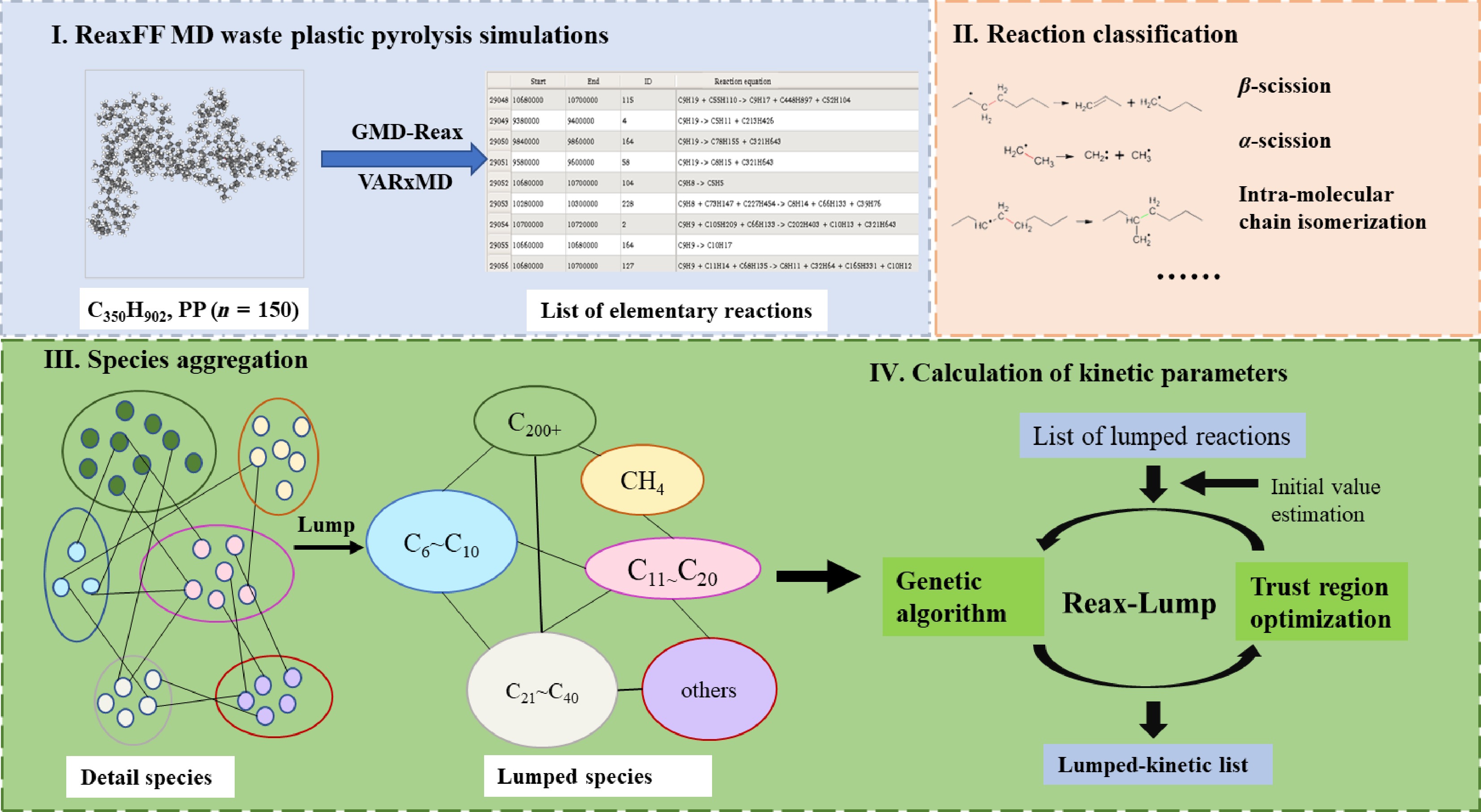
Figure 1.
Processing scheme of Reax-Lump for generating lumped mechanisms of polymer plastics based on ReaxFF MD simulations.
-
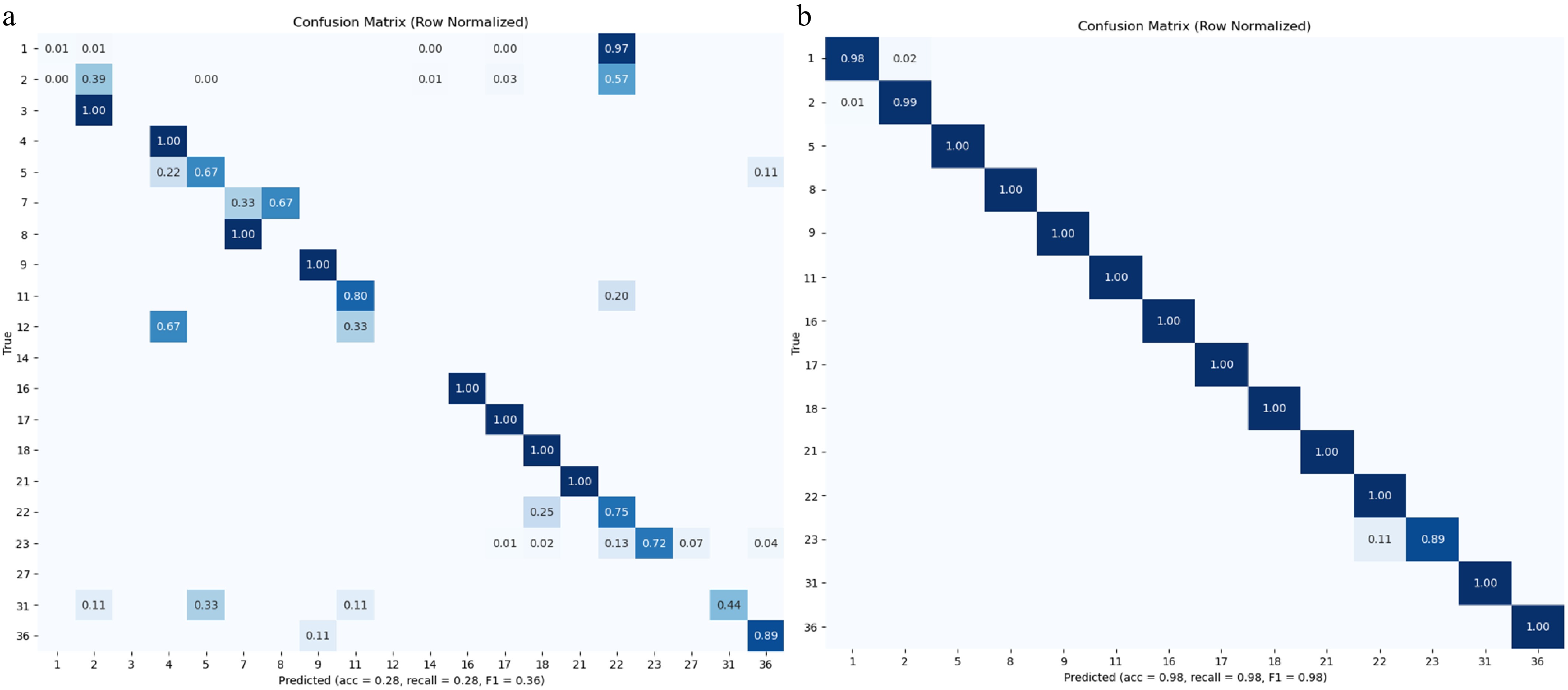
Figure 2.
Confusion matrices of the reaction classification model: (a) the model training set consists of the original dataset (n-dodecane, RP-1, RP-3); (b) the model training set is augmented with an additional 924 data points from the PP pyrolysis dataset.
-
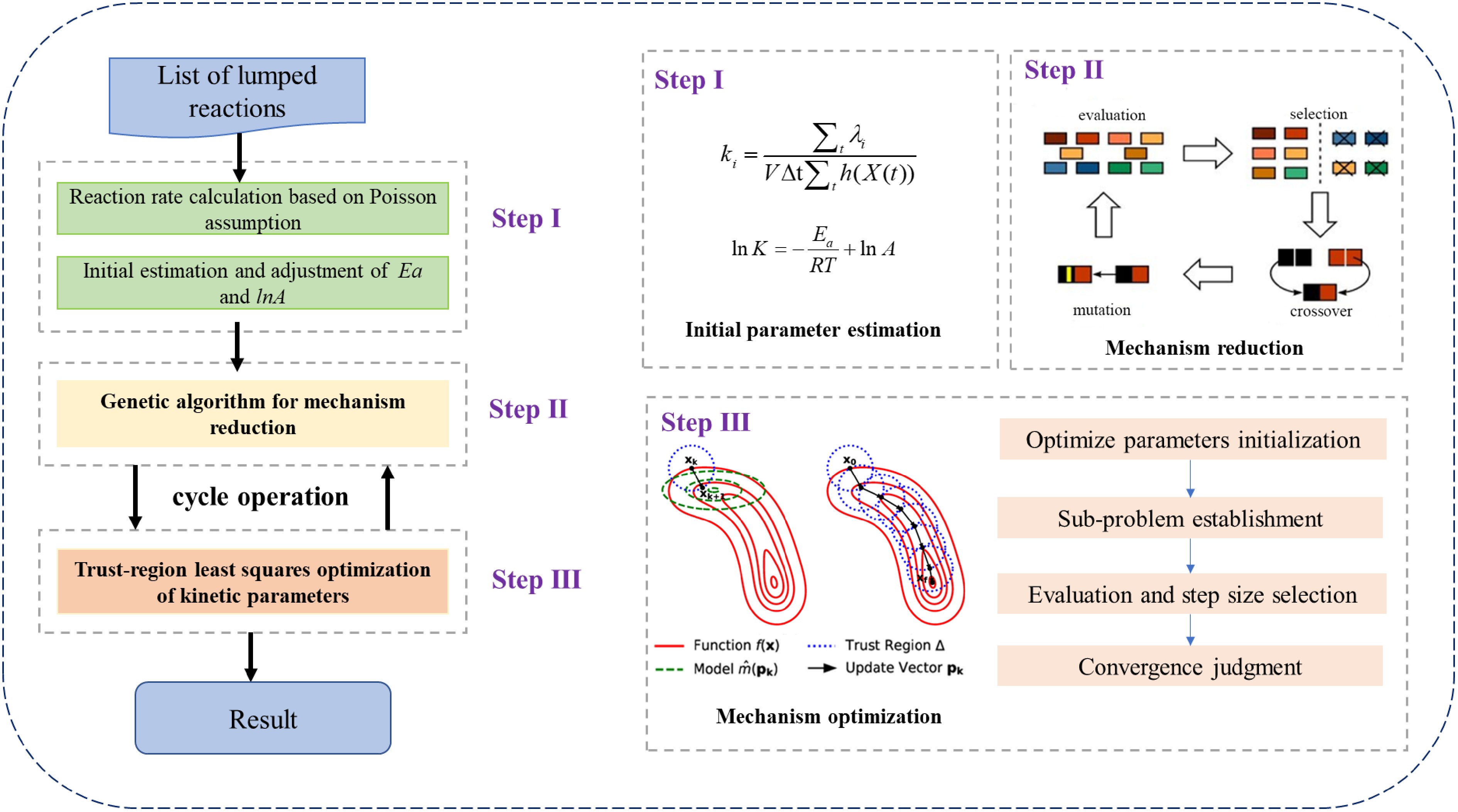
Figure 3.
Schematic diagram of the collaborative training framework of Reax-Lump.
-
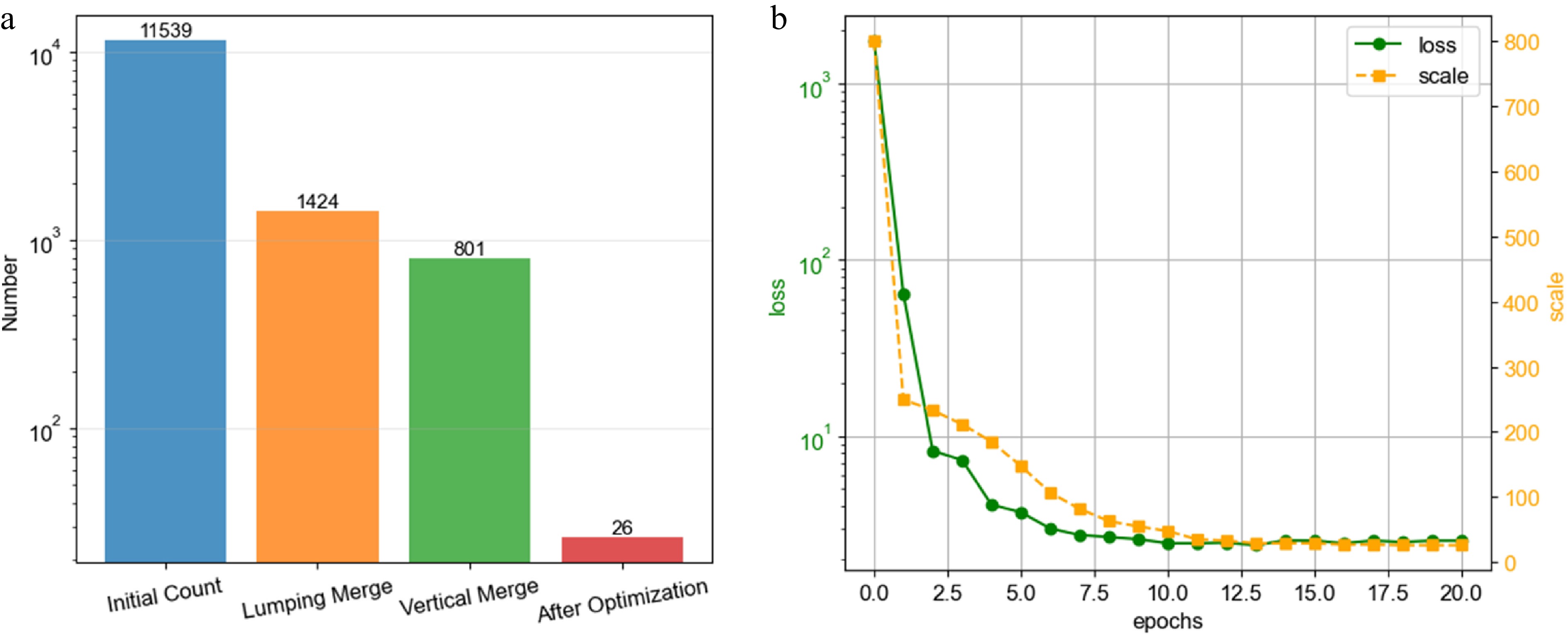
Figure 4.
(a) Number of reactions after different steps for PP heating at 4 K/ps. (b) The optimized loss function and mechanism scale curve for PP heating at 4 K/ps.
-
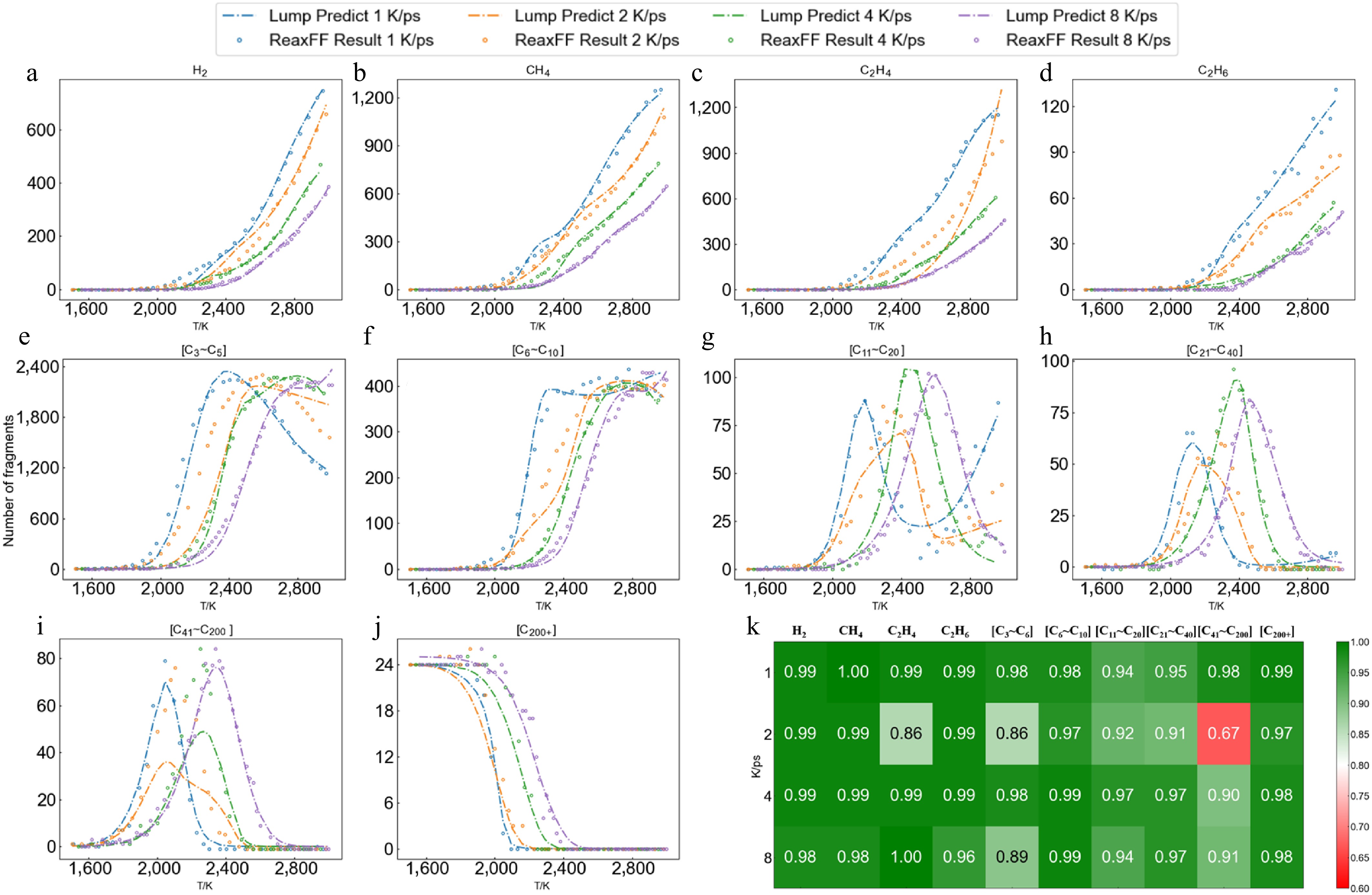
Figure 5.
(a)−(j) Comparison of the predicted number of fragments between ReaxFF MD and lumped mechanisms under 1, 2, 4, and 8 K/ps heating rates. (k) heatmap of R2 for fitting between predicted and experimental concentrations of various species at different heating rates.
-
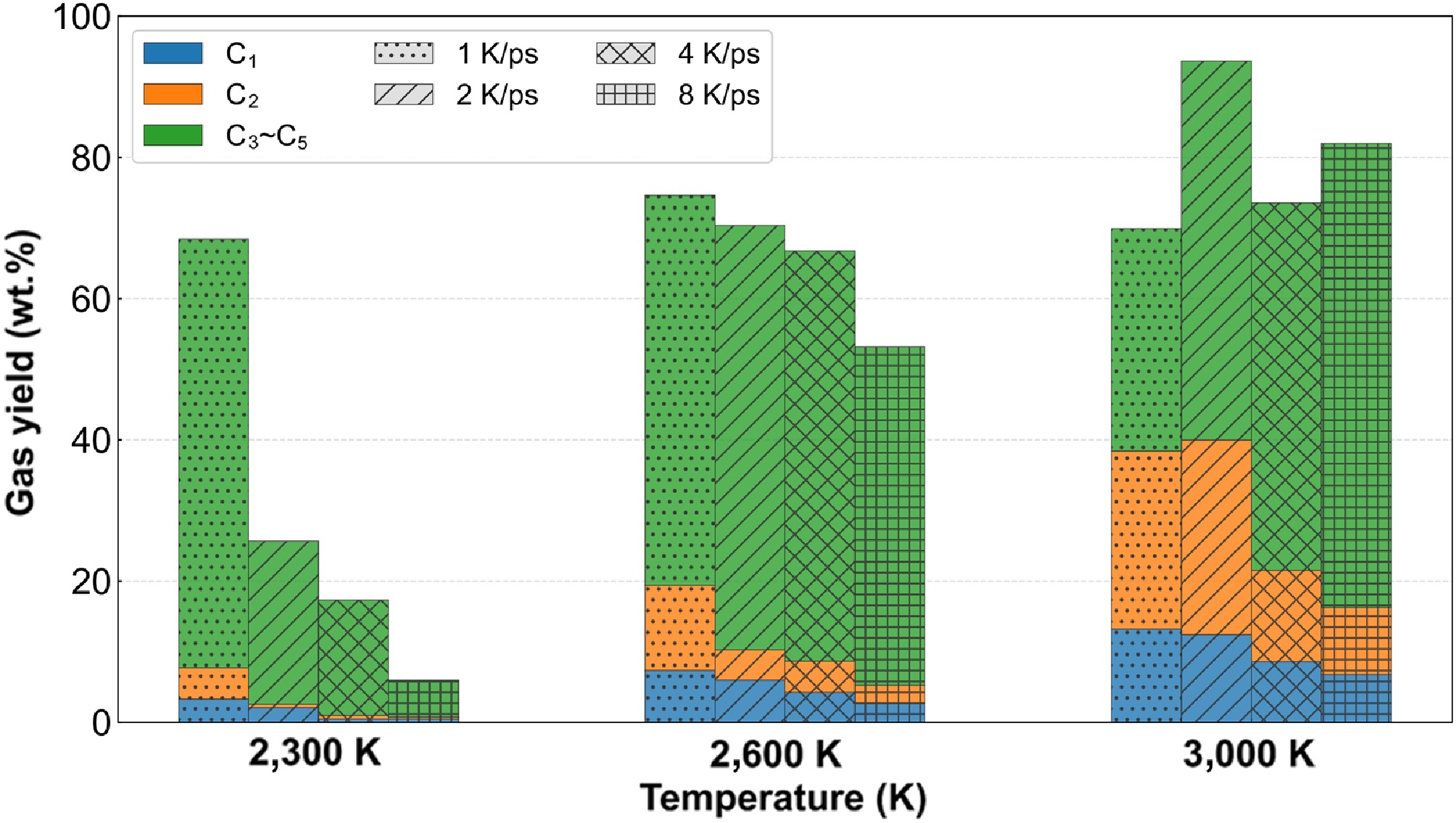
Figure 6.
The yields of small-molecule gases under different temperatures and heating rates.
-
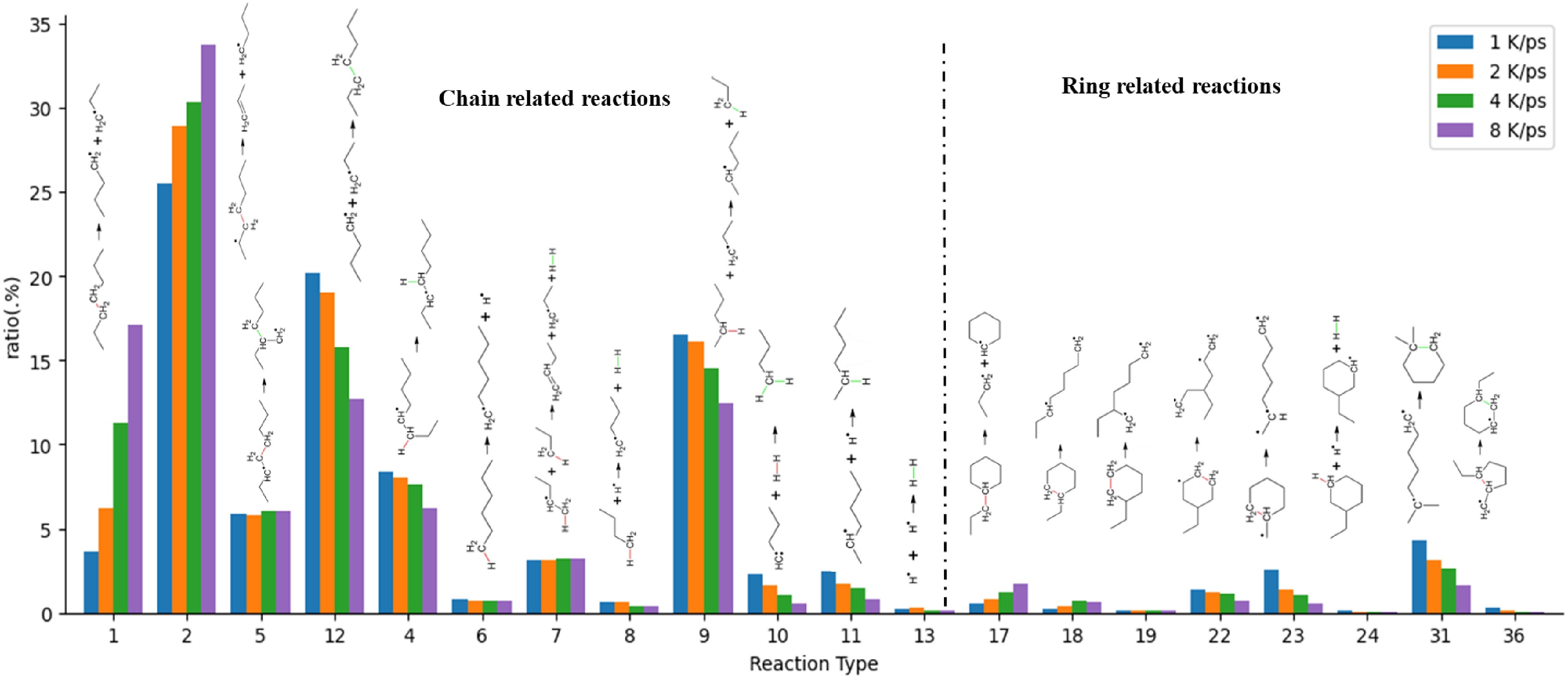
Figure 7.
The distribution of the total 29 reaction classes obtained from ReaxFF MD simulation by using SRG-Reax at different heating rates.
-
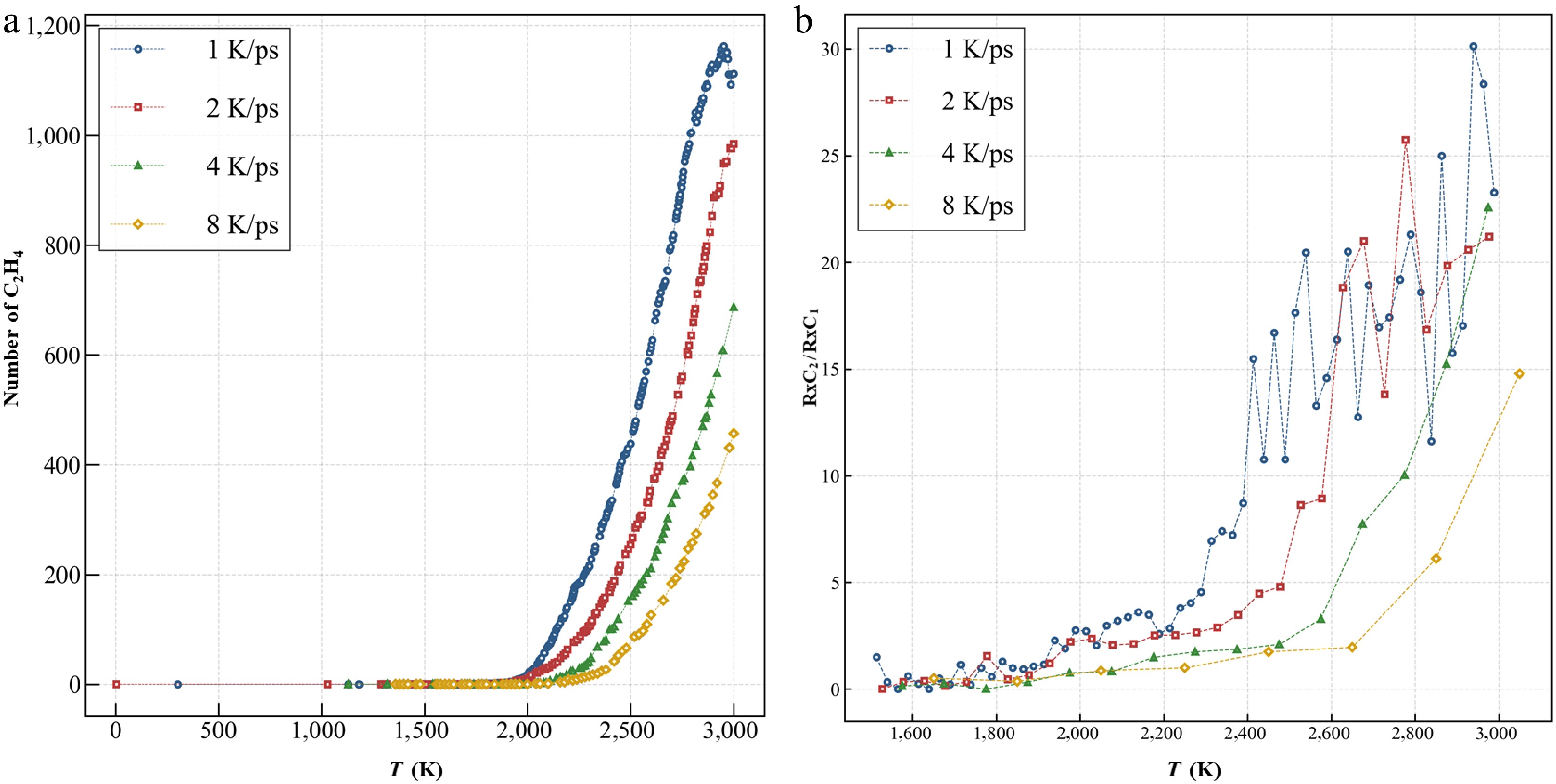
Figure 8.
Evolution trends of (a) C2H4 yields, and (b) RxC2/RxC1 ratios with temperature.
-
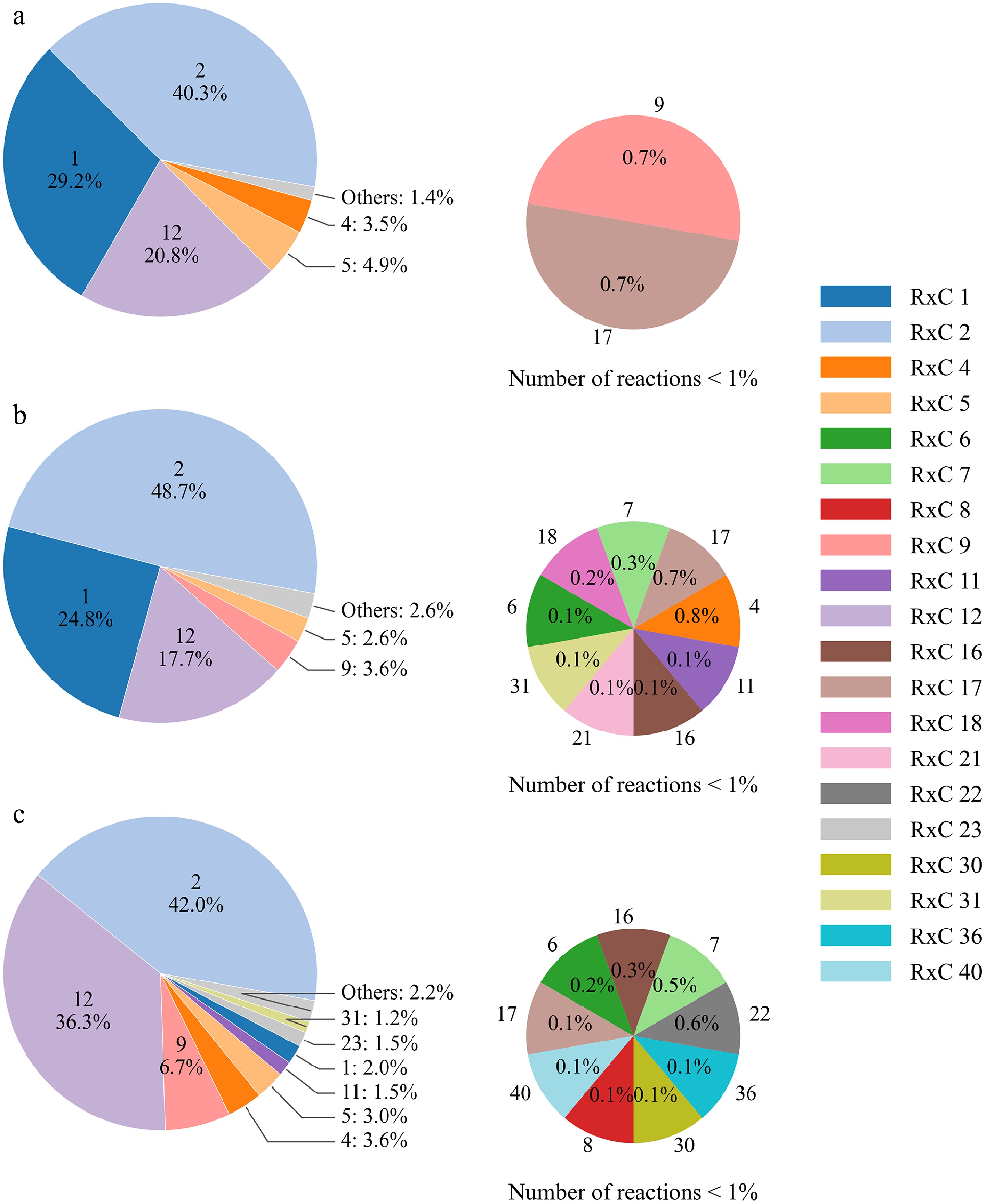
Figure 9.
Comparison of the proportion of reaction categories related to [C11~C20] at various temperature stages under the heating rate of 1 K/ps. (a) 1,750–2,100 K; (b) 2,100–2,500 K; (c) 2,500–3,000 K.
-
Evaluation indicator The entire
validation setPart of the validation set
(reactant carbon numbers > 16)Part of the validation set
(reactant carbon numbers ≤ 16)Prediction on validation set after
incorporating PP datasetAccuracy 0.5069 0.4192 0.8001 0.9770 Precision 0.5692 0.4312 0.9125 0.9831 Recall 0.5069 0.4192 0.8000 0.9770 F1-score 0.5158 0.4212 0.8184 0.9790 Table 1.
Comparison of evaluation metrics for predictions using different validation sets and classification models.
-
Number Lumped name Lumped rule Representative industrial products 1 [C200+] > 200 PP and its oligomers 2 [C41~C200] 200 ≥ n > 40 Oligomers and wax 3 [C21~C40] 40 ≥ n > 20 Wax 4 [C11~C20] 20 ≥ n > 10 Heavy oil 5 [C6~C10] 10 ≥ n > 5 Light oil 6 [C3~C5] 5 ≥ n ≥ 3 Gas 7 C2H6 Ethane Gas 8 C2H4 Ethylene Gas 9 CH4 Methane Gas 10 H2 Hydrogen Gas Table 2.
Lumping rules for the species in the PP pyrolysis process.
-
Heating rate (K/ps) Detailed reaction number Lumped reaction number Vertical combination reaction number Optimized reaction number 1 37,931 2,911 1,653 18 2 19,831 1,881 1,080 19 4 11,539 1,424 801 26 8 5,986 1,269 706 27 Table 3.
Reaction scale after different reduction steps.
-
Heating rate (K/ps) Pre-lumping average reaction frequency Post-lumping average reaction frequency Loss value before optimization Loss value after optimization 1 1.005 13.08 1,804.8 18.6 2 1.004 7.94 1,184.4 14.87 4 1.003 7.43 1,746.0 1.28 8 1.003 4.73 472.0 0.61 Table 4.
Changes in the average reaction frequency and loss function before and after Reax-Lump optimization under different heating rates.
-
Reaction ID Reaction $\ln A $ Ea (kJ/mol) 1 [C200+] → [C21~C40] + 3[C41~C200] 42.433 326.289 2 2[C11~C20] → [C21~C40] 41.282 164.841 3 [C41~C200] + [C6~C10] → 3[C3~C5] + [C21~C40] 42.068 215.119 4 [C21~C40] + CH4 → [C3~C5] + [C11~C20] 46.783 285.703 5 [C41~C200] + CH4 → [C11~C20] + 2[C21~C40] 37.222 112.062 6 [C3~C5] + [C6~C10] → [C11~C20] 34.095 60.606 7 2CH4 → C2H6 + H2 39.102 158.663 8 [C21~C40] → 2[C11~C20] + 2[C3~C5] 35.762 229.277 9 [C3~C5] + C2H6 → [C6~C10] 39.742 123.188 10 [C3~C5] → C2H6 + C2H4 32.002 200.656 11 C2H6 → C2H4 + H2 37.813 257.440 12 [C3~C5] + H2 → C2H6 + CH4 34.647 111.807 13 C2H4 + H2 → C2H6 34.698 221.893 14 C2H6 + [C6~C10] → 2[C3~C5] 39.552 108.848 15 [C6~C10] → [C3~C5] + C2H6 + H2 38.843 256.380 16 [C3~C5] + C2H6 → C2H4 + H2 + [C3~C5] 38.625 245.262 17 [C11~C20] + [C3~C5] + C2H6 → 2[C6~C10] + H2 53.427 290.191 18 [C3~C5] + C2H4 → C2H6 + H2 + [C3~C5] 34.486 203.009 19 [C11~C20] + C2H6 + H2→ 2[C3~C5] + [C6~C10] 52.412 188.332 20 [C21~C40] → 2[C11~C20] + [C3~C5] + [C6~C10] 36.157 248.102 21 [C41~C200] → 2[C11~C20] + [C3~C5] + 3[C21~C40] + CH4 34.970 217.058 22 [C11~C20] → 4[C3~C5] + [C6~C10] 34.870 175.052 23 2[C3~C5] → 2C2H6 + 2CH4 38.653 221.624 24 2C2H6 + 2H2 → 4CH4 50.683 219.295 25 2[C6~C10] + H2 → 4[C3~C5] 45.566 220.359 26 2[C21~C40] → [C41~C200] + [C6~C10] 39.542 161.946 Table 5.
Optimized lumped reaction mechanism list for PP pyrolysis at 4 K/ps.
-
Heating rate
(K/ps)RxC4
(intra-molecular H-shift)RxC9 (inter-molecular
H abstraction by C)RxC11 (H radical
addition to C)RxC12 (recombination
of C radicals)RxC31 (chain
cyclization)Ea (kJ/mol) lnA 1 22 (2.37%) 31 (3.34%) 83 (8.93%) 778 (83.7%) 15 (1.61%) 150.03 42.03 2 7 (1.64%) 22 (5.15%) 24 (5.62%) 372 (87.1%) 2 (0.468%) 138.04 40.63 4 3 (1.69%) 10 (5.65%) 15 (8.47%) 145 (81.9%) 4 (2.25%) 123.19 39.74 Table 6.
Numbers and ratios of the top five detailed reaction types for the lumped reaction: [C3~C5] + C2H6 → [C6~C10].
Figures
(9)
Tables
(6)