-
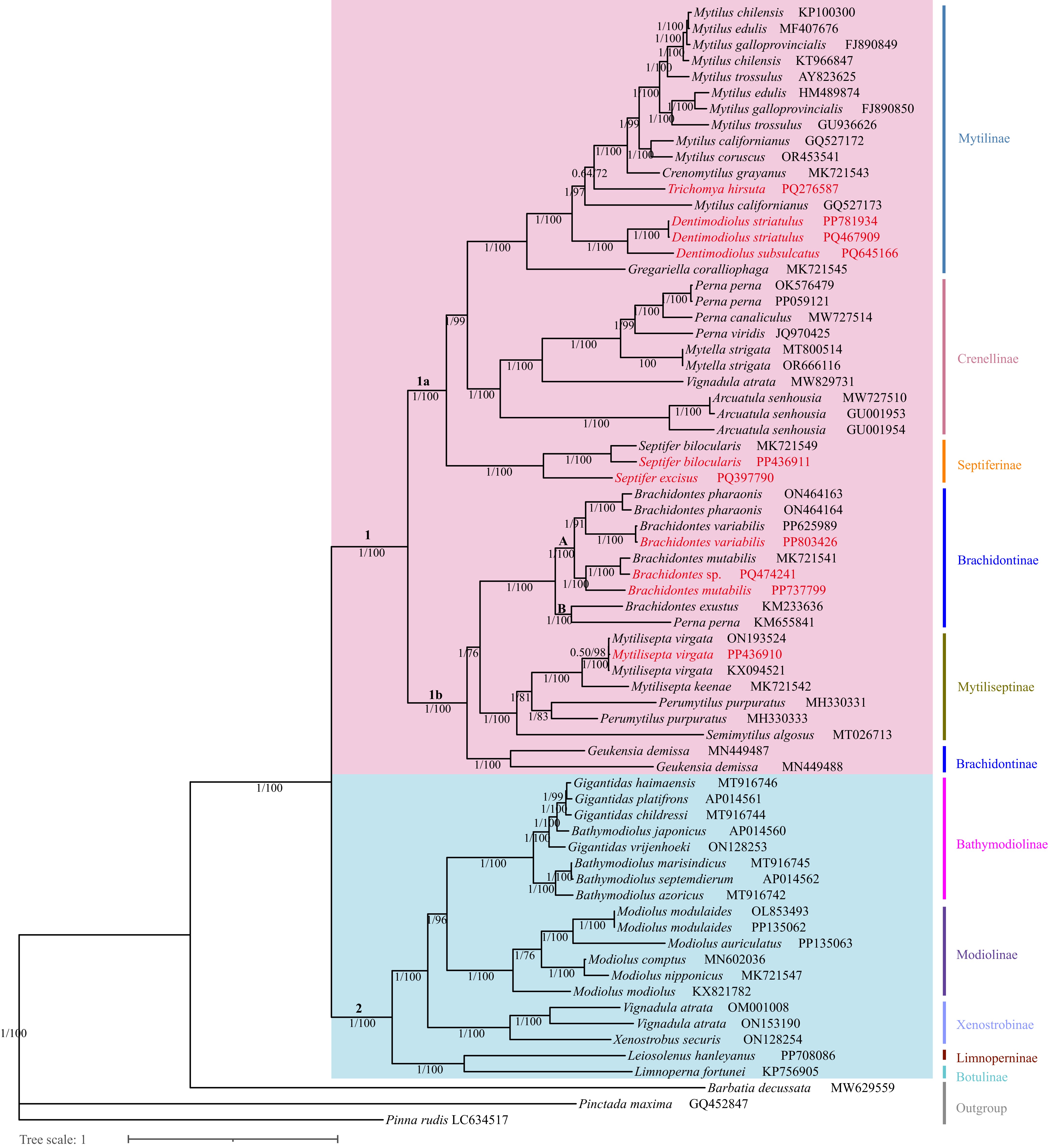
Figure 1.
The phylogenetic tree based on the mitogenomes of Mytiloidea. The mitogenomes newly sequenced in this study are marked in red. Posterior probability (PP) / bootstrap (BS) are shown at nodes. The bold letters represent different clades.
-
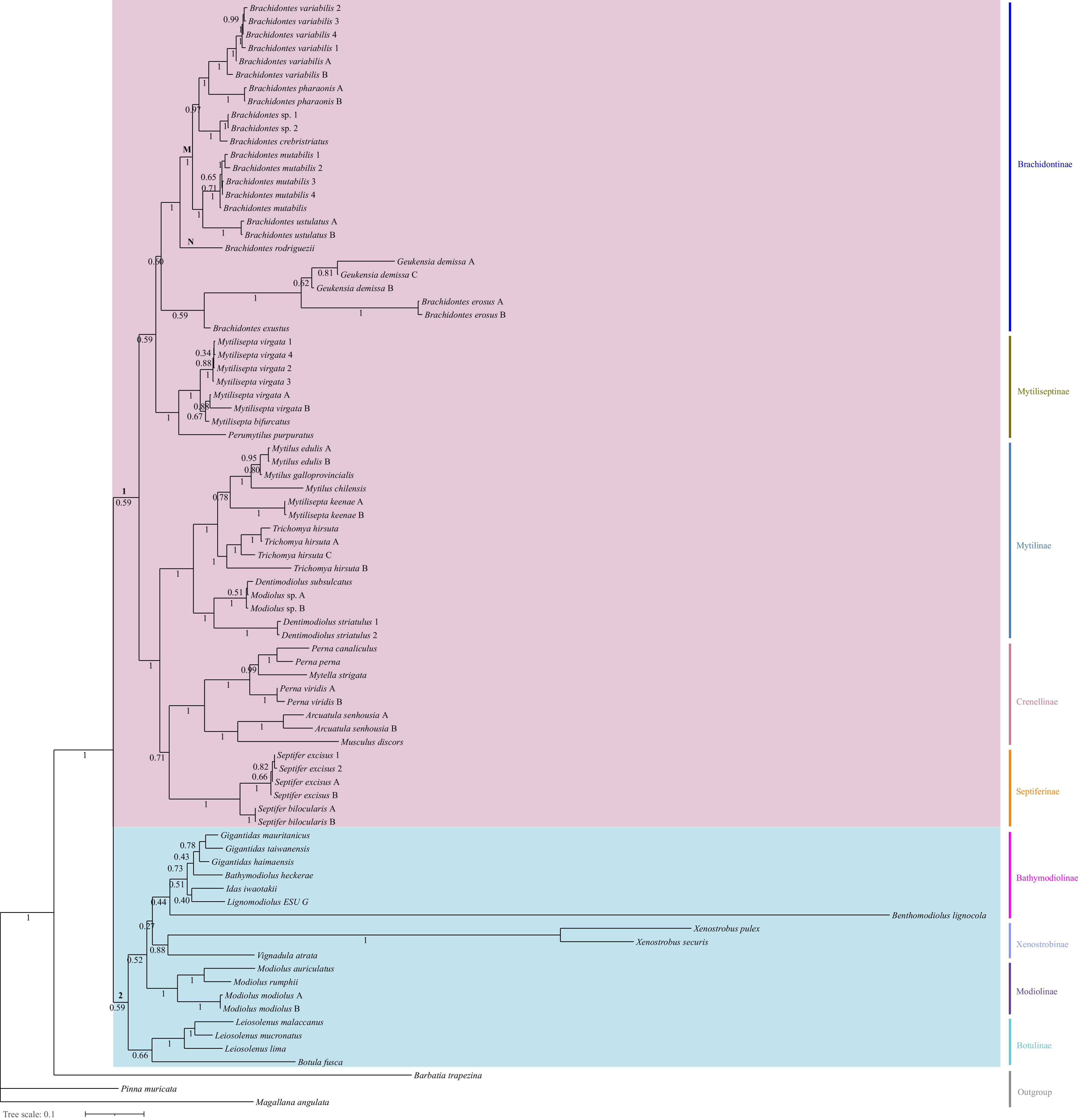
Figure 2.
The Bayesian tree based on multiple fragments. The posterior probabilities are under the branches. The bold letters represent different clades.
-
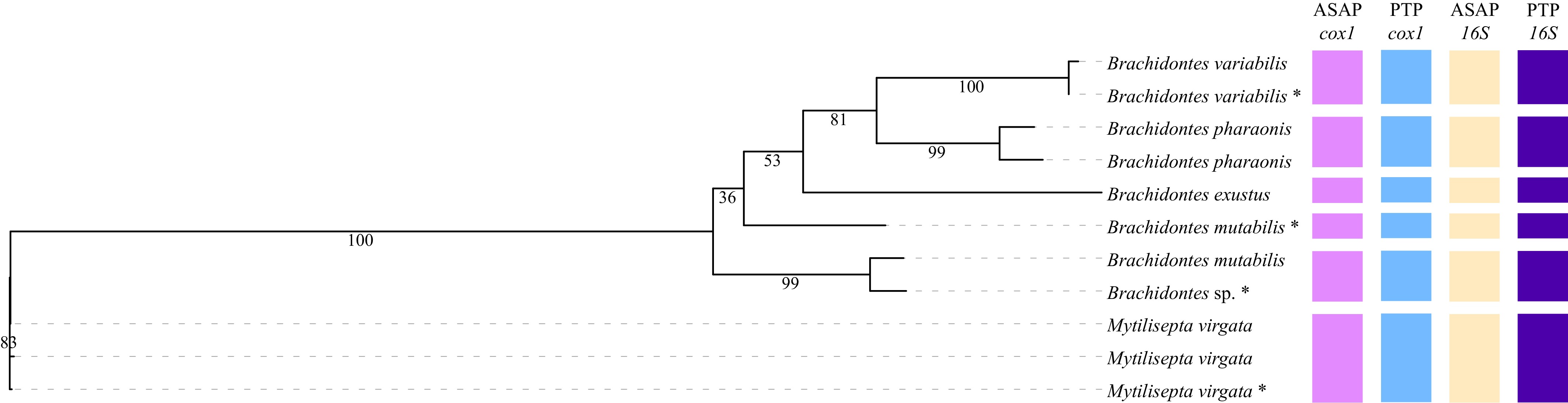
Figure 3.
Species delimited by ASAP and PTP on the basis of complete cox1 and 16S sequences. The posterior probabilities are under the branches. The mitogenomes newly sequenced in this study are marked with *.
-
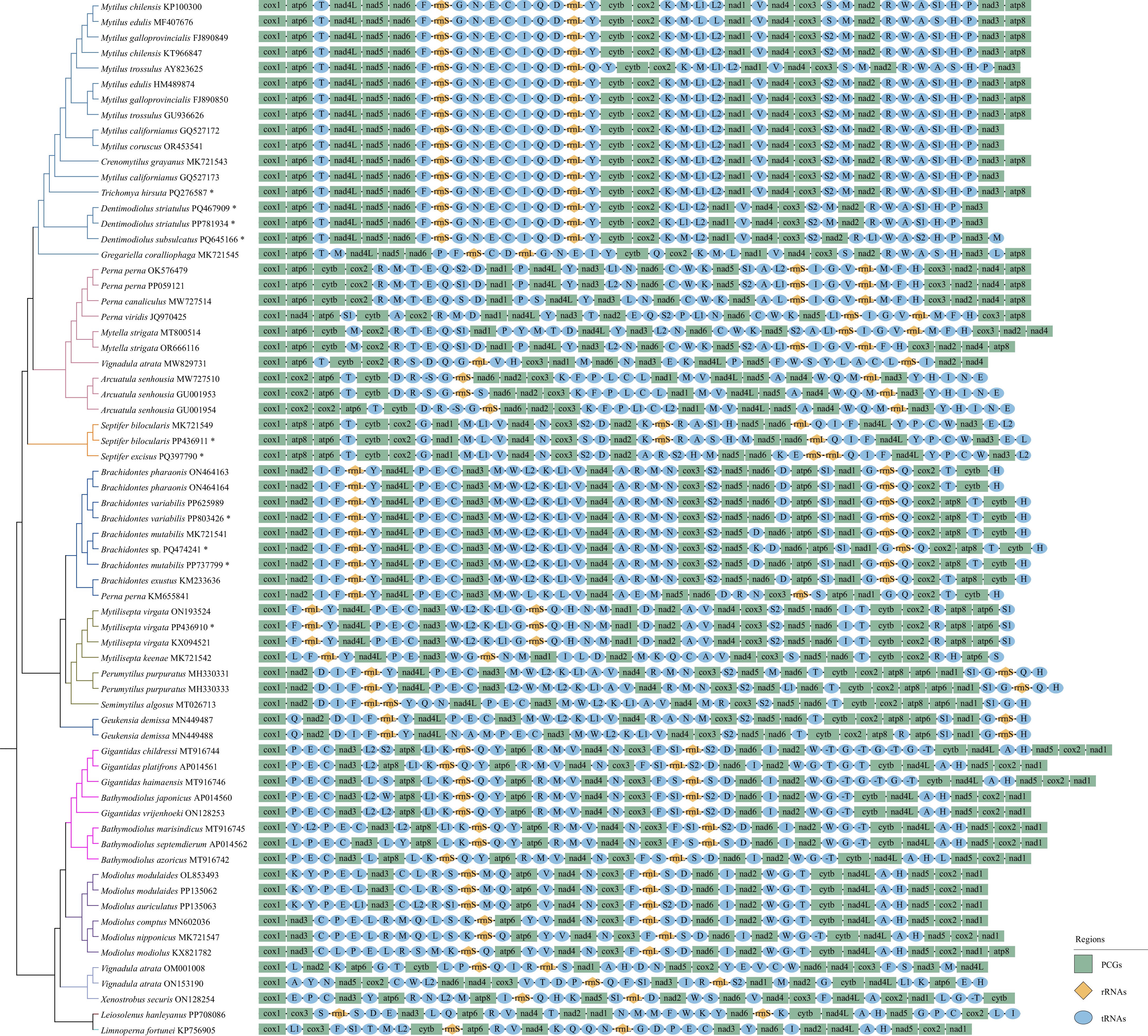
Figure 4.
The gene arrangements of the Mytiloidea mitogenomes. The mitogenomes newly sequenced in this study are marked with *. Different colored branches represent different subfamilies, consistent with the phylogenetic tree.
-
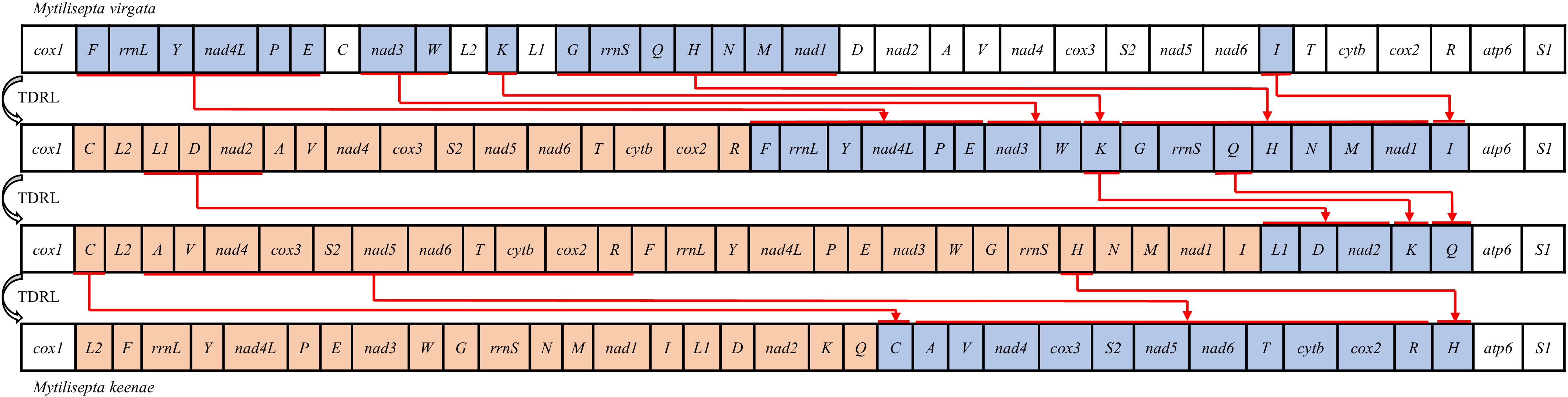
Figure 5.
Putative gene rearrangement events from Mytilisepta virgata to Mytilisepta keenae. The tandem duplication random loss (TDRL) events are represented by red lines and different colors.
-
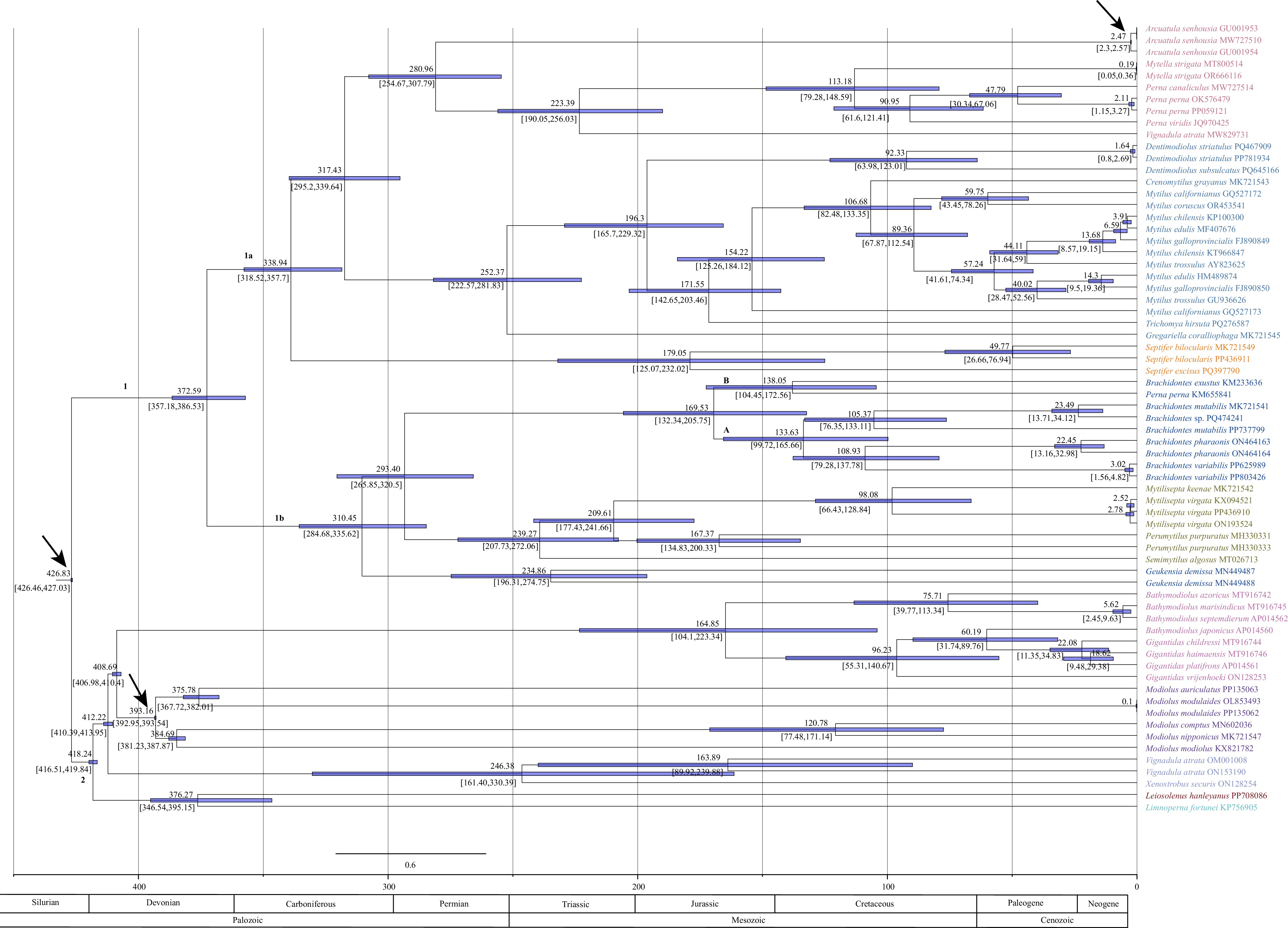
Figure 6.
Divergence times of Mytilidae. The mean divergence times (in Mya) are labeled on the nodes. The number ranges in parentheses under the purple rectangles indicate the 95% highest posterior density (HPD) intervals for the divergence times. Calibration points are marked by arrows. Different colors represent different subfamilies consistent with Fig. 1. The bold letters represent different clades.
-
Family Subfamily Genus Species Accession number Mytilidae Brachidontinae Brachidontes variabilis PP803426 PP625989 exustus KM233636 mutabilis PP737799 MK721541 pharaonis ON464164 ON464163 sp. PQ474241 Geukensia demissa MN449488 MN449487 Mytilinae Gregariella coralliophaga MK721545 Crenomytilus grayanus MK721543 Mytilus californianus GQ527172 coruscus OR453541 trossulus GU936626 AY823625 edulis HM489874 MF407676 chilensis KT966847 KP100300 galloprovincialis FJ890849 FJ890950 Trichomya hirsuta PQ276587 Dentimodiolus striatulus PP781934 PQ467909 subsulcatus PQ645166 Crenellinae Arcuatula senhousia MW727510 GU001953 GU001954 Mytella strigata OR666116 MT800514 Perna perna KM655841 OK576479 PP059121 viridis JQ970425 canaliculus MW727514 Mytiliseptinae Mytilisepta keenae MK721542 virgata PP436910 KX094521 ON193524 Perumytilus perpuratus MH330331 MH3303333 Semimytilus algosus MT026713 Septiferinae Septifer bilocularis PP436911 MK721549 excisus PQ397790 Modiolidae Bathymodiolinae Bathymodiolus septemdierum AP014562 japonicus AP014560 marisindicus MT916745 azoricus MT916742 Gigantidas platifrons AP014561 haimaensis MT916746 childressi MT916744 vrijenhoeki ON128253 Modiolinae Modiolus modiolus KX821782 nipponicus MK721547 modulaides OL853493 PP135062 auriculatus PP135063 comptus MN602036 Limnoperninae Limnoperna fortunei KP756907 Xenostrobinae Xenostrobus securis ON128254 Vignadula atrata ON153190 OM001008 Botulinae Leiosolenus hanleyanus PP708086 Margaritidae − Pinctada maxima GQ452847 Pinnidae − Pinna rudis LC634517 Arcidae − Barbatia decussata MW629559 Sequences obtained in this study are marked in bold. Table 1.
Taxonomic information and GenBank accession numbers of the mitogenomes used in this study.
Figures
(6)
Tables
(1)