-
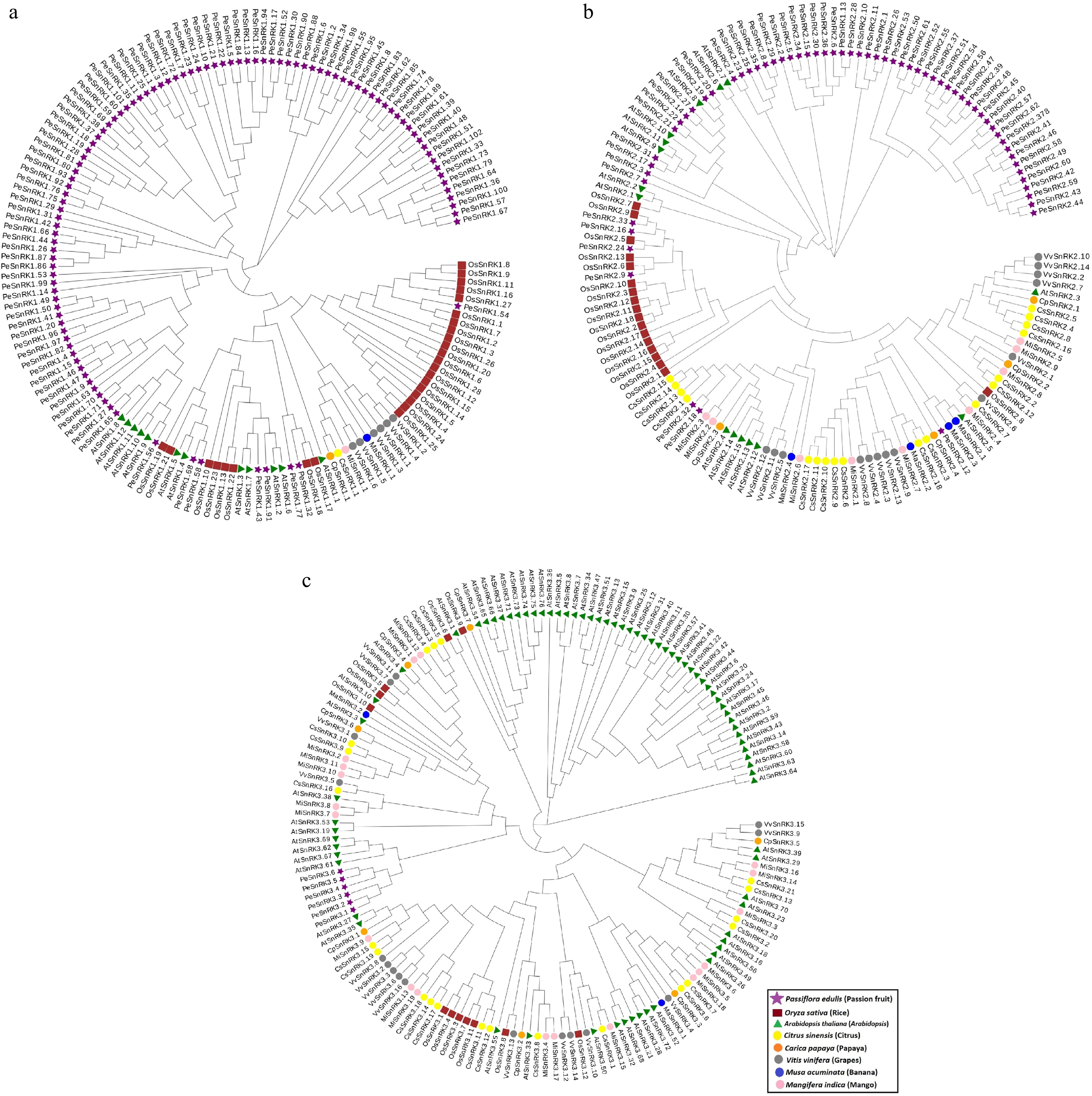
Figure 1.
SnRK proteins' phylogeny across plant lineages. Phylogenetic trees of SnRK proteins were constructed using the maximum likelihood method based on full-length amino acid sequences and visualized in a circular layout. The SnRK gene family is divided into three distinct subfamilies: (a) SnRK1 (SNF1-related kinases), (b) SnRK2 (stress-activated protein kinases, SAPKs), and (c) SnRK3 (CBL-interacting protein kinases, CIPKs). Each panel represents one subfamily: (a) SnRK1, (b) SnRK2, and (c) SnRK3. Distinct colors and symbols denote different plant species as follows: P. edulis (purple stars), O. sativa (red squares), A. thaliana (green triangles), C. sinensis (yellow circles), C. papaya (orange circles), V. vinifera (gray circles), M. acuminata (blue circles), and M. indica (pink circles). The clustering pattern reveals clear subfamily segregation and highlights both conserved evolutionary relationships and lineage-specific expansion of SnRK genes across monocot and dicot species.
-
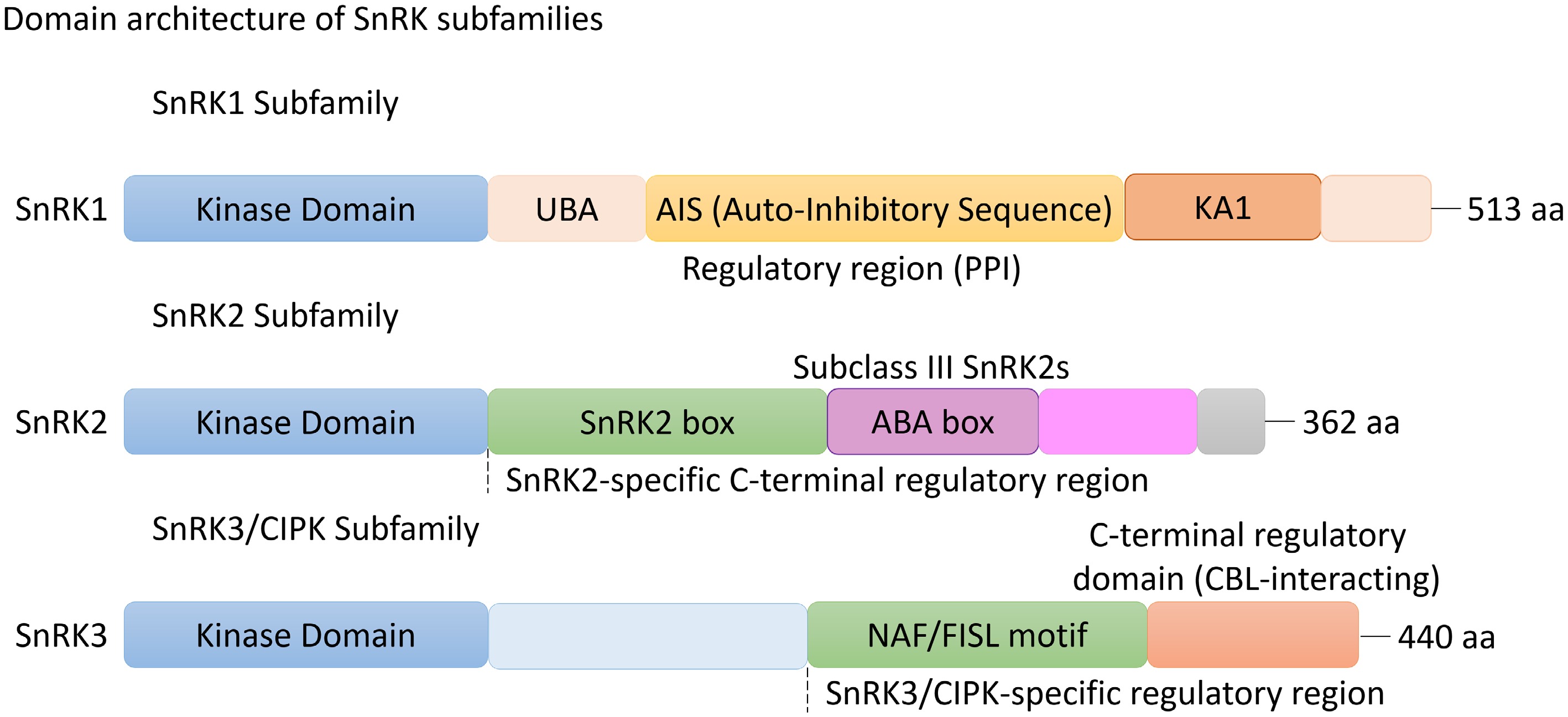
Figure 2.
Schematic representation of the conserved domain organization of plant Sucrose nonfermenting-1-related protein kinase (SnRK) family. All subfamilies share a conserved N-terminal serine/threonine kinase domain but differ markedly in their C-terminal regulatory regions. SnRK1 contains a ubiquitin-associated (UBA) domain, an autoinhibitory/ regulatory sequence (AIS), and a kinase-associated 1 (KA1) domain involved in protein–protein interactions and complex assembly. SnRK2 proteins possess a SnRK2-specific C-terminal regulatory region containing the SnRK2 box required for kinase activation and, in Subclass III SnRK2, an ABA box mediating the interaction with PP2C phosphatases during ABA signaling. SnRK3/CIPKs harbor a conserved NAF/FISL motif within a SnRK3/CIPK-specific regulatory region that facilitates interactions with calcineurin B-like (CBL) calcium sensors and regulates kinase activity. Approximate protein lengths are indicated for each subfamily.
-
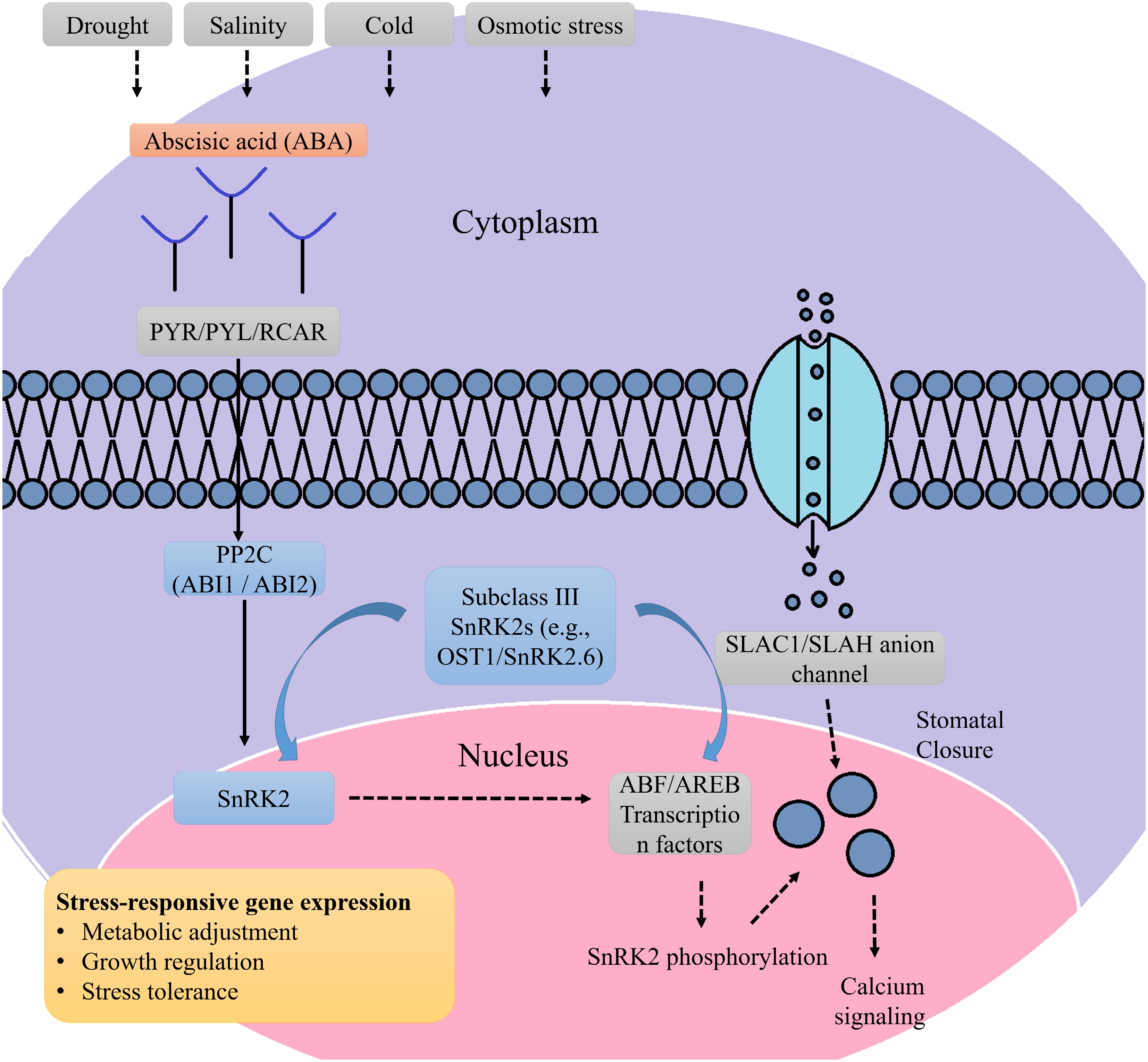
Figure 3.
Schematic overview of the ABA–PP2C–SnRK2 signaling cascade under abiotic stress conditions. Abiotic stresses, including salinity, cold, drought, and osmotic stress, promote the accumulation of ABA. ABA is perceived by PYR/PYL/RCAR receptor proteins, which subsequently inhibit Clade A protein phosphatases 2C (PP2Cs; ABI1/ABI2). Relief of PP2C-mediated repression enables the activation of Subclass III SnRK2 kinases (e.g., OST1/SnRK2.6). Activated SnRK2s phosphorylate plasma membrane anion channels, such as SLAC1/SLAH, leading to anion efflux and stomatal closure. In parallel, SnRK2 translocates to the nucleus, where they phosphorylate ABA-responsive bZIP TFs (ABF)/ABA-responsive element binding (AREB) transcription factors, inducing the expression of ABA-responsive genes involved in metabolic adjustment, growth regulation, and stress tolerance. Calcium signaling acts as an additional regulatory component, integrating with ABA–SnRK2 signaling to fine-tune downstream responses.
-
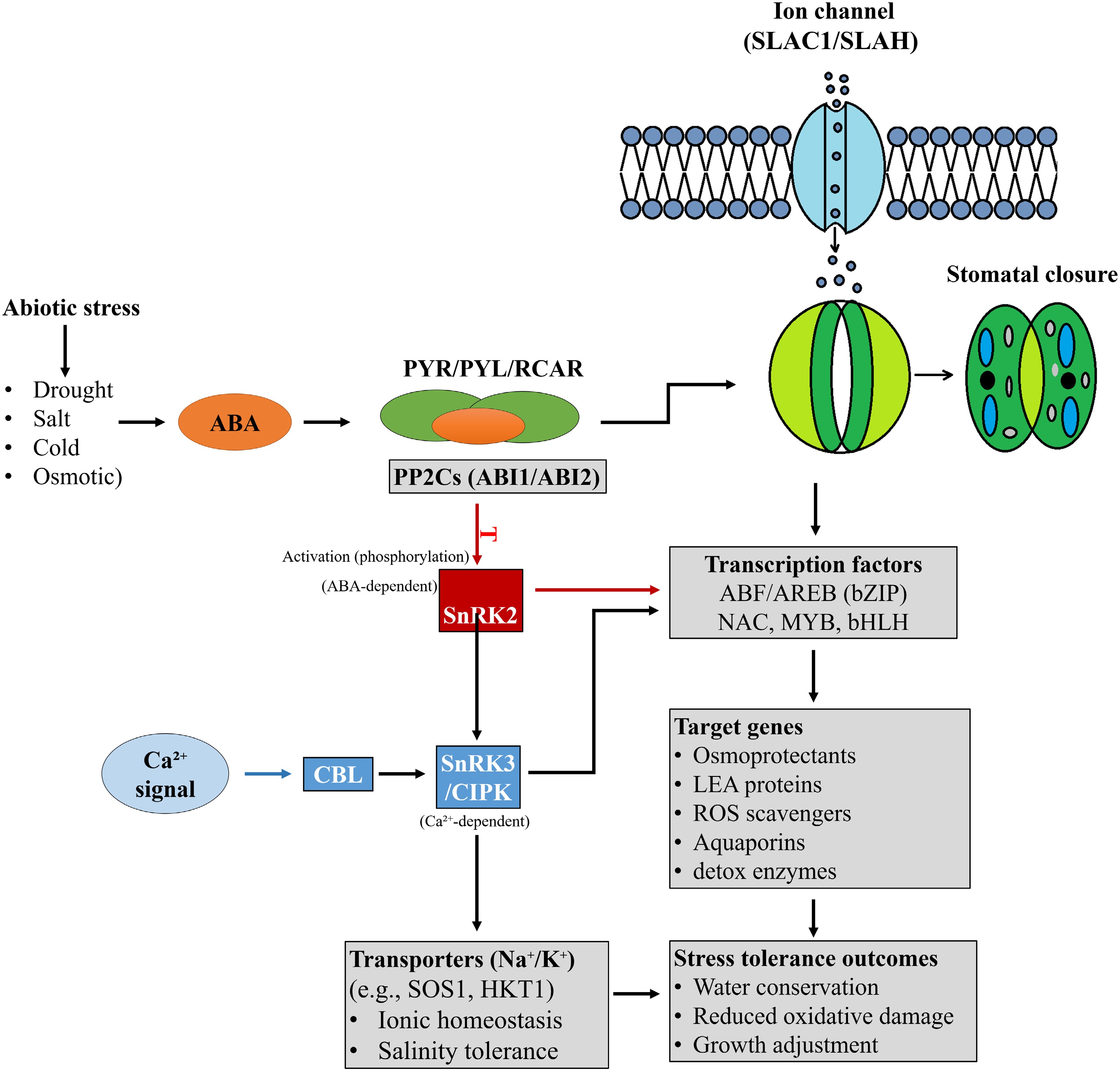
Figure 4.
SnRK2-mediated regulatory network integrating the ABA pathway with the regulation of abiotic stress responses at the transcriptional level. ABA accumulation is caused by abiotic stress, leading to the activation of SnRK2 protein kinases through the inhibitory effect of PYRs/PYLs on the activity of PP2Cs. SnRK2 act on ion channels and ABA-responsive TFs, whereas the Ca2+-regulated CBL-CIPK pathway is responsible for the regulation of ion homeostasis.
-
SnRK subfamily Alternative name Conserved structural features Primary biological functions Representative genes SnRK1[13,16−18,20,25] SNF1-related kinase 1 N-terminal kinase domain; regulatory C-terminal region Energy sensing; carbon metabolism; growth–stress balance AtSnRK1.1, AtSnRK1.2 SnRK2[12,15,19,27−38] Stress-activated protein kinases (SAPKs) Kinase domain; SnRK2 box; ABA box ABA signaling; drought and osmotic stress response; transcriptional regulation OST1/SnRK2.6, SAPK8 SnRK3[13,20,21,39,40] CIPKs (CBL-interacting protein kinases) Kinase domain; NAF/FISL motif for CBL binding Calcium signaling; ion homeostasis; salinity tolerance CIPK23, CIPK16 Table 1.
Classification, structural features, and core functions of the SnRK gene family in plants
-
Species SnRK gene/subfamily Abiotic stress Experimental evidence Key findings A. thaliana[65] SnRK2.6 (OST1) Drought Mutant + kinase assays Phosphorylates SLAC1; induces stomatal closure A. thaliana[35] SnRK2 ABA/osmotic stress Biochemical reconstitution Core PYR/PYL–PP2C–SnRK2 signaling module A. thaliana[66] SnRK2 ABA signaling Genetic + molecular studies PP2Cs act as gatekeepers of SnRK2 activity A. thaliana[37] SnRK2 kinases Stress signaling Structural biology SnRK2 box and ABA box regulate autoactivation A. thaliana[33] SnRK2 Salinity Genetic + transcriptomic Regulate mRNA decapping and stress adaptation Rice[67] SAPK family (SnRK2) Salinity, drought Expression profiling Enhanced stress tolerance and ABA response Populus spp.[68] CIPKs (SnRK3) Salinity Genome-wide + expression Ion homeostasis and stress adaptation Wheat[69] CIPK16 Salinity Transgenic validation Improves Na+/K+ balance and salt tolerance Bamboo[56] SnRK Abiotic stress Genome-wide + functional analysis Stress-induced SnRK expression Tobacco[38] SnRK2 family Salinity Comparative genomics Conserved SnRK2 expansion patterns passion fruit[59] Stress-responsive TFs (MYB). No PeSnRK genes characterized to date Drought, temperature RNA-seq TF networks associated with stress passion fruit[62] bHLH TFs (no PeSnRK genes characterized to date) Cold, osmotic stress Genome-wide + expression TF-mediated stress regulation passion fruit[63] NAC TFs (no PeSnRK genes characterized to date) Cold stress Transcriptomics Stress-responsive NAC regulation passion fruit[64] bZIP TFs (no PeSnRK genes characterized to date) Multiple stresses Transcriptomics + metabolomics Hormone and metabolic coordination This table summarizes both SnRK kinases and functionally associated downstream regulatory genes, including TFs and signaling components, which participate in abiotic stress responses. Table 2.
SnRK-centered regulatory networks and associated genes involved in abiotic stress responses across plant species.
Figures
(4)
Tables
(2)