-
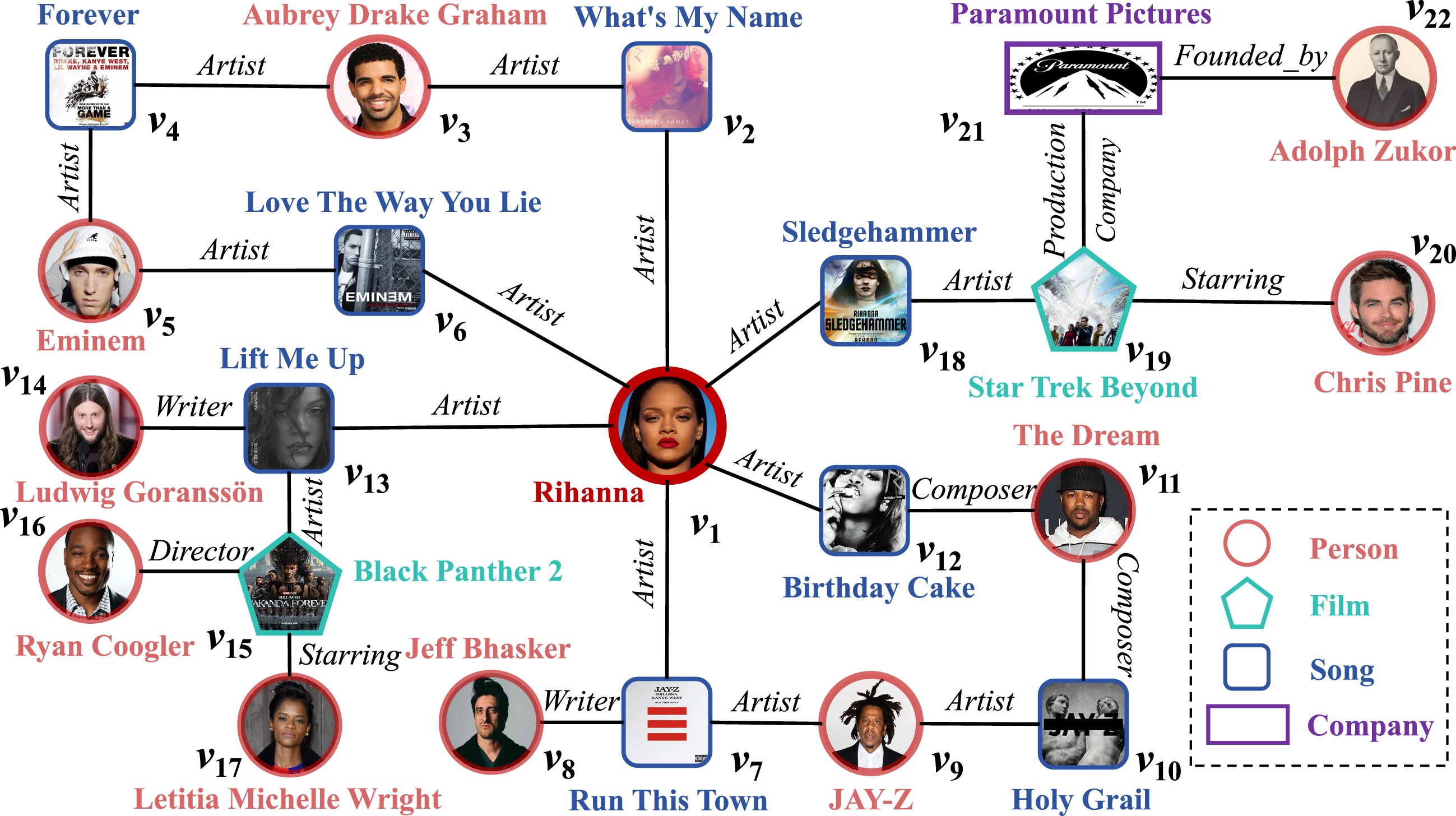
Figure 1.
An example of the semantic-rich HIN DBpedia.
-
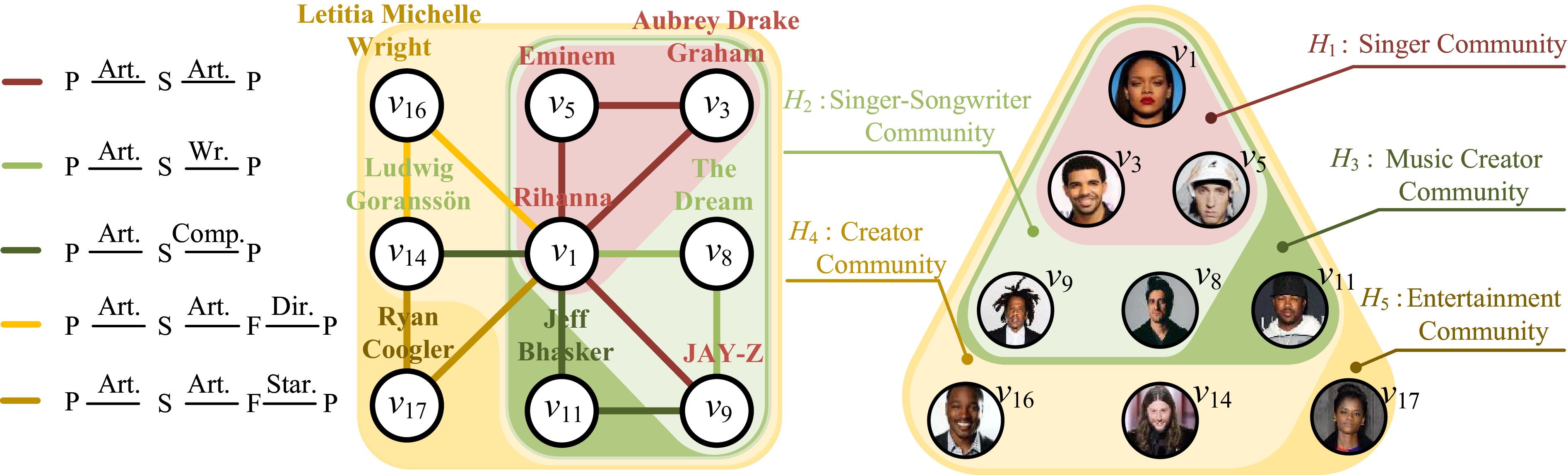
Figure 2.
Diverse semantically similar communities.
-
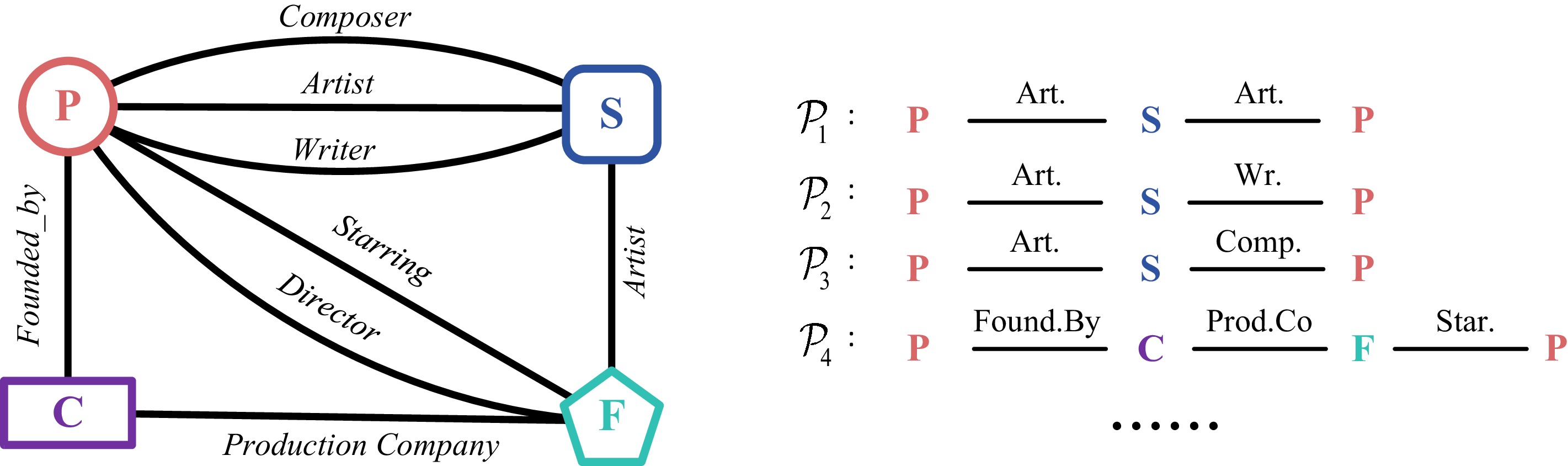
Figure 3.
The schema of the HIN illustrated in Fig. 1 with five example meta-paths between nodes with a type
$\mathrm{Person}$ -
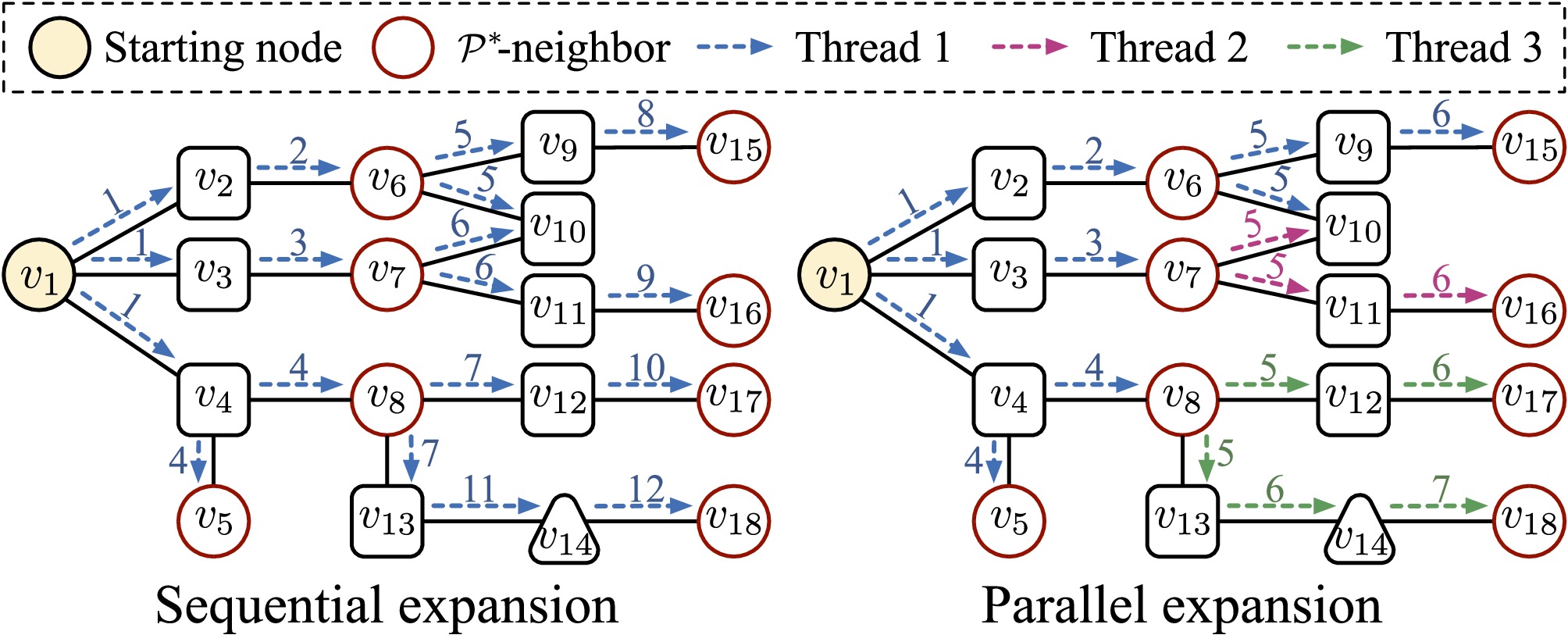
Figure 4.
Parallel
$ {\cal{P}}^* $ -
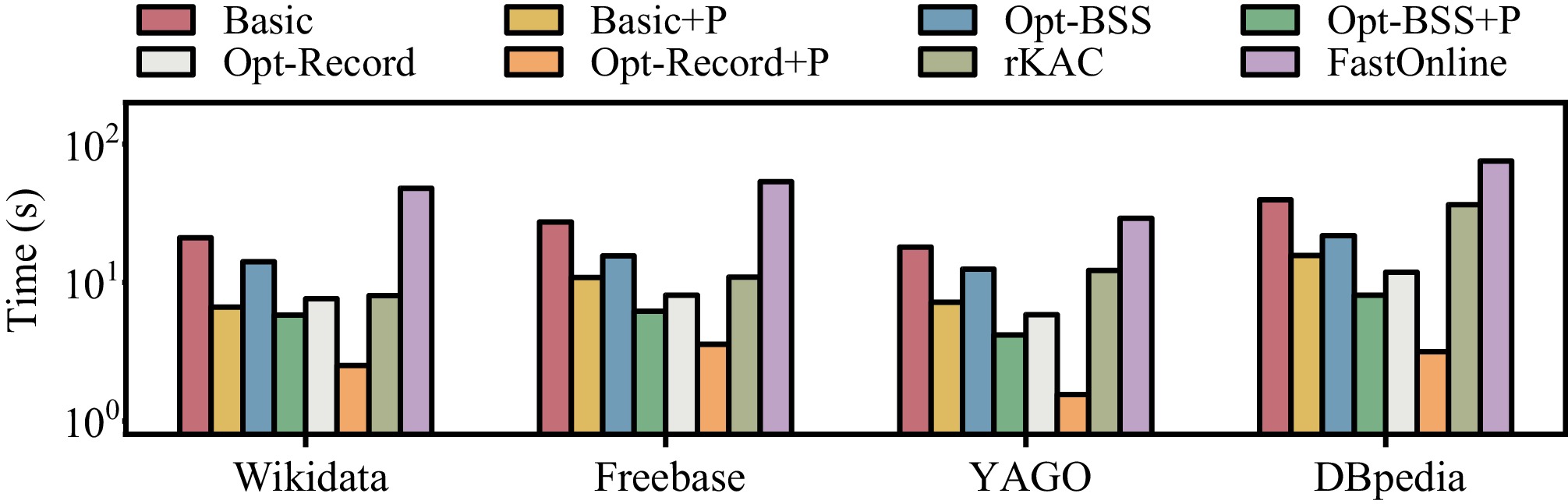
Figure 5.
Efficiency comparison.
-

Figure 6.
Effect of
$ \hat{l} $ -

Figure 7.
Effect of
$ \hat{l} $ -

Figure 8.
Effect of
$ k $ -

Figure 9.
Effect of
$ k $ -

Figure 10.
Effect of
$ r $ -

Figure 11.
Effect of
$ r $ -

Figure 12.
Effect of
$ b $ -

Figure 13.
Effect of # threads on efficiency.
-
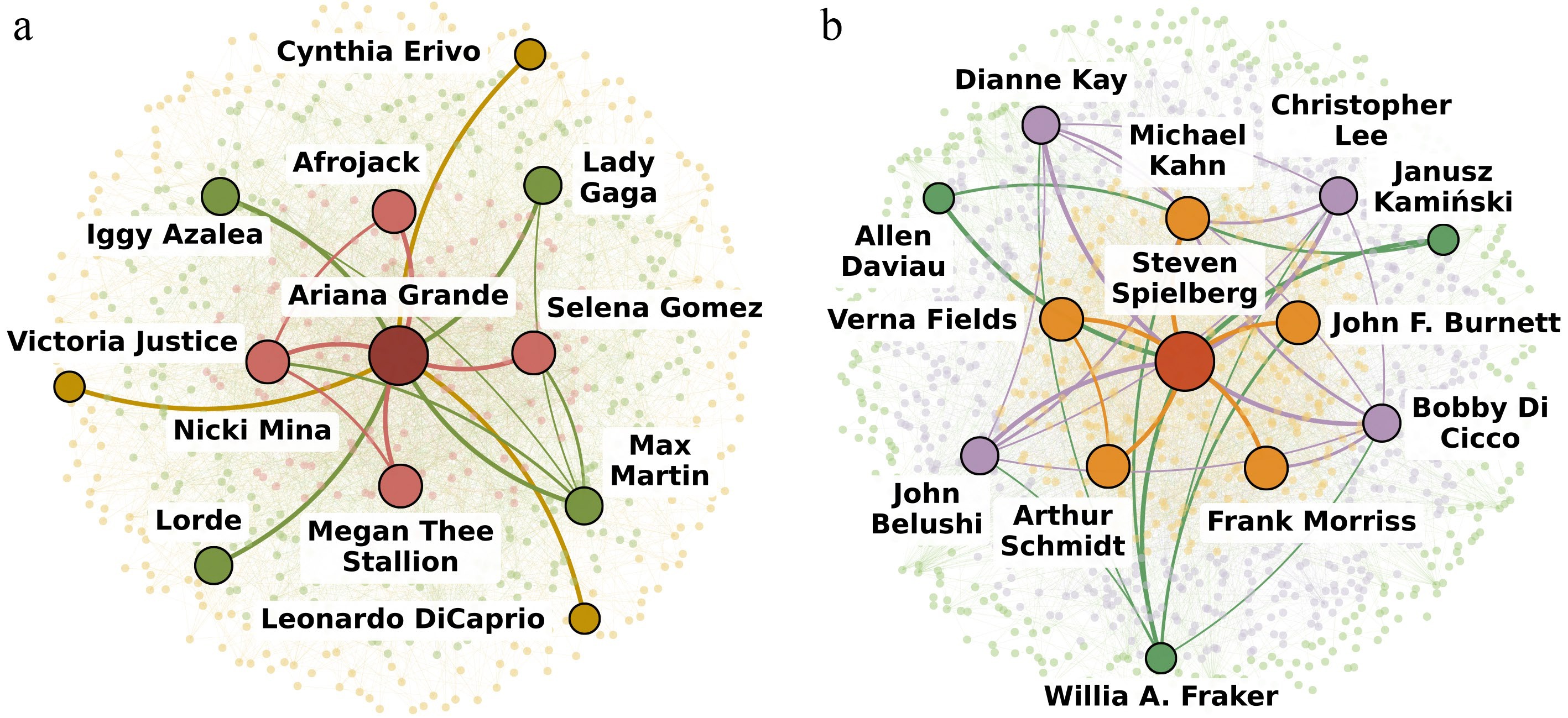
Figure 14.
Case studies on DBpedia.
-
Input: HIN $ G $ $ \langle A_t,A_a,S,\hat{l} \rangle $ $ q $ $ k \geq $ $ r \geq 1 $ Output: top- $ r $ 1 $ \mathrm{HSet} \leftarrow \emptyset $ $ \mathrm{SemSet}\leftarrow \emptyset $ $ H^{\prime} \leftarrow \emptyset $ 2 $ \mathrm{count} \leftarrow $ $ \mathrm{ number of SICs}$ 3 $ \mathrm{R} \leftarrow \{ S_i \in {\cal{R}} \} $ $ W_{S_i\rightarrow S} $ 4 while: ${\it{\mathrm{count}}} \lt r $ // $\mathrm{Step (1): Semantic expansion} $ 5 if $ |{\it{\mathrm{SemSet}}}| = |{\it{\mathrm{R}}}| $ 6 break; 7 $ \mathrm{SemSet} \leftarrow \mathrm{SemSet}\cup\mathrm{R} $ // $\mathrm{Step (2): } G_{\mathrm{SMP}} \mathrm{ construction } $ 8 $ G_{\text{SMP}} \leftarrow \mathrm{getSMPGraph} (G, \text{SMP}, q, \mathrm{SemSet}) $ // $\mathrm{Step (3): SIC extraction} $ 9 $ H \leftarrow $ $ k $ $ q $ $ G_{\text{SMP}} $ 10 if $ H $ 11 continue; // $\mathrm{Step (4): Quality evaluation} $ 12 if $ |V(H)| \gt |V(H^{\prime})| $ 13 $ \mathrm{HSet} \leftarrow \mathrm{HSet} \cup H $ 14 $ H^{\prime} \leftarrow H $ 15 $ \mathrm{count} \leftarrow \mathrm{count}+1 $ 16 return ${\it{\mathrm{HSet}}}$ Table 1.
$\mathrm{Basic}$ -
Input: HIN $ G $ $ \langle A_t,A_a,S,\hat{l} \rangle $ $ q $ $\mathrm{SemSet}$ Output: $ q $ $ G_{\text{SMP}} $ 1 $\mathrm{Expand} \leftarrow q $ $ \mathrm{Visited} \leftarrow \emptyset $ $ G_{\text{SMP}} \leftarrow \emptyset $ 2 while: $ \mathrm{Expand} \neq \emptyset $ // $ \mathrm{Step (1): Neighbor retrieval} $ 3 $ u \leftarrow \mathrm{Expand} $ 4 $ \langle N^*(u), E^*(u) \rangle \leftarrow \mathrm{FPN}$ $ G, u $ $\mathrm{SemSet}$ // $ \mathrm{Step (2): Graph update} $ 5 $ G_{\text{SMP}} \leftarrow G_{\text{SMP}} \cup \langle N^*(u), E^*(u) \rangle $ 6 $ \mathrm{Visited} \leftarrow \mathrm{Visited} \cup \{u\} $ 7 $ \mathrm{Expand} \leftarrow \mathrm{Expand} \cup (N^*(u) \setminus \mathrm{Visited}) $ 8 return $ G_{\text{SMP}} $ Table 2.
$\mathrm{getSMPGraph}$ $ G $ $ q $ $\mathrm{SemSet}$ -
Input: HIN $ G $ $ u $ $ \langle A_t,A_a,S,\hat{l} \rangle $ $ q $ $\mathrm{SemSet}$ Output: $ {\cal{P}}^* $ $ u $ $ \langle N^*(u), E^*(u) \rangle $ 1 $ N^*(u) \leftarrow \emptyset $ $ E^*(u) \leftarrow \emptyset $ 2 $ \mathrm{NbrExpand} \leftarrow u $ 3 $ \mathrm{Path} \leftarrow p_{uu} $ 4 while: $ \mathrm{NbrExpand} \neq \emptyset $ // $\mathrm{Step (1): Neighbor exploration} $ 5 $ w \leftarrow \mathrm{NbrExpand} $ 6 $ p_{uw} \leftarrow \mathrm{Path} $ 7 $ \mathrm{Neighbor}(w) \leftarrow $ $ G $ 8 while: $ \mathrm{Neighbor}(w) \neq \emptyset $ // $\mathrm{Step (2): Path extension} $ 9 $ v \leftarrow \mathrm{Neighbor}(w) $ 10 if $ \mathrm{SemSet} $ $ \psi(e_{wv}) $ 11 $ p_{uv} \leftarrow p_{uw} \cup e_{wv} $ 12 if $ u=v $ 13 continue; // Step (3): Neighbor update 14 if $ p_{uv} $ $ \leq \hat{l} $ $ \phi(v) = A_t $ $ \phi(x) = A_a $ $ x $ $ p_{uv} $ 15 $ N^*(u) \leftarrow N^*(u) \cup v $ 16 $ E^*(u) \leftarrow E^*(u) \cup p_{uv} $ 17 else if $ p_{uv} $ $ \lt \hat{l} $ 18 $ \mathrm{NbrExpand} \leftarrow \mathrm{NbrExpand} \cup v $ 19 $ \mathrm{Path} \leftarrow \mathrm{Path} \cup p_{uv} $ 20 return $ \langle N^*(u), E^*(u) \rangle $ Table 3.
$\mathrm{FPN}$ $ G, u $ $\mathrm{SemSet}$ -
Input: HIN $ G $ $ \langle A_t,A_a,S,\hat{l} \rangle $ $ q $ $ k \geq $ $ r\geq 1 $ $ b \gt 1 $ Output: top- $ r $ 1 $ \mathrm{HSet} \leftarrow \emptyset $ $ \mathrm{SemSet} \leftarrow \emptyset $ $ H^{\prime} \leftarrow \emptyset $ 2 $ \mathrm{R} \leftarrow \{ S_i| S_i \in {\cal{R}} \} $ 3 $ U \leftarrow $ 4 while: $ U \lt |\mathrm{R}| $ // $ \mathrm{Step (1): Batch semantic expansion} $ 5 if $ U+b \lt |\mathrm{R}| $ 6 $ D = U+b $ 7 else 8 $ D = |\mathrm{R}| $ 9 for $ i\leftarrow U $ $ D $ 10 $ \mathrm{SemSet} \leftarrow \mathrm{SemSet} \cup \mathrm{R} $ $ i $ // $ \mathrm{Step (2): Construct } G_\mathrm{SMP}$ 11 $ G_{\text{SMP}} \leftarrow \mathrm{getSMPGraph}(G, \text{SMP}, q, \mathrm{SemSet}) $ // $ \mathrm{Step (3): SIC extraction} $ 12 $ H \leftarrow $ $ k $ $ q $ $ G_{\text{SMP}} $ // $ \mathrm{Step (4): Binary semantic search} $ 13 if $ H $ 14 $ U\leftarrow D+1 $ 15 continue; 16 else 17 if $ |V(H)| \gt |V(H^{\prime})| $ 18 $ \mathrm{HSet} \leftarrow \mathrm{HSet} \cup \mathrm{BSS} $ $ H' $ $ G_{\text{SMP}} $ $ U $ $ D $ $\mathrm{R}$ $ r $ $ |\mathrm{HSet}| $ $ q $ 19 if $ |\mathrm{HSet}| $ $ r $ 20 break; 21 $ H^{\prime} \leftarrow H $ 22 $ U\leftarrow D+1 $ 23 else 24 $ U\leftarrow D+1 $ 25 continue; 26 return ${\it{\mathrm{HSet}}}$ Table 4.
$\mathrm{Opt-BSS}$ -
Input: $ H' $ $ G_{\text{SMP}} $ $ U \gt 0 $ $ D \gt 0 $ $\mathrm{R}$ $ r \geq 1 $ $ \mathrm{count} \geq $ $ q $ Output: top- $ r $ 1 $\mathrm{left} \leftarrow U $ $ \mathrm{right} \leftarrow D $ 2 $\mathrm{HSet} \leftarrow \emptyset $ $ \mathrm{SemSet}\leftarrow \emptyset $ 3 while $ \mathrm{left} \leq \mathrm{right} $ // $\mathrm{Termination check}$ 4 if $\mathrm{count}$ $ r $ 5 break; 6 if $\mathrm{count}$ 7 $ H^{\prime} \leftarrow \emptyset $ // $\mathrm{Step (1): Midpoint selection}$ 8 $\mathrm{mid}$ $\mathrm{left}$ $ \lfloor (\mathrm{right} - \mathrm{left}) / 2 \rfloor $ 9 $\mathrm{SemSet}\_\mathrm{BSS} \leftarrow \emptyset $ 10 for $ i \leftarrow 1 $ $\mathrm{mid}$ 11 $ \mathrm{SemSet}\_\mathrm{BSS} \leftarrow \mathrm{SemSet}\_\mathrm{BSS} \cup \mathrm{R} $ $ i $ // $\mathrm{Step (2) and (3)}$ 12 $ G'_{\text{SMP}} \leftarrow $ $ G'_{\text{SMP}} $ $\mathrm{SemSet}\_\mathrm{BSS}$ 13 $ H \leftarrow $ $ k $ $ q $ $ G'_{\text{SMP}} $ // $\mathrm{Step (4): SIC refinement}$ 14 if $ H $ $ |V(H)| \gt |V(H^{\prime})| $ 15 if $\mathrm{mid}$ $\mathrm{left}$ 16 $ H' \leftarrow H $ 17 $\mathrm{count}$ $\mathrm{count}$ 18 $\mathrm{HSet} \leftarrow \mathrm{HSet} \cup H $ 19 $\mathrm{left} \leftarrow \mathrm{mid} +1 $ 20 $\mathrm{right} \leftarrow D $ 21 continue; 22 else 23 $\mathrm{right}$ $\mathrm{mid}-1 $ 24 else 25 $\mathrm{left}$ $\mathrm{mid}+1 $ 26 if $\mathrm{left} \gt \mathrm{right}$ 27 $\mathrm{SemSet}\_\mathrm{BSS} \leftarrow \mathrm{SemSet}\_\mathrm{BSS} \cup \mathrm{R} $ $ \mathrm{left}$ 28 repeat lines 12-13; 29 if $ H $ 30 repeat lines 16−21; 31 return ${\it{\mathrm{HSet}}}$ Table 5.
$\mathrm{BSS}$ $ H' $ $ G_{\text{SMP}} $ $ U $ $ D $ $\mathrm{R}$ $ r $ $ \mathrm{count}$ $ q $ -
Input: HIN $ G $ $ \langle A_t,A_a,S,\hat{l} \rangle $ $ q $ $ k \geq $ $ r \gt 0 $ $ b \gt 1 $ Output: SICs with top- $ r $ 1 $\mathrm{HSet} \leftarrow \emptyset $ $ \mathrm{SemSet} \leftarrow \emptyset $ $ H^{\prime} \leftarrow \emptyset $ 2 $\mathrm{R} \leftarrow \{ S_i| S_i \in {\cal{R}} \} $ 3 $ U \leftarrow $ $\mathrm{count} \leftarrow $ 4 while: $ U \lt |\mathrm{R}| $ // $\mathrm{Step (1)-(3)}$ 5 lines 5-12 in $\mathrm{Opt-BSS}$ // $\mathrm{Step (4): Binary semantic search with recording}$ 6 if $ H $ 7 lines 14-15 in $\mathrm{Opt-BSS}$ 8 else 9 if $ |V(H)| \gt |V(H^{\prime})| $ 10 $\mathrm{findedH} $ $\mathrm{mid} $ $ H $ 11 $ \mathrm{HSet} \leftarrow \mathrm{HSet} \cup \mathrm{RecordBSS} $ $ H' $ $ U $ $ D $ $\mathrm{R}$ $ r $ $ \mathrm{count}$ $ q $ $ \mathrm{findedH}$ 12 lines 19-22 in $\mathrm{Opt-BSS}$ 13 else 14 lines 24-25 in $\mathrm{Opt-BSS}$ 15 return $\mathrm{HSet}$ Table 6.
$\mathrm{Opt-Record}$ -
Input: previously discovered community $ H' $ $ U \gt 0 $ $ D \gt 0 $ $\mathrm{R}$ $ r \gt 0 $ $ \mathrm{count} \geq $ $ q $ Output: SICs with top- $ r $ 1 $ \mathrm{left} \leftarrow U $ $ \mathrm{right} \leftarrow D $ 2 $ \mathrm{HSet} \leftarrow \emptyset $ $ \mathrm{SemSet}\_\mathrm{BSS} \leftarrow \emptyset $ 3 $ \mathrm{lastRight} \leftarrow \emptyset $ $ \mathrm{SemSizeSet} \leftarrow \emptyset $ 4 while: $ \mathrm{left} \leq \mathrm{right}$ // $ \mathrm{Step (1): Midpoint selection}$ 5 lines 4–11 in $\mathrm{BSS}$ // $ \mathrm{Step (2): SIC extraction}$ 6 if $\mathrm{right = D}$ 7 $\mathrm{lastH}$ $\mathrm{findedH}$ $\mathrm{right}$ 8 else 9 $\mathrm{lastH}$ $\mathrm{findedH}$ $\mathrm{right + 1}$ 10 $ H \leftarrow $ $ k $ $\mathrm{SemSet}\_\mathrm{BSS}$ $\mathrm{lastH}$ $ q $ // $ \mathrm{Step (3): SIC refinement}$ 11 if $ H $ $ |V(H)| \gt |V(H^{\prime})| $ 12 if $\mathrm{mid}$ $\mathrm{left}$ 13 $\mathrm{count}$ $\mathrm{count}$ 14 lines 16–20 in $\mathrm{BSS}$ 15 if $\mathrm{left} \gt \mathrm{right}$ 16 if $\mathrm{lastRight}$ 17 break; 18 $\mathrm{right} \leftarrow \mathrm{lastRight} $ 19 else 20 $ \mathrm{findedH}$ $\mathrm{mid}$ $ H $ 21 $\mathrm{lastRight}$ $\mathrm{right}$ 22 $\mathrm{right}$ $\mathrm{mid}-1 $ 23 $\mathrm{SemSizeSet} \leftarrow \mathrm{SemSizeSet} \cup \mathrm{mid}$ 24 else 25 $ \mathrm{left}$ $\mathrm{mid}+1 $ 26 if $\mathrm{SemSizeSet}$ $ \mathrm{mid}+1 $ 27 lines 16–18 in $\mathrm{BSS}$ 28 repeat lines 15–18 29 return $\mathrm{HSet}$ Table 7.
$\mathrm{BSS-Record}$ $ H' $ $ U $ $ D $ $\mathrm{R}$ $ r $ $\mathrm{count} $ $ q $ $\mathrm{findedH}$ -
Table 1.
Statistics of datasets.
-
Method Wikidata Freebase NMP ALSD SC AAS NMP ALSD SC AAS Ours (1)–(6) 34 20.6% 0.844 0.291 34.5 21.5% 0.802 0.186 $ r $ 12.25 55.6% 0.576 0.181 15.5 50.6% 0.649 0.209 KC 15.7 − 0.413 0.101 21 − 0.294 0.082 VAC 3.2 − 0.558 0.081 4.5 − 0.504 0.105 FastOnline 5.3 − − 0.124 13.7 − − 0.163 Boldface indicates the best result, and underlining indicates the second-best result. Table 2.
Effectiveness evaluation on Wikidata and Freebase.
-
Method YAGO DBpedia NMP ALSD SC AAS NMP ALSD SC AAS Ours (1)–(6) 26 16.3% 0.898 0.226 77.75 26.1% 0.877 0.149 $ r $ 11.3 46.6% 0.543 0.128 13.17 73.9% 0.578 0.118 KC 7 − 0.503 0.115 22.8 − 0.639 0.131 VAC 2 − 0.524 0.111 2.75 − 0.571 0.116 FastOnline 8.2 − − 0.142 18.3 − − 0.105 Red values indicate the best results, while blue underlined values indicate the second-best results. Table 3.
Effectiveness evaluation for YAGO and DBpedia.
-
Methods Wiki Freebase YAGO DBpedia $ G_{\rm{SMP}} $ Other $ G_{\rm{SMP}} $ Other $ G_{\rm{SMP}} $ Other $ G_{\rm{SMP}} $ Other Basic 22.38 7.462 21.37 6.028 13.88 3.916 28.86 8.162 Opt-BSS 15.05 6.665 9.660 4.278 7.770 3.330 19.60 8.460 Opt-Record 10.44 6.456 4.017 2.483 4.202 2.598 12.36 7.716 Basic+P 4.940 2.210 16.64 5.256 2.964 0.936 4.560 1.708 Opt-BSS+P 3.876 1.824 4.148 1.952 1.904 0.896 3.944 1.856 Opt-Record+P 2.460 1.640 2.880 1.920 0.840 0.560 2.460 1.640 Table 4.
The runtime (sec) of each step.
Figures
(14)
Tables
(11)